Ziarat Juniper Forest: Pakistan’s Ancient Living Fossils
In the highlands of Balochistan, about 130 kilometres from Quetta, grows a forest that was already ancient when the first cities of the Indus Valley were built. The Ziarat juniper forest covers roughly 110,000 hectares of mountain slopes, and its gnarled, slow-growing trees are routinely described as living fossils, some of them estimated to be thousands of years old. In 2013 UNESCO made it Pakistan's second biosphere reserve, and in 2016 the country proposed it for the World Heritage list, where it still waits on the tentative list.
This is a forest with a remarkable double story. It is a place of extraordinary natural history, home to black bears, wolves, markhor and wild sheep, and it is also the valley where Pakistan's founder spent his final summer. And it is a forest under real pressure, shrinking under the combined weight of firewood cutting, grazing, land hunger and a changing climate. Here is what makes the Ziarat junipers worth knowing, and worth saving.
A forest older than empires
Junipers are among the slowest-growing trees on Earth, and the Ziarat forest may be their greatest stronghold. The woodland spreads across the mountains around the hill town of Ziarat and Mount Zarghoon, forming what is widely described as one of the largest and oldest juniper forests in the world, second in scale only to the juniper country of California in the United States.
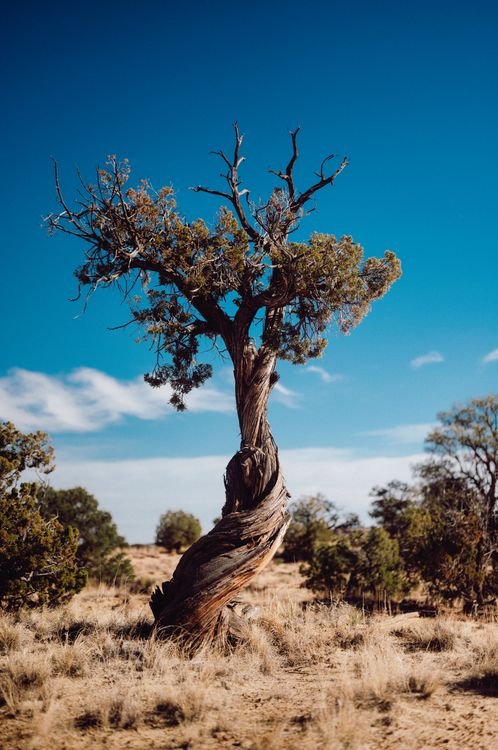
The trees here belong to Juniperus seravschanica (older literature calls them Juniperus excelsa or Juniperus polycarpos, and local sources sometimes use Juniperus macropoda). Whatever the name on the herbarium sheet, the trees themselves are unmistakable: massive, twisted trunks with reddish bark in peeling layers, branches contorted by centuries of wind and snow, and a fresh, resinous fragrance that hangs over the hillsides. Local people call the tree sanober.
What the junipers do for the landscape goes beyond beauty. Their root systems channel rainwater into the ground, recharging the underground aquifers that feed Ziarat's famous orchards and springs. The forest floor and clearings support medicinal herbs such as Ephedra and Artemisia, and researchers have catalogued 54 plant species in the area, more than half of them with known medicinal or ethno-botanical uses. For generations, the people of Ziarat relied on these herbal remedies as their principal medicine.
How old are the trees, really?
This is where the story gets both more wonderful and more honest. Local tradition puts the age of the oldest Ziarat junipers at 5,000 to 7,000 years. International reporting, including the BBC, describes mature trees as "often thousands of years old." Wikipedia's Ziarat entry mentions trees of 4,000 years. The trees certainly grow with agonising slowness: one commonly cited figure is that a juniper may grow only a few centimetres a year, or a few inches in a century.
But here is the crucial caveat that most travel writing skips: no dendrological study has ever been conducted on the Ziarat junipers. That detail comes from Pakistan's own Directorate General of Archaeology report submitted to UNESCO in April 2016. Tree-ring dating, the gold standard for ageing old trees, has simply never been done here. So the famous ages are estimates, not measurements.
That does not make the forest any less remarkable. Even conservative estimates place the largest trees at well over a thousand years old, which still makes them older than most human monuments. And their longevity has a scientific value beyond bragging rights: ancient trees record past climate in their wood, making the Ziarat junipers potentially important for climate-change and ecological research. The forest's proposed World Heritage nomination rests partly on exactly this significance.
Where the forest stands
The Ziarat juniper forest occupies mountains ranging from 1,181 to 3,488 metres above sea level, covering about 110,000 to 111,852 hectares depending on the source. The climate is temperate and semi-arid: mild summers, cold winters. Ziarat town itself records an average annual rainfall of just 269 millimetres, with July the wettest month (74 mm) and January the driest (3 mm). July averages 27.4 degrees Celsius, January 7.9 degrees. Snow falls from November to April, peaking at around 68 centimetres in February.
These are dry, high mountains, and that is precisely why the juniper thrives here. Juniper is a tree of arid, cold climates, and the Ziarat forest is the largest juniper tract in Pakistan, extending beyond Ziarat itself to the Zarghoon and Harboi areas. The wider juniper belt of Balochistan covers some 247,000 acres across these ranges, though the dense, ancient heart of it is at Ziarat.
Ziarat juniper forest: key facts
| Detail | Facts |
|---|---|
| Location | Ziarat district, Balochistan, around Ziarat town and Mount Zarghoon |
| Area | About 110,000 hectares (111,852 ha per UNESCO tentative listing) |
| Elevation | 1,181 to 3,488 metres |
| Main species | Juniperus seravschanica (syn. J. excelsa) |
| Tree ages | Estimated thousands of years; no tree-ring study ever conducted |
| Wildlife sanctuary | Declared 1971 |
| UNESCO biosphere reserve | Designated 2013 |
| World Heritage | On Pakistan's tentative list since 2016 |
| Distance from Quetta | About 120-130 km, 3 to 4 hours by road |
The wildlife hidden among the junipers
The forest is far from just trees. It shelters a highland fauna that includes the Himalayan black bear and the grey wolf, both of which roam the juniper slopes. The Sulaiman markhor, a large wild goat and one of Pakistan's most charismatic mountain animals, lives on the crags above the treeline, alongside urial wild sheep. More common residents include foxes, jackals and the Afghan pika, while the birdlife features the chakor partridge and dozens of migratory species; one local account puts the number of rare migratory birds at 36.
These animals make the forest an ecosystem, not a museum. The markhor and urial graze the high pastures, the wolves and bears follow, and the whole community depends on the juniper woodland holding the thin mountain soil together. Lose the trees, and the wildlife unravels with them.
The Quaid's residency: history inside the forest
Ziarat is woven into Pakistan's national story. In the summer of 1948, Muhammad Ali Jinnah, the founder of Pakistan, came to Ziarat on his doctors' advice, seeking the cool mountain air for his failing health. He stayed at the wooden colonial-era Quaid-e-Azam Residency, set among junipers and orchards, and spent his final months there before his death in September 1948.
The town's reputation as a health resort dates from that stay, and the Residency became a national monument and museum, drawing visitors for its history as much as for the forest. In June 2013 the Residency was attacked and burnt by militants, a national trauma that made headlines across Pakistan. It has since been restored, and it stands again among the junipers, a reminder that this valley holds both natural and national memory.
A protected forest that keeps shrinking
For all its honours, the Ziarat forest is in trouble, and the threats are depressingly concrete. The largest is firewood. With no piped gas supply, local households cut juniper for cooking and heating fuel. The irony is bitter: Balochistan produces the bulk of Pakistan's natural gas, yet Ziarat was never connected to the piped supply, leaving residents with little alternative. As one Ziarat resident told reporters, families collect dry juniper branches for cooking, guided by a traditional belief that cutting a green tree is a sin, because the trees are alive like people. But dead branches are not always what gets taken.
Grazing is the second pressure. Livestock browse the young saplings, and juniper regeneration is painfully slow: forest officials report that only about 10 percent of new saplings survive. Every sapling lost is a tree that will not be replaced for centuries, if ever.
The third pressure is land. Over the past two decades, demand for land for agriculture and human settlements has grown sharply, eating into the forest edge. Climate change adds a fourth: rising temperatures and shifting rainfall stress trees that evolved for a cooler, more stable regime. There has also been some illegal commercial felling, though awareness campaigns by NGOs have limited its scale.
The numbers tell the story in miniature. A forest where trees take millennia to mature and saplings mostly die cannot absorb these losses. Ecologists warn that without intervention, the ancient core of the forest will keep thinning, and with it the watershed, the wildlife and the local economy built on orchards and tourism.
The science hidden in ancient wood
Beyond their age, the Ziarat junipers are scientific instruments that nobody has fully read yet. Because the trees live so long, their wood records centuries of rainfall, temperature and drought in the width and chemistry of their growth rings. In other parts of the world, ancient junipers and bristlecone pines have been used to reconstruct climate histories stretching back thousands of years, and researchers have argued that Ziarat's trees could do the same for South Asia's climate past. A 2021 peer-reviewed study on carbon stock and land-use change in the Ziarat juniper stand was one of the first attempts to apply modern monitoring science to the forest, using satellite data to track how the tree cover is changing. But the basic dendrological work, actually coring the oldest trees and reading their rings, remains undone. For students of climate science, that is both a frustration and an opportunity: one of the world's great natural archives is sitting in Balochistan, largely unread, while it faces the very climate pressures its rings could help explain.
Can this forest be saved?
Protection on paper has existed for decades. Part of the forest was declared a wildlife sanctuary in 1971, the biosphere reserve designation came in 2013, and the World Heritage tentative listing in 2016. The Balochistan Forest and Wildlife Department administers the area. But protection on paper and protection on the ground are different things, and local critics have long argued that the provincial authorities have not done enough.
There are signs of movement. The federal Green Pakistan Programme allocated Rs. 64 million for the revival of the juniper forests, aimed at regeneration and protection work. Researchers, including a 2021 peer-reviewed study on carbon stock and land-use change in the Ziarat juniper stand, are building the scientific baseline the forest has always lacked. And the biosphere reserve framework itself is designed to balance conservation with the needs of local people, which matters in a valley where the forest and the community are economically inseparable.
What would actually help is well understood: extend clean fuel alternatives so firewood pressure drops, protect saplings from grazing, enforce the sanctuary boundaries, and fund the forest department properly. The Balochistan Forest Department has noted that UNESCO has not provided funds for the reserve's protection since the 2013 designation, a gap that better financing, including from Pakistan's own climate programs, could fill.
Visitors can help too. Stay on established tracks, take nothing from the forest, not even a cone or a branch, and support local conservation-minded guides and businesses. In a forest this slow to heal, responsible visiting is not a slogan; it is a practical necessity.
Visiting Ziarat
Ziarat town sits at about 2,450 metres and is roughly 120 to 130 kilometres from Quetta, a three to four hour drive through mountain scenery. The best season is April to October, when the weather is pleasant and the forest is at its greenest. Winters are beautiful but harsh, with heavy snow and freezing temperatures.
Beyond the forest and the Residency, the valley offers orchards (Ziarat is famous for its apples, particularly the black and red Kulu varieties, and its cherries), wildflower meadows, and the lavender-like wild bush the locals call shinshaob, which looks lovely in the twilight. The town's cool summers made it a colonial-era hill station, and that character survives.
A note of realism: check current travel advisories and local guidance before planning a trip to Balochistan, and travel with reputable local operators. The forest rewards those who come prepared and respect its fragility. Carry warm layers even in summer, as mountain evenings turn cold, bring sturdy walking shoes for the uneven forest tracks, and keep a respectful distance from any wildlife you encounter. Most importantly, remember the arithmetic of this place: a tree that took two thousand years to grow cannot be replaced in a human lifetime, so leave every branch, cone and stone exactly where you found it.
Frequently asked questions
Where is the Ziarat juniper forest? It is in Ziarat district, Balochistan, Pakistan, spread across the mountains around the hill town of Ziarat and Mount Zarghoon, about 120-130 km from Quetta.
How old are the Ziarat juniper trees? Mature trees are estimated to be thousands of years old, with local estimates of 5,000 to 7,000 years for the oldest specimens. However, no dendrological (tree-ring) study has ever been conducted, so these are estimates rather than measured ages. Even conservative estimates make them among the oldest living trees in the region.
Is the Ziarat juniper forest a UNESCO site? It has been a UNESCO biosphere reserve since 2013, Pakistan's second after Lal Suhanra. In 2016 Pakistan placed it on its tentative list for UNESCO World Heritage status, where it remains.
What wildlife lives in the Ziarat juniper forest? The forest supports the Himalayan black bear, grey wolf, Sulaiman markhor, urial wild sheep, foxes, jackals, Afghan pika, chakor partridge and many migratory birds.
Why is the forest under threat? The main threats are cutting for firewood (Ziarat has no piped gas), livestock grazing that kills saplings (only about 10 percent of new saplings survive), conversion of land for agriculture and settlements, climate change, and some illegal commercial felling.
What is the Quaid-e-Azam Residency? The wooden colonial-era Residency in Ziarat where Pakistan's founder, Muhammad Ali Jinnah, spent the last months of his life in the summer of 1948. It was burnt in a militant attack in 2013 and has since been restored as a national monument and museum.
When is the best time to visit Ziarat? April to October, when the weather is mild and the mountain roads are reliably open. Winter brings heavy snow and extreme cold.
How do junipers help the local environment? Their root systems channel rainwater into the ground, recharging underground aquifers that irrigate Ziarat's orchards and supply local water. The forest also stabilises thin mountain soils and supports medicinal plants like Ephedra and Artemisia.
A forest that measures time differently
Stand among the Ziarat junipers and you are standing among organisms that may have been seedlings when the pyramids were new. They grow a few centimetres a year, endure drought, snow and wind, and hold an entire mountain watershed together. That a forest like this still exists is remarkable. That it is shrinking, for want of cooking fuel and sapling protection, is a solvable tragedy. The Ziarat junipers have all the time in the world. The question is whether we will give them the protection they need to keep it.