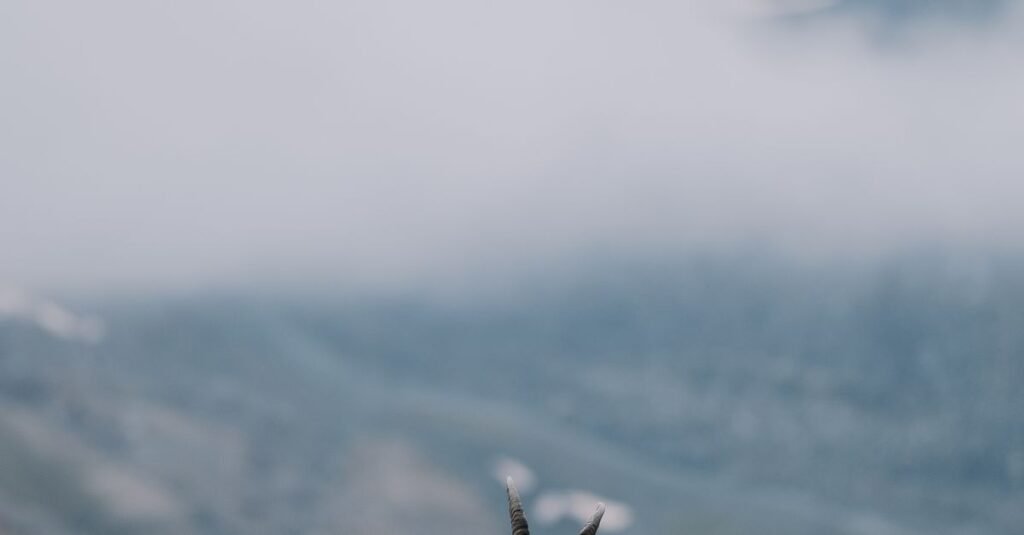
Sindh Ibex: Pakistan’s Wild Goat of the Kirthar Hills
High in the dry, sun-baked ridges of the Kirthar mountains, a stocky wild goat picks its way along a cliff face that looks almost vertical. Its horns sweep back in long scimitars, its body is silver-white against the brown rock, and it moves with a balance that seems to ignore gravity. This is the Sindh ibex, one of Pakistan's most distinctive wild animals and the provincial animal of Sindh.
Known locally as the Sarah, the Sindh ibex is a subspecies of wild goat found almost nowhere else on Earth. Its entire range is limited to southwest Pakistan and a corner of southeast Iran, with the Kirthar mountains of Sindh and Balochistan forming its stronghold. For decades it was hammered by hunting and habitat loss. In recent years, though, strict protection inside Kirthar National Park has turned it into one of Pakistan's quieter conservation success stories. This guide covers what the Sindh ibex looks like, where it lives, how it behaves, and what its future holds.
What is the Sindh ibex?
The Sindh ibex (Capra aegagrus blythi, described by Hume in 1875) is a subspecies of the wild goat, the same species that gave rise to the domestic goat. It is also called the Turkman wild goat. Like the markhor and the Himalayan ibex, it belongs to the goat-antelope group, but it is its own distinct subspecies with its own range and appearance.
Taxonomically, the Sindh ibex sits within the wild goat species Capra aegagrus. The species as a whole is assessed on the IUCN Red List, and the Sindh ibex subspecies itself is considered vulnerable, meaning its future depends on continued protection. It is endemic to a small region: the Kirthar mountains spanning southern Sindh and southwestern Balochistan, plus the lowlands along the Makran coastal range. A separate population lives in southeast Iran.
For the people of Sindh, the animal carries cultural weight beyond biology. The Sindh ibex is the provincial animal of Sindh, and its local name, Sarah, appears in school textbooks and wildlife quizzes across the province. In the wild it is far less seen than celebrated, because it keeps to remote, rocky country and retreats from disturbance.
Appearance: how to recognize a Sindh ibex
Few wild goats are as visually striking as a mature male Sindh ibex in winter coat. The sexes look so different that an inexperienced observer could mistake them for different species.
Mature males are the showpieces. They carry long, sweeping scimitar-shaped horns that can exceed 102 cm (40 inches) in length, strongly keeled along the front edge, sweeping upward and outward with the tips diverging. Their bodies turn an almost silver-white with age, set off by a sooty grey chest, throat and face. A conspicuous black stripe runs from the withers down the front of the shoulders and merges into the black chest. The belly, the outsides of the lower limbs, the short beard and the front of the face range from black to deep chestnut-brown. Older males develop a dark face pattern and a long dorsal crest of buck-and-grey hair running from just in front of the shoulders toward the rump, which makes old bucks look bigger and higher at the shoulder from a distance.
Females and young males look plainer but have their own markings. Until their second winter, young animals are yellowish-brown to reddish-grey with a darker brown mid-dorsal line running from between the shoulders to the base of the tail. Females are beardless and carry short, backward-curving horns of about 150 mm, finely striated toward the base. Both sexes have broad hooves and strong limbs built for rock.
The coat changes with the seasons. Summer hair is short and coarse, and even adult males look more reddish-buff in summer than in winter. In the northern parts of the range, such as around Kalat, animals grow a considerable woolly undercoat for winter.
Sindh ibex vs Himalayan ibex vs markhor
Pakistan is home to three famous wild goats, and visitors often confuse them. The table below separates them.
| Feature | Sindh ibex | Himalayan ibex | Markhor |
|---|---|---|---|
| Scientific name | Capra aegagrus blythi | Capra sibirica | Capra falconeri |
| Range in Pakistan | Kirthar mountains (Sindh, Balochistan), Makran coast | Northern mountains (Gilgit-Baltistan, Chitral) | Chitral, Gilgit-Baltistan, parts of Balochistan and KP |
| Male horns | Scimitar-shaped, sweeping back, over 102 cm | Long, curved back in a wide arc, heavily ridged | Corkscrew-shaped, flaring outward, up to 160 cm |
| Male coat | Silver-white body, dark chest and face | Brown-grey, darker in winter | Grey-brown with long shaggy hair |
| Status in Pakistan | Provincial animal of Sindh | Widespread in the north | National animal of Pakistan |
The key field mark is the horns. If the horns sweep back like curved swords, it is an ibex. If they twist like a corkscrew, it is a markhor. Between the two ibexes, geography does most of the work: the Sindh ibex lives in the arid southwest, the Himalayan ibex in the high north, and the two never meet in the wild.
Habitat and range: the Kirthar and Makran mountains
The present range of the Sindh ibex centers on the Kirthar mountains, a rugged limestone range running along the Sindh-Balochistan border, roughly 156 kilometers (a three to four hour drive) from Karachi. The range also extends into the lowlands along the Makran coastal range in southwestern Balochistan. The population inside Kirthar National Park is isolated from the other groups.
This is harsh country. The Kirthar range is arid, with steep cliffs, deep valleys and sparse thorn scrub. Ibex live at elevations from the foothills up to around 3,350 meters in the higher Kirthar, though most stay in the rocky middle zone where cliffs and feeding grounds sit close together. They concentrate around freestanding springs within the mountains, because water is scarce and the animals must drink regularly despite their desert toughness.
Kirthar National Park is the species' main refuge. Established in 1974, the park covers about 3,087 square kilometers, making it the second-largest national park in Pakistan, stretching from Jamshoro district toward Karachi. Its fauna also includes the urial, chinkara gazelle, striped hyena, Indian wolf and, rarely, the Persian leopard. Outside the park, Sindh ibex also occur in Hingol National Park and the Khuzdar and Lasbela districts of Balochistan, where recent surveys have tracked their numbers closely.
Behavior and daily life
The Sindh ibex is a gregarious animal. Where it is not disturbed, it gathers in fairly large herds of females, kids and young males, while older males associate with the herd but tend to keep to its periphery. Where it is disturbed, the whole pattern changes: the animals become wary, climb into inaccessible crags very early in the morning, and only emerge again just before dusk.
Daily rhythms shift with the seasons. During the hottest part of the year, ibex rest in shade through the day and may graze for much of the night. Their climbing ability is the stuff of legend among wildlife watchers. A Sindh ibex can make a standing leap of about 1.75 meters straight up a seemingly vertical rock face. Moving across cliffs, the animals look slow and deliberate, placing each hoof with care. Yet they can also slide down near-perpendicular rock faces, dropping four to six meters without injury, landing with a casualness that alarms first-time observers.
Males settle disputes with ritual and force. When two males challenge each other, they frequently rear up on their hind legs, bend the head to one side, and then charge forward to clash horns. The sound of the impact can carry across a valley.
Breeding follows the rhythm of domestic goats, to which they are closely related. Females typically give birth to two or three kids, and the gestation period is around six months, similar to domestic goats. Kids are born able to stand and follow within hours, a necessity in country full of cliffs and predators such as leopards and wolves.
Population and conservation status
Counting a cliff-dwelling goat across thousands of square kilometers of remote mountains is difficult, and estimates for the Sindh ibex have swung over the years. The picture that emerges from recent research is mixed: recovery in the best-protected areas, decline in others.
The most systematic recent data comes from Balochistan. Surveys conducted between 2019 and 2022 in Khuzdar and Lasbela districts, including Hingol National Park, found the local population dropped from about 720 animals in 2019 to 548 in 2022, a downward trend the researchers linked to prolonged drought, poaching, habitat degradation, climate change and heavy livestock grazing in core habitat. This peer-reviewed study, published in the European Journal of Wildlife Research in 2024, warns that climate pressure on the arid Kirthar zone is intensifying.
The news from Sindh is brighter. According to wildlife department officials, the population inside Kirthar National Park rose to around 20,000 animals by 2022, with more than ten thousand animals added over the previous decade. Animalia.bio lists the total population at roughly 30,000. These figures come from departmental counts rather than peer-reviewed surveys, so they should be read as official estimates, but the direction of travel at Kirthar is widely accepted: protection is working there.
Globally, the wild goat species is assessed on the IUCN Red List, and the Sindh ibex subspecies is treated as vulnerable. It has no separate Red List entry of its own, which is one reason its conservation depends so heavily on Pakistan's own wildlife laws and their enforcement.
The Kirthar recovery story
The turnaround at Kirthar National Park is one of the more encouraging wildlife stories in Pakistan, and it rests on three pillars.
The first is a complete ban on hunting of the Sindh ibex, enforced by the Sindh Wildlife Department. The second is community involvement: more than 500 members of local communities have been engaged to help protect the species, particularly against illegal hunting. Rangers drawn from nearby villages know the terrain, know the people, and have a stake in the outcome. The third is the park itself, whose sheer size and ruggedness give the ibex room to behave naturally.
Wildlife officials credit the last decade as the crucial period, during which the Kirthar population grew from a precarious remnant to a five-figure herd. The ibex's status as the provincial animal of Sindh has helped: it is politically and culturally harder to ignore the decline of an animal that symbolizes the province.
The lesson travels beyond one species. Kirthar's recovery suggests that even in arid, heavily used landscapes, a combination of legal protection, community rangers and a large enough protected area can reverse the fortunes of a mountain ungulate within a single decade.
Threats the Sindh ibex still faces
The recovery is real but fragile. Across the range, researchers list the same threats repeatedly.
Poaching remains the most direct pressure. Despite legal protection, illegal hunting for meat and trophies continues in remote parts of the range, particularly outside the national parks. Habitat degradation runs a close second: expanding livestock grazing competes directly with ibex for the same sparse forage, while cutting of shrubs for fuelwood strips cover and food. Human activity around springs and valleys disturbs animals at the water points they depend on.
Drought and climate change are the slow-burning threat. The Kirthar zone is already one of Pakistan's driest mountain systems, and research indicates more frequent and severe droughts ahead. During prolonged dry spells, forage fails, springs dry up, and ibex are forced into lower, more disturbed ground.
Trophy hunting is the contested issue. Pakistan's community-based trophy hunting programs have funded conservation for markhor in the north, but the Sindh ibex story at Kirthar has been built on a complete ban rather than regulated hunting. Outfitters still advertise Sindh ibex hunts in Balochistan, which keeps the debate alive about which model serves the species better.
Where to see Sindh ibex in Pakistan
Three protected areas give you the best chance of seeing a Sindh ibex, and each offers a different experience.
Kirthar National Park is the stronghold. About 156 kilometers from Karachi, it is the most accessible of the three, with jeep tracks reaching into the hills and two guest houses for overnight stays. The park's ibex population is the largest and the most accustomed to protection, which makes sightings more likely here than anywhere else. Winter mornings are best: the animals descend to feed in the cooler hours and the light is kind to photographers. Contact the Sindh Wildlife Department before visiting, since access to core areas is regulated.
Hingol National Park in Balochistan holds ibex in wilder, more dramatic country along the Makran coast, about 190 kilometers from Karachi. The park is famous for its mud volcanoes, the Hingol river and the Princess of Hope rock formation, so an ibex sighting comes as part of a much larger landscape. Ibex here share the cliffs with the Balochistan urial and chinkara.
Dureji Wildlife Sanctuary, also in the Kirthar foothills of Sindh, protects ibex and urial in a smaller, quieter reserve. It sees fewer visitors than Kirthar, which suits travelers who prefer their wildlife without crowds.
A practical note: ibex are most active at dawn and dusk, rest through midday heat, and vanish into crags at the first sign of disturbance. Move slowly, keep your distance, and let a local guide read the slopes for you.
The Sindh ibex in culture and science
The Sindh ibex occupies an unusual double role: a symbol and a study animal.
As the provincial animal of Sindh, it appears in textbooks, wildlife quizzes and provincial publicity. Schoolchildren across Sindh learn its local name, Sarah, before most of them have seen a photograph of the animal. That symbolic status has had a practical effect. When wildlife officials argue for budgets, rangers and anti-poaching patrols, the ibex's emblematic standing makes the case easier to win.
For science, the ibex has been a model for conservation planning. A well-known 2004 study by Yamada and colleagues built a detailed habitat and population model for the Kirthar population, examining how sensitive the species is to changes in habitat quality. More recently, Pakistani and Chinese researchers used satellite imagery and field surveys to map how ibex groups distribute across habitat types in Balochistan, from rocky shrubland to stony foothills, finding high spatial and temporal variability between 2019 and 2022. Behavioral researchers have also studied captive Sindh ibex to improve welfare and breeding management, work published in the Pakistan Journal of Science in 2025.
Captive breeding exists but plays a minor role. A few registered wildlife breeding farms in Sindh, such as one in Thatta district, keep Sindh ibex in enclosures built to international standards. These farms help people see the animal up close and maintain a backup population, but the species' future rests on wild herds in protected mountains, not cages.
FAQ
Where can I see a Sindh ibex in the wild? Kirthar National Park in Sindh is the most reliable place, about 156 kilometers from Karachi. Hingol National Park in Balochistan also holds ibex. Both are remote, so go with a local guide and check access rules with the wildlife departments first.
Is the Sindh ibex endangered? The subspecies is considered vulnerable. The wild goat species as a whole is assessed on the IUCN Red List. Populations are recovering inside Kirthar National Park but declining in parts of Balochistan, so its status depends heavily on continued protection.
What is the local name of the Sindh ibex? It is called Sarah in Sindhi. It is also known as the Sindh wild goat and the Turkman wild goat.
How big are a Sindh ibex's horns? Mature males carry scimitar-shaped horns over 102 cm (40 inches) long. Females have short, backward-curving horns of about 150 mm.
What is the difference between a Sindh ibex and a Himalayan ibex? They are different species living in different regions. The Sindh ibex (Capra aegagrus blythi) lives in the arid Kirthar and Makran mountains of the southwest. The Himalayan ibex (Capra sibirica) lives in the high mountains of Gilgit-Baltistan and Chitral in the north.
What does a Sindh ibex eat? Grasses, herbs, shrubs and the leaves of thorny bushes. Like domestic goats, they are adaptable browsers and grazers, feeding mostly in the cooler hours and at night during summer.
How high can a Sindh ibex climb? They live from the foothills up to around 3,350 meters in the higher Kirthar, and can make a standing leap of about 1.75 meters up a near-vertical rock face.
Is trophy hunting of Sindh ibex allowed? The Sindh Wildlife Department enforces a complete hunting ban on the species inside Kirthar National Park. Regulated trophy hunting is advertised by some outfitters in parts of Balochistan, which remains a subject of conservation debate.
The Sindh ibex is easy to overlook. It lives in one of Pakistan's least-visited mountain ranges, keeps to cliffs, and feeds at night in summer. But it is worth knowing: a wild goat found almost nowhere else, wearing silver and black, climbing walls of rock above the Indus plain. A decade of protection has given it a second chance in the Kirthar hills. Whether that chance holds will depend on rangers, villages, water, and the willingness to keep the hunting ban in place.