Punjab Urial: Pakistan’s Endangered Wild Sheep Explained
High on the stony ridges of the Salt Range, between the Indus and Jhelum rivers, lives an animal found nowhere else on Earth. The Punjab urial (Ovis vignei punjabiensis) is a wild sheep endemic to northern Punjab, Pakistan: a reddish-coated, curl-horned ungulate that has roamed these low, dry hills for millennia. It is also in trouble. Listed as vulnerable internationally and endangered within Pakistan, it faces poachers who steal its lambs for the pet trade, illegal hunters who shoot its rams, and a landscape increasingly crowded with livestock, roads and settlements.
This is the story of a uniquely Pakistani animal: what it looks like, how it lives, how many remain, and the difficult, sometimes controversial efforts to keep it alive.
The wild sheep that belongs to Punjab alone
The urial is one of the wild parents of the domestic sheep, a species scattered across the mountains of Central and South Asia from Iran to Kazakhstan. Within that wide range, the Punjab urial is a distinct subspecies, described scientifically as Ovis vignei punjabiensis by Richard Lydekker in 1913. The species name Ovis vignei was proposed back in 1841 by Edward Blyth for wild sheep of the Sulaiman Mountains, honouring the traveller Godfrey Vigne.
Taxonomists recognise six subspecies in the vignei group, spread from Turkmenistan to Ladakh. Three occur in Pakistan: the Ladakh urial of Gilgit-Baltistan, the Balochistan urial (Blanford's urial) of the southwest, and the Punjab urial. Of the three, the Punjab urial has the smallest and most fragmented range, confined to the Kala Chitta Range and the Salt Range of northern Punjab, between the Indus and Jhelum rivers, at elevations below about 1,500 metres, with some animals spilling into adjoining southern Khyber Pakhtunkhwa.
That endemism is what makes the animal special and what makes it vulnerable. A species found across ten countries can survive local disasters. A subspecies found on a handful of hill ranges cannot.
What a Punjab urial looks like
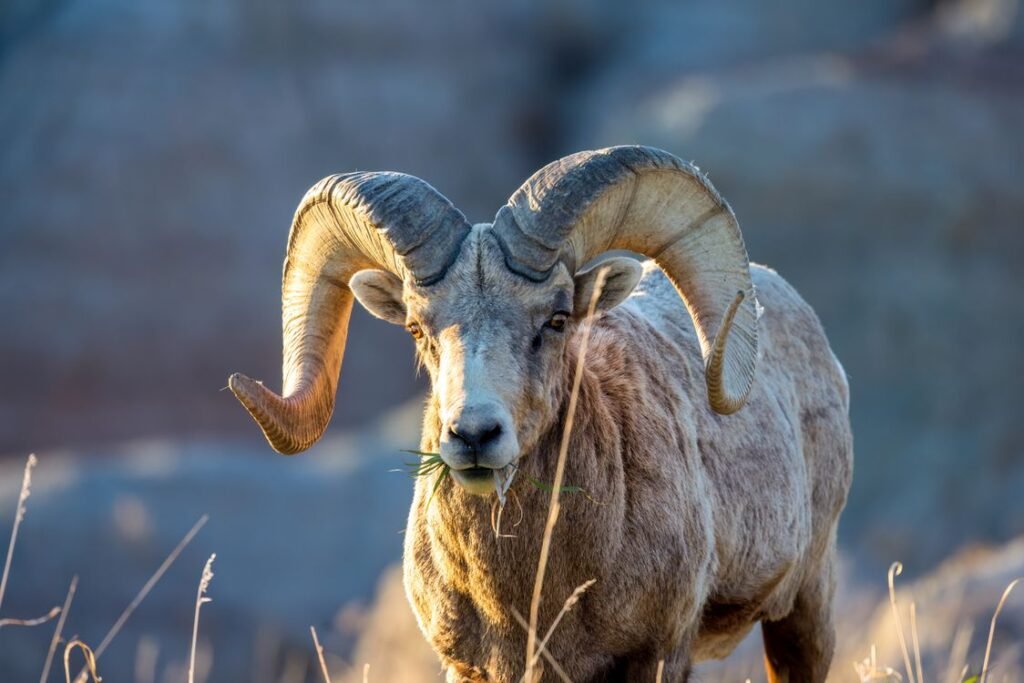
The Punjab urial is a handsome, medium-sized wild sheep, strongly sexually dimorphic: males and females look quite different. Adult males stand 80 to 90 centimetres at the shoulder and weigh roughly 40 to 48 kilograms. Their coat is a distinctive reddish-brown that sets them apart from other urials, and in winter mature rams grow a striking black neck ruff above a white bib. Many carry a two-coloured saddle patch, black in front and white behind, though some show a fully white patch or none at all.
The horns are the glory of the ram. They are massive, ridged structures that curl outward from the top of the head and sweep back, reaching up to 100 centimetres in large males. Females are smaller, around 25 kilograms, with short, straight horns only about 12 centimetres long. Young animals resemble the females until the males begin developing their ruffs and heavier horns.
In the field, the combination of reddish coat, black ruff and sweeping horns makes a mature Punjab urial ram unmistakable, one of the most beautiful wild sheep in Asia, and, unfortunately, one of the most coveted by trophy hunters.
Punjab urial: key facts
| Detail | Facts |
|---|---|
| Scientific name | Ovis vignei punjabiensis (Lydekker, 1913) |
| Range | Endemic to northern Punjab, Pakistan: Salt Range and Kala Chitta Range, between the Indus and Jhelum rivers, below ~1,500 m |
| Male size | 80-90 cm at shoulder, 40-48 kg, horns to ~100 cm |
| Female size | ~25 kg, horns ~12 cm |
| Identification | Reddish coat; males with black neck ruff, white bib, two-toned saddle patch |
| IUCN status | Vulnerable (urial); endangered within Pakistan |
| Population trend | Declining; ~30% decline over three generations |
Where they live
The Salt Range is not a single ridge but a rumpled belt of low, stony hills running across northern Punjab through the districts of Mianwali, Jhelum and Chakwal, with the Kala Chitta hills to the north. The urial's habitat is classic wild-sheep country: rounded hills dotted with wild olive (Olea ferruginea) and Acacia modesta, grassy slopes, ridgelines and cliffs. Researchers have found that proximity to ridgelines and crests matters enormously to urials, which use the high ground as an escape route from predators.
The vegetation survey at Kalabagh Game Reserve recorded around 32 plant species in urial habitat: thirteen grasses, four herbs and fifteen trees and shrubs. The hills look barren to a casual visitor, but they feed a surprising community of wild grazers.
Historically the range was wider. A 1980 survey by Mirza and colleagues counted 1,288 urials in the Kalabagh Reserve, 213 in the Kala Chitta hills and 588 in the Jhelum Valley hills. Those numbers have not been matched since, and the population is now scattered in small, isolated groups across the ranges.
Life in the herd
Punjab urials are gregarious, social animals. The big herds are typically made up of females, lambs and immature males, while mature rams may keep to themselves or form bachelor groups outside the breeding season. Group sizes shift with the seasons: the sheep gather in larger groups in winter and break into smaller parties during the lambing season.
They are primarily grazers, preferring grasses but browsing shrubs as well. Detailed feeding studies in the Salt Range have mapped a seasonal menu: Dodonaea viscosa is eaten year-round; wild olive and Acacia modesta are staples throughout the year; Zizyphus jujuba is favoured in winter; Zizyphus nummularia in winter and the monsoon; Acacia nilotica in winter and summer; Adhatoda zeylanica in spring and summer; and Maytenus royleana in spring and winter. It is a flexible diet for an inflexible landscape.
The breeding calendar is precise. The rut, when rams compete for ewes, falls in the final week of October and the first week of November, timed to the autumn flush of vegetation. Gestation lasts about five months, and peak parturition comes in the first half of April. The lambing season, roughly March to May, is the most vulnerable moment of the urial year, and, as we will see, the moment poachers strike hardest.
| Life stage | Timing |
|---|---|
| Rut (mating) | Final week of October to first week of November |
| Lambing | March to May, peak in first half of April |
| Herd structure | Large mixed herds in winter; smaller groups at lambing |
| Diet | Grasses preferred; seasonal shrubs incl. wild olive, acacias, Dodonaea, Zizyphus |
How many are left?
Counting urials across thousands of square kilometres of broken hills is difficult, but recent surveys give a reasonably clear picture. The most intensive recent count, conducted at Kalabagh Game Reserve between November 2024 and April 2025, used line-transect sampling across eleven sites and estimated 532 Punjab urials in the reserve, at a density of 8.9 animals per square kilometre. The survey found good survival of lambs and rams in the reserve's recent age classes, a genuinely encouraging sign.
Zoom out, and the picture darkens. A 2021 survey across the wider urial range estimated 3,484 animals over 7,953 square kilometres, a density of just 0.4 animals per square kilometre. The urial population as a whole has declined by about 30 percent over the last three generations, which is what earned it the IUCN's Vulnerable listing. Within Pakistan, where the pressures are most intense, it is considered endangered.
Genetics adds a deeper worry. A genomic study of the Kalabagh population found the animals divided into three distinct genetic clusters, with one cluster showing signs of inbreeding linked to habitat isolation. The population's effective size, the number of breeding individuals that actually contribute genes, has collapsed from an ancestral 20,000 to 50,000 down to 1,000 or fewer, partly through a bottleneck around 10,000 years ago and partly through recent fragmentation. Small, isolated clusters can wink out one by one, with no natural recolonisation to replace them. The researchers' prescription is blunt: maintain connectivity between urial localities, or watch the clusters fade.
Why they are in trouble
The Punjab urial's threats are almost entirely human, and they strike hardest at the youngest animals.
Lamb poaching for the pet trade. This is the greatest short-term threat. In parts of the Salt Range, poachers watch pregnant ewes in the nullahs and seize the newborn lambs within days of birth; one study in the Soan Valley found that nearly half the lambs were taken within a week of parturition, and that about 90 percent of captured lambs die in captivity. That means roughly 45 percent of each year's newborns are simply removed from the wild. In Pakistan, keeping a wild animal as a pet is a status symbol, and researchers note that licences to legally possess pet urials have made the problem worse.
Illegal hunting. Although the urial is protected in Punjab and only a handful of trophy permits are issued legally each year, illegal shooting is widespread. A landmark comparison of two populations found that in the Eastern Salt Range, where enforcement was lax, about a quarter of each lamb crop was poached and every ram older than six years had been shot out; in well-guarded Kalabagh, fewer than 5 percent of lambs were taken and a third of adult rams survived past six years. Yearly recruitment in the Eastern Salt Range was just 4 yearling females per 100 ewes, against 13 in Kalabagh, too few to sustain the population.
Habitat destruction. Collecting fuelwood, deliberately set fires to stimulate fresh grass for livestock, road building, expanding settlements and agriculture all shrink and fragment urial habitat. Human habitations now sit directly adjacent to urial hills in many areas.
Livestock competition. Domestic sheep and goats graze the same slopes, competing for forage and bringing disturbance and disease.
Jackals. Golden jackals (Canis aureus), boosted by organic waste from the poultry industry around the Salt Range, have become abundant and prey on newborn urial lambs during the lambing season.
The pattern is clear from the research: where protection is real, as in Kalabagh, urials hold on; where it is not, they slide away.
The protection puzzle: hunting permits and game reserves
The Punjab urial sits at the centre of one of conservation's oldest arguments: whether regulated trophy hunting helps or harms an endangered animal.
The legal framework is this. The Punjab Wildlife and Parks Department auctions a small number of trophy hunting permits each year, around 14 by recent accounts, to the highest-bidding outfitters. A single permit has fetched US$15,000 to 16,000 at auction. Hunts take place in the winter season, roughly December to January, in the Salt and Kala Chitta ranges, within a couple of hours' drive of Islamabad. Supporters argue that the revenue funds rangers, anti-poaching patrols and community incentives, and point to Kalabagh as evidence: the private game reserve there, where rangers patrol with guns to stop poachers, holds the densest and healthiest urial population in the country, partly because the animals are valuable alive as well as hunted.
Critics reply that shooting the finest rams from a small, inbred, declining population is reckless, that illegal hunting dwarfs the legal quota, and that the pet trade in lambs continues regardless. The truth, as the Eastern Salt Range data shows, is that enforcement is the variable that matters most. Legal hunting with strong protection, as at Kalabagh, coincides with recovery; weak protection with or without legal hunting coincides with decline.
What is not in dispute is what the science recommends: stronger law enforcement, community participation in management, fewer competing livestock on urial hills, strict protection during the March-to-May lambing season, and genetic connectivity between the isolated clusters. Captive breeding programs exist and are being refined, with researchers developing welfare assessment protocols for captive Punjab urials, but no captive program substitutes for protecting the wild hills.
Pakistan's three urials
The Punjab urial is one of three urial subspecies in the country, and the differences matter for conservation because each faces different pressures. The Ladakh urial (Ovis vignei vignei) lives in the high valleys of Gilgit-Baltistan, where a 2024-25 government survey counted 229 animals across five districts. The Balochistan urial, or Blanford's urial (Ovis vignei blanfordi), roams the southwest, where surveys in Khuzdar and Lasbela recorded a drop from 860 animals in 2019 to 534 in 2022. The Punjab urial is the lowland specialist of the trio, confined to hills below 1,500 metres in the country's most densely populated province, which is exactly why its habitat is the most fragmented and its poaching pressure the most intense. Saving Pakistan's urials means three different strategies for three different mountains.
Frequently asked questions
What is a Punjab urial? A subspecies of wild sheep (Ovis vignei punjabiensis) endemic to northern Punjab, Pakistan, found only in the Salt Range and Kala Chitta Range between the Indus and Jhelum rivers. Males are reddish-coated with a black neck ruff and large curling horns.
Where can I see Punjab urials? The Kalabagh Game Reserve in Mianwali district holds the densest population and is the most reliable place to see them; visits are typically arranged through the reserve or specialist wildlife tour operators. Urial country is also accessible in parts of the Salt Range in Jhelum and Chakwal districts, but the animals are shy and a local guide is essential.
How many Punjab urials are left? A 2024-25 survey estimated 532 in Kalabagh Game Reserve; a 2021 wider survey estimated 3,484 across 7,953 square kilometres. The population has declined about 30 percent over three generations.
Is the Punjab urial endangered? It is listed as Vulnerable on the IUCN Red List and considered endangered within Pakistan, with a declining population trend driven by poaching, habitat loss and fragmentation.
What is the difference between a urial and a markhor? Both are wild caprines of Pakistan, but the urial is a wild sheep with curling, ridged horns and a reddish coat, living on low dry hills; the markhor is a wild goat with spectacular spiralled, corkscrew horns, living in higher, steeper mountains. The markhor is Pakistan's national animal; the urial is Punjab's endemic sheep.
Why are urial lambs poached? Newborn lambs are captured for the pet trade, where owning a wild animal is a status symbol in Pakistan. Studies suggest nearly half of lambs can be taken in badly protected areas, and most die in captivity. This is considered the single greatest short-term threat to the subspecies.
Is trophy hunting of Punjab urial legal? A small number of permits (around 14) are auctioned annually by the Punjab Wildlife and Parks Department for tightly regulated winter hunts. All other hunting of the species is illegal, though poaching remains widespread.
What do Punjab urials eat? Mainly grasses, supplemented by shrubs including wild olive (Olea ferruginea), Acacia modesta, Dodonaea viscosa and various Zizyphus species, with the menu shifting by season.
A sheep worth more alive
The Punjab urial's story compresses the whole dilemma of wildlife conservation in Pakistan into one animal: an endemic species found nowhere else, hammered by poaching and habitat loss, sustained in its best refuge by the very hunting economy that also threatens it. The science is unusually clear about what works: guard the lambing season, enforce the law, connect the isolated herds, and keep livestock off the ridges. Kalabagh proves that protection pays. The question is whether Punjab will extend the Kalabagh model to the rest of the urial's hills before the clusters fade one by one. A wild sheep that belongs to Punjab alone deserves nothing less than Punjab's full protection.