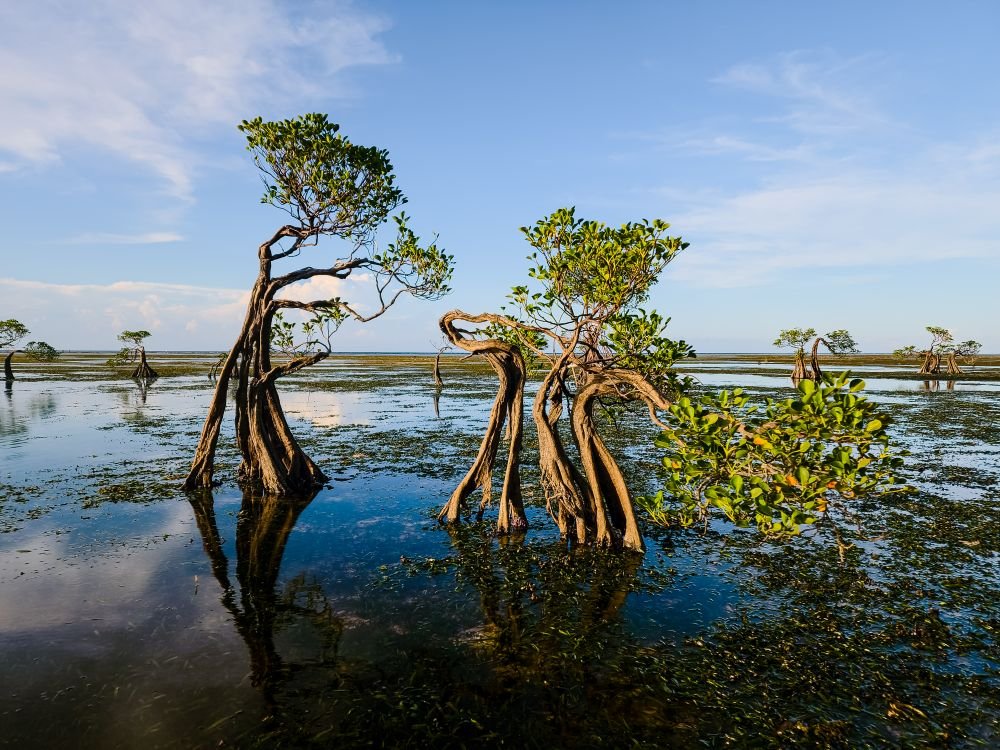
Indus Delta Mangroves: Pakistan’s Arid Coastal Forest
Where the Indus River finally meets the Arabian Sea, it fans out into one of the great river deltas of the world, and along its mudflats and tidal creeks grows a forest unlike any other. The Indus Delta mangroves are, by the account of the Sindh Forest Department, the largest arid-climate mangroves on Earth. They hold 97 percent of all the mangrove forest in Pakistan, shelter threatened pelicans and dolphins, support close to a million people, and are now at the centre of what is billed as the world's largest mangrove restoration project.
Few Pakistanis ever see this forest. It lies in the creeks and islands of Sindh's coast, far from the highways, in a landscape of mud, salt and tide. But its story, of near-collapse and ambitious comeback, is one of the most important conservation stories in the country. Here is the full picture.
The largest arid mangroves on Earth
The Indus River runs about 2,880 kilometres from the glaciers of Tibet to the Arabian Sea, and where it arrives it has built an alluvial fan covering roughly 600,000 hectares, with some 150 kilometres of coastline, seventeen major channels and countless smaller creeks. This is the fifth largest delta in the world, formed under largely arid climatic conditions, and it is fringed with mangrove swamps that act as a barrier against storm surges.
The mangrove ecoregion spanning the Indus Delta and the Arabian Sea coast covers about 5,698 square kilometres across Pakistan and India, and the forests rank as the seventh largest mangrove system in the world. Within Pakistan, the numbers are striking. The Ramsar listing for the Indus Delta records about 129,000 hectares of mangrove, overwhelmingly a single species, and notes that this is 97 percent of the country's total mangrove area. The remaining 3 percent sits in three small pockets on the Balochistan coast: Miani Hor, Kalmat Khor and Gawatar Bay.
The delta as a whole is a Ramsar wetland of international importance: site number 1284, covering 472,800 hectares, designated on 5 November 2002. Its legal protection includes the Keti Bunder, Shah Bunder and Cut Manarki Chach wildlife sanctuaries.
Four species, one survivor's club
Pakistan's mangrove flora is small but tough. The Sindh Forest Department lists just four mangrove species in the Indus Delta, and one of them does almost all the work.
| Species | Share of delta mangroves | Notes |
|---|---|---|
| Avicennia marina (grey mangrove) | About 90% | The great survivor: tolerates high salinity and long dry spells, the backbone of the arid mangrove system |
| Rhizophora mucronata (loop-root mangrove) | About 8% | Recognisable by its stilt-like prop roots; needs more freshwater than Avicennia |
| Aegiceras corniculatum | About 1.5% | A smaller shrubby species of the upper tidal zone |
| Ceriops tagal | About 0.5% | Rare in the delta, found in scattered patches |
Avicennia marina deserves a closer look, because it is the reason this forest exists at all. It is one of the most salt-tolerant trees on the planet, excreting excess salt through its leaves and breathing through pencil-like roots (pneumatophores) that poke up out of the mud at low tide. In the Indus Delta it grows short and scrubby, rarely more than a few metres tall, but it holds the coastline together. Without it, the mudflats would wash into the sea.
Why the delta's mangroves are special
Most of the world's great mangrove forests grow in wet tropical climates: the Sundarbans, the Amazon mouth, Southeast Asia. The Indus Delta mangroves grow in a desert. Annual rainfall on this coast is minimal, summer temperatures are brutal, and the trees survive almost entirely on the freshwater the Indus brings down to the sea, supplemented by a small quantity of domestic and industrial effluent from Karachi.
That dependence on the river is the key to everything about this forest. When the Indus flows strongly to the sea, the mangroves thrive; when upstream dams and barrages hold the water back, salinity rises and the trees suffer. The delta has shrunk significantly over the 20th century as river management reduced the freshwater and silt reaching the coast. Mangrove cover in the ecoregion stood at 16 percent in 1990 and had fallen by about a tenth by 2017, according to published assessments.
There is a governance quirk worth knowing. The delta's mangroves are managed by three different bodies: the Sindh Forest Department and the Port Qasim Authority administer their areas as "Protected Forests," while the land under the Board of Revenue is classified as government wasteland. Conservation across such a fragmented jurisdiction is a permanent challenge.
Life among the roots
A mangrove forest is a nursery, a pantry and a fortress at once, and the Indus Delta's version is no exception. The Ramsar listing records a rich fauna: threatened Dalmatian pelicans, fish and shrimps in abundance, and a remarkable set of marine mammals including the plumbeous dolphin, the finless porpoise, the bottlenose dolphin and even the humpback whale offshore, plus a full cast of reptiles.
The ecological role that matters most is the nursery function. Mangrove roots shelter the juveniles of commercially vital fish and shrimp species, which later move out to sea and sustain the coastal fishery. Lose the mangroves and the fishery collapses with them; protect them and the sea keeps paying. The forest also buffers the coast against cyclones, windstorms, flooding and erosion, a natural seawall for ports and villages alike.
Birdlife is rich and still being documented. Beyond the Dalmatian pelican, the creeks and mudflats attract herons, egrets, terns, gulls and waders, many of them migrants on the Central Asian flyway. For a birder willing to hire a boat at Keti Bandar, the delta offers one of Pakistan's least-visited but most rewarding birding experiences.
A million livelihoods
The human dimension of the delta is as large as the ecological one. The Ramsar information sheet notes some 40 settlements in the area, with about a million people finding their livelihoods largely from fishing. The Sindh Forest Department puts the number depending on the delta for subsistence at around 200,000, about half of them in the Korangi area on Karachi's southern outskirts and the rest spread along the coast toward the Indian border.
These are among Pakistan's poorest and most climate-exposed communities. When the mangroves degrade, fish catches fall, erosion eats the shoreline, and seawater pushes further up the creeks, salting farmland and wells. When the mangroves recover, the opposite happens: fish return, the coast stabilises, and the villages breathe easier. The forest and the fishing villages rise and fall together.
One striking recent development is the emergence of women forest rangers on the delta, reported by Arab News, who patrol and protect the mangrove plantations. In a traditionally male-dominated field, their presence signals how seriously the restoration effort now takes community involvement.
What almost killed the mangroves
The WWF-Pakistan assessment of the country's mangroves describes "considerable qualitative and quantitative loss" over the last 50 years, and names the causes plainly: a sharp reduction in river water reaching the delta, increased marine pollution, overharvesting of mangrove wood by local communities, sedimentation and coastal erosion. Dykes and embankments built for coastal management made some land unsuitable for mangroves altogether. Add pollution and oil spills drifting down from Karachi, and the pressure was relentless.
The freshwater story deserves emphasis because it is the master variable. Mangroves need the annual pulse of river water to flush salt from the soil and deliver silt. As Pakistan's upstream irrigation expanded through the 20th century, the flow reaching the delta dwindled, and sea intrusion advanced. Overharvesting compounded the damage: mangrove wood is cut for fuel and fodder, and grazing livestock trample seedlings. The Global Mangrove Alliance's 2024 assessment marked the entirety of Pakistan's mangrove forests as "vulnerable," a sobering official verdict on their condition.
The great comeback: restoration and blue carbon
Here the story turns. Over the past fifteen years, the Indus Delta has become one of the world's great mangrove restoration laboratories, and the numbers are remarkable.
The Sindh Forest Department reports that mangrove cover in the delta grew from about 108,000 hectares in 2008 to roughly 250,000 hectares in 2021. A divisional forest officer credited continuous work by the department, the federal government, WWF and the World Bank, and claimed a 300 percent expansion. Nature helped too: the great floods of 2010 and 2012 sent enormous volumes of water past the Kotri Barrage to the sea, reviving plantations that were already in the ground. As one environmentalist put it, the plantation was underway and then the floods gave life to the plants.
The engine of the current effort is the Delta Blue Carbon project, a public-private partnership between the Government of Sindh and Indus Delta Capital, launched in 2015. It is designed as a 60-year program (extendable to 100) covering 350,000 hectares in Thatta and Sujawal districts, and it is described as the world's largest mangrove reforestation project. More than 75,000 hectares have been regenerated so far, sequestering over 3.2 million tonnes of CO2 equivalent, with a projected total of 142 million tonnes over the project's lifetime.
The economics are novel. Mangroves are "blue carbon" ecosystems: coastal wetlands that lock away carbon in their muddy soils at extraordinary rates. Pakistan's federal maritime affairs minister has stated that the Delta Blue Carbon project has already generated about $40 million in revenue from carbon-credit sales, and that mangroves absorb roughly four times more carbon than ordinary trees. The project sells that carbon removal to polluting companies, turning conservation into a revenue stream for the province.
The model has critics. Reporting by NPR noted that some local observers question who benefits most from the carbon money, and the company behind the project declined detailed questions. That debate is worth having. But the physical result, hundreds of thousands of hectares of new and restored mangrove, is visible from satellite and from the boats at Keti Bandar, where rangers harvest propagules (the spear-like germinated seeds that drop from the mother tree) and raise them in nurseries before planting.
Indus Delta mangroves: key figures
| Measure | Figure | Source |
|---|---|---|
| Delta area | ~600,000 hectares | Ramsar / WWF |
| Mangrove area (historic) | ~129,000 hectares | Ramsar site listing |
| Share of Pakistan's mangroves | 97% | Ramsar / WWF-Pakistan |
| Global rank | 7th largest mangrove forest | Ecoregion assessments |
| Ramsar site | No. 1284, 472,800 ha, designated 2002 | Ramsar Sites Information Service |
| Cover 2008 to 2021 | ~108,000 to ~250,000 hectares | Sindh Forest Department |
| Delta Blue Carbon area | 350,000 hectares | Project documentation / PID |
| Projected sequestration | 142 million tonnes CO2 over 60 years | Project documentation / PID |
| Carbon revenue to date | ~$40 million | Federal Minister for Maritime Affairs |
| Conservation status | "Vulnerable" (all Pakistan mangroves) | Global Mangrove Alliance 2024 |
From propagule to forest: how restoration actually works
Restoring a mangrove forest is slower and more hands-on than most people imagine. It starts with the propagule: the spear-like, already-germinated seed that drops from the mother Avicennia tree and lodges in the mud. Wildlife rangers and plantation workers collect these propagules from healthy stands and raise them in nurseries on the forest edge, where the young plants are sheltered until they are hardy enough to survive the tides.
Planting happens in the two main growing seasons, and at the peak of the effort thousands of people have been employed across the delta, a forester at Keti Bandar told reporters, with plantations running over thousands of hectares each season. The work is timed to the tides and the rains, and survival depends on getting the elevation right: too low and the seedlings drown, too high and they dry out. This is why the floods of 2010 and 2012 mattered so much. Plantation was already underway, and then the floodwaters arrived, flushing salt from the soil and giving the young plants exactly the freshwater pulse they needed. Environmentalists credit those floods with reviving whole plantation blocks that might otherwise have failed.
The Delta Blue Carbon project industrialised this craft. It mapped degraded areas across Thatta and Sujawal districts, signed agreements with local communities and the government, and committed to decades of planting and protection, because carbon-credit auditors require proof that the forest will stand for the long term. That long horizon is the project's real innovation: where government plantation drives used to plant and walk away, the carbon model pays for the forest to be guarded, replanted and measured for sixty years.
Frequently asked questions
Where are the Indus Delta mangroves? They fringe the creeks, mudflats and islands of the Indus Delta on Sindh's Arabian Sea coast, centred on areas like Keti Bandar in Thatta district, with smaller pockets on the Balochistan coast.
How big are the Indus Delta mangroves? The Ramsar listing records about 129,000 hectares of mangrove, about 97 percent of Pakistan's total, making it the seventh largest mangrove forest in the world. Restoration has since expanded the planted cover significantly, with the Sindh Forest Department reporting around 250,000 hectares by 2021.
What species of mangrove grow in the Indus Delta? Four species: Avicennia marina (about 90 percent), Rhizophora mucronata (about 8 percent), Aegiceras corniculatum (about 1.5 percent) and Ceriops tagal (about 0.5 percent).
Why are the Indus Delta mangroves unique? They are the world's largest arid-climate mangroves, surviving on minimal rainfall and depending almost entirely on freshwater flows from the Indus River. Most great mangrove forests grow in wet tropical climates.
What animals live in the Indus Delta mangroves? Threatened Dalmatian pelicans, large numbers of fish and shrimps, three dolphin species (plumbeous, finless porpoise and bottlenose), humpback whales offshore, and many reptiles and migratory birds.
What is the Delta Blue Carbon project? A 60-year public-private mangrove restoration project covering 350,000 hectares of the Indus Delta, registered for carbon credits. It aims to sequester 142 million tonnes of CO2 and has reportedly generated about $40 million in carbon-credit revenue.
Are the mangroves recovering? Yes, substantially. Cover reportedly grew from 108,000 hectares in 2008 to 250,000 in 2021 thanks to planting programs and the reviving effect of the 2010 and 2012 floods. But the Global Mangrove Alliance still rates Pakistan's mangroves as vulnerable, and their long-term health depends on freshwater continuing to reach the delta.
Can tourists visit the Indus Delta mangroves? It is possible but adventurous: boat trips can be arranged from Keti Bandar with local guides. There is little tourist infrastructure, so go with an experienced operator, carry supplies, and respect this working landscape of fishing villages.
The forest that pays for itself
The Indus Delta mangroves spent half a century in decline, starved of river water, cut for fuel and dismissed as wasteland. Their recovery is one of Pakistan's genuine environmental success stories, and it carries a lesson with global resonance: a mangrove forest is not just trees in mud. It is a fishery, a storm wall, a carbon vault and a livelihood, all at once. If the freshwater keeps flowing and the planting keeps pace, the seventh largest mangrove forest in the world may yet become the best-protected one in an arid land.