Whale Shark Facts: 25 Things About the Ocean’s Giant
Imagine a fish longer than a school bus, weighing as much as several elephants, with a mouth wide enough to swallow a person whole. Now imagine that it is completely harmless, spends its days sipping plankton like a whale, and carries a star map of spots no other individual shares. That is the whale shark, the largest fish in the sea and one of its gentlest.
These whale shark facts draw on research from NOAA Fisheries, National Geographic, MarineBio, and the IUCN Red List, covering everything from how big whale sharks really get to why their numbers are falling.
What Is a Whale Shark, Exactly?
First, the name. A whale shark is not a whale. It is a shark, and its scientific name is Rhincodon typus. It is the only living member of its genus and its family, Rhincodontidae, which places it among the carpet sharks in the order Orectolobiformes.
The "whale" in the name refers only to its size. Like whales, it is enormous and feeds by filtering tiny organisms from the water. Unlike whales, it breathes through gills, not lungs, and it is cold-blooded like other fish. The species was first scientifically described in 1828, yet it took more than a century of scattered sightings before researchers began to understand its life history. Much about whale sharks, from where they give birth to exactly how long they live, is still being worked out.
How Big Is a Whale Shark?
This is the question almost everyone asks first, and the answer depends on which number you mean: the biggest ever measured, or the typical animal you would meet.
The largest reliably recorded whale shark measured about 18.8 meters, or nearly 62 feet. Most adults that researchers encounter are smaller, commonly between 6 and 12 meters (20 to 40 feet), with an average in the range of 5.5 to 10 meters. NOAA Fisheries puts the upper end at around 46 feet and nearly 24,000 pounds. Weight estimates for large individuals run to 20 metric tons or more.
To put that in perspective:
| Animal | Typical length | Weight | Feeding style |
|---|---|---|---|
| Whale shark | 6 to 12 m (up to ~18.8 m) | Up to 20+ tons | Filter feeder, harmless |
| Great white shark | 4.6 to 6.1 m | Over 2,268 kg | Predator |
| Basking shark | Second largest fish | Several tons | Filter feeder, harmless |
| School bus | About 12 m | About 12 tons | Not applicable |
The whale shark is not only the biggest fish alive today, it is by far the largest non-whale animal in the ocean. A great white shark, the ocean's largest predatory fish, is dwarfed beside it. And size runs in the family line of records: whale sharks also have some of the thickest skin of any animal, up to 10 centimeters, and the widest mouth of any fish, stretching about 1.5 meters across.
Females grow larger than males, a common pattern in sharks. Young whale sharks start life at well under a meter long, and they grow slowly for decades.
Anatomy: How to Recognize a Whale Shark
You do not need a guidebook to identify one, but the details are worth knowing.
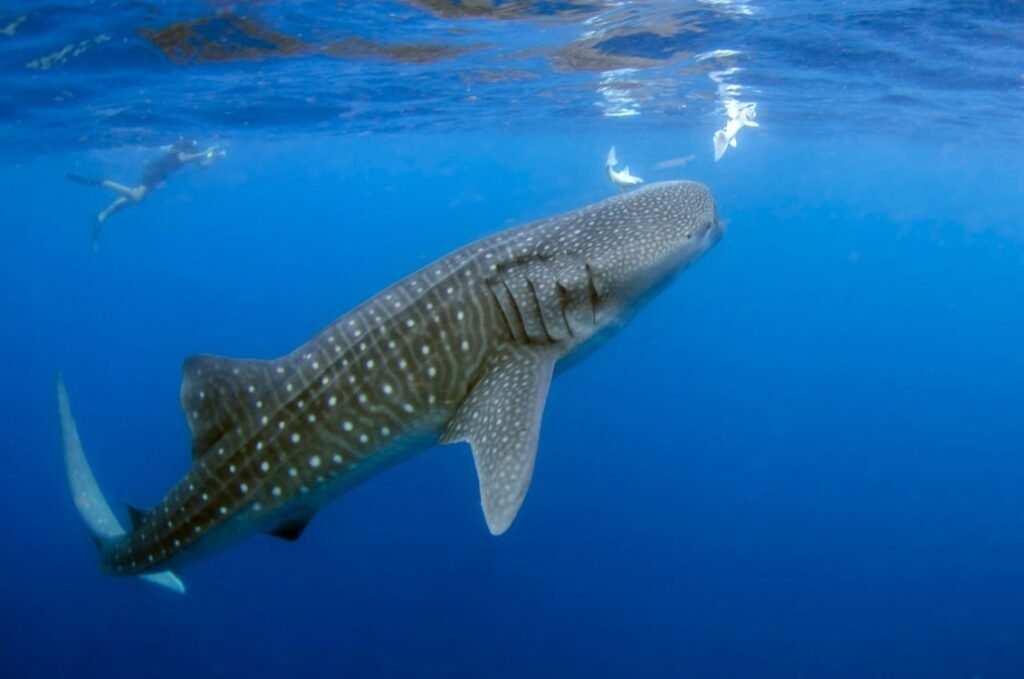
The spotted pattern. A whale shark's back and sides are gray to brown, covered with white spots set among pale vertical and horizontal stripes, while the belly is white. Every individual's spot pattern is unique, like a human fingerprint. Researchers use photographs of these patterns to identify and track individual sharks across years and oceans, a technique that has underpinned much of what we know about their migrations.
The flattened head. The head is broad and flattened with a blunt snout. The huge mouth sits at the very front of the head rather than underneath it, as in most sharks. Short, whisker-like sensory organs called barbels protrude from the nostrils.
The gills and fins. Five very large gill slits run along each side, and inside them sit the filter pads that strain food from the water. Two dorsal fins are set far back on the body, which ends in a large tail with a slightly larger upper lobe. Three prominent ridges run along each side of the body.
The tiny teeth. A whale shark has thousands of minute teeth arranged in rows, more than 3,000 by some counts. They play no role in feeding. They are evolutionary leftovers from a predatory past, now vestigial in an animal that eats by filtration.
What Do Whale Sharks Eat?
For the largest fish on Earth, the menu is remarkably small. Whale sharks are filter feeders that live mainly on plankton, krill, fish eggs, and small schooling fish such as sardines and anchovies. They also take squid and other tiny drifting prey when the opportunity arises.
They feed in two ways. Sometimes they swim steadily forward with their enormous mouths open, passively straining everything in their path. At other times they use active suction, gulping water in great mouthfuls. A whale shark can process more than 6,000 liters of water per hour through its specialized gill pads.
How a Whale Shark Filters the Ocean
The filtering mechanism itself is a subject of active research. Scientists believe whale sharks use a technique called cross-flow filtration, in which water flows across the filter surface rather than straight through it, similar to the method used by some bony fish and baleen whales. This keeps the fine sieve of the gill pads from clogging, letting the shark feed continuously in dense plankton.
The strategy shapes the shark's whole life. Because plankton blooms are seasonal and patchy, whale sharks are wanderers, traveling thousands of miles between feeding grounds. They gather in large, predictable aggregations where food is briefly abundant, then disperse across the open ocean. Everything about their movement is really a story about following food.
Where Do Whale Sharks Live?
Whale sharks inhabit the open waters of all tropical oceans. They are rarely found in water cooler than about 21°C (70°F), and they prefer surface temperatures between roughly 21 and 30°C. Their range covers the Indian, Pacific, and Atlantic Oceans, though they are absent from the Mediterranean Sea. Most of the world's whale sharks, around three quarters, are found in the Indian and Pacific Oceans.
During the day they spend much of their time feeding near the surface. At night and while traveling, they often dive deep, descending to depths of more than 700 meters. Satellite tagging has shown that individual sharks roam across entire ocean basins, crossing national boundaries and the high seas with ease.
Migration: Where Whale Sharks Travel
Whale sharks are highly migratory. Large, predictable feeding aggregations form at coastal sites when seasonal food appears, and these gatherings are the best places in the world to see them.
| Aggregation site | When they gather | Why they come |
|---|---|---|
| Ningaloo Reef, Western Australia | March to May | Coral spawning fuels plankton blooms |
| Yucatan Peninsula, Mexico | Summer months | Seasonal plankton upwellings |
| Gulf of Mexico | Spring and summer | Rich feeding grounds tracked by NOAA researchers |
| Gujarat and Kerala coasts, India | Seasonal | Plankton blooms in the Arabian Sea |
| The Philippines | Year-round at some sites | Reliable local food sources |
| The Maldives | Year-round at some sites | Plankton in atoll channels |
| Belize | Spring | Snapper spawning draws them in |
Ningaloo Reef is the classic example: every year, the mass spawning of corals releases a feast of plankton into the water, and whale sharks arrive to harvest it. NOAA research in the Gulf of Mexico has tracked sharks moving between U.S., Mexican, and Cuban waters, showing that effective conservation has to be international. The sharks do not recognize borders; protection that stops at a maritime boundary is protection with holes in it.
Reproduction and Lifespan
Whale sharks give birth to live young, but almost everything else about their reproduction remains mysterious. No one has ever observed a whale shark giving birth in the wild, and pregnant females are rarely encountered. What is known comes from a handful of remarkable cases and from studying growth bands in vertebrae.
The lifespan estimates are striking. Based on vertebral growth bands and the growth rates of free-swimming sharks, scientists estimate whale sharks live between 80 and 130 years. NOAA notes that the oldest documented individual was 75 years old, but researchers believe they can live well past a century. They are slow to mature as well: calculations suggest they reach sexual maturity at around 30 years of age.
This slow life history is the crux of their conservation problem. An animal that takes 30 years to start breeding and may live over a century cannot replace its losses quickly. Every adult killed, whether by a ship's propeller or a fishing net, represents decades of growth that the population cannot easily replace.
Are Whale Sharks Dangerous to Humans?
No. Despite their size, whale sharks are among the most docile sharks in the ocean. They are filter feeders with no interest in large prey, and their thousands of tiny teeth are not used for biting. Divers and snorkelers swim alongside them regularly at aggregation sites, and the sharks are usually indifferent to the attention.
That said, they are still enormous wild animals. An accidental blow from a whale shark's powerful tail has caused serious injury, and wildlife experts strongly advise against touching or riding them. Several countries, including the Philippines, have made it illegal to approach too closely, with fines or jail time for violations. The respectful distance protects both the swimmer and the shark: being climbed on or chased disrupts feeding and stresses the animal.
Endangered: Why Whale Shark Numbers Are Falling
The whale shark is listed as Endangered on the IUCN Red List. It was uplisted from Vulnerable to Endangered in 2016, and reassessed as Endangered again in 2025. The listing reflects a population decline of more than 50 percent over the last 75 years.
The threats are all human-caused:
Targeted fishing. Whale sharks are still hunted in parts of Asia for their meat, fins, and oil. The demand comes from the same fin and meat markets that threaten other shark species.
Bycatch. Sharks are caught incidentally in tuna purse-seine nets and other industrial fisheries, and many do not survive the encounter.
Ship strikes. This threat has only recently come into focus. A NOAA-archived study mapped more than 50 whale shark aggregation sites, "constellations" where up to 400 individuals gather, against global shipping lanes. It found that large vessel collisions pose a major, underappreciated threat. The danger zones with the greatest collision risk include the Arabian Sea and adjacent waters, the Gulf of Mexico, the Gulf of California, and Southeast and East Asia. In other words, some of the busiest shipping corridors on Earth run straight through whale shark habitat, including waters close to South Asia.
Slow recovery. Because whale sharks mature late and breed slowly, populations cannot bounce back quickly even when killing stops. The loss of large, old females is especially damaging, since they are the most productive breeders.
Conservation and Responsible Whale Shark Tourism
Whale sharks are protected by national laws in many countries and by international agreements covering migratory species. The CITES listing regulates international trade, and several nations have banned hunting outright. But enforcement is uneven, and the sharks' vast migrations carry them through waters with very different levels of protection.
Tourism is a double-edged sword. Whale shark watching supports local economies in Australia, the Philippines, the Maldives, Mexico, and Belize, giving coastal communities a financial reason to protect the animals. To keep it sustainable, many countries have developed interaction guidelines: limits on the number of swimmers, minimum distances, and bans on touching. The rules are enforced strictly in places like Western Australia and Belize, and less consistently elsewhere.
If you go to see whale sharks, choose operators that follow science-based codes of conduct, keep your distance, never touch the animal, and avoid flash photography. The best encounters are the quiet ones, where the shark does not even know you are there.
FAQ: Whale Shark Facts
How big is a whale shark? The largest reliably recorded individual measured about 18.8 meters (nearly 62 feet). Most adults encountered in the wild are 6 to 12 meters long and can weigh 20 metric tons or more, making the whale shark the largest fish in the sea.
Is a whale shark a whale or a shark? It is a shark. The name refers to its whale-like size. It breathes through gills, is cold-blooded, and belongs to the carpet shark order. Its scientific name is Rhincodon typus.
What do whale sharks eat? Plankton, krill, fish eggs, small schooling fish like sardines and anchovies, and squid. They are filter feeders that strain food from the water using specialized gill pads, processing more than 6,000 liters of water per hour.
Are whale sharks dangerous? No. They are docile filter feeders that pose no significant threat to humans. Swimmers should still keep a respectful distance, since an accidental tail strike from such a large animal can cause injury.
Why are whale sharks endangered? The IUCN lists them as Endangered after a population decline of more than 50 percent over 75 years. The main threats are targeted fishing, bycatch, and collisions with large ships. Their slow growth and late maturity make recovery difficult.
How do scientists tell individual whale sharks apart? Each whale shark has a unique pattern of spots and stripes, like a human fingerprint. Researchers photograph these patterns and use them to identify and track individuals across years and oceans, which is how much of their migration data has been gathered.
How long do whale sharks live? Scientists estimate 80 to 130 years, based on vertebral growth bands. They reach sexual maturity at around 30 years old.
Where can you see whale sharks? Reliable aggregation sites include Ningaloo Reef in Western Australia (March to May), the Yucatan Peninsula in Mexico, the Philippines, the Maldives, Belize, and the coasts of Gujarat and Kerala in India.
Conclusion
The whale shark is a study in contrasts: the biggest fish in the ocean eats the smallest food, the most formidable-looking shark is one of the most harmless, and an animal that has swum the seas for millions of years is now endangered within a single human lifetime.
These whale shark facts point to a clear conclusion. The species' future depends on decisions made far from the open ocean: in shipping lanes, in fishing policy, and in the tourism boats that follow them. Protect the plankton-rich waters they gather in, give the great slow migrants safe passage between them, and a fish that can live for over a century has every chance to recover. The largest fish in the sea deserves nothing less than the largest effort to save it.