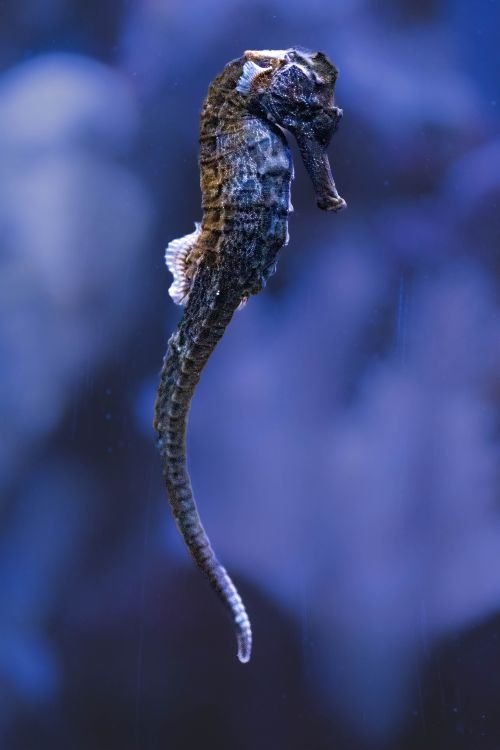
Seahorse Facts: 21 Surprising Things About Seahorses
A seahorse looks like a creature assembled from spare parts: a horse's head on a fish's body, a kangaroo's pouch on its belly, a monkey's tail for gripping, and the color-changing skin of a chameleon. It swims upright, eats like a vacuum cleaner, and the males get pregnant. If ever an animal deserved a long second look, it is this one.
Seahorses are found in coastal waters on nearly every continent, and scientists are still learning their basic biology. Here are the most fascinating seahorse facts, checked against research and conservation authorities, from their impossible anatomy to the trade that is emptying the seas of them.
What Exactly Is a Seahorse?
A seahorse is a genuine fish, not a myth or a marine oddity in its own separate category. It belongs to the genus Hippocampus, a Greek name that means "bent horse," and to the family Syngnathidae. Its closest relatives are pipefishes, pipehorses, and seadragons.
There are around 47 recognized seahorse species, and they live in coastal waters around the globe, in both tropical and temperate seas. Scientists consider them a charismatic but still poorly understood group: much of their basic biology has been worked out, yet large gaps remain in what we know about population sizes and life histories. That uncertainty itself is part of their conservation story.
Built Like No Other Fish: Seahorse Anatomy
Most fish are streamlined for speed. Seahorses went the other way entirely, and their bodies read like a list of rule-breaking adaptations.
They wear armor instead of scales. Where most fish have overlapping scales, a seahorse's body is covered in thin skin stretched over a series of bony rings and ridges. This gives the animal its segmented, almost armored appearance and offers protection from predators, though at the cost of flexibility.
They swim upright. Unlike almost every other fish, seahorses hold themselves vertical in the water. They get around by beating a single dorsal fin on their back at frantic speed, up to 70 beats per second according to National Geographic, while tiny pectoral fins near the head provide steering and stability. They are poor swimmers by any measure: easily exhausted, they can be swept away in heavy currents or killed in storm-churned seas.
Their tail works like a hand. The prehensile tail curls around seagrass blades, mangrove roots, and coral branches, anchoring the animal in place while it rests or feeds. During courtship, pairs even link tails. Because they grip instead of swim, many seahorses live their lives in a home range no bigger than a small garden, which makes them extremely vulnerable when that habitat is damaged.
Their eyes move independently. Each eye can swivel on its own, letting a seahorse watch for predators with one eye while scanning for prey with the other. Few fish have this ability, and it suits a sit-and-wait hunter perfectly.
Their jaws are fused into a straw. A seahorse's narrow snout ends in a small mouth that works like a pipette. It cannot bite or chew; it sucks. When prey drifts within range, the mouth opens in a sudden snap and the animal is drawn in whole.
They have no stomach and no teeth. Food passes through a simple digestive tract, which means a seahorse cannot store a meal. It must feed almost constantly, for up to ten hours a day in some species, just to keep up with its metabolism.
Where Do Seahorses Live?
Seahorses prefer calm, shallow coastal waters, the sheltered zones where plants and structure break the force of waves and currents. You will find them in:
- Seagrass meadows, where they anchor their tails to blades of grass
- Mangrove swamps, tangled among the roots
- Coral reefs and coral gardens, hiding among branches
- Estuaries, where rivers meet the sea
Their global range is enormous, spanning tropical and temperate coastlines of the Atlantic, Pacific, and Indian Oceans. But within that range, individual seahorses stay remarkably local. A pygmy seahorse may spend its entire life on a single coral fan. This sedentary lifestyle is charming, and it is also dangerous: when a trawler rips up a seagrass bed or a coastline is dredged, the local seahorses have nowhere else to go.
What Do Seahorses Eat?
A seahorse is a carnivore with a fast metabolism and no way to store food, so hunting is nearly a full-time job. It perches motionless, tail wrapped around a holdfast, eyes swiveling, and waits for tiny animals to drift past. Then it strikes, sucking up its prey in a fraction of a second.
The menu consists of whatever small animals the current delivers: copepods, tiny shrimp, fish larvae, and plankton. A large seahorse can consume thousands of these small crustaceans in a single day. Because they feed by sight and suction, murky or polluted water makes hunting harder, one of several quiet ways that degraded water quality hurts them.
The Male Gives Birth: How Seahorse Reproduction Works
Here is the fact that made seahorses famous: the male, not the female, becomes pregnant. It is one of the rarest reproductive strategies in the animal kingdom, shared only with their close relatives the pipefishes and seadragons.
It starts with one of the ocean's most elaborate courtships. A male and female pair rise and fall face to face in the water, sometimes for days, communicating through flashes of color and gentle tail embraces. Many species form monogamous pairs that stay together for an entire breeding season, and some appear to mate for life, reuniting each morning with a brief greeting dance.
When the pair is ready, the female deposits her yolk-rich eggs into the male's brood pouch through a tube on her trunk called an ovipositor. Inside the pouch, the male fertilizes the eggs. The pouch is not just a carrying case: it regulates salt levels, supplies oxygen, and nourishes the developing embryos, functioning much like a mammalian placenta.
Gestation lasts from a few days to about four weeks depending on the species. Then the distended male goes into labor, his body contracting as he ejects the young into the current. A single brood can contain anywhere from 50 to 1,500 babies in smaller species, and up to thousands in the largest ones. A few days after giving birth, the male is ready to receive eggs again, and the cycle repeats through the breeding season.
From Pouch to Predators: A Seahorse Baby's First Days
A newborn seahorse is fully formed but minuscule, and the odds are stacked against it. The babies drift with the current for a while before settling down, and only a tiny fraction survive the gauntlet of predators in those first days. This is why broods are so large: a seahorse's reproductive strategy is to produce enormous numbers of young in the hope that a few make it to adulthood.
Those that survive grow into adults that live, on average, one to five years in the wild. Some species are annual, completing their whole life cycle in a single year, while others persist a little longer in the relative safety of captivity.
How Big (and Small) Do Seahorses Get?
Seahorses span a remarkable size range, from animals no bigger than a grain of rice to ones longer than your forearm. National Geographic puts the overall range at 0.6 to 14 inches (roughly 1.5 to 36 centimeters).
| Species | Size | Conservation status | Notable |
|---|---|---|---|
| Pygmy seahorse | As small as a fingernail | Varies by species | Lives on coral fans, nearly invisible |
| Dwarf seahorse (Hippocampus zosterae) | A few centimeters | Least Concern | Small broods of 50 to 100 young |
| White's seahorse (H. whitei) | Up to 16 cm | Endangered | Endemic to Australia's east coast |
| Knysna seahorse (H. capensis) | Up to about 12 cm | Endangered | Found only in South African estuaries |
| Satomi's pygmy seahorse (H. waleananus) | Among the smallest known vertebrates | Critically Endangered | Named after a Japanese dive guide |
| Big-belly seahorse | Larger than a human hand | Least Concern | One of the largest seahorse species |
The species in real trouble tend to be the ones with the smallest ranges. The Knysna seahorse lives in just a handful of South African estuaries. Satomi's pygmy seahorse, one of the tiniest vertebrates on Earth, is listed as critically endangered. Small range plus habitat damage is a recipe for extinction.
Masters of Disguise: Camouflage and Color Change
A seahorse that cannot outswim a predator must out-hide one. Many species can change color in minutes, shifting from black or grey to bright yellow or red to match their surroundings or signal mood. Some grow lacy skin extensions, spikes, and bumps that break up their outline against coral and algae.
Pygmy seahorses take this to an extreme. They match the exact color and texture of the gorgonian corals they live on, down to the tiny polyps, and are so well hidden that several species were discovered only in the last few decades, hiding in plain sight from divers. During courtship, the same color-changing ability becomes a language: flashing patterns help pairs recognize and bond with each other.
Are Seahorses Endangered?
As a group, seahorses are in serious trouble. According to the IUCN SSC Seahorse, Pipefish and Seadragon Specialist Group, of the recognized seahorse species assessed on the IUCN Red List:
- 1 is Critically Endangered
- 2 are Endangered (the Knysna seahorse and White's seahorse)
- 14 are Vulnerable
- 14 are Data Deficient, meaning scientists do not even have enough information to judge their risk
All seahorse species are listed on Appendix II of CITES, the Convention on International Trade in Endangered Species, which means international trade in them is regulated and requires permits. Despite these protections, populations continue to decline in many regions.
The Biggest Threats Seahorses Face
Bycatch. The single largest source of seahorse deaths is incidental capture. Bottom trawlers and other catch-all fishing gear sweep seahorses off the seabed along with their target catch. The seahorses are then dried and sold into the traditional medicine trade. Research on Southeast Asian fisheries has documented how this bycatch devastates local populations, because seahorses' low mobility and small home ranges mean a trawled area may never recover.
The dried trade. Millions of seahorses are harvested every year for use in traditional medicine, as curios, and for the aquarium trade. Market surveys in Taiwan alone have identified eight seahorse species in herbal medicine shops, including endangered and vulnerable ones. Countries involved in the trade span the globe, from Brazil and Mexico to India, Indonesia, Thailand, Vietnam, and the Philippines, with much of South and Southeast Asia serving as both source and market.
Habitat destruction. Seahorses need seagrass, mangroves, and reefs, exactly the habitats that coastal development destroys first. In Portugal's Ria Formosa lagoon, once a stronghold for European seahorses, clam farming and illegal bottom trawling have buried or ripped up the seagrass beds the animals depend on. Dredging, pollution, and climate change add further pressure.
What Is Being Done to Save Them?
The picture is not all bleak. The CITES Appendix II listing, in force since the early 2000s, gave regulators a legal tool to control exports, and several countries have since tightened or banned the trade.
In Australia, the Sydney Seahorse Project has been rebuilding habitat for the endangered White's seahorse by installing biodegradable "seahorse hotels" in Sydney Harbour. Designed to mimic the discarded crab traps seahorses naturally colonize, the structures are left to accumulate algae and sponges for a month before captive-bred seahorses are released onto them. Early results were encouraging: a year after a 2020 release, a fifth of the released animals were still on the hotels and some were already breeding in the wild.
Elsewhere, marine protected areas that safeguard seagrass and reef habitat protect seahorses along with everything else that lives there. Because seahorses are flagship species that the public loves, they have become ambassadors for the less glamorous habitats they inhabit. Saving a seagrass meadow for seahorses also saves the dugongs, turtles, and juvenile fish that use it.
The Sound of a Seahorse: Clicking Hunters
Seahorses are not silent. Every time a seahorse feeds, it makes a sharp clicking sound as its snout snaps open to suck in prey. Aquarium keepers know this well: in seahorse nurseries, the constant clicking is the soundtrack of feeding time. The sound comes from the mechanics of the strike, and it is loud enough for divers and researchers to hear underwater.
Color is their other voice. During the multi-day courtship dances, pairs brighten, darken, and flash patterns at each other in a silent conversation that strengthens the pair bond. The same skin that hides a seahorse from predators becomes a billboard when it is time to find a mate.
FAQ: Seahorse Facts
Do male seahorses really give birth? Yes. The female deposits her eggs into the male's brood pouch, where he fertilizes them and carries them through gestation. When the young are ready, the male goes into labor and ejects them into the water. This male pregnancy is unique to seahorses and their close relatives, the pipefishes and seadragons.
How many babies does a seahorse have at once? It depends on the species and the size of the father. A single brood can contain from 50 to 1,500 young in smaller species, and up to a few thousand in the largest ones. Very few survive to adulthood.
Are seahorses fish? Yes. Despite their unusual shape, seahorses are true bony fish in the family Syngnathidae, related to pipefishes and seadragons. Their scientific genus name, Hippocampus, comes from the Greek for "bent horse."
Can seahorses change color? Many species can, and quickly, sometimes within minutes. They use color change both for camouflage and for communication, especially during courtship when pairs flash patterns at each other.
Why are seahorses endangered? The main drivers are bycatch in trawl fisheries, harvest for the traditional medicine and aquarium trades, and destruction of the seagrass beds, mangroves, and reefs they live in. Their small home ranges and slow reproduction make recovery difficult.
How long do seahorses live? In the wild, most species live between one and five years. They can live longer in aquariums where predators and food shortages are not a concern.
Do seahorses make noise? Yes. A feeding seahorse produces a distinct clicking sound each time its snout snaps open to capture prey. In aquariums, keepers can hear the clicking during feeding time.
Conclusion
Seahorses pack more biological surprises into a few inches of armored body than almost any other fish: upright swimming, a gripping tail, independent eyes, a stomach-free digestive system, and the famous male pregnancy. These seahorse facts are more than curiosities. They explain why the animals are so vulnerable. A fish that cannot swim well, cannot leave its meadow, and breeds slowly cannot absorb the pressures of trawling, trade, and habitat loss indefinitely.
The good news is that seahorses respond to protection. Guard their meadows and reefs, control the trade, and give them somewhere to anchor, and they will do the rest. Few ocean animals reward conservation with such visible results, or give us such good reasons to care about the quiet, shallow places where they live.