Deep Sea Creatures: Life in Earth’s Darkest Ocean Zones
Descend past 200 metres beneath the ocean surface and sunlight gives up. By 1,000 metres, the last stray photons are gone and the water is blacker than any night on land. Yet this darkness is not empty. It holds most of the living space on Earth, and it is filled with deep sea creatures stranger than anything science fiction has invented: fish with transparent heads, eels with mouths like pelicans, squid with eyes the size of dinner plates, and sharks that have barely changed in 80 million years.
Scientists estimate that more than 80 percent of the ocean remains unmapped, unobserved, and unexplored, according to NOAA. Every serious expedition still returns with animals never seen before. This is a guided tour of that world, zone by zone, through the physics that shapes it and the animals that have mastered it.
What Counts as the Deep Sea? A Map of the Zones
Oceanographers divide the water column into layers defined mostly by light and pressure. The deep sea begins where sunlight fades, around 200 metres down. From there it stretches to nearly 11 kilometres at the bottom of the Mariana Trench. Here are the five main zones:
| Zone | Depth | Light | Example residents |
|---|---|---|---|
| Sunlight (epipelagic) | 0-200 m | Full sunlight | Tuna, sharks, sea turtles, reef fish |
| Twilight (mesopelagic) | 200-1,000 m | Faint blue glow, fading | Lanternfish, hatchetfish, giant squid |
| Midnight (bathypelagic) | 1,000-4,000 m | None | Anglerfish, viperfish, gulper eels |
| Abyssal (abyssopelagic) | 4,000-6,000 m | None | Tripod fish, rattails, dumbo octopus, sea pigs |
| Hadal | Below 6,000 m | None | Snailfish, amphipods, trench-exclusive species |
Temperature falls fast with depth and then stays near freezing, typically 2 to 4 degrees Celsius in the deep zones. Pressure climbs by about one atmosphere for every 10 metres descended, so an animal at 4,000 metres endures roughly 400 times the pressure we feel at sea level. At the bottom of the Mariana Trench, the pressure tops a thousand atmospheres, the equivalent of balancing a small car on your thumbnail. Nothing about these conditions is gentle, and everything living down there is built for them.
The Twilight Zone: Where the Last Light Fades
Between 200 and 1,000 metres lies the mesopelagic, the twilight zone. Enough blue light filters down for eyes to work, but not enough for photosynthesis. Plants cannot survive here, so every animal is either a hunter, a scavenger, or a migrant.
This layer hosts the greatest fish biomass on the planet. Lanternfish, small silvery fish dotted with light organs, rise toward the surface each night to feed and sink back down by day in the largest daily migration of animals on Earth. Bristlemouths, tiny jawed fish barely longer than a finger, may be the most numerous vertebrates alive, with population estimates running into the quadrillions.
The twilight zone is also where the legends live. The giant squid, Architeuthis, patrols these depths with eyes among the largest in the animal kingdom, built to catch the faintest movement in near darkness. Females can reach around 13 metres including their long feeding tentacles. For centuries the species was known only from carcasses and sucker scars on sperm whales. It was not photographed alive in its natural habitat until 2004, when Japanese researchers captured the first images off the Ogasawara Islands.
Sperm whales are the twilight zone's most dramatic visitors. These toothed whales dive a kilometre or more, holding their breath for over an hour, to hunt squid in the dark. The circular scars on their heads are the signatures of those battles.
The Midnight Zone: Total Darkness Below 1,000 Metres
Cross 1,000 metres and you enter the bathypelagic, the midnight zone. No sunlight has ever reached here. The water is uniformly cold, the pressure is crushing, and food is vanishingly scarce. Animals that live here cannot afford to be picky, fast, or wasteful.
The anglerfish is the midnight zone's most famous resident, and it earns the title. More than 200 species are known. Females of the deep-sea kinds carry a fleshy stalk tipped with a glowing bulb, the esca, which houses bioluminescent bacteria. In the darkness the light is an irresistible lure, drawing curious prey close enough to be swallowed by jaws that can stretch around victims larger than the fish itself. Their stomachs expand to match.
Anglerfish reproduction is even stranger than their hunting. Males are tiny compared to females, sometimes less than a tenth of her size. When a male finds a female, he bites into her skin and gradually fuses with her body, sharing her bloodstream and living the rest of his life as a attached mate. In a world where finding a partner in the dark is nearly impossible, permanent attachment is a practical solution.
Other midnight hunters take different approaches. Viperfish dangle needle teeth longer than their own jaws can close around, and the first vertebra behind their skull works like a hinge so they can spear prey upward. Black dragonfish generate their own light and even produce red light, a wavelength almost no other deep-sea animal can see, giving them a private hunting beam invisible to their prey. The pelican eel, or gulper eel, solves the scarcity problem with a mouth that makes up about a quarter of its body length, a vast net it can scoop through the water to trap whatever drifts by.
The Abyssal Plains and the Hadal Trenches
Below 4,000 metres the seafloor spreads into abyssal plains, vast muddy deserts that cover more than half the planet's surface. Life here runs at a whisper. The tripod fish stands on three elongated fins like a camera tripod, facing into the current to catch drifting morsels. Rattails, also called grenadiers, cruise just above the mud with sensitive barbels that taste the darkness. Sea pigs, a type of sea cucumber, plough slowly through the sediment eating the rain of organic debris.
Then the seafloor cracks open. Hadal trenches plunge past 6,000 metres, and the deepest of all, the Mariana Trench's Challenger Deep, falls to nearly 11 kilometres, deeper than Mount Everest is tall. For decades scientists assumed fish could not survive below about 8,000 metres, where pressure disrupts the proteins that keep cells working. The trenches proved them wrong.
In September 2022, a joint expedition by the University of Western Australia and the Tokyo University of Marine Science and Technology filmed a snailfish in the Izu-Ogasawara Trench off Japan at 8,336 metres. Guinness World Records certified it as the deepest fish ever observed, breaking the previous record of 8,178 metres set in the Mariana Trench. The fish was a juvenile of the genus Pseudoliparis, pale and tadpole-like, swimming calmly above the seabed where the pressure exceeds 800 atmospheres. A few days later the same team trapped two more snailfish at 8,022 metres, the deepest catch ever made. Researchers believe warmer trench waters may let fish push slightly deeper than the old theoretical limit.
How Deep Sea Creatures Survive Crushing Pressure
Pressure is the defining physics of the deep sea, and animals handle it with chemistry rather than armor. Surface fish have gas-filled swim bladders that would collapse or explode with depth changes, so many deep-sea fish have reduced them or lost them entirely. Instead of resisting pressure, their bodies equalize with it: their tissues are mostly water, which barely compresses.
At the molecular level, deep-sea animals load their cells with protective compounds. One of the most important is trimethylamine oxide, or TMAO, a molecule that stabilizes proteins under pressure. The deeper a fish lives, the more TMAO it carries, which is part of why scientists once drew a hard depth limit for fish: beyond a certain point, the chemistry needed to survive becomes toxic in its own right. Snailfish appear to have pushed that boundary further than expected.
Slow living is another strategy. With little food and near-freezing water, deep-sea metabolisms run at a fraction of surface rates. The Greenland shark, a deepwater Arctic species, may live for centuries, with one female estimated at around 400 years old, making it the longest-lived vertebrate known. Growth is slow, reproduction is infrequent, and energy is spent only where it counts.
Finding Food Where the Sun Never Shines
Every calorie in the deep sea ultimately comes from the sunlit surface, delivered as marine snow: a constant gentle rain of dead plankton, fecal pellets, shed skins, and other organic debris drifting down from above. On the abyssal plains, entire communities of scavengers, from sea cucumbers to rattails to swarms of amphipods, make their living from this fall. When a whale dies and sinks, the carcass becomes a months-long feast that can support specialized communities of bone-eating worms, sleeper sharks, and hagfish in succession.
Where geology helps, life gets denser. Hydrothermal vents along mid-ocean ridges spew mineral-rich superheated water, and around them entire ecosystems run on chemosynthesis instead of sunlight. Giant tube worms, eyeless shrimp, and the famous yeti crab, a pale crab with hairy arms discovered in 2005, farm bacteria that convert vent chemicals into food. These oases proved that sunlight is optional for complex life, a discovery that reshaped ideas about where life might exist elsewhere.
Hunters that cannot wait for snow use light itself. An estimated three quarters or more of deep-sea animals can produce bioluminescence, and in the twilight zone NOAA research has found that around 80 percent of animals between 200 and 1,000 metres make their own light. They use it as lures, as burglar alarms that flash to attract a bigger predator to attack their attacker, and as camouflage: light organs on the belly erase the animal's silhouette against the faint glow from above, a trick called counterillumination.
The Strangest Residents, Up Close
A few deep sea creatures deserve individual introductions, because each one solves the deep-sea problem differently.
The dumbo octopus, named for the ear-like fins on its head, is the deepest-living octopus group, found down past 4,000 metres and possibly much deeper. It does not ink, it has no sharp beak like shallow octopuses, and it swallows prey whole. One species holds the record for the deepest octopus sighting at nearly 7,000 metres.
The vampire squid is neither vampire nor squid, despite the name. It drifts in oxygen minimum zones where almost nothing else can survive, breathing water that would suffocate most animals. When threatened, it turns itself inside out, wrapping its webbed arms around its body to show rows of harmless spines, and it ejects a cloud of glowing mucus instead of ink.
The frilled shark is a living fossil, an eel-like shark with a mouth full of hundreds of backward-facing, three-pointed teeth arranged in neat rows. It hunts like a snake, lunging at squid and fish in the deep water off continental slopes, and it has changed little in 80 million years.
The goblin shark carries a long flattened snout studded with electric sensors and jaws that catapult forward off its face to snatch prey, one of the fastest feeding strikes ever measured in a shark. Like the frilled shark, it belongs to an ancient lineage, the only surviving member of a family 125 million years old.
The giant isopod is a woodlouse relative the size of a football, scavenging whale falls and anything else it finds. Deep-sea gigantism, the tendency for crustaceans and other invertebrates to grow far larger in the deep than their shallow relatives, is on full display here, likely helped by cold water, high oxygen, and scarce food rewarding big energy-efficient bodies.
The barreleye fish takes strange anatomy furthest. Its head is a transparent fluid-filled dome, and its tubular eyes rotate inside it, looking up through its own skull to spot the silhouettes of prey drifting overhead.
The Deep Arabian Sea: Closer to Home Than You Think
For readers in Pakistan and South Asia, the deep sea is not a distant rumor. Off the Makran coast, the seafloor drops away into the Arabian Sea basin, where depths pass 3,000 metres. The Arabian Sea is famous among oceanographers for one of the thickest oxygen minimum zones on the planet, a vast midwater layer where oxygen is so scarce that only specially adapted animals can live. Lanternfish and other twilight zone species migrate through it daily, and deep-diving squid and sharks patrol its edges.
Further south, the Indus Fan, built from sediments carried down the Indus River over millions of years, forms one of the largest submarine fans on Earth, spreading across the deep Arabian Sea floor. Its channels and abyssal plains host the same kinds of communities found elsewhere in the deep Indian Ocean: rattails, deep-sea sharks, sea cucumbers, and swarms of scavenging amphipods. Very little of this deep water has been biologically surveyed, which means Pakistan's own deep sea is still largely a blank page, and almost certainly holds species new to science.
How Little We Have Explored
For all these discoveries, the deep sea remains the least explored habitat on Earth. We have better maps of the surface of Mars than of our own seafloor. Crewed submersibles have reached the bottom of the Mariana Trench only a handful of times in history, and most of the deep ocean has never been seen by human eyes at all.
That ignorance has consequences. Deep-sea trawling scrapes ancient coral gardens that took thousands of years to grow. Mining companies eye the mineral-rich nodules of the abyssal plains. Because deep-sea animals grow slowly and reproduce rarely, populations damaged by these activities may take centuries to recover, if they recover at all. Protecting a world we have barely seen is one of conservation's hardest problems, and it starts with knowing what is down there.
Frequently Asked Questions
What is the deepest living creature ever found? The deepest fish ever filmed is a snailfish recorded at 8,336 metres in the Izu-Ogasawara Trench off Japan in 2022, certified by Guinness World Records. Invertebrates such as amphipods and sea cucumbers live even deeper, right down into Challenger Deep at nearly 11 kilometres.
How do deep sea creatures survive the pressure? They equalize rather than resist: their tissues are mostly incompressible water, they have little or no gas inside them, and their cells are packed with stabilizing molecules like TMAO that keep proteins working under hundreds of atmospheres of pressure.
Do any deep sea creatures have eyes? Many do. Twilight zone animals often have huge, sensitive eyes for catching faint light, like the giant squid. True midnight zone species may have small eyes or none at all, navigating by smell, touch, vibration, and bioluminescence instead.
What do deep sea creatures eat? Mostly marine snow, the rain of organic debris from above, plus each other. Predators use lures, ambush, and enormous mouths to make every rare meal count, while scavengers gather at whale falls and other bonanzas.
Can humans visit the deep sea? Yes, but rarely. A handful of crewed submersibles can reach hadal depths, and remotely operated vehicles do most of the exploring. The vast majority of the deep ocean has never been directly observed.
The deep sea is Earth's final wilderness, a world of permanent night where life runs on falling snow, living light, and patience. Every expedition reminds us that the strangest creatures are not the ones we imagine, but the ones already down there, waiting in the dark.
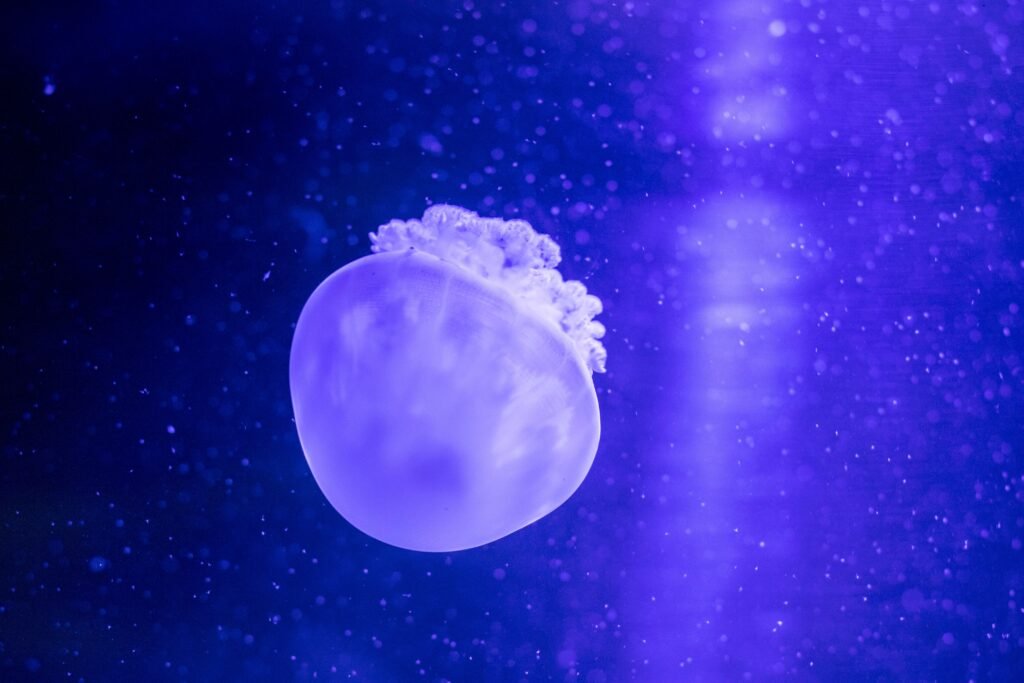
Image: a glowing jellyfish drifting in deep blue water, photographed by Matea Gvozdenović via Pexels.