Bioluminescence in the Ocean: How and Why the Sea Glows
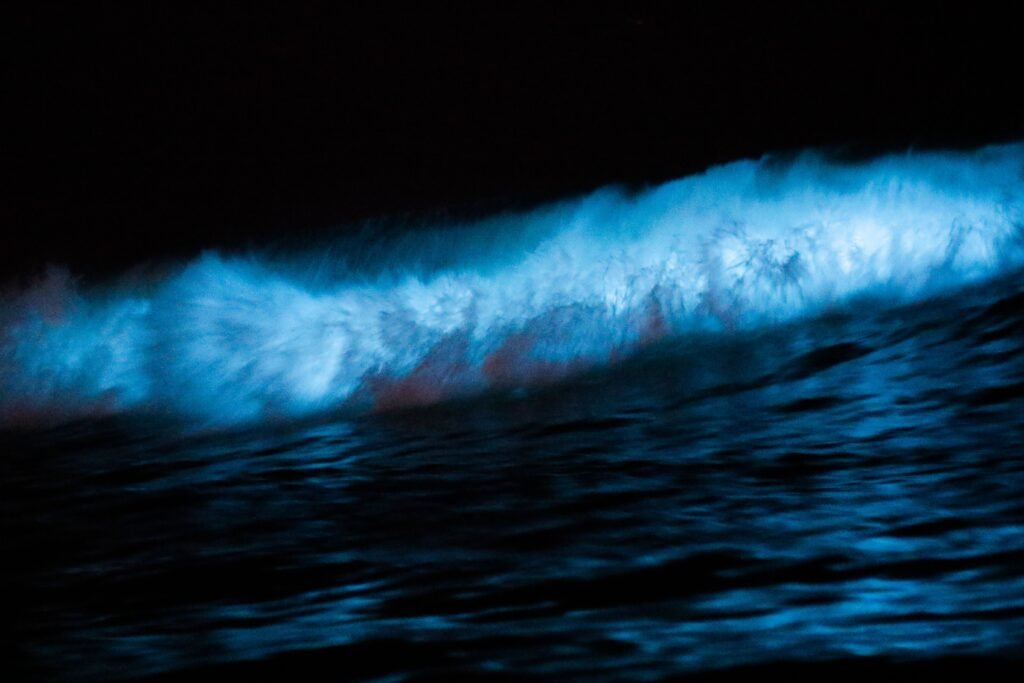
On certain nights, in certain bays around the world, the sea catches fire. Every wave that breaks glows electric blue. Footsteps on wet sand leave glowing prints. A swimmer's stroke trails light like a comet's tail. This is bioluminescence in the ocean, one of nature's most startling spectacles, and it is far more than a pretty trick. From the sunlit shallows to the deepest trenches, living light is one of the ocean's main languages, used for hunting, hiding, warning, and wooing.
Scientists now believe bioluminescence has evolved independently more than 40 times across the tree of life, and that the overwhelming majority of light-making animals live in the sea. To understand the glowing ocean, you have to start with the chemistry, meet the creatures that wield it, and learn where you can see it yourself.
What Is Bioluminescence? The Chemistry of Living Light
Bioluminescence is simply light produced by a living organism through a chemical reaction. In almost every case, the recipe has two main ingredients: a light-emitting molecule called luciferin and an enzyme called luciferase that drives the reaction. When luciferin reacts with oxygen in the presence of luciferase, energy is released as visible light instead of heat. The result is "cold light": remarkably efficient, with nearly all of the reaction's energy converted directly into photons and almost none wasted as warmth.
Animals make or borrow these chemicals in different ways. Some manufacture luciferin themselves. Others host symbiotic glowing bacteria inside specialized light organs. Still others steal the chemistry by eating luminous prey. The light-emitting structures range from simple clusters of glowing cells to elaborate organs called photophores, complete with reflectors, lenses, color filters, and shutters of muscle that switch the light on and off like a lamp.
The same basic chemistry lights up a firefly on a summer evening. But while only a handful of land animals glow, the ocean is full of them. Researchers estimate that roughly three quarters of deep-sea animals can produce light, and NOAA Ocean Exploration reports that about 80 percent of animals living between 200 and 1,000 metres are bioluminescent. In much of the ocean, darkness is not the absence of light. It is a different lighting system altogether.
Why the Ocean Glows Blue
Ask why glowing waves look blue and the answer is physics. Water absorbs red, orange, and yellow wavelengths quickly, while blue light travels furthest through seawater. Evolution followed the physics: the most common color of marine bioluminescence is blue or blue-green, the exact wavelengths that carry best underwater.
This is no accident of chemistry alone. The precise color depends on the structure of the luciferin molecule and on accessory proteins that can shift the emitted wavelength. Over millions of years, natural selection tuned ocean light to the blue band because that is the light other ocean animals can actually see. A red glow in the deep sea would be nearly invisible, since red wavelengths barely penetrate and few deep-sea eyes detect them. A few crafty predators exploit exactly this: the black dragonfish produces red light that most of its prey cannot see, giving it a private searchlight in a blue world.
On the surface, the famous electric-blue glow of breaking waves comes from dinoflagellates flashing in blue for the same reason: blue is the color that shows.
The Glowing Plankton: Dinoflagellates and the "Sea Sparkle"
The most familiar face of bioluminescence in the ocean is also the smallest. Dinoflagellates are single-celled plankton, often invisible by day, that emit brief flashes of blue light when disturbed. A crashing wave, a paddle stroke, a fish darting past, or your own hand trailing through the water is enough to trigger millions of simultaneous flashes. A single liter of seawater can hold tens of thousands of these organisms, which is why the effect looks like the whole sea is glowing rather than individual cells.
One species, Noctiluca scintillans, is responsible for the most spectacular displays. Its common name, "sea sparkle," says everything. When Noctiluca blooms in huge numbers under calm, warm conditions, coastlines can glow for nights on end. Ireland's Marine Institute notes that these blooms need the right combination of calm seas and warm water, which is why the displays are seasonal and gloriously unpredictable.
Why does a single-celled organism flash at all? The leading idea is defense. A sudden burst of light may startle a grazing predator, like a copepod, into letting go. An even cleverer theory says the flash works as a burglar alarm: by lighting up, the dinoflagellate draws the attention of a larger predator to the smaller one attacking it, turning the hunter into the hunted. Either way, the flash is controlled by the plankton's internal clock. Dinoflagellates run on circadian rhythms and glow most strongly during their night phase, building up the necessary chemicals through the day.
Not all plankton blooms are friendly. Some dinoflagellate blooms are the toxic red tides that can poison shellfish and fish, a reminder that the same organisms behind the magic can also be dangerous in excess.
Deep-Sea Animals That Make Their Own Light
Below the reach of sunlight, bioluminescence stops being a spectacle and becomes survival equipment. Here are the main groups that carry their own lamps:
Anglerfish and viperfish. The female anglerfish dangles a glowing lure, the esca, in front of her toothy jaws. The light comes from symbiotic bacteria housed in the bulb. Viperfish use rows of photophores along their bellies and a flashing lure to draw prey within strike range in the midnight zone.
Lanternfish and bristlemouths. These abundant twilight zone fish wear constellations of photophores on their undersides. The lights break up the fish's silhouette against the faint glow filtering down from above, making them nearly invisible to predators lurking below. This camouflage trick is called counterillumination, and each lanternfish species carries its own distinct pattern of lights, which may also help them recognize mates in the dark.
Squid. Bioluminescence is remarkably common among squid: an estimated two thirds of all squid genera include glowing species. Photophores can appear almost anywhere on a squid's body, around the eyes, along the mantle, on the arms and tentacles, even on internal organs. The Hawaiian bobtail squid takes symbiosis furthest, farming glowing bacteria in a dedicated light organ and using the gentle downward glow to erase its shadow on moonlit nights.
Jellyfish. Many deep-sea jellies glow, and some weaponize it. The Atolla jellyfish, when attacked, produces a spinning pinwheel of blue light pulses that races around its bell. Biologists interpret this as a burglar alarm display, a scream of light meant to summon something bigger to eat the attacker. The crystal jelly, Aequorea victoria, glows green rather than blue, and its glow would end up changing medicine forever, as we will see below.
Crustaceans and worms. Deep-sea shrimp, krill, and copepods flash and squirt glowing clouds. Some bristle worms unfurl like glowing green fireworks. Even single-celled organisms beyond dinoflagellates get in on the act.
| Animal | How it uses bioluminescence |
|---|---|
| Anglerfish | Glowing lure (esca) attracts prey to its jaws |
| Lanternfish / bristlemouth | Belly photophores provide counterillumination camouflage |
| Hawaiian bobtail squid | Bacterial light organ erases its shadow from predators below |
| Atolla jellyfish | Spinning light display acts as a burglar alarm |
| Vampire squid | Ejects a cloud of glowing mucus to confuse attackers |
| Dinoflagellates | Flashes startle grazers or expose them to bigger predators |
How Sea Creatures Use Light to Survive
Step back and the patterns become clear. Ocean animals use living light for a small set of jobs, repeated across thousands of species.
Hunting. Lures are the most dramatic use. The anglerfish's glowing bait is only the famous example; siphonophores trail tentacles tipped with red glowing lures, and some sharks carry glowing patches hypothesized to attract prey. Light can also be a flashlight. Some deep-sea fish and squid shine light forward to spot prey, including the dragonfish with its invisible-to-others red beam.
Defense. The burglar alarm strategy appears again and again: when grabbed, flash brightly to attract the attacker's own predators. Others eject glowing decoys, like the vampire squid's luminous mucus cloud, or detach glowing body parts that keep twinkling while the animal escapes into the dark. Brittle stars and some worms sacrifice glowing arms this way.
Camouflage. Counterillumination is one of evolution's neatest tricks. By matching the brightness and color of the faint light from above with their own belly lights, midwater animals erase their silhouettes. It only works if the disguise is precise, so many species can tune their photophores to match changing surface light.
Communication. In a world without sunlight, light is language. Lanternfish species recognize each other by their unique photophore patterns. Firefly squid gather in huge spawning aggregations, flashing in synchrony. Male anglerfish may use species-specific glow patterns to find females of their own kind in the abyss.
Where to See Bioluminescence in the Wild
You do not need a submersible to witness bioluminescence in the ocean. The surface displays are the most accessible, and a few places on Earth glow with unusual reliability.
Mosquito Bay, Vieques, Puerto Rico. Often called the brightest bioluminescent bay in the world, Mosquito Bay holds staggering concentrations of dinoflagellates in its shallow, mangrove-fringed waters. The bay is fragile: after Hurricane Maria in 2017, it went dark for seven months before the plankton recovered. Kayak tours here let visitors trail light with every paddle stroke.
The Maldives. Vaadhoo Island became famous for its "Sea of Stars," where glowing plankton wash up on the beach and mirror the night sky. The displays are seasonal and depend on plankton blooms, but when they arrive, the photographs look unreal.
Luminous Lagoon, Jamaica. One of the few places where the glow continues nearly year-round, thanks to a rare combination of fresh and salt water mixing in the lagoon.
Elsewhere. Bioluminescent bays also glow in the Cayman Islands, St. Croix, Vietnam's Halong Bay, and Australia's Jervis Bay. Along the California coast, seasonal red tides of dinoflagellates have set entire surf breaks glowing blue in recent years, drawing nighttime crowds to beaches from San Diego to Los Angeles. Even the coast near Karachi and Gwadar occasionally reports glowing waves when plankton blooms drift in, though sightings are unpredictable.
If you go, remember the etiquette: the organisms are delicate. Avoid stirring up sediment, skip chemical sunscreens before swimming, and choose tour operators that limit light pollution and protect the mangroves that shelter these bays.
Milky Seas: When the Whole Ocean Glows
Dinoflagellate sparkles are not the ocean's largest light show. Sailors have reported "milky seas" for centuries: vast stretches of ocean, sometimes covering thousands of square kilometres, glowing a steady white-green for nights on end. Unlike the flashing of plankton, the milky sea glow is continuous, bright enough to be seen by satellites orbiting hundreds of kilometres above.
Scientists now attribute milky seas to colonies of luminous bacteria, principally Vibrio harveyi, blooming in astronomical numbers. Satellite sensors have confirmed multiple events in the northwestern Indian Ocean, off the Horn of Africa and near Socotra, making this phenomenon a neighbor of South Asian waters. Research vessels that have sailed into a milky sea describe the water glowing from horizon to horizon, with the ship's wake trailing darkness instead of light. How trillions of bacteria synchronize their glow across such distances remains an open question, and one of the loveliest mysteries in marine science.
From Glowing Jellyfish to Medicine: The GFP Story
The most important glow in the ocean may be the one that left it. In the 1960s, researcher Osamu Shimomura began studying the crystal jellyfish, Aequorea victoria, off the coast of Washington State, curious about its green glow. He isolated a protein responsible for the color: green fluorescent protein, or GFP. Decades later, Martin Chalfie and Roger Tsien turned GFP into a revolutionary tool, a molecular lantern that scientists attach to proteins, cells, and genes to watch living processes unfold in real time.
Today GFP and its engineered cousins light up cancer research, brain mapping, and developmental biology in laboratories worldwide. The three scientists shared the 2008 Nobel Prize in Chemistry for the discovery and development of GFP. It remains the loveliest example of why exploring the ocean matters: a glowing jellyfish, studied out of pure curiosity, became one of the most useful tools in modern medicine.
Beyond the Sea: Fireflies, Glowworms, and Fungi
The ocean dominates the story, but bioluminescence exists on land too, and the comparison is instructive. Fireflies use the same luciferin-luciferase chemistry as marine animals, flashing in species-specific patterns to attract mates on summer nights. Their light is usually yellow-green rather than blue, tuned to the air instead of water.
New Zealand's famous glowworm caves hold the larvae of fungus gnats, which dangle sticky threads lit by their own glowing bodies to lure flying insects, an underground mirror of the anglerfish's strategy. Certain fungi, including the ghost fungus of Australia and the jack-o'-lantern mushroom, glow faintly green from their gills, possibly to attract insects that spread their spores at night.
Land examples are rare enough to count on your fingers. In the sea they number in the thousands. That contrast tells you something fundamental: bioluminescence is, at heart, an ocean invention, perfected in the dark over hundreds of millions of years before a few lineages carried it ashore.
Frequently Asked Questions
What causes bioluminescence in the ocean? A chemical reaction between a molecule called luciferin and an enzyme called luciferase, using oxygen, releases energy as visible light. In surface waters the glow usually comes from dinoflagellate plankton flashing when disturbed; in the deep sea it comes from fish, squid, jellyfish, and crustaceans making their own light.
Is bioluminescence harmful to humans? The light itself is harmless. However, some dinoflagellate blooms are toxic red tides, so glowing water during a known harmful algal bloom should be admired from a distance rather than swum in. Check local advisories.
Why is bioluminescence usually blue? Blue light travels furthest through seawater, so evolution tuned most marine glow to blue or blue-green wavelengths, the colors other ocean animals see best.
When is the best time to see bioluminescence? On dark, moonless nights, typically in warmer months when plankton blooms peak. The displays are unpredictable, depending on plankton concentrations, water temperature, and recent weather.
Do all jellyfish glow? No. Many deep-sea jellyfish are bioluminescent, but plenty of shallow-water species are not. The famous glowing ones include the crystal jelly and the Atolla jellyfish of the deep sea.
Bioluminescence in the ocean is a reminder that the sea is never truly dark. From a single plankton cell flashing in a wave to a dragonfish hunting with invisible red light a kilometre down, living light shapes how ocean animals eat, hide, and find each other. And on the right night, in the right bay, it lets us watch. It is a language written in photons, and we are only beginning to read it.
Image: bioluminescent waves crashing at night, photographed by Noah Munivez via Pexels.