Ocean Sunfish (Mola Mola) Facts: The Giant With No Tail
Imagine a fish the size of a small car, shaped like a giant floating head, with no real tail, a mouth it cannot fully close, and skin like sandpaper. That is the ocean sunfish, Mola mola, one of the strangest animals swimming in the open sea. It looks unfinished, as if evolution sketched a fish and forgot the back half. Yet this oddball is a master of the pelagic world: a deep-diving, jellyfish-eating giant that produces more eggs than any other vertebrate on Earth.
Here are the essential ocean sunfish facts, from the real weight record to the mystery of why these giants spend so much time sunbathing at the surface.
What Exactly Is an Ocean Sunfish?
The ocean sunfish, also called the common mola, is a member of the family Molidae, a small group of open-ocean fishes with only five living species. Its scientific name, Mola mola, comes from the Latin word for millstone, which the Swedish taxonomist Carl Linnaeus thought the fish's round, flattened body resembled when he named it in 1758.
Taxonomists place molas in the order Tetraodontiformes, which makes them relatives of pufferfish, triggerfish, and boxfish. That explains a lot: like pufferfish, sunfish have tough skin, small mouths, and teeth fused into a beak. Somewhere in their evolutionary past, their ancestors left the reefs for the open ocean, and growing enormous turned out to be a winning strategy.
Ocean sunfish live in tropical and temperate waters around the world, from the Atlantic to the Pacific to the Indian Ocean. They are true pelagic wanderers, at home in the open sea from near the surface down to nearly 500 metres. Despite their size, much about them remains poorly understood, including their mating behavior, spawning grounds, and migration routes. They are solitary by nature but gather in small groups at cleaning stations and, occasionally, in larger numbers that still surprise researchers.
How Big Do Ocean Sunfish Get? The Real Weight Record
The ocean sunfish is routinely called the heaviest bony fish in the world, and the family deserves the title, though the details recently changed. For years the record was credited to Mola mola itself. Genetic and anatomical work has since shown that the true giants belong to a close relative, the giant sunfish, Mola alexandrini, also known as the bump-head sunfish.
Here is where the numbers stand, based on verified specimens:
- Mola mola (common ocean sunfish): reaches about 3.3 metres (nearly 11 feet) and up to roughly 1,900 kg (4,000 pounds). Adults typically weigh between 250 and 1,000 kg.
- Mola alexandrini (giant sunfish): reaches about 3.32 metres and 2,300 kg, and holds the all-time record.
- The record holder: in December 2021, a dead giant sunfish found floating off Faial Island in the Azores, Portugal, was hauled ashore with a forklift and weighed at 2,744 kg (6,050 pounds), with a body length of 3.59 metres. It is the heaviest bony fish ever actually measured, beating the previous verified record of 2,300 kg from a specimen caught off Japan in 1996.
To put that in perspective, 2,744 kg is roughly the weight of a large car, or about 40 adult humans. And sharks and rays can grow heavier, but they are cartilaginous fish, built on cartilage rather than bone, so they compete in a different category.
Females grow larger than males in these species, and researchers note that the very largest individuals on record have all been female.
The Fish With Half a Body: Anatomy of a Mola
The sunfish's weirdest feature is the one it is missing. It has no true tail fin. Instead, its body ends abruptly behind the tall dorsal and anal fins in a thick, rounded rudder called the clavus. The clavus forms as the young fish grows: the back fin it is born with folds into itself rather than developing normally, creating the lumpy steering paddle adults carry.
Locomotion comes from the two great vertical fins. The dorsal and anal fins beat together from side to side like wings, sculling the fish through the water with surprising grace. Sunfish can make rapid turns and swim independently of currents, and despite their clumsy reputation they are active swimmers, not drifters.
Other anatomical oddities pile up:
- Beak-like mouth. Their teeth are fused into a parrot-like beak, and the small mouth cannot fully close. To eat, a sunfish sucks food in and pushes it out repeatedly, grinding it into manageable pieces.
- Armored skin. The body is covered in thick, rough, rubbery skin, sometimes several centimetres of tough collagen, with small denticles. There are no scales in the usual sense.
- No swim bladder. Adult sunfish lack the gas-filled organ most bony fish use for buoyancy, one less thing to fail under pressure during deep dives.
- Skeleton. Much of the skeleton is cartilage-like rather than hard bone, which keeps the giant frame lighter than it looks.
- Coloration. Grey, brown, or silvery, often with mottled blotches or spots. Some individuals have striking patterns that researchers use to tell them apart.
The overall effect is a fish that looks like a head with fins, which is why divers sometimes describe meeting one as encountering a swimming head or a gigantic pancake.
What Do Ocean Sunfish Eat?
For a two-ton animal, the ocean sunfish eats remarkably low-calorie food. Its primary prey is jellyfish and other gelatinous plankton, especially salps. Jellyfish are about 95 percent water and famously poor in energy, which raises an obvious question: how does a giant grow on such thin soup?
The answer is volume. Sunfish eat constantly and in enormous quantities, swimming through jellyfish blooms and vacuuming them up. Their diet is broader than the old "jellyfish specialist" label suggests: studies have found small fish, fish larvae, squid, crustaceans, molluscs, and zooplankton in sunfish stomachs. They are generalist predators of the open water column, taking what the drift provides.
They are well equipped for the menu. Thick, mucus-coated lips and a tough digestive tract protect them from jellyfish stings, and the beak nips and tears gelatinous prey into pieces. To find enough food, sunfish dive deep, descending several hundred metres into cold water to hunt, then return to the sunlit surface to warm up. Satellite tagging has tracked individuals moving between the surface and depths approaching 500 metres in a single day.
This diet gives sunfish an underappreciated ecological role. By consuming vast quantities of jellyfish, they may help keep jellyfish blooms in check, blooms that can smother fish larvae, clog fishing nets, and sting swimmers.
Recent stomach-content and DNA studies have only strengthened the generalist picture. Individual sunfish switch menus with the seasons and the region, taking whatever the local water column offers, from tiny crustaceans in one ocean to dense jellyfish aggregations in another. Far from being picky, the ocean sunfish is an opportunist on a grand scale, and its appetite connects it to nearly every level of the open-ocean food web.
The 300-Million-Egg Mystery: Reproduction
Here is the statistic that stops people mid-sentence: a single female ocean sunfish can release some 300 million eggs at once, more than any other known vertebrate. The eggs are tiny, and the newborn fry are just a few millimetres long, meaning a sunfish grows in mass by tens of millions of times between hatching and adulthood, one of the most extreme growth trajectories in the animal kingdom.
Almost everything else about sunfish reproduction is mysterious. Spawning has rarely been observed. Scientists believe fertilization happens externally, with males and females releasing sperm and eggs into the water in broadcast spawning events, but the locations and seasons remain largely unknown. The fry look nothing like adults: they are spiny, puffy little balls that resemble tiny pufferfish, their close relatives. As they mature, they lose the spines and the tail transforms into the clavus.
The strategy is clear even if the details are not: produce an astronomical number of offspring and invest nothing in raising them. Nearly all will be eaten. The survivors grow into giants few predators dare challenge.
Sunbathing Giants: Basking, Parasites, and Breaching
The "sunfish" name comes from the animal's most photographed habit: lying on its side at the surface, basking in the sunshine. For years this looked like laziness. Researchers now read it as maintenance.
Sunfish skin hosts more than 40 species of parasites, an extraordinary load. Basking serves as a cleaning session. At the surface, sunfish invite small cleaner fish and even seabirds to pick parasites from their skin. The warmth and ultraviolet light may also help kill skin parasites directly. Sunfish are known to breach, hurling their multi-ton bodies clear of the water and landing with a tremendous splash, possibly to dislodge stubborn parasites.
They are also surprisingly social at cleaning stations. In places like Bali's Nusa Penida, sunfish rise from the deep to hover near reefs while bannerfish and angelfish swarm over them, picking parasites from skin and gills. In October 2026, a divemaster in Bali filmed six ocean sunfish schooling together past a reef, a rare sight of these usually solitary giants moving as a group.
Predators of adult sunfish are few but formidable: sea lions, orcas, and large sharks all take them. The thick skin and sheer bulk deter most attackers, but a determined orca or white shark is more than a match.
Meet the Whole Family: Five Species of Mola
The family Molidae holds five living species in three genera. Here is the lineup:
| Species | Common name | Maximum size | Notes |
|---|---|---|---|
| Mola mola | Ocean sunfish / common mola | ~3.3 m, ~1,900 kg | The classic sunfish of temperate and tropical seas worldwide |
| Mola alexandrini | Giant / bump-head sunfish | ~3.3 m, ~2,300 kg (record 2,744 kg) | The true heaviest bony fish; adults develop a head bump |
| Mola tecta | Hoodwinker sunfish | ~2.4 m | Discovered in 2017, the first new sunfish species in over 130 years |
| Masturus lanceolatus | Sharptail mola | ~3.4 m | Named for the pointed projection on its clavus |
| Ranzania laevis | Slender mola | ~1 m | The small, fast, torpedo-shaped member of the family |
The hoodwinker sunfish deserves a special mention. Described by researcher Marianne Nyegaard in 2017, it had been hiding in plain sight for over a century, misidentified in museum collections and beach strandings. Genetic analysis finally proved it was a separate species, thought to roam the temperate Southern Hemisphere. It was the first new species in the genus Mola identified in more than 130 years, a reminder of how much we still have to learn about even the largest animals in the sea.
Where to See an Ocean Sunfish in the Wild
For divers, a mola encounter is a bucket-list event, and a few places on Earth offer realistic odds. The most famous is Nusa Penida, off Bali, Indonesia, where ocean sunfish rise from the deep to visit cleaning stations between roughly July and October, when cold upwellings draw them shallower. Dive sites like Crystal Bay are known worldwide for mola sightings, and the October 2026 schooling footage was filmed in these very waters.
Other reliable spots include the Mediterranean Sea, where sunfish bask at the surface in summer; the coast of California, particularly around San Diego, where they follow jellyfish blooms; and the waters off South Africa during the sardine run, when the whole food web is on the move. Sunfish are also spotted regularly off Portugal and in the Galapagos.
If you are lucky enough to meet one, the etiquette is simple: keep your distance, never chase, and let the animal come to you. Sunfish are curious and may approach divers on their own. Touching is off limits everywhere: their skin is protected by a mucus layer, and contact stresses the animal.
Are Ocean Sunfish Endangered?
The ocean sunfish (Mola mola) is listed as Vulnerable on the IUCN Red List, with a decreasing population trend. The giants face no shortage of threats, nearly all of them human.
Bycatch. The single biggest danger is entanglement in drift gillnets and other fishing gear. Sunfish are frequently caught accidentally, and their slow reproductive maturity means populations recover slowly from losses.
Plastic. A sunfish vacuuming up jellyfish cannot easily distinguish a drifting plastic bag from its prey. Ingested plastic can block the digestive tract and kill.
Boat strikes. Basking sunfish lie motionless at the surface, directly in the path of boat traffic, and collisions injure and kill them.
Consumption. Sunfish are eaten as a delicacy in parts of Japan, Korea, and Taiwan. In the European Union, regulations ban the sale of fishery products from the Molidae family.
Conservationists argue that basic biology is still missing: without reliable population estimates, migration maps, or spawning data, protecting sunfish is difficult. Satellite tagging programs and citizen sighting networks are slowly filling the gaps. What is clear is that an animal this slow-growing, this late to mature, and this heavily exposed to fishing gear needs active protection, not just admiration.
Frequently Asked Questions
How big do ocean sunfish get? Common ocean sunfish (Mola mola) reach about 3.3 metres and 1,900 kg. The heaviest bony fish ever measured was a giant sunfish (Mola alexandrini) weighing 2,744 kg, found off the Azores in December 2021.
What do ocean sunfish eat? Mostly jellyfish and salps, plus small fish, squid, crustaceans, and zooplankton. They eat huge quantities to fuel their bulk on such low-calorie prey.
Are ocean sunfish dangerous to humans? No. They are docile and pose no threat to swimmers or divers, though boaters should give basking giants plenty of space to avoid collisions.
Why do ocean sunfish bask at the surface? To warm up after deep, cold dives and to get cleaned: they invite cleaner fish and seabirds to remove their heavy parasite loads, and may use sunlight to kill skin parasites.
How many eggs does an ocean sunfish lay? A single female can release around 300 million eggs at once, the highest fecundity of any known vertebrate.
Can you eat ocean sunfish? They are eaten in Japan, Korea, and Taiwan, but sale of Molidae products is banned in the European Union, and the species is IUCN-listed as Vulnerable.
How long do ocean sunfish live? Reliable figures are scarce, which tells its own story about how little we know. In captivity they have lived up to around 10 years, but wild lifespans are unconfirmed and likely longer.
Do ocean sunfish have predators? Adults are too big for most hunters, but sea lions, orcas, and large sharks all prey on them. Juveniles, which start life only millimetres long, are eaten by a wide range of predators.
The ocean sunfish is proof that evolution has a sense of humor and a talent for extremes: half a fish, two tons of it, eating jellyfish in the dark and sunbathing at noon. The more we learn about Mola mola and its relatives, the less they look like accidents and the more they look like exactly what the open ocean ordered.
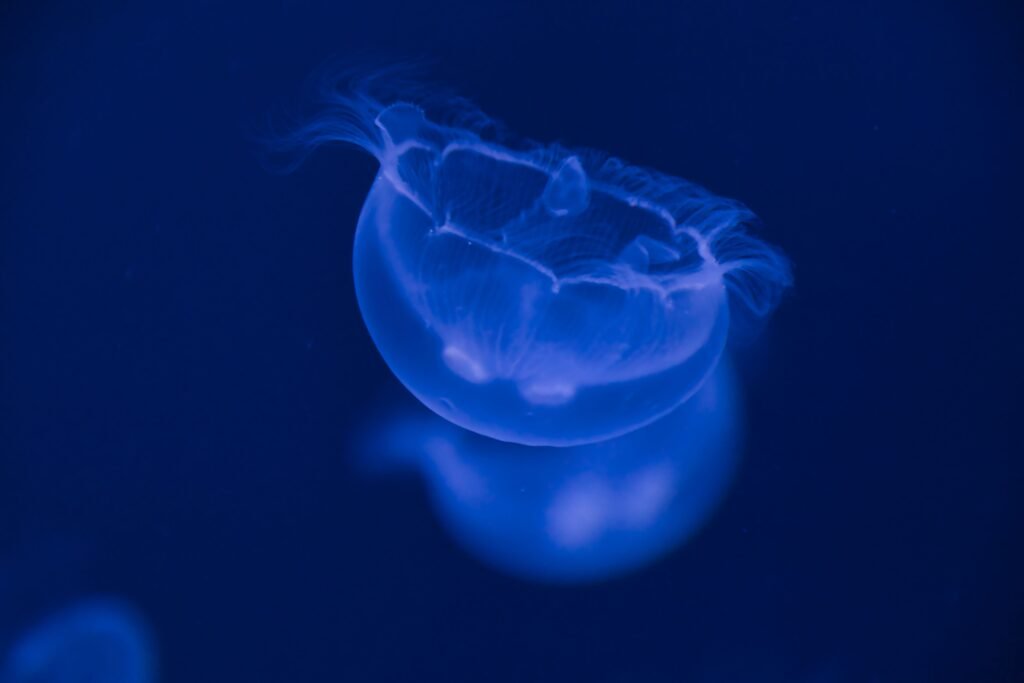
Image: a blue jellyfish, the ocean sunfish's favorite food, photographed by Philipp Kappler via Pexels.