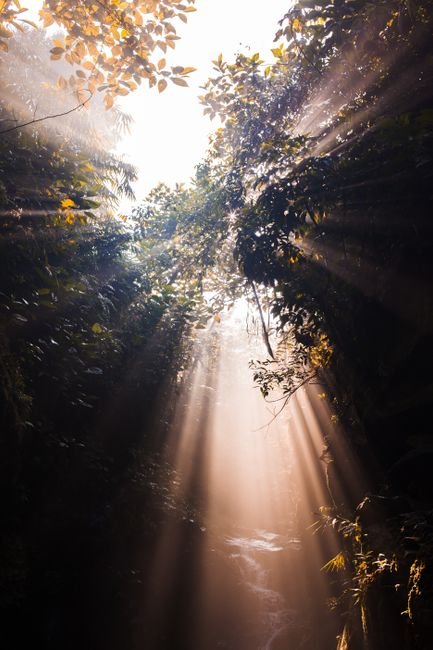
Rainforest Layers Explained: From Canopy to Forest Floor
Stand at the edge of a tropical rainforest and look up. What seems like a single wall of green is really a vertical city, stacked in four distinct neighborhoods. Botanists call these the emergent layer, the canopy, the understory, and the forest floor. Each has its own climate, its own cast of plants and animals, and its own rules for survival. Understanding the rainforest layers is the key to understanding why these forests hold more life than any other habitat on land.
The Four Layers at a Glance
Before we climb, here is the whole structure in one view, from the treetops down to the soil.
| Layer | Height above ground | Light reaching it | Signature residents |
|---|---|---|---|
| Emergent layer | 45 to 75 m (150 to 250 ft) | Full, fierce sunlight | Harpy eagles, macaws, fruit bats, butterflies |
| Canopy | 20 to 45 m (60 to 150 ft) | Strong, filtered by leaves | Monkeys, sloths, toucans, tree frogs, orchids |
| Understory | 5 to 20 m (15 to 65 ft) | Dim, only a few percent of canopy light | Jaguars, snakes, geckos, tree seedlings, palms |
| Forest floor | 0 to 5 m | Around 1 to 3 percent of sunlight | Termites, fungi, ants, anteaters, tapirs |
Heights vary from forest to forest. In the Amazon, emergent giants like the kapok can push past 60 metres, while in parts of Southeast Asia a few species stretch even taller. But the four-layer pattern itself shows up again and again, in every tropical rainforest on Earth.
Why Rainforests Grow in Layers
Layers do not form by accident. They are the result of the fiercest competition in nature: the race for sunlight.
Tropical rainforests sit near the equator, where warmth and rain are nearly constant all year. Forests here receive between 160 and 400 inches (406 to 1,016 cm) of rain annually, with no real dry season, and temperatures rarely dip below 60°F (16°C). With water and warmth in endless supply, the one resource plants must fight over is light.
So trees grow tall, fast. The winners spread their crowns wide at the top and knit them into a nearly unbroken roof: the canopy. That roof intercepts most of the sunlight, and everything beneath it must make do with the leftovers. Botanists estimate that as little as 1 percent of the light striking the top of the forest reaches the lowest levels. This vertical gradient of light is what carves the forest into layers. Where you live in the stack decides how much sun, wind, and rain you get, and evolution has shaped a different community for each band.
The system is dynamic, not fixed. When an old giant falls, it tears a hole in the canopy, and a shaft of light pours through to the gloom below. Seedlings on the forest floor, some of which have waited years in the shade, suddenly sprint upward in a race to claim the gap. Most will lose. One or two will win and become the canopy of the future. This cycle of fall and regrowth means the layers are constantly rebuilding themselves.
The Emergent Layer: Life Above the Canopy
A few trees refuse to stop at the canopy. They punch through it and keep climbing, their crowns rising 15 to 30 metres above the roof of the forest. These are the emergents, the skyscrapers of the rainforest.
Life up here is extreme. Emergent crowns take the full force of tropical sun, drying winds, and pounding rainstorms. Their leaves tend to be small, thick, and waxy, built to shed water and survive the glare. Kapok, Brazil nut, and mahogany trees are classic emergents of the Amazon, while Southeast Asian forests have their own towering dipterocarps.
Few animals live here full time, but the emergent layer is a highway for the strong fliers. Harpy eagles, among the most powerful raptors on Earth, nest in emergent crowns and scan the canopy below for monkeys and sloths. Macaws and toucans commute across the open air between fruiting trees. Fruit bats stream out at dusk in clouds. And on still mornings, clouds of butterflies gather minerals at sunlit treetops. For these travelers, the emergents are both lookout towers and landing pads.
The Canopy: The Rainforest's Crowded Rooftop
Drop just below the emergents and you enter the busiest neighborhood in the forest: the canopy. This is the continuous roof formed by the interlocking crowns of mature trees, roughly 20 to 45 metres above the ground. If the rainforest is a city, the canopy is downtown.
This single layer holds the majority of the forest's life. Researchers working with canopy walkways and cranes have found that canopy plants produce around 90 percent of all the forest's leaves, fruit, and seeds. Flowers bloom here, fruits ripen here, and so the animals follow the food. Monkeys swing through in troops, sloths hang motionless for hours, toucans and parrots flash between branches, and red-eyed tree frogs hunt insects on the leaves at night. Ants, the most abundant animals in the rainforest, march along branches in endless columns.
The canopy is also a garden growing on top of a garden. Because light is plentiful but soil is far below, thousands of plant species have learned to live on the trees themselves. These are the epiphytes: orchids, ferns, mosses, and bromeliads that anchor to bark and gather water from rain and mist. Some bromeliads hold tiny pools in their leaf cups, creating miniature ponds that house entire communities of frogs and insects high above the ground. Thick woody vines called lianas, some more than 8 inches (20 cm) across, climb from the forest floor all the way to the canopy, then sprawl from tree to tree, stitching the crowns together and making the roof even denser.
For a long time, scientists could barely study this layer. Everything we knew came from the ground looking up. That changed when researchers began building canopy walkways and using construction cranes to work among the treetops. What they found was staggering: the canopy holds species found nowhere else, many still unnamed. Some biologists now believe the majority of rainforest species live their whole lives without ever touching the ground.
The Understory: The Dim Middle World
Beneath the canopy, the light drops off a cliff. The understory, the band of smaller trees, shrubs, and young saplings between about 5 and 20 metres up, receives only a small fraction of the light available above. Measurements suggest it gets roughly 60 percent less light and half the wind of the canopy, and some estimates put its light at just 2 to 5 percent of what strikes the treetops. It is warm, still, and humid, a green twilight world.
Plants here are specialists in patience. Palms, philodendrons, and heliconias grow broad leaves to catch every stray sunbeam. Thousands of tree seedlings wait in the gloom, growing almost imperceptibly, sometimes for years, until a canopy gap opens and releases them. Their strategy is simple: be ready when luck arrives.
Animals of the understory tend to be secretive. This is the hunting ground of jaguars and ocelots, which use the dim light and dense stems as cover. Snakes, including boa constrictors and pit vipers, coil on branches at face height. Geckos, tree frogs, and countless insects fill the middle air. Bats roost in hollow trunks. Because the understory is sheltered from the worst of the sun and storms, it is also a nursery: many canopy birds build their nests here, and young animals learn to climb in its tangled safety before venturing higher.
The Forest Floor: Darkness, Decay, and Renewal
At the bottom of the stack lies the forest floor, the darkest and most humid of all the rainforest layers. Only around 1 to 3 percent of the sunlight that hits the top of the forest makes it down here. Walk the floor of an untouched rainforest at noon and you may need a moment for your eyes to adjust.
Few plants can photosynthesize in such gloom, so the ground is surprisingly open. What covers it is not grass but a deep carpet of fallen leaves, branches, fruits, and dead wood: the litter of the layers above. In the hot, wet air, this litter rots with astonishing speed. Fungi spread their threads through it, termites and millipedes shred it, bacteria finish the job, and the nutrients locked inside flow back into the soil within weeks or months. Nothing is wasted. The forest floor is the rainforest's recycling plant, and its efficiency is the reason the whole towering structure can stand on such poor soil.
Because tropical downpours wash nutrients out of the ground almost as fast as they arrive, rainforest soils are famously thin and infertile. Trees cope by keeping their roots shallow and spreading them wide, like the guy ropes of a tent. Many grow buttress roots, great flaring fins of wood that brace the trunk, while others send out stilt roots from several feet up the stem. These adaptations trade depth for spread, gripping the thin fertile skin of the forest floor.
Large animals rule this layer. Giant anteaters shuffle through the leaf litter, tapirs browse fallen fruit, wild pigs travel in herds, and gorillas, orangutans, and elephants move through the forests of Africa and Asia. Leaf-cutter ants march in columns, carrying green fragments like tiny sails back to underground fungus gardens. And through it all, the decomposers keep the great cycle turning, returning every fallen leaf to the trees above.
How the Layers Work Together
The four layers are not separate worlds. They are organs of one body, joined by constant flows of energy, water, and life.
Nutrients fall downward: leaves, fruit, and dead insects rain from the canopy to feed the decomposers of the floor. Water and minerals climb back up through roots and trunks. Animals carry the traffic between floors. Toucans eat fruit in the canopy and drop the seeds onto the forest floor, planting the next generation. Monkeys and bats pollinate flowers across layers. Lianas act as ladders and bridges, letting ants, snakes, and small mammals travel vertically without ever touching the ground.
Some plants cheat the whole system. Strangler figs begin life as epiphytes high in the canopy, then send roots snaking down the host tree's trunk until they reach the soil. The roots thicken into a lattice that slowly squeezes the host to death, and when the host rots away, the fig stands on its own woven trunk, a tree built from the top down.
Even death is collaborative. When a giant falls, it may crush everything beneath it, but its corpse becomes a nursery log: seedlings sprout along its length, fungi bloom, and insects feast. The gap it leaves in the canopy lets light flood down, and the race for the opening begins again. Disturbance, in the right measure, is what keeps the layered forest young and diverse.
Why the Layers Matter
A rainforest is not just a collection of trees. It is a three-dimensional habitat, and its biodiversity is packed into its vertical structure. Tropical rainforests cover only about 6 percent of Earth's land surface, yet they hold more than half of the planet's plant and animal species. Much of that richness exists because the layers multiply the available living space: four stacked habitats, each with its own climate, where one flat forest could only offer one.
This is also why rainforest destruction is so devastating. Clearing a forest does not just remove trees. It collapses the entire vertical architecture, the dim understory nurseries, the canopy highways, the recycling engine of the floor, in a single stroke. Species that live only in the canopy, and there are many, cannot survive on the ground. When the structure falls, they fall with it.
The layered design is not unique to the Amazon or Congo. South Asia has its own great rainforests: the tropical evergreen forests of the Western Ghats in India, which geographers describe as well stratified, with trees reaching 60 metres or more beneath a dense canopy. Pakistan's forests are different but no less structured. The moist temperate forests of the Himalayan foothills rise in their own bands of oak, pine, and deodar, while the mangroves of the Indus Delta build layered canopies over tidal mud, their stilt roots echoing the buttress roots of the tropics. Wherever trees compete for light, layers emerge, and wherever layers emerge, life multiplies.
Rainforests are often called the world's pharmacy for the medicines their plants have given us, and the home of Indigenous peoples whose knowledge of these layered forests runs deeper than any textbook. Protecting the layers means protecting all of that at once.
Frequently Asked Questions
How many layers does a rainforest have?
Most scientists describe four main layers in a tropical rainforest: the emergent layer at the top, the canopy, the understory, and the forest floor. Some textbooks merge the emergents into the canopy and teach three layers, while a few add a fifth "shrub layer" between the understory and the floor. The four-layer model is the most widely used.
Which rainforest layer gets the most sunlight?
The emergent layer receives the most direct sunlight, since its treetops rise above everything else. The canopy gets strong light too, but its own leaves shade everything below. By the time sunlight filters through to the forest floor, only around 1 to 3 percent remains.
Which layer has the most animals?
The canopy holds the greatest share of rainforest animal life, because that is where most of the food grows. Canopy plants produce roughly 90 percent of the forest's leaves, fruit, and seeds, so monkeys, sloths, toucans, parrots, tree frogs, bats, and countless insects concentrate there. The forest floor has fewer species but includes the largest animals, such as jaguars, tapirs, and gorillas.
Why is the forest floor so dark?
The canopy above intercepts almost all incoming sunlight as its leaves photosynthesize. With each layer filtering out more light, the floor ends up in deep shade. This darkness limits plant growth on the ground but creates ideal conditions for decomposers like fungi, termites, and bacteria, which thrive in the warm, damp gloom.
Do temperate rainforests have layers too?
Yes, though they are less pronounced. Temperate rainforests, such as the old-growth forests of the Pacific Northwest, also develop a canopy, an understory, and a forest floor. Because their trees grow more slowly and their canopies are less dense, the light gradient is gentler and the layering is subtler than in the tropics.
A Forest in Four Stories
The next time you see a photograph of mist hanging over a rainforest, look at it vertically. The sunlit crowns of the emergents, the dense green roof of the canopy, the shadowed middle world of the understory, and the dark, breathing floor are not just scenery. They are four interlocking habitats, built by the competition for light and held together by the cycling of nutrients, each one making the others possible. The rainforest layers, explained simply, are nature's way of stacking four forests into the space of one, and filling every inch with life.