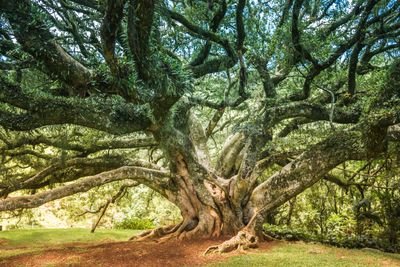
Oldest Trees in the World: Ancient Giants Explained
Some trees were already ancient when the pyramids were young. While most living things measure their lives in years or decades, a handful of trees have stood for millennia, watching empires rise and fall from the same patch of ground. This is the story of the oldest trees in the world: which ones hold the records, how scientists know their ages, why they live so long, and the threats that now face them.
What Is the Oldest Tree in the World?
The honest answer depends on what you mean by "tree." The oldest single tree with a confirmed age is Methuselah, a Great Basin bristlecone pine (Pinus longaeva) growing high in the White Mountains of eastern California. Ring counting dates it to about 4,858 years old, which means it sprouted around 2833 BC, centuries before the Great Pyramid of Giza was built and roughly two millennia before Rome was founded.
But older living things exist if you count organisms that are not single trees. In Utah, a quaking aspen colony called Pando may be tens of thousands of years old. In Sweden, a Norway spruce named Old Tjikko has been cloning itself from the same root system for roughly 9,500 years. And in Sri Lanka, a sacred fig planted in 288 BC is the oldest tree on Earth with a documented human planting date.
To keep things clear, this article separates the records into three categories: the oldest single trees, the oldest clonal colonies, and the oldest tree with a known birthday. Each tells a different story about survival.
How Scientists Date Ancient Trees
Before looking at the champions, it helps to understand how anyone can say a tree is 4,858 years old. The main tool is dendrochronology, the science of dating by tree rings, pioneered in the early twentieth century and applied to bristlecones by Edmund Schulman of the University of Arizona in the 1950s.
A tree in a seasonal climate typically adds one growth ring per year: light, fast-grown spring wood followed by darker, denser summer wood. In principle, counting rings from bark to center gives the tree's age. In practice, researchers use a hollow increment borer, a pencil-thin drill that extracts a core the width of a drinking straw without killing the tree. They then cross-date the ring pattern against overlapping patterns from older wood, living and dead, to build a continuous chronology. This cross-checking matters because trees sometimes skip a ring in a drought year or grow a false one, and the only way to catch those errors is to match patterns across many samples.
Not every ancient tree can be ring counted. Some, like baobabs, do not form reliable annual rings. Others, like Japan's Jomon Sugi, have hollow or rotted cores that make a complete count impossible. For these, scientists turn to radiocarbon dating, which measures the decay of carbon-14 in wood to estimate when it stopped growing. Radiocarbon gives ranges rather than exact birthdays, which is why some ancient trees carry age estimates spanning thousands of years.
The Oldest Single Trees: The Top Contenders
When researchers mean one tree, one trunk, one life, these are the oldest known individuals still standing:
| Tree | Species | Location | Estimated age |
|---|---|---|---|
| Methuselah | Great Basin bristlecone pine | White Mountains, California, USA | ~4,858 years |
| Gran Abuelo (Alerce Milenario) | Patagonian cypress | Alerce Costero National Park, Chile | ~3,600 years ring counted; possibly more |
| Black River bald cypress (BLK227) | Bald cypress | North Carolina, USA | ~2,624 years |
| Coast redwood (oldest known) | Coast redwood | Northern California, USA | ~2,200 years |
| Jomon Sugi | Japanese cedar (Cryptomeria) | Yakushima, Japan | 2,170 to 7,200 years |
| Sierra Nevada foxtail pine (SHP7) | Foxtail pine | California, USA | ~2,110 years |
| Jaya Sri Maha Bodhi | Sacred fig | Anuradhapura, Sri Lanka | ~2,314 years (planted 288 BC) |
Methuselah: the oldest confirmed tree
Methuselah grows between about 2,900 and 3,000 metres elevation in the Methuselah Grove of the Ancient Bristlecone Pine Forest, within the Inyo National Forest. It was named after the biblical patriarch who is said to have lived 969 years, the human symbol of longevity. Bristlecones up here endure a growing season of roughly 45 days, poor alkaline soils, and bitter cold, and they respond by growing almost impossibly slowly: a tree may add as little as an inch of girth in a century. The payoff is wood so dense and resinous that it resists rot, insects, and fire for millennia.
Methuselah's exact location is kept secret by the US Forest Service, which leaves the record holder unmarked among its neighbors. That anonymity is deliberate: visitors walk the 4.5-mile Methuselah Grove trail past trees of the same generation without being told which one holds the crown. The policy grew out of a hard lesson, which we will come to shortly.
Gran Abuelo: Chile's great-grandfather
Deep in the Alerce Costero National Park, about 800 kilometres south of Santiago, stands a Patagonian cypress (Fitzroya cupressoides) known as Gran Abuelo, the great-grandfather, or by its Mapuche name Lañilawal. It is roughly 28 metres tall with a trunk about four metres across, its bark draped in mosses and lichens. Ring counting confirms an age of around 3,600 years, making it one of the oldest known single trees on Earth.
In 2022, Chilean researcher Jonathan Barichivich and colleagues suggested the tree could be even older, over 5,000 years, based on statistical modeling of an incomplete core sample. That claim attracted global headlines but was never published in a peer-reviewed journal, and other scientists dispute it because it relies on modeled rather than counted rings. Until better evidence arrives, Gran Abuelo's confirmed age remains around 3,600 years, with a possible greater age unproven.
Jomon Sugi: Japan's mystery cedar
On the misty island of Yakushima, a UNESCO World Heritage site, grows Jomon Sugi, the oldest and largest Japanese cedar (Cryptomeria japonica) on the island. It stands about 25 metres tall with a trunk roughly five metres across. Because its core has rotted away, no one can count its rings, and estimates swing wildly from about 2,170 to 7,200 years. Named for Japan's prehistoric Jomon period, it was rediscovered in the 1960s and had escaped earlier logging mainly because of its irregular, twisted shape. The wide range of estimates makes Jomon Sugi a famous example of why radiocarbon alone cannot give ancient trees an exact birthday.
The Prometheus warning
No account of the oldest trees is complete without Prometheus, a bristlecone pine from Nevada that was cut down in 1964 during a research project. When its rings were counted afterward, it turned out to be around 4,900 years old, the oldest tree ever dated. Prometheus is no longer standing, but its loss taught the scientific world a permanent lesson: ancient trees are irreplaceable, and curiosity must never again cost one its life. That is a large part of why Methuselah's location stays secret today.
The Immortal Clones: Older Than Any Single Tree
Some organisms beat every single tree by refusing to be single trees. Clonal colonies grow new trunks from the same ancient root system, so the individual stems may be young while the organism itself is vastly older. Tree-ring dating cannot touch them, since the rings record only the stem, not the roots. Here are the most remarkable:
Pando, the trembling giant. In Utah's Fishlake National Forest, about 47,000 quaking aspen stems rise from one interconnected root system, covering roughly 106 acres. All are genetically identical, all male, all one organism whose name means "I spread" in Latin. Individual stems live only about 100 to 130 years before being replaced by new shoots from the roots. A 2024 genomic study estimated the colony's age at between 16,000 and 80,000 years based on mutation rates, meaning Pando may have germinated as glaciers retreated at the end of the last ice age. It is also among the heaviest known living organisms, weighing thousands of tons. Concerningly, aerial photographs suggest the colony has not expanded in decades, and heavy browsing by mule deer threatens the young shoots it needs to keep regenerating.
Old Tjikko. On Fulufjället mountain in Sweden's Dalarna province stands a modest Norway spruce, about five metres tall, named after the dog of its discoverer, geologist Leif Kullman. The visible trunk is only a few centuries old, but radiocarbon dating of the root system gives an age of about 9,560 years. For millennia the tree survived as a stunted, shrub-like krummholz form in the harsh subarctic climate, sprouting new trunks through layering, where branches pressed to the ground by snow take root. It began growing soon after the ice sheet retreated, and genetically it is the same individual today as it was then.
Jerupa Oak. In the hills near Crestmore Heights, California, a Palmer oak (Quercus palmeri) colony has been cloning itself for an estimated 13,000 years, making it one of the oldest known plant organisms in North America.
These clones raise a philosophical question that botanists genuinely debate: if no single part of Pando is more than a century old, is the organism 80,000 years old? Most scientists say yes, the genetic individual has persisted that long. But when people ask for the oldest tree, the convention is to give the oldest single trunk: Methuselah.
The Oldest Tree With a Birthday: Sri Lanka's Sacred Fig
The Jaya Sri Maha Bodhi in Anuradhapura, Sri Lanka, holds a record no other ancient tree can claim: a documented planting date. In 288 BC, King Devanampiya Tissa planted a sapling of a sacred fig (Ficus religiosa) that had been brought from Bodh Gaya in India by Sanghamitta Theri, the daughter of Emperor Ashoka. The sapling came from the very Bodhi tree under which the Buddha is said to have attained enlightenment.
That makes the tree more than 2,300 years old, and unlike every other ancient tree, its birthday comes from human records rather than science. It has survived storms, branch-breaking vandalism, and even a 1985 attack on the temple complex, tended continuously by generations of monks and pilgrims. For Buddhists it is one of the most sacred living objects on Earth, and for everyone else it is a reminder that a tree can be both a natural wonder and a cultural monument. It also gives BiosGraphic's South Asian readers one of the world's great ancient trees within the region.
Why Do Some Trees Live So Long?
Longevity in trees is not an accident. The oldest species share a set of traits that, taken together, let them shrug off centuries of drought, cold, fire, and disease:
Grow slowly in hard places. Bristlecones, alerces, and foxtail pines all live in marginal, stressful environments where almost nothing else thrives. Slow growth produces dense, tightly packed wood that resists decay. As dendrochronologist Peter Brown, keeper of the OldList database of ancient trees, has put it, the oldest trees tend to grow in very stressful environments, which makes them grow very, very slowly.
Invest in defense, not speed. The oldest trees produce resins, tannins, and dense heartwood that deter insects, fungi, and rot. A bristlecone's dead wood can stand for thousands of years without decaying, which is why the groves are full of gleaming, sculptural snags.
Keep only part of yourself alive. Bristlecones use what botanists call sectored architecture: at any time, only a thin ribbon of bark may be alive, connecting a few roots to a single tuft of needles. The rest of the tree is dead but standing. By abandoning most of its body, the tree concentrates its scarce resources on a small living fraction.
Clone instead of starting over. Pando, Old Tjikko, and the Jerupa Oak never bet everything on one trunk. When a stem dies, the root system sends up another, so the organism never has to survive the vulnerable seedling stage again.
Reproduce late or rarely. Many ancient trees put little energy into seeds, investing instead in maintenance. Pando is triploid, meaning its cells carry three sets of chromosomes, which hampers sexual reproduction entirely; it has committed fully to cloning.
Threats to the Ancient Ones
Trees that have survived five thousand years are now meeting threats that evolved in decades.
Climate change. Bristlecones live in a narrow band of cold, dry mountaintop. As temperatures rise, that band shifts upward, and on many peaks there is no higher ground. Bark beetles, once held back by cold winters, are moving upslope into forests that have no defenses against them.
Fire. Ancient groves evolved with particular fire regimes, and the hotter, more frequent fires of recent decades can kill trees that survived thousands of fire-free or low-intensity years. The giant sequoia groves of the Sierra Nevada, whose oldest members exceed 3,000 years, have seen unprecedented fire mortality in the 2020s.
Development and foot traffic. An ancient tree's root system is shallow and easily damaged by soil compaction from visitors. The secrecy around Methuselah exists because a single vandal with a saw could erase five thousand years in an afternoon, a fear rooted in the memory of Prometheus.
Browsing and regeneration failure. Pando's crisis is not that old stems die, they always have, but that young shoots are eaten by deer before they can replace them. A clonal colony that stops regenerating is a colony with a countdown.
Slow science, fast headlines. The disputed claim that Gran Abuelo is over 5,000 years old shows how easily an unverified estimate becomes "official" in news coverage. For a science magazine, the lesson is to distinguish counted rings from modeled guesses.
Can You Visit the Oldest Trees?
Yes, and the ancient groves are among the most moving places on Earth, as long as you go gently:
- Ancient Bristlecone Pine Forest, California. The Schulman Grove has a visitor center, interpretive talks in summer, and two trails: the short Discovery Walk and the 4.5-mile Methuselah Grove loop. The Patriarch Grove holds the world's largest bristlecone. Open roughly mid-May to November, weather permitting. You will not be told which tree is Methuselah, and that is the point.
- Alerce Costero National Park, Chile. A boardwalk trail leads to Gran Abuelo, about an hour's walk through younger alerce forest. Visits are regulated and require registration, with forest guards protecting the giant.
- Yakushima, Japan. Reaching Jomon Sugi takes a demanding ten-hour round-trip hike along old logging railways and mountain trails, with mountain huts for those who split the journey. The island's mossy forests inspired the landscapes of Princess Mononoke.
- Fishlake National Forest, Utah. Pando sits near Fish Lake on State Highway 25. Autumn is the finest time to visit, when the 47,000 genetically identical stems turn gold at once, the whole organism changing color in unison.
- Fulufjället National Park, Sweden. Old Tjikko is a modest hike from the park's visitor center, and the surrounding fell is one of Europe's great wilderness areas.
- Anuradhapura, Sri Lanka. The Jaya Sri Maha Bodhi is freely accessible within the sacred city, a UNESCO World Heritage site, and is best visited at dawn when pilgrims gather.
Wherever you go, the rules are simple: stay on marked trails, never carve or climb, and keep your distance from the roots. These trees were old before writing was invented. They deserve to outlast us.
Frequently Asked Questions
What is the oldest tree in the world?
The oldest confirmed single tree is Methuselah, a Great Basin bristlecone pine in California's White Mountains, at about 4,858 years old. Older living organisms exist, but they are clonal colonies rather than single trees.
How old is the oldest tree ever?
Prometheus, a bristlecone pine cut down in Nevada in 1964, was about 4,900 years old, the oldest tree ever dated. The oldest clonal organism, Utah's Pando aspen colony, may be between 16,000 and 80,000 years old.
How do scientists know how old a tree is?
Mostly through dendrochronology: extracting a thin core and counting annual growth rings, then cross-dating the pattern against other samples to catch missing or false rings. Trees that cannot be ring counted, such as baobabs or hollow ancient cedars, are dated with radiocarbon analysis.
Is Pando really one organism?
Yes. All 47,000 aspen stems in Utah's Fishlake National Forest are genetically identical shoots from a single massive root system. The individual trunks live about a century, but the organism may have persisted for tens of thousands of years.
Where is the oldest tree in Asia?
The oldest tree in Asia with a verified age is the Jaya Sri Maha Bodhi, a sacred fig in Anuradhapura, Sri Lanka, planted in 288 BC, making it over 2,300 years old. Japan's Jomon Sugi on Yakushima may be older, but its age cannot be precisely determined.
Can I see Methuselah?
You can walk the Methuselah Grove trail in California's Ancient Bristlecone Pine Forest, but the US Forest Service keeps the exact tree unmarked and its location secret to protect it from vandalism.