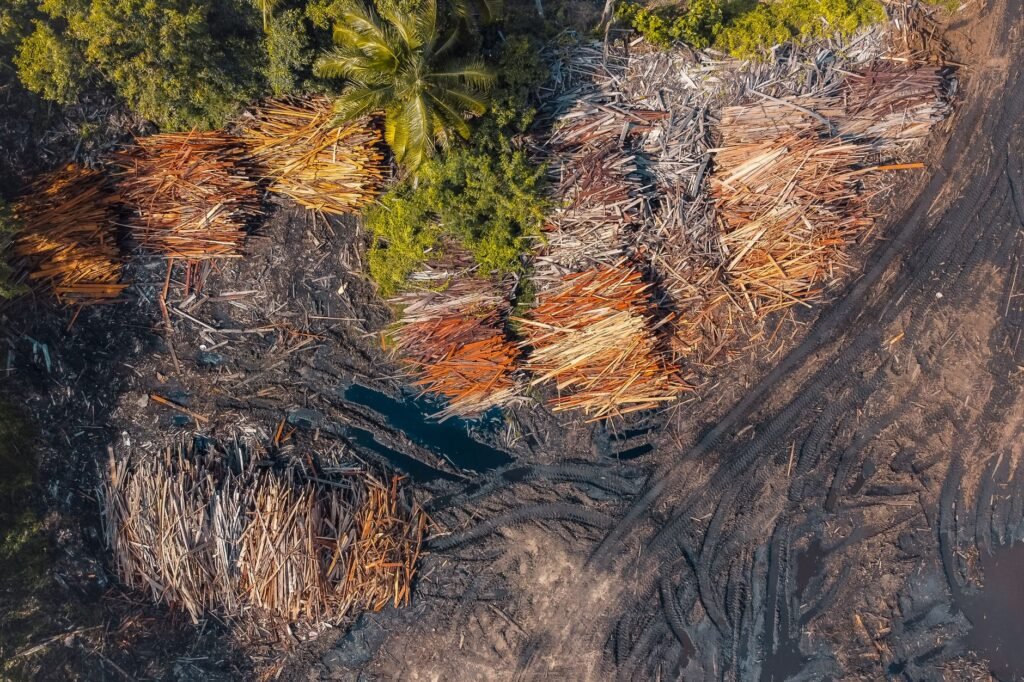
Causes of Deforestation: What Is Destroying Our Forests
Every year, the world loses millions of hectares of forest. The chainsaws, fires, and bulldozers are easy to picture, but they are only the final act. Behind every cleared hectare stands a chain of causes: a farmer seeking land, a company feeding global demand for beef or palm oil, a logger working outside the law, a road opening a remote valley to settlers. To understand the causes of deforestation, we have to look at both the axes on the ground and the economic and political forces that put them there.
What Counts as Deforestation?
Deforestation is the purposeful clearing of forested land that leads to permanent land-use change. That definition matters, because not all tree loss qualifies. When a forest is logged selectively and left to regrow, or when a wildfire burns an area that later recovers, that is forest disturbance, not deforestation. Deforestation means the forest is gone and something else, a cattle pasture, a soy field, a mine, a suburb, has taken its place for good.
It is also worth distinguishing deforestation from forest degradation, a related but different problem:
| Deforestation | Forest degradation | |
|---|---|---|
| What happens | Forest is completely removed and converted to another land use | Forest remains but loses health, density, or biodiversity |
| Typical examples | Clearing for soy fields, cattle pasture, palm oil plantations, mines | Selective illegal logging, overharvesting of fuelwood, repeated fires |
| Reversibility | Usually permanent | Can recover if pressures ease |
| Climate impact | Large, immediate release of stored carbon | Gradual carbon loss, weakened carbon storage |
Degradation often comes first. Unsustainable logging and fuelwood collection thin a forest out, a process WWF has called "death by a thousand cuts," until what remains is so damaged that full conversion becomes easy. In this article we focus on the causes of outright deforestation, but remember that the two processes feed each other.
The Big Picture: Direct and Underlying Causes
Scientists who study forest loss divide its causes into two layers. Direct (or proximate) causes are the human activities you can see on the ground: a field being plowed, a mine being dug, a road being cut. Underlying (or indirect) causes are the forces that make those activities profitable or inevitable: population growth, global demand for food and timber, government subsidies, weak law enforcement, and poverty.
This distinction matters because treating only the direct causes is like mopping the floor while the tap is still running. A logging ban in one province means little if the global price of palm oil keeps rising and there is no one to enforce the rules. Keep this framework in mind as we walk through each driver below.
Agriculture: The Leading Cause of Deforestation
Across the tropics, one driver towers above the rest: agriculture. WWF identifies expanding agriculture as the biggest single cause of deforestation worldwide, and the World Resources Institute's research points to farming as the main force behind permanent forest loss. Forests are being converted to grow oil palm, soy, rubber, coffee, tea, rice, and other crops to meet rising global demand for food and consumer products.
This is commercial-scale conversion, not just subsistence farming. Vast, uniform plantations replace some of the most biodiverse forests on Earth. The conversion is usually irreversible, and it brings knock-on damage: without tree roots to hold it, exposed topsoil erodes into rivers, choking waterways and degrading the ecosystems that depend on them.
Small-scale farmers play a role too. In many tropical regions, families clear patches of forest to grow food, often because they have no other options. But the largest share of forest cleared for agriculture serves distant markets, not local mouths. The food on supermarket shelves in Europe, North America, and Asia is, in a real sense, one of the causes of deforestation in the tropics.
Cattle Ranching and Soy: The Amazon Story
In South America, home of the Amazon rainforest, two commodities have been the key culprits: beef and soy. Huge areas of forest have been felled and burned to create pasture for cattle, while neighboring tracts have been converted to industrial soy plantations. About 17 percent of the Amazon has been destroyed over the past 50 years, and losses have been rising in recent years. In 2022 alone, an estimated 1.98 million hectares (4.89 million acres) of Amazon forest were cleared.
The soy story has a twist: most of it is not eaten by people directly. WWF reports that almost 80 percent of the global soybean crop is fed to livestock, including cows, pigs, and chickens. So the soy fields carved out of the forest and the pastures carved out beside them are two faces of the same demand: the world's appetite for meat.
Shifting government policies have created uncertainty about how much of the rainforest will ultimately be protected. Colombia, for example, reported losing 113,608 hectares of forest in 2024, a 43 percent increase over the year before, a reminder that deforestation rates can surge back even after periods of progress.
Palm Oil: The Southeast Asian Story
Travel to Southeast Asia and the driver changes but the pattern rhymes. In Malaysia and Indonesia, forests have been cut down to make way for oil palm plantations. Palm oil is extraordinarily versatile: it appears in everything from shampoo and cosmetics to margarine, instant noodles, and detergents. That versatility has made it one of the most powerful causes of deforestation in the region.
The numbers are stark. Palm trees grown for their oil accounted for 7 percent of global deforestation between 2000 and 2018, according to FAO data cited by National Geographic. And between 1990 and 2005, more than half of all oil palm expansion in Malaysia and Indonesia happened directly at the expense of forests. These are forests that sheltered orangutans, Sumatran tigers, and thousands of other species. WWF notes that 80 percent of Earth's land animals and plants live in forests, which is why converting them to monoculture plantations is so devastating for biodiversity.
Certification schemes for sustainable palm oil exist, and some companies have cleaned up their supply chains. But despite years of commitments, much palm oil is still produced unsustainably, and demand keeps growing.
Logging: Legal, Illegal, and Fuelwood
The timber trade drives deforestation in several ways. Legal commercial logging, when practiced unsustainably, can degrade forests to the point of no return. Illegal logging is worse: it involves harvesting, transporting, or selling timber in violation of the law, and it is a multi-billion-dollar global industry. WWF estimates the illegal timber trade is worth US$51 to 152 billion, and that illegally harvested wood represents up to 90 percent of the timber harvest in some countries. Governments lose an estimated US$6 to 9 billion in tax revenue to the practice.
The pulp and paper industry is a quieter but massive driver. It accounts for 13 to 15 percent of total wood consumption and uses between 33 and 40 percent of all industrial wood traded globally, turning forests into office paper, packaging, and tissues. Unsustainable pulp and paper operations have converted high-conservation-value forests and fueled illegal harvesting and social conflict.
Then there is the wood nobody counts in trade statistics: fuelwood and charcoal. In much of Africa and South Asia, wood is the primary cooking and heating fuel. The pressure is relentless and largely invisible to global markets. In sub-Saharan Africa's miombo woodlands, researchers identify subsistence agriculture combined with charcoal production and forest fires as the main drivers of loss, with charcoal-making alone degrading vast areas around growing cities. When 72 percent of all wood a country uses goes up in cooking fires, as Pakistan's Institute of Development Economics found citing FAO data, the forest feels it every single day.
Mining, Dams, Roads, and Infrastructure
Not all forest clearing is about farming. Digging a coal, gold, or diamond mine requires stripping every tree from the site, plus access roads for trucks and equipment. Between 2000 and 2019, mining directly destroyed around 3,264 square kilometers (1,260 square miles) of forest. That figure counts only the pits themselves, not the wider damage.
Hydroelectric dams are another controversial driver. Building a dam floods large areas of forest, and the reservoirs that result decompose vegetation and release greenhouse gases. Worse, dams and the roads built to service them open remote forests to loggers, miners, and settlers who would otherwise never reach them.
Roads deserve special attention because they are a cause of deforestation twice over. A new highway through a forest directly clears a corridor, but its real damage is what follows: settlers, ranchers, and illegal loggers pour in along it. Studies of the Amazon have repeatedly shown that deforestation radiates outward from new roads. Urban expansion, airports, and power plants complete the picture: as cities and infrastructure grow, forests shrink.
Fire: Cause and Amplifier
Fires destroy forest with terrifying speed, and they act as both a cause of deforestation and an amplifier of other causes. Some fires are set deliberately to clear land for farming or pasture, the classic slash-and-burn technique. Others escape from agricultural burns or ignite accidentally. Logged forests are especially vulnerable: the dried slash left behind becomes kindling, and the broken canopy lets sunlight dry out the forest floor.
Climate change is making the fire problem worse. Hotter, drier conditions lengthen fire seasons, and in some regions, pests that once died off in winter now survive year-round, killing trees and adding to the fuel load. Once a rainforest burns, it often burns again more easily, a vicious cycle that can convert lush forest to scrub within a few decades.
The Hidden Drivers: Demand, Money, and Power
If the sections above describe what cuts the trees, this section describes why the cutting is profitable, permitted, or unstoppable. These underlying causes rarely appear in simple lists, but they decide whether forests live or die.
Global demand. Four consumer commodities, beef, soy, palm oil, and wood pulp and paper products, are responsible for the majority of commodity-driven deforestation, together accounting for the loss of nearly 5 million hectares a year. Every purchase of products containing them sends a price signal back through the supply chain to the forest frontier. Cheap land, low-cost labor, and government subsidies for plantations add fuel, making forest conversion artificially profitable even where it destroys more value than it creates.
Weak governance and corruption. WWF groups the causes of deforestation into forest conversion, illegal logging, and poor governance for a reason. Where laws are unclear, enforcement is absent, or officials can be bought, forests are effectively open for the taking. Illegal loggers sell untaxed timber cheaply, undercutting responsible operators and pulling the whole market downward in a vicious cycle. In some regions, organized crime has become a major hidden driver: researchers have documented how drug trafficking networks in Latin America launder money through cattle ranching and land speculation, clearing forests as a side effect of crime.
Poverty and population pressure. Hundreds of millions of people depend on forests for fuel, food, and income because they have no alternatives. Population growth intensifies the pressure: more mouths need more farmland, more firewood, more building material. This does not make the poor the villains of the story. The communities most dependent on forests are usually the ones who lose most when forests disappear, outcompeted by powerful logging companies, ranchers, and speculators.
Policy choices. Governments decide, through action or inaction, which forests survive. Subsidies for cattle or biofuel crops, road-building programs through intact forest, and amnesties for illegal land grabs all accelerate loss. Conversely, protected areas, land rights for Indigenous peoples, and deforestation-free supply chain laws have all been shown to slow it. At the 2021 UN climate conference in Glasgow, more than 100 world leaders pledged to halt deforestation by 2030, backed by over US$19 billion in public and private funding. Pledges only matter if they are kept, but they show that the political layer of the problem is finally being named.
The Main Drivers at a Glance
| Driver | How it clears forest | Hotspot regions |
|---|---|---|
| Commercial agriculture (soy, palm oil, rubber, coffee) | Large-scale conversion to plantations | Amazon, Southeast Asia, West Africa |
| Cattle ranching | Forest felled and burned for pasture | Amazon basin, Gran Chaco |
| Legal and illegal logging | Selective removal degrades forest; clear-felling converts it | Congo Basin, Southeast Asia, Russia |
| Fuelwood and charcoal | Daily harvesting thins and degrades woodlands | Sub-Saharan Africa, South Asia |
| Mining and drilling | Pits, access roads, and pollution | Amazon, Congo Basin, Indonesia |
| Infrastructure (roads, dams, cities) | Direct clearing plus opening forests to settlers | Global, especially frontier regions |
| Fires | Deliberate clearing burns and escaped wildfires | Amazon, Indonesia, Mediterranean, Australia |
| Weak governance and crime | Illegal land grabs, corruption, conflict logging | Global tropics |
Deforestation in Pakistan and South Asia
Global drivers play out differently in every country, and Pakistan illustrates how local pressures create a distinct national pattern. Pakistan is a forest-poor country: the FAO puts its forest cover at just 2.2 percent of land area (about 1.687 million hectares), and estimates the country lost 840,000 hectares of forest between 1990 and 2010, a rate of roughly 42,000 hectares per year.
The leading cause is not industrial agriculture but daily survival. Around 90 percent of rural households and 60 percent of urban households depend on fuelwood as their primary energy source, according to FAO research on Pakistan's forests, and an estimated 72 percent of all wood used in the country is burned as fuel. The Pakistan Economic Survey 2021-22 identifies firewood and timber extraction as the main drivers of forest cover loss. Demand for fuelwood in Sindh province alone runs to about 6.4 million cubic meters against a sustainable supply of only 1.68 million, a gap the forests pay for.
On top of this come commercial timber harvesting, including the notorious timber mafia that targets valuable deodar, pine, and cedar in the northern forests, plus unsustainable grazing that strips seedlings before they can grow, and development pressure from roads, buildings, and reservoirs. Natural factors compound the damage: an arid climate, floods, fires, and pests. The result is a slow-motion crisis in the Himalayan foothills and watersheds, where deforested slopes erode, landslides increase, and the floods that follow hit downstream communities hardest, as Pakistan's devastating 2022 floods showed.
South Asia's other forests face their own versions of these pressures. India's Western Ghats, one of the world's great tropical rainforest regions, contend with plantation expansion and infrastructure projects. Across the region, the pattern is consistent: where governance is weak and alternatives to forest resources are scarce, the causes of deforestation multiply.
Frequently Asked Questions
What is the number one cause of deforestation?
Agriculture is the leading cause of deforestation worldwide. Expanding farmland and pasture, including commercial plantations for soy, palm oil, and other commodities as well as cattle ranching, clears more forest than any other activity. WWF identifies expanding agriculture, both commercial operations and encroachment by small-scale farmers, as the biggest driver globally.
What are the 5 main causes of deforestation?
The five most commonly cited direct causes are: (1) agricultural expansion, including cattle ranching and commodity crops like soy and palm oil; (2) logging, both legal and illegal, including pulp and paper production; (3) fuelwood and charcoal harvesting; (4) mining, drilling, and infrastructure such as roads and dams; and (5) fires, both deliberate and accidental. Underlying all of these are demand, weak governance, and poverty.
How does eating meat cause deforestation?
Beef production is one of the largest drivers of tropical deforestation, especially in the Amazon, where forests are cleared for cattle pasture. In addition, most of the world's soy crop is grown to feed livestock, so soy plantations carved from forests are also tied to meat consumption. Reducing demand for deforestation-linked beef and animal feed is one of the most effective consumer-level levers.
Is deforestation getting better or worse?
It depends on the region and the year. Some countries have cut deforestation sharply through enforcement and protected areas, while others have seen losses surge. In 2022 the Amazon saw record clearing, and Colombia's forest loss jumped 43 percent in 2024. Globally, the long-term trend is still downward for forests: WWF warns that without action, most future deforestation will concentrate in just 11 "deforestation fronts," and more than 100 countries have pledged to halt forest loss by 2030.
What is the difference between deforestation and forest degradation?
Deforestation is the complete, permanent removal of forest for another land use, such as farming or mining. Forest degradation means the forest still stands but has been damaged, thinned, or impoverished, for example by selective illegal logging, overharvesting of fuelwood, or repeated fires. Degradation often leads to deforestation if the pressures continue.
Seeing the Whole Chain
The causes of deforestation form a chain that runs from a supermarket shelf or a cooking fire all the way back to a forest frontier. Beef and soy in the Amazon, palm oil in Southeast Asia, timber and pulp across the tropics, fuelwood in Africa and South Asia, mines and roads and dams everywhere, and beneath it all, the demand, subsidies, and governance failures that keep the chain profitable. That is also the hopeful part of the story. Because the causes are connected, action at any link helps: stronger forest governance, deforestation-free supply chains, land rights for forest communities, and cleaner cooking fuels for the hundreds of millions who still depend on wood. Forests fall for human reasons, and for human reasons, they can also be saved.