Margalla Hills Wildlife: Leopards at Islamabad’s Edge
Islamabad ends and the wilderness begins with no buffer in between. One minute you are in traffic near Faisal Mosque; minutes later you are on a trail winding through chir pine forest where a leopard may have walked the night before. Margalla Hills National Park is one of the strangest protected areas in South Asia: a national park pressed directly against a capital city of more than a million people, holding leopards, pangolins, and hundreds of bird species within sight of government offices.
The park was established in 1980 and covers about 17,386 hectares (roughly 173 square kilometers), including the Margalla Hills proper plus Shakarparian Park and Rawal Lake. Its limestone ridges rise from around 500 meters to over 1,600 meters, creating stacked habitats from scrub forest to pine. That variety, combined with its position linking the Himalayan foothills to the Punjab plains, makes it far richer in wildlife than its modest size suggests.
But the Margalla is also a park under siege, and its wildlife story cannot be told without the human one. Villages inside the boundary, decades of quarrying, illegal construction, and relentless visitor pressure have all taken their toll. What survives here does so against the odds, which is exactly what makes it worth understanding.
The mammals: a full cast in a small park
For a park you can cross in a day's hike, the mammal list is impressive. The Islamabad Wildlife Management Board reports 38 mammal species in the park, while a 2022 field survey published through GBIF documented 30 mammalian species, alongside 117 bird species and 27 reptile species in its study area.
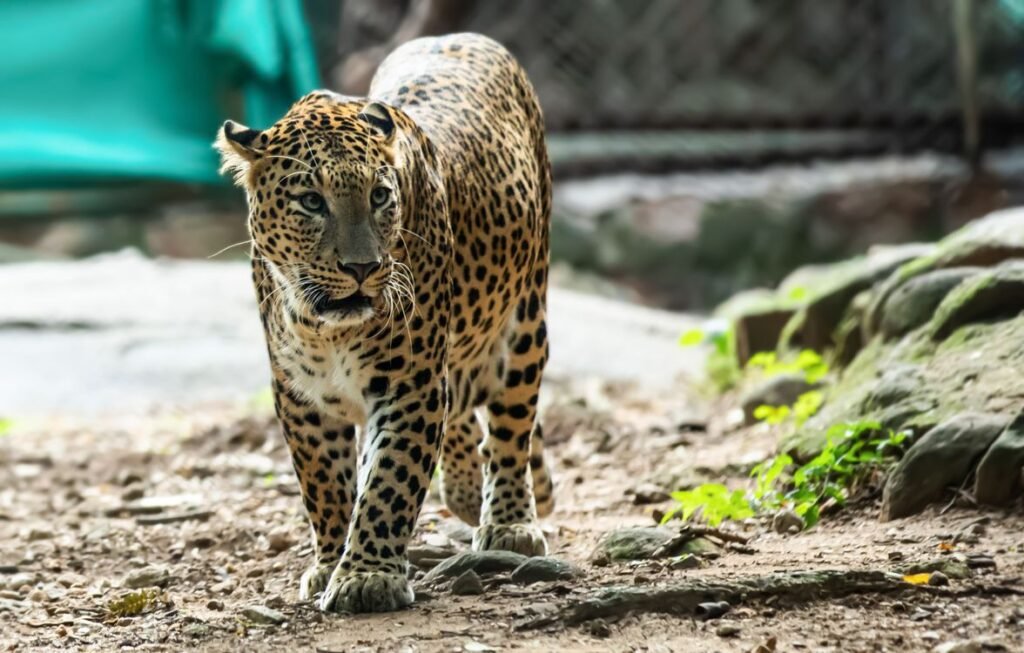
The headline species is the common leopard (Panthera pardus), the apex predator of the hills. Leopards here are shy and mostly nocturnal, using the higher, remoter ridges, but camera traps have confirmed a breeding population. More on them below.
The supporting cast is rich. Golden jackals call at dusk from the valleys. Wild boar root through the forest floor in sounders. Barking deer, small and russet, freeze on trails at dawn before melting into cover. Rhesus macaques are the monkeys most visitors actually see, troops of them working the forest edge near trails. Red foxes trot the fire lines. Indian porcupines leave their quills as calling cards. After dark, the forest belongs to others: the Indian pangolin (Manis crassicaudata), a scaly anteater and one of the most trafficked mammals on Earth; the leopard cat, a small spotted wildcat; the yellow-throated marten; and clouds of fruit bats commuting between roost and orchard.
Reptiles add another layer: monitor lizards bask on rocks, and the park hosts several venomous snakes including Russell's viper, the Indian cobra, the Himalayan pit viper, and the saw-scaled viper. The GBIF survey recorded 27 reptile species, a reminder that the Margalla's biodiversity extends well beyond the photogenic mammals.
The leopard's quiet return
The leopard is the soul of Margalla Hills wildlife, and its recent history is a genuine conservation story. Surveys in 2020 and 2021 identified two leopard families totaling about seven animals. Later camera-trap work detected a third family, indicating the population is growing rather than just holding on.
During the COVID-19 lockdowns, when the trails fell silent, the hills seemed to exhale. A Trail-5 regular later recalled a nocturnal leopard venturing out in daylight, one of several signs that wildlife reclaims space the moment human pressure lifts. The Islamabad Wildlife Management Board mapped a sanctuary of nearly 10 square kilometers used intensively by leopards, stretching from Kalinjar behind the Pakistan Air Force cantonment to Trail-6 near Faisal Mosque. Camera-trap footage showed the cats moving confidently through areas that trekkers use by day.
This recovery did not happen by accident. Anti-poaching patrols, trail monitoring, and public awareness campaigns, led by the IWMB after its establishment in 2015, gave the cats room. Pheasants were seen performing courtship displays again; porcupines and foxes became bolder. It was evidence for a simple principle: in the Margalla, protection works, and quickly.
The leopard's presence also creates friction. Livestock losses in the villages inside the park spark retaliation fears, and every sighting near a trail generates headlines. Managing that coexistence, keeping both leopards and people safe, is the central challenge of the park's mammal conservation.
The grey goral: the one that got away
Every wildlife story needs its ghost, and the Margalla's is the grey goral (Naemorhedus goral), a stocky mountain goat-antelope of Himalayan cliffs. The park was partly established to protect the goral, the barking deer, and the leopard. Protection helped the deer and the cats. It came too late, or was not enough, for the goral.
According to the Islamabad Wildlife Management Board, the grey goral is the only species officially reported as locally extinct within the national park. No specimen has been recorded since 2018. The GBIF vertebrate survey lists it as extinct at the site. Habitat degradation, disturbance, and hunting pressure are the likely drivers, though the precise sequence of its disappearance was never fully documented.
The goral's loss matters beyond sentiment. It was a flagship species, the animal the park was partly created to save, and its extinction inside a protected area is a warning about what "protected" means when enforcement is weak and human pressure is constant. Conservationists now point to the goral when arguing for stronger protection of what remains: the leopard, the pangolin, and the cheer pheasant could follow the same path without sustained effort.
There is a small thread of hope. A cheer pheasant hatchery was established at Chak Jabri and Dhok Jewan to breed the birds, which had become extinct in the hills, for release back into the wild. Captive breeding and reintroduction are slow, uncertain tools, but they show that the will to reverse losses exists.
Birds: residents, visitors, and passers-through
If mammals are the park's drama, birds are its daily life. The Margalla Hills are a recognized birding hotspot, and the numbers are striking. Data compiled by the Capital Development Authority's Environment Wing documents 218 bird species in the Margalla Hills Range, broken down by how they use the hills.
| Category | Species count | Examples |
|---|---|---|
| Year-round residents | 82 | Black partridge, kalij pheasant, white-cheeked bulbul |
| Summer breeders | 32 | Paradise flycatcher, golden oriole, Asian koel |
| Winter visitors | 73 | Himalayan griffon vulture, crested honey buzzard, warblers |
| Passage migrants | 31 | Birds pausing briefly on Himalayan journeys |
Each autumn, the hills become a staging ground. More than a hundred traveling species join the resident birds; as winter deepens, about 31 push onward to warmer southern areas while more than 150 settle in for the cold season. Raptors are a particular draw: peregrine falcons, laggar falcons, kestrels, Eurasian sparrowhawks, Egyptian vultures, and Himalayan griffons all hunt or scavenge here.
For birdwatchers, the practical advice is simple. Winter brings the greatest diversity, with migrants swelling the resident population. Early mornings on the quieter trails, especially Trail-5 and the ridges above, offer the best chances. The cheer pheasant and kalij pheasant are prized sightings, and the paradise flycatcher with its streaming white tail is the bird most likely to make a visitor stop mid-stride.
The forests that hold it together
Wildlife needs habitat, and the Margalla's forests are a Himalayan foothill community. The lower slopes carry scrub forest dominated by phulai (Acacia modesta), wild olive, and sanatha (Dodonaea viscosa). Higher up, chir pine (Pinus roxburghii) takes over, with oaks in the moister ravines. In spring, wildflowers spread across the open meadows, and the forest floor comes alive with insects, which in turn feed the birds.
Seasonal streams and springs thread the valleys, critical water sources in an otherwise dry landscape. These water points concentrate wildlife, which is why the quieter ravines away from the main trails are often the most productive for sightings.
The forest is also the park's shield. Tree cover stabilizes the steep limestone slopes, regulates the streams that feed Rawal Lake, and cools the city below. When the Margalla burns, as it does in dry summers, or when trees are cut for fuel, the damage cascades: soil erodes, streams silt up, and wildlife habitat shrinks. Protecting the forest and protecting the animals are the same task.
Living with 300,000 neighbors
Here is the fact that defines the Margalla more than any species list: the park is inhabited. An estimated 40 villages lie within its boundaries, home to roughly 300,000 people according to a Capital Development Authority estimate. Many of these communities predate the park's 1980 notification, and their relationship with the hills is daily and practical.
Villagers depend on the forest for firewood, especially for cooking and winter heating, and on the hillsides for grazing livestock. The result is steady pressure: tree cutting, habitat fragmentation, soil erosion, and disturbance that pushes sensitive species deeper into the hills. Grazing competes directly with wild herbivores like the barking deer. Wood extraction opens the canopy and dries the forest floor.
Authorities have known about this for decades. CDA documents show a proposal to supply subsidized LPG cylinders to reduce firewood dependence, but logistical problems meant the program was never implemented. Without alternatives, the pressure continues, and with it the slow attrition of habitat.
This is not a simple villains-and-victims story. The communities are not the park's enemies; they are its neighbors, and any conservation plan that ignores their needs will fail. The workable answer, conservationists argue, is a practical and humane policy: alternative fuels, regulated grazing zones, employment in park management, and a share in the benefits of a healthy park. What the Margalla needs is not the removal of people but a new bargain with them.
Conservation battles: quarrying, restaurants, and disappearing watchdogs
The Margalla's recent history reads like a case study in how hard it is to keep a protected area protected next to a growing city.
Stone crushing. For over four decades, limestone quarrying and stone crushing scarred the hills. The Margalla's high-quality limestone fed cement factories and road projects. At one point a cement factory held a lease to mine inside the park's designated boundaries, granted in 1990, a full decade after the park was declared. Dozens of stone crushers operated in and around the park, and studies found their particulate emissions 33 to 40 times higher than environmental standards. By 2003, as many as 109 stone-crushing sites had been prohibited, but illegal operations persisted. The blasting ate away hillsides near Taxila and the GT Road, destroying habitat outright. Eventually, after repeated court rulings went against the operators, the government shut the crushing units down. The hills are still recovering.
The tunnel proposal. In the early 2000s, authorities proposed cutting a tunnel through the Margalla to connect Islamabad directly with Haripur. The idea resurfaced in 2013 with a formal project concept, promising shorter commutes for traffic from Gilgit-Baltistan, Mansehra, and Abbottabad. Environmentalists objected, the Supreme Court took suo motu notice, and the project was shelved the same year. It remains a reminder that the park's location makes it a permanent target for infrastructure schemes.
Monal and the restaurants. Monal Restaurant, built in 2006 at Pir Sohawa inside the park, became Islamabad's most famous viewpoint eatery. It also became a symbol of tourism colliding with conservation: heavy traffic, noise, light pollution, litter, and habitat disruption pushed wildlife deeper into the hills. After years of legal challenges, the Supreme Court ordered the closure and removal of Monal and other eateries from the national park. In September 2024, Monal closed permanently and demolition began to restore the site. For conservationists, it was a landmark victory, proof that the park's legal protections could be enforced.
Encroachments. A 2021 survey by the climate change ministry with the Survey of Pakistan found more than 80 locations inside the park where government offices, hotels, restaurants, golf courses, and housing had been built illegally over decades. The report went to the Islamabad High Court in December 2021. Clearing decades of encroachment is slow political work, and much of it remains unresolved.
The watchdog's fate. The Islamabad Wildlife Management Board, established in 2015, led the park's conservation turnaround: patrols, camera traps, the leopard sanctuary study, public awareness. Then the federal government dissolved the IWMB and reconstituted it under bureaucratic control, a move conservationists saw as weakening independent oversight. The episode illustrates a pattern: the Margalla's protections are only as strong as the institutions behind them, and those institutions keep shifting.
Seeing wildlife responsibly
The Margalla rewards patience and punishes noise. Most visitors see macaques, jackals, and birds; leopards remain a matter of luck, tracks, and camera traps. Dawn and dusk are the productive hours. The quieter trails, particularly Trail-5 and the upper reaches of Trail-3, offer better chances than the busy picnic corridors.
A few rules make the difference between a visitor and a disturbance. Stay on marked trails; wandering off compacts soil and tramples habitat. Never feed wildlife: fed macaques become aggressive, and fed predators lose their fear of people. Carry out all litter, including food waste that draws animals to trailsides. Keep dogs leashed or, better, leave them home; dogs harass wildlife and can trigger leopard encounters. If you are lucky enough to spot a leopard or hear one, keep your distance, stay calm, and do not try to follow it.
Birdwatchers should note that winter, roughly November to February, brings peak diversity as migrants arrive. A basic pair of binoculars and a field guide will do more for your trip than any gadget.
The park's estimated 100,000 to 150,000 annual visitors, a figure experts believe understates reality, mean that every small act of care multiplies. The Margalla survives because enough people treat it as a living place rather than a backdrop.
FAQ
What animals live in the Margalla Hills?
Common leopards, golden jackals, wild boar, barking deer, rhesus macaques, red foxes, Indian porcupines, Indian pangolins, leopard cats, and yellow-throated martens, plus 27 recorded reptile species and over 200 bird species. The grey goral, once present, is now locally extinct.
Are there leopards in the Margalla Hills?
Yes. Camera-trap surveys have confirmed a breeding population, growing from two families of about seven leopards in 2020-2021 to three families in later surveys. Sightings are rare because leopards are nocturnal and shy, but they use the higher ridges and a mapped sanctuary of nearly 10 square kilometers.
What happened to the grey goral in Margalla Hills?
The grey goral has not been recorded in the park since 2018 and is officially reported as locally extinct there. Habitat degradation, disturbance, and hunting pressure are the likely causes. The park was partly established to protect this species.
When is the best time to visit the Margalla Hills for wildlife?
Spring (March to April) and autumn (October to November) offer the best hiking weather. For birdwatching, winter (November to February) brings peak diversity with the arrival of migratory species. Go at dawn or dusk for mammals.
Is it safe to hike in the Margalla Hills with leopards around?
Leopard attacks on people in the Margalla are extremely rare. Stay on marked trails, avoid hiking alone at night, keep dogs leashed, and never feed wildlife. If you encounter a leopard, keep your distance and do not approach it.
Which trail is best for wildlife spotting in the Margalla Hills?
Trail-5 and the upper sections of Trail-3 are generally the quietest and most productive for wildlife. Trail-6 and the Kalinjar area fall within the mapped leopard sanctuary zone. Daman-e-Koh is scenic but busy; go early for a better chance of sightings.