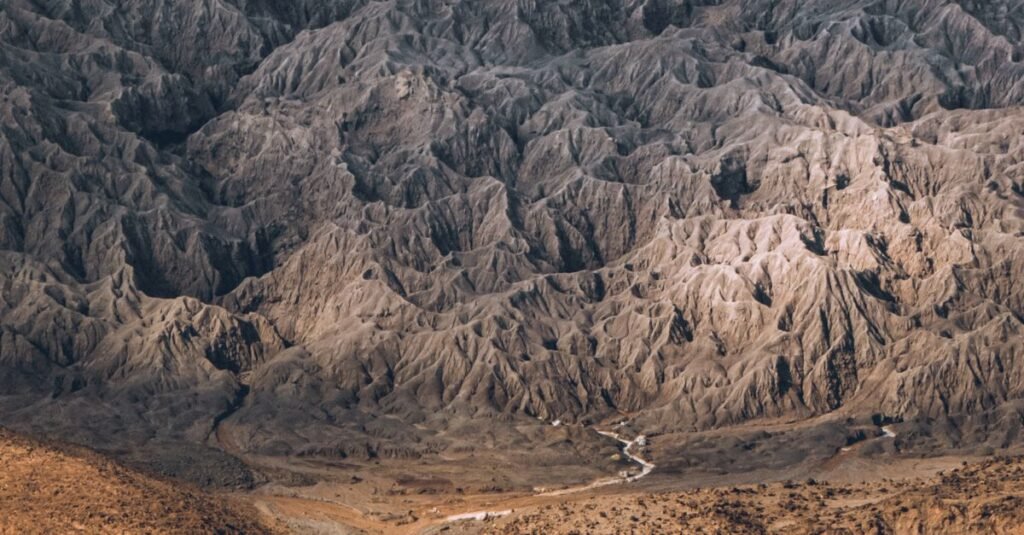
Hingol National Park: Pakistan’s Wild Coastal Frontier
Few places on Earth pack as much strangeness into one boundary as Hingol National Park. Drive west from Karachi along the Makran Coastal Highway and the city falls away fast. The road threads between barren mountains and the Arabian Sea, and before long you are inside Pakistan's largest national park, a protected area of about 6,100 square kilometers spread across the districts of Gwadar, Lasbela, and Awaran in Balochistan.
Hingol is not one landscape but many stacked together. Desert plains run into a year-round river. The river ends in an estuary full of crocodiles. Offshore, dolphins and nesting sea turtles patrol the coast. Inland, mud volcanoes burp cold mud into the air, and wind-carved rock formations rise like sculptures from the plain. Then there is the human layer: a cave temple that has drawn Hindu pilgrims for centuries, sitting at the geographic heart of the park.
NASA's Earth Observatory chose Hingol for its Image of the Day in 2021, calling it one of Pakistan's natural wonders. That attention was overdue. The park was declared a national park in 1988, yet it remains lightly visited compared to the northern mountains, which is part of its appeal. This guide walks through what makes Hingol work as an ecosystem, what lives there, and how to see it responsibly.
Where Hingol National Park is and why it matters
Hingol sits in the Makran coastal region of southwestern Balochistan, roughly 190 to 200 kilometers west of Karachi. The Makran Coastal Highway, completed in 2004, runs through the park and changed everything: places that once took days of rough travel became reachable in a three to four hour drive from Karachi. Tourism to the park's rock formations has grown steadily ever since.
The park is named after the Hingol River, which flows through it and empties into the Arabian Sea. The Hingol is the longest river in Balochistan and unusual for the province because it flows all year, while most Balochistan rivers are seasonal. That permanent water is the foundation of the park's ecology. Everything from marsh crocodiles to migratory flamingos depends on it.
Size matters in conservation, and Hingol has it. At roughly 6,100 square kilometers, it is the largest national park in Pakistan, bigger than many better-known reserves. Large protected areas let wide-ranging animals like ibex and predators maintain viable populations, and they buffer ecosystems against the pressures building up outside the boundary.
The Hingol River: the park's lifeline
In a province defined by drought, the Hingol River is an anomaly. It rises far inland and runs about 560 kilometers through the Hungol Valley and the Makran Coastal Range before reaching the sea. Along the way it feeds narrow ribbons of green vegetation, tamarisk forest on the floodplains, and scattered pools that wildlife depends on during the long dry months.
Before it meets the Arabian Sea, the river spreads into an estuary. NASA's Earth Observatory notes that this estuary supports threatened fish, birds, and crocodiles. Estuaries are among the most productive habitats on the planet, mixing fresh and salt water to create nurseries for fish and feeding grounds for birds. At Hingol, the estuary is also where marsh crocodiles (Crocodylus palustris) concentrate. A field survey of Balochistan's crocodile populations recorded 118 marsh crocodiles in the Hingol River system: 20 hatchlings, 18 juveniles, and 80 adults. For a species under pressure across South Asia, that is a meaningful stronghold.
The river's pools matter beyond the main channel. Side valleys run dry for much of the year, so animals move to the permanent pools of the Hingol during drought. Ibex, chinkara, urial, wolves, and crocodiles have all been recorded using these refuges. Protecting the river's flow is therefore the single most important conservation action in the park, and proposed dam projects on the Hingol have been a recurring source of concern for conservationists.
Six ecosystems inside one boundary
Hingol's defining feature is variety. Most national parks protect one dominant ecosystem. Hingol contains at least six, arranged from north to south like layers in a cake.
| Zone | Location in park | What defines it |
|---|---|---|
| Arid subtropical forest | Northern section | Drought-tolerant trees and scrub on rocky slopes |
| Dry mountainous terrain | Western portion | Rugged Makran range ridges and valleys |
| Desert plains | Central areas | Open arid flats with sparse shrubs |
| River and floodplain | Along the Hingol River | Year-round water, tamarisk forest, crocodile pools |
| Mud volcano fields | Eastern section | Active mud volcanoes venting methane and mud |
| Coastal and marine zone | Southern edge | Beaches, sea caves, mangroves, offshore waters |
This compression of habitats explains the park's species richness. Roughly 257 plant species and 289 animal species have been recorded here, including 35 mammal species along with reptiles, amphibians, fish, and a long list of migratory birds. Few protected areas in Pakistan combine desert, river, and marine ecosystems in one management unit, which is why Hingol is often described as unique among the country's national parks.
Rainfall is scarce and erratic. The coastal zone receives roughly 50 to 150 millimeters a year, mostly in winter and during the July to September monsoon. The region endured a severe drought from 1997 to 2004, and flash floods in February 2005 washed away villages along the river. Life here is tuned to extremes.
Wildlife on land: ibex, urial, and gazelles
The park's signature mammals are its wild ungulates, superbly adapted to cliffs and heat. The Sindh ibex (Capra aegagrus blythi) picks its way across near-vertical rock faces. The Balochistan urial (Ovis vignei), a wild sheep with impressive curved horns, grazes the rougher slopes. The chinkara (Gazella bennettii), also called the Indian gazelle, is built for the open desert flats, surviving on sparse browse and morning dew.
These herbivores support the park's predators. The mammal list includes the Indian wolf, striped hyena, honey badger (ratel), Indian fox, and the elusive Sindh leopard, which still occurs in the park's remoter corners. Smaller mammals include porcupines, jackals, and pangolins. The Indian pangolin, the world's most trafficked mammal, finds refuge here, though it is rarely seen.
Birdlife is one of Hingol's underappreciated strengths. The park's varied habitats attract a remarkable assemblage: Dalmatian pelicans and spotted-billed pelicans on the water, greater flamingos on the estuary flats, houbara bustards on the desert plains, imperial eagles and sooty falcons overhead, and the mahseer fish drawing kingfishers and herons to the river. Grey herons stalk the shallows. For birdwatchers willing to travel in winter, when Palearctic migrants arrive, Hingol offers species that are hard to find anywhere else in Pakistan.
Reptiles are well represented too, led by the marsh crocodile. Monitor lizards patrol the riverbanks, and several snake species inhabit the scrub. The park's amphibians, including the skittering frog, cluster around the permanent water.
Coastal and marine life: where the desert meets the sea
Hingol's southern edge is where the story gets even more interesting. The park includes a stretch of Arabian Sea coastline with beaches, sea caves, and offshore waters that host Indo-Pacific dolphins, green turtles, and olive ridley turtles. Mangroves grow in the sheltered coastal pockets, stabilizing the shoreline and sheltering juvenile fish.
Kund Malir Beach, just inside or beside the park boundary depending on the map, is regularly listed among Pakistan's most beautiful beaches. Desert cliffs drop straight to clear water, and the beach is a short detour off the Makran Coastal Highway. Sapat Beach nearby is wilder and harder to reach.
The turtles are the coast's most vulnerable residents. Green and olive ridley turtles nest on these beaches, coming ashore at night, mostly in August, to lay their eggs. But plastic pollution has made nesting harder: debris on the sand blocks females from digging, and some turn back to the sea without laying. Researchers have documented declining turtle numbers along the Sindh and Balochistan coasts as a result. It is a vivid example of how a threat generated far away, in cities and fishing fleets, lands on a protected beach.
The marine zone also supports a rich fish fauna, including the mahseer in the river's lower reaches and diverse reef and pelagic species offshore. Dolphins are regularly seen from the coastal highway and from boats at Kund Malir.
Sculpted stone: the Princess of Hope and the Sphinx
Hingol's rocks are the reason most Pakistanis have heard of the park. The Makran coastal strip has been carved by sea waves, storm winds, and sedimentation over centuries into forms that look deliberately sculpted. A joint study by the University of Geneva and the University of Tehran documented 36 notable rock formations along this coast, formed as tidal action and wind stripped away softer layers of rock.
The most famous is the Princess of Hope, a tall hoodoo that resembles a standing woman gazing toward the horizon. Its name has a modern origin story: when actress Angelina Jolie visited Pakistan on a UN goodwill mission in 2004, the formation caught her eye and she named it the Princess of Hope. The name stuck. Despite its statuesque look, the pinnacle owes its form purely to wind and water erosion, and it continues to change as those forces keep working.
Nearby stands the Balochistan Sphinx, also called the Lion of Balochistan or Abul-Hol. Visible from the Buzi Pass section of the Makran Coastal Highway, it bears an uncanny resemblance to the Great Sphinx of Giza: a recumbent lion-like body with a humanoid head, all of it natural. Together, the two formations have become icons of Pakistani tourism photography, and they are the first stop for most visitors entering the park.
Mud volcanoes: cold fire from the Earth
East of the highway lies one of the strangest landscapes in Pakistan: the Hingol mud volcanoes. The park holds around ten clusters of them, with the most important being Chandragup and Khandewari. The Chandragup complex consists of three major cones, Chandragup 1, 2, and 3, plus smaller vents, and the tallest rises about 300 feet.
Mud volcanoes erupt mud and methane gas instead of lava. At Chandragup the grey mud bubbles and oozes from the crater, sometimes with enough gas pressure to produce small flames. Geologists value the site because active mud volcanoes are rare worldwide, and the Makran examples are tied to the same tectonic forces that built the coastal ranges.
Chandragup is also sacred ground. Hindus revere the volcano as Baba Chandrakup, a manifestation of Lord Shiva, and climbing to its rim is the first ritual of the annual Hinglaj Yatra. Pilgrims toss coconuts and rose petals into the crater to make wishes and give thanks. The site sits about a kilometer off the Makran Coastal Highway, near a Sui Southern Gas Company installation that serves as a landmark, and local guides can point visitors to the exact track.
Hinglaj Mata: faith at the center of the park
Deep inside Hingol, in a mountain cave on the banks of the Hingol River, sits the Hinglaj Mata mandir, also known as Nani Mandir. It is one of the 51 Shakti Peethas, the holiest shrines in Shaktism, marking spots where parts of the goddess Sati are believed to have fallen to Earth. For Pakistan's Hindu community, it is the single most important pilgrimage destination in the country.
Each April, the Hinglaj Yatra transforms the park. Buses pour in from Karachi, Hyderabad, and beyond. Pilgrims climb Chandragup, then travel roughly 45 kilometers of rough desert track to the cave temple. Estimates of attendance vary by year, but recent yatras have drawn well over 100,000 pilgrims, with some counts reaching 250,000. Stalls selling food, flowers, coconuts, and incense spring up in the desert. The Hingol River itself becomes part of the ritual, as pilgrims bathe in its waters much as they would in the Ganges.
The yatra is also a study in coexistence. Local Muslim communities along the route help organize logistics, provide water, and manage crowds for a Hindu festival inside a national park in a Muslim-majority country. For a few days each spring, Hingol becomes one of the most crowded places in Balochistan, which creates real management challenges: waste, traffic, and disturbance to wildlife spike during the festival. Park authorities and temple committees have had to learn to plan the pilgrimage together, balancing religious access with ecological protection.
Planning a visit: best time, routes, and practical tips
Best time to visit Hingol National Park: October to March. Winter days are pleasant, skies are clear, and wildlife is more active around water. November through February is the sweet spot. Avoid May through August, when temperatures in the desert and rock zones can push past 45°C and travel becomes genuinely uncomfortable.
Getting there: From Karachi, take the Makran Coastal Highway west. The park boundary begins roughly 190 kilometers out, and the drive takes three to four hours. The Princess of Hope and the Sphinx are visible from or just off the highway near the Buzi Pass. Reaching the mud volcanoes, Kund Malir, or the Hinglaj temple requires turning off the highway onto rough tracks, where a 4×4 is strongly recommended.
What to bring: This is a desert with almost no services inside the park. Carry drinking water, food, sunscreen, a hat, and a basic first aid kit. Trekking shoes matter on the rocky tracks. A light jacket helps after sunset in winter. Binoculars will transform the experience, especially for birds and distant ibex on the cliffs.
Where to stay: Most visitors day-trip from Karachi or camp. Riverside camping near the Hingol River and beach camping at Kund Malir are popular, but camp responsibly: carry out all waste, keep fires small and contained, and never camp in dry riverbeds during rain season because of flash flood risk. Limited food stalls operate near Kund Malir. For more comfort, guesthouses in Ormara or Uthal are options.
Etiquette: Hingol is a national park, not a picnic ground. Do not litter, do not disturb wildlife, and keep noise down near water sources where animals drink. If you visit during the Hinglaj Yatra, respect the religious nature of the sites and give pilgrims space at the temple and the volcano.
Threats and conservation
Hingol's ecosystems face pressures from several directions. Poaching of ibex and urial persists in remote areas despite legal protection. Livestock grazing on the floodplains competes with wild herbivores and degrades the tamarisk forest. Plastic on the nesting beaches threatens the turtle population. Proposed water infrastructure on the Hingol River could alter the flow regime that the entire park depends on.
There is also the pressure of popularity itself. Since the Makran Coastal Highway opened, visitor numbers have climbed, and with them come litter, off-road driving damage, and disturbance. The park's management has to thread a difficult needle: the same road that lets people fall in love with Hingol also exposes it.
Still, the fundamentals are strong. The park's size gives wildlife room. The river still flows year-round. Crocodile, ibex, and turtle populations persist. Conservationists working in Balochistan continue to push for better enforcement, community involvement, and protection of the river's flow. Hingol's future depends less on any single project than on the slow work of keeping a very large, very dry, very beautiful place intact.
FAQ
How big is Hingol National Park?
About 6,100 square kilometers (roughly 2,400 square miles), making it the largest national park in Pakistan. It spans parts of Gwadar, Lasbela, and Awaran districts in Balochistan.
What is the Princess of Hope?
A naturally eroded rock pinnacle in Hingol National Park that resembles a standing woman. It was named by Angelina Jolie during her 2004 UN visit to Pakistan. Wind and water erosion sculpted it, and it continues to erode.
Are there really mud volcanoes in Hingol National Park?
Yes. The park contains about ten clusters of active mud volcanoes, most famously the Chandragup complex, whose tallest cone rises around 300 feet. They erupt mud and methane rather than lava, and Chandragup is sacred to Hindu pilgrims.
What animals can you see in Hingol National Park?
Sindh ibex, Balochistan urial, chinkara gazelle, Indian wolf, striped hyena, marsh crocodiles in the Hingol River and estuary, Indo-Pacific dolphins and sea turtles offshore, and a rich birdlife including flamingos, pelicans, and houbara bustards.
When is the best time to visit Hingol National Park?
October to March, with November to February ideal. Summers are extremely hot, often exceeding 45°C. If you want to witness the Hinglaj Yatra pilgrimage, visit in April, but expect large crowds.
How do I get to Hingol National Park from Karachi?
Drive west on the Makran Coastal Highway for about 190 kilometers (three to four hours). The main rock formations are near the highway; the mud volcanoes, beaches, and temple require 4×4 tracks off the highway.