Kangaroo Facts: Speed, Joeys, and Australia’s Hopping Icon
Kangaroo Facts at a Glance
The kangaroo is Australia's most famous animal and one of the strangest success stories in mammal evolution. It cannot walk backward, it carries its babies in a built-in nursery, and it moves by bouncing on spring-loaded legs that actually become more efficient the faster it goes. Male red kangaroos can stand over two meters tall and weigh up to 90 kilograms, making them the largest marsupials alive.
Here are the essential kangaroo facts in brief, before we hop into the details.
| Fact | Detail |
|---|---|
| Family | Macropodidae, meaning "big foot" |
| Species | Four kangaroo species, plus about 50 related wallabies and kin |
| Largest species | Red kangaroo (Macropus rufus): males to ~2 m tall, up to ~90 kg |
| Top speed | Around 60-65 km/h in short bursts; ~20 km/h sustained |
| Longest bound | Over 9 m in a single leap (red kangaroo) |
| Diet | Herbivore: grasses, plus leaves and shrubs |
| Newborn joey | ~2.5 cm long, under a gram, climbs to the pouch unaided |
| Social group | Mobs of up to 50 or more animals |
| Lifespan | Up to ~23 years in the wild |
| Conservation status | Least Concern (IUCN) |
What Is a Kangaroo? Meet the Four Species
When people say "kangaroo," they usually mean one of four large species. All are marsupials, mammals whose young are born tiny and underdeveloped and finish growing in a pouch. Kangaroos belong to the family Macropodidae, from Greek roots meaning "big foot," a name that needs no explanation once you see those enormous hind feet.
The four kangaroo species are:
- Red kangaroo (Macropus rufus): the largest of all, living across arid and semi-arid central Australia. Males are reddish, females are blue-grey. Some taxonomists now place it in the genus Osphranter, but Macropus rufus remains the widely used name.
- Eastern grey kangaroo (Macropus giganteus): common along the fertile east coast and inland woodlands, familiar to millions of Australians.
- Western grey kangaroo (Macropus fuliginosus): found in the south and west, in woodlands and shrublands.
- Antilopine kangaroo (Macropus antilopinus): the tropical north's kangaroo, living in monsoonal woodlands.
Beyond these four sit roughly 50 smaller relatives, wallabies, wallaroos, pademelons, and tree-kangaroos, all macropods sharing the same basic body plan. Together with possums, wombats, and koalas, they make Australia the world's great stronghold of marsupial life.
The Marsupial Blueprint: Pouches and Joeys
The kangaroo's reproductive strategy looks bizarre only until you consider the environment that shaped it. Australia is a continent of unreliable rain and boom-bust food supplies. Instead of carrying a pregnancy to an advanced stage and committing to a large, costly infant, the mother kangaroo produces a tiny, unfinished baby and finishes the job in the pouch, where she can adjust her investment as conditions change.
A newborn joey is astonishingly small: about 2.5 centimeters long, weighing less than a gram, roughly the size of a grape or jellybean. Blind, hairless, and with only its forelimbs well developed, it climbs unaided through its mother's fur from the birth canal to the pouch, a journey guided by smell that takes just a few minutes. Once inside, it latches onto a nipple and stays attached for about 70 days. Because the newborn cannot suckle or swallow on its own at first, the mother uses muscles in the mammary gland to pump milk down its throat.
The joey first pokes its head out of the pouch at about 150 days, begins leaving the pouch for short trips around seven to eight months, and leaves for good at roughly 235 to 240 days, though it may keep suckling until about a year old. The pouch is not just a pocket; it is a climate-controlled nursery with four separate teats, and the mother can produce different milk formulations from different teats at the same time.
That last detail enables one of the kangaroo's most remarkable tricks: a mother can nurse two joeys of different ages simultaneously, one in the pouch drinking rich, high-fat milk, and an older one outside drinking a leaner formula, while a third embryo waits in reserve. This is possible because of embryonic diapause: after giving birth, the female mates again, but the new embryo develops only to a ball of about 100 cells and then pauses. If the pouch joey dies or leaves, the dormant embryo resumes development and is born about a month later. It is reproductive insurance, tuned to an unpredictable climate.
Why Kangaroos Hop: The Science of an Energy-Saving Bounce
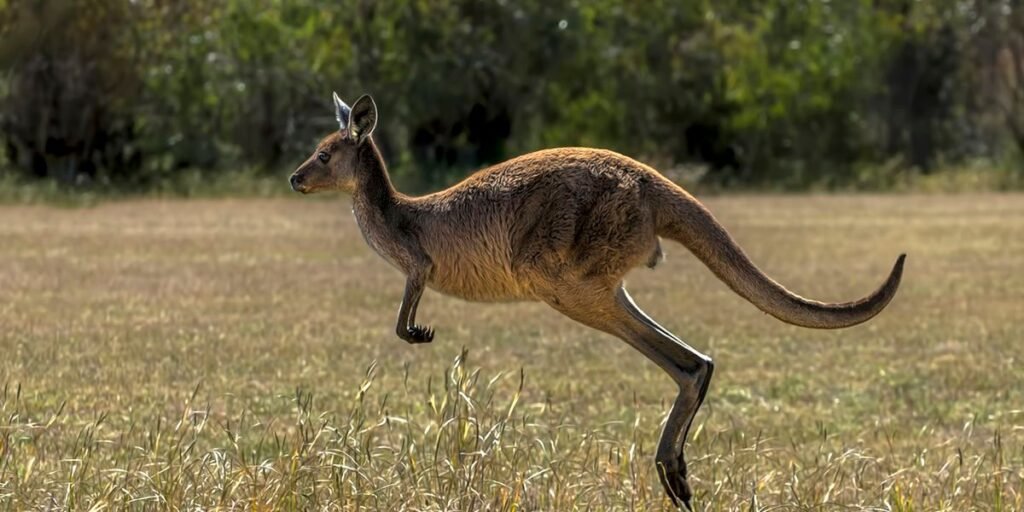
Hopping looks like hard work, but for a kangaroo it is one of the most efficient ways to move on the planet. The secret is in the tendons. A kangaroo's hind legs contain long, stretchy tendons, particularly in the ankle, that work like rubber bands or pogo sticks. Each time the animal lands, the tendons stretch and store elastic energy; each time it launches, that energy snaps back, returning a large fraction of the effort for free.
The result is a gait that breaks the usual rules of locomotion. In most animals, moving faster costs disproportionately more energy. In kangaroos, hopping becomes relatively cheaper as speed increases, up to a point. Red kangaroos can reach 60 to 65 kilometers per hour in short bursts, with the fastest reliably recorded individuals hitting the top of that range, and they can sustain around 20 kilometers per hour for long periods. A big red kangaroo can cover more than 9 meters in a single bound.
Researchers have also found that hopping is not the only option in the kangaroo's repertoire. At slow speeds, kangaroos move their hind legs independently in a clumsy-looking walk, and they cannot easily move their hind legs one at a time the way most mammals do, which is why a walking kangaroo looks so awkward. The familiar efficient bounce takes over as speed rises.
The Tail as a Fifth Leg
For a long time, the kangaroo's long, muscular tail was described as a counterbalance and a prop: something to lean on while sitting and to steady the body mid-hop. Then biomechanics researchers put red kangaroos on force-measuring walkways and discovered the tail does much more. When a kangaroo moves slowly, it plants its tail on the ground and uses it as a propulsive limb, pushing off with it in rhythm with its legs. The tail contributes real mechanical work, making slow kangaroo locomotion effectively pentapedal, five-legged walking, the only such gait known in the animal kingdom.
At hopping speed the tail switches roles, swinging as a dynamic counterbalance that keeps the body stable and even helps rotate the body in mid-air. The tail is also a weapon of sorts: males use it as a tripod leg when they rear up to box, bracing themselves for the powerful kicks their hind legs can deliver.
Size and Strength: The Biggest Marsupial on Earth
The red kangaroo holds the marsupial heavyweight title. A big male, called a boomer, can stand over 1.8 meters tall when upright, with some individuals passing two meters, and weigh up to 90 kilograms, more than twice the weight of a female. Females, sometimes called blue flyers for their blue-grey coats, are much smaller at 25 to 35 kilograms. This extreme size difference between the sexes, called sexual dimorphism, is driven by male competition: the biggest, strongest males win the most mating opportunities, so evolution has rewarded bulk.
Those muscles are not for show. A large male's hind legs can deliver kicks powerful enough to disembowel a dingo, and their forelimbs, though small, are used in boxing matches where males grapple, push, and strike at each other. When threatened, kangaroos also thump the ground with their powerful hind feet, a deep drumming that alerts the mob to danger.
Despite their strength, kangaroos are grazers, not fighters by temperament. Their preferred response to trouble is to flee, and few predators can catch a healthy adult red kangaroo at full speed.
What Do Kangaroos Eat?
Kangaroos are herbivores, and grasses are the staple of the diet. Eastern and western greys graze on grasses and herbs, occasionally taking shrubs. Red kangaroos are more flexible, grazing on grasses but also browsing on leaves and shrubs when grass is scarce. All kangaroos are adapted to extract maximum value from poor forage: they chew their food thoroughly, regurgitate and re-chew it, and have chambered stomachs with microbes that ferment tough plant material, a digestive setup that parallels a cow's in function though not in anatomy.
Water strategy is where desert kangaroos truly shine. Red kangaroos can go long periods without drinking, getting most of their moisture from the plants they eat. They are mainly active at night and in the early morning, resting in the shade during the heat of the day to conserve water. They also have a built-in cooling system: they lick their forearms, and the evaporating saliva cools the blood in the dense network of vessels just under the skin.
There is a climate footnote worth knowing. Cattle produce large quantities of methane as they digest grass, but kangaroos, eating similar diets, produce only about 27 percent of the body-mass-specific methane that ruminants do, thanks to different gut microbes. Researchers have studied the kangaroo's digestive system for clues about cutting livestock emissions, a case of wildlife biology informing climate solutions.
Mob Life: Social Behavior and Boxing Males
Kangaroos are social animals that live in groups called mobs, troops, or herds, with "mob" the characteristically Australian term. A mob can number 50 or more animals, though the group is loose and fluid rather than tightly organized like a wolf pack. Eastern and western greys form particularly close-knit mobs of males and females.
Mob life is mostly peaceful grazing, but males compete for access to females, and those contests produce the famous boxing matches. Two males face off, rear up on their tails, and grapple with their forelimbs while attempting to rake each other with their hind feet. The bouts look dramatic and can draw blood, but they rarely cause serious injury; the loser usually backs down before things go too far.
Mothers and joeys form the closest bonds in the mob. A female can breed from her third year to about her twelfth, and with embryonic diapause and double nursing, she can keep a near-continuous production line of young going through good seasons. Communication within the mob is mostly subtle: ear movements, body posture, and the foot-thump alarm that sends the group bouncing for cover.
Predators, Defense, and the Water Escape
Adult kangaroos have few natural predators. The main one is the dingo, Australia's wild dog, which targets joeys and smaller species, and can occasionally bring down larger kangaroos by hunting in groups. Introduced predators, red foxes, feral dogs, and feral cats, take joeys and smaller macropods. Wedge-tailed eagles may snatch very young joeys.
Kangaroos have a striking reported defense against pursuing predators: they flee toward water. Once chest-deep, a large kangaroo may turn, grab the predator with its forelimbs, and attempt to drown it. There are credible accounts of kangaroos drowning dogs and dingoes this way, using their height and forelimb strength in an element where the predator cannot maneuver. It is a reminder that the gentle grazer has a formidable side.
Humans are the other major pressure. Kangaroos are culled in large numbers under government management programs, a contentious issue in Australia, and road collisions kill many more. At the same time, kangaroos have adapted well to human-altered landscapes, and the large species remain abundant, all listed as Least Concern.
Kangaroos and People: Coexistence and Conservation
The kangaroo is woven into Australian identity like no other animal. It appears on the coat of arms alongside the emu, supposedly because neither animal can move backward easily, symbolizing a nation always moving forward. It is on the currency, on the national airline's livery, and on sports teams' emblems. The 2032 Brisbane Olympics even considered native animals for mascots, a sign of how deeply these icons run.
Living alongside kangaroos requires respect. Wild kangaroos, especially large males, can be dangerous if cornered, fed, or approached during the breeding season. Wildlife authorities advise watching from a respectful distance, never feeding them, and giving them space on roads at dawn and dusk when they are most active.
Conservation-wise, the big kangaroos are secure, but the story is different for some smaller macropods, several of which are threatened by habitat loss, introduced predators, and changed fire regimes. Protecting kangaroo country means protecting the whole community of animals that share it.
Frequently Asked Questions
How fast can a kangaroo hop? Red kangaroos can reach 60 to 65 km/h in short bursts, among the fastest speeds of any animal their size on two legs. They can sustain about 20 km/h for long distances, and a large male can leap more than 9 meters in a single bound.
How long does a baby kangaroo stay in the pouch? About eight months. The joey is born after just 33 days of pregnancy at about 2.5 cm long, stays attached to a nipple for the first 70 days, first peeks out at around five months, starts leaving the pouch at seven to eight months, and leaves for good at roughly 235 to 240 days.
Why can't kangaroos walk backward? Their hind legs are built for hopping, with limited independent movement, and their long tail gets in the way. Combined with the structure of their legs, backward movement is nearly impossible, which is why the kangaroo and emu were chosen for Australia's coat of arms as symbols of forward progress.
Can kangaroos swim? Yes, kangaroos can swim, though they avoid water when possible. They have been observed fleeing into water to escape predators and even using the water to their advantage against attackers.
What is a group of kangaroos called? A mob, also called a troop or herd. Mobs can include 50 or more animals, though the membership is loose and changes over time.
Do kangaroos really box? Yes. Male kangaroos fight over access to females by rearing up on their tails, grappling with their forelimbs, and kicking with their powerful hind legs. The contests establish dominance with minimal serious injury.
Are kangaroos dangerous to humans? They can be. Large males are strong and armed with sharp claws, and they may attack if cornered, startled, or habituated to being fed. Wild kangaroos should be observed from a distance and never fed or approached.
How many joeys can a kangaroo have at once? Usually one at a time, but a mother can nurse two joeys of different ages simultaneously, one in the pouch and one outside, producing different milk for each, while a third embryo waits in paused development (embryonic diapause).
What do kangaroos eat? Mainly grasses, with leaves, herbs, and shrubs as supplements. Red kangaroos get most of their water from the plants they eat and can survive long dry stretches without drinking.
Are kangaroos endangered? The four large kangaroo species are listed as Least Concern and remain abundant. However, several smaller wallaby and macropod relatives are threatened by habitat loss and introduced predators.
Why do kangaroos hop instead of running? Because hopping is remarkably energy efficient for them. Elastic tendons in their legs store and return energy with each bounce, so going faster costs relatively less energy, an ideal system for covering the vast distances between food and water in Australia.
Australia's Forward-Looking Icon
The kangaroo is a study in making the most of a difficult continent. Born the size of a jellybean, raised in a pouch that doubles as a climate-controlled nursery, powered by spring-loaded legs and a fifth-limb tail, and able to pause a pregnancy until the rains come, it is an animal engineered for uncertainty. That it also became a national symbol, an animal that literally cannot go backward, feels entirely appropriate.
Research note: Speed, locomotion, and behavior figures follow the Victorian Government's Eastern Grey Kangaroo fact sheet and World Animal Protection Australia; reproductive details follow zoo and Australian Museum references; the methane comparison reflects published CSIRO-affiliated research on kangaroo digestion.