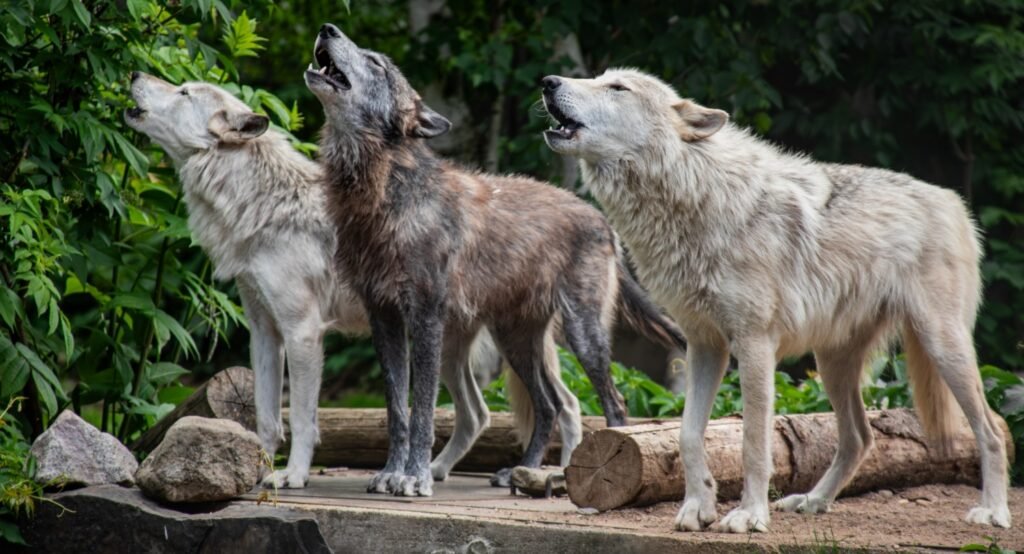
Grey Wolf Pack Behavior: How Wolf Families Really Work
Grey Wolf Pack Behavior at a Glance
A grey wolf pack is not what most people imagine. It is not a gang of rivals constantly fighting for dominance, led by a tyrant called the alpha. Decades of field research have shown that a typical wild pack is something simpler and more relatable: a family. A breeding male and a breeding female, plus their offspring from the last two or three years, usually six to ten animals in all, though packs can grow larger where prey is abundant. In Yellowstone National Park, where wolves have been studied intensively since their reintroduction, the average pack holds 11.8 individuals.
Everything a pack does, hunting, raising pups, defending territory, communicating across miles of forest, flows from that family structure. Once you understand that the "leaders" are essentially parents, grey wolf pack behavior starts to make sense in a way the old alpha mythology never did.
| Behavior | What it looks like | Purpose |
|---|---|---|
| Chorus howling | Several wolves howling together, often with tail wags and face licking | Pack bonding, rallying, territory advertisement |
| Scent marking | Urine marking, ground scratching along boundaries | Territory claims and "keep out" signals |
| Body language rituals | Chin rests, hip slams, posturing, submissive rolls | Reinforcing relationships with almost no injuries |
| Cooperative hunting | Chasing, flanking, and relay pursuit of large prey | Taking down animals no single wolf could kill |
| Alloparental care | Non-breeding adults feeding and guarding pups | Higher pup survival; shared parenting load |
| Dispersal | Young adults leaving to find mates and new territory | Preventing inbreeding; founding new packs |
A Pack Is a Family, Not an Army
The single most important correction in modern wolf science concerns the word "alpha." The concept entered popular culture through early studies of captive wolves: unrelated animals thrown together in enclosures did fight for dominance, and the winners were dubbed alphas. The biologist who helped popularize the term, L. David Mech, later spent years trying to take it back. His multi-year observations of a wild pack on Ellesmere Island in the Canadian Arctic, published in 1999 in the Canadian Journal of Zoology, showed something entirely different.
Wild wolf packs are almost always families. A breeding male, a breeding female, and their offspring from the past two or three years that have not yet left to start their own packs. In these packs, infighting for dominance is basically unheard of. The young wolves do not scheme to overthrow their parents; when they reach two or three years old, they simply leave in search of mates. The alpha wolf notion of a pup challenging its father for control of the pack is not how wolves behave in the wild.
That does not mean the pack has no order. Mech found that all pack members defer to the breeding male, and all but the breeding male defer to the breeding female. The youngest pups submit to their older siblings. But this deference is the calm of a family, not the tension of a prison yard. Even when food is scarce, parents feed the young first, much as human parents might tend to a fragile infant. Mech eventually had his famous 1970 book, the one that spread the alpha concept, taken out of print, and he has urged writers and filmmakers to stop using the term for wild wolves.
The Breeding Pair: Leaders by Parenting, Not by Fighting
In most packs, only the breeding pair reproduces. They are not the pack's dictators; they are its anchors. The breeding male typically leads the pack's travels and initiates hunts, while the breeding female is often the social center, the one whose authority the others most consistently respect. Together they choose den sites, decide when the pack moves, and set the rhythm of daily life.
Breeding pairs are usually monogamous and often stay together for life, though if one dies, the survivor will find a new mate. The breeding season runs from late January through March, peaking in February, and females are pregnant for about 63 days before giving birth to four to six pups in a den dug into well-drained soil, a hollow log, or a similarly sheltered spot.
What makes the breeding pair's "leadership" real is experience. These are typically the oldest and most experienced animals in the pack. They know where the elk winter, where the caribou cross, where rival packs patrol. Younger wolves follow them the way children follow parents who know the way home. When researchers at the International Wolf Center and in Yellowstone describe pack leadership, they describe decision-making by the most knowledgeable animals, not domination by the strongest.
How Wolves Communicate: Howls, Body Language, and Scent
Wolves have one of the richest communication systems of any land mammal, with three main channels that work together.
Howling. The howl is the wolf's signature, and it does far more than sound atmospheric on a soundtrack. Each wolf has a unique howl, which lets pack members recognize one another by voice. Howls carry for miles, with some estimates putting the range at up to 10 kilometers in open country, and they serve several purposes: locating separated pack members, rallying the pack before a hunt, advertising territory to rival packs, and strengthening social bonds through chorus howling, when one wolf's howl triggers the others to join in.
Yellowstone research has revealed that howling follows a seasonal cycle. In fall and winter, wolves howl more and their howling is largely territorial, aimed at neighboring packs during the breeding season. In spring, when the pack establishes den sites to raise pups, territorial howling fades; wolves howl less and mostly to their own family members, coordinating the complicated business of caring for pups while still hunting. Scientists have even used synchronized audio recorders to locate howling wolves to within about 20 yards at ranges over four miles, a technique now helping monitor the park's population.
Contrary to folklore, wolves do not howl at the moon. They are simply more active and vocal on bright nights, which often coincide with a full moon.
Body language. Wolves read each other with extraordinary subtlety: ear position, tail carriage, hackle raising, facial expressions, and full-body postures that signal confidence, submission, playfulness, or warning. Ritual behaviors such as chin rests on another wolf's back, hip slams, and mock stalking resolve social questions with almost no injuries. A chorus howl often ends in a social greeting of wagging tails, face licking, and posturing that reinforces bonds. Wolves communicate, as one researcher put it, more through harmony and integration than through aggression and submission.
Scent. A wolf's nose is vastly more sensitive than a human's, and scent marking is the pack's bulletin board. Wolves urine-mark along territory boundaries, scratch the ground to leave visual and scent signals, and scent-roll to share smells with pack mates. These marks carry information about identity, reproductive status, and recent passage, and they are the first line of territorial defense, warning strangers long before a confrontation is needed.
Territory: How Packs Claim and Defend Ground
A wolf pack's territory is the ground it needs to feed itself, and its size depends almost entirely on prey. Where prey is dense, territories can be relatively compact; where prey is sparse, a pack may roam across hundreds of square miles, following the movements of deer, elk, moose, or caribou. Wolves mark the boundaries with scent and patrol them regularly, and they defend them with howling that tells neighboring packs, in effect, that this ground is taken.
When defense fails, the consequences are severe. Interactions between packs are typically aggressive, and larger packs usually defeat smaller ones, unless the smaller group has more old adults or adult males. According to the National Park Service, 65 percent of radio-collared wolves in Yellowstone are ultimately killed by rival packs, making other wolves the leading cause of natural wolf death in the park. This is the main reason dispersal is so dangerous: a young wolf striking out alone must cross ground claimed by strangers.
Territorial behavior also explains the famous seasonal movement pattern researchers describe as stationary and nomadic phases. In spring and summer, the pack is anchored to the den while pups are small, the stationary phase. From autumn through winter, with pups grown enough to travel, the pack ranges widely across its territory, the nomadic phase.
Hunting as a Team: Cooperative Strategies
Wolves are built for endurance rather than sprinting. They typically travel at a steady trot of about 5 miles per hour and can sustain chases at 28 to 40 miles per hour for up to 20 minutes, wearing down prey that is far larger than any single wolf. That endurance, combined with cooperation, lets packs kill animals that would be impossible for a lone hunter: elk, moose, bison, and caribou.
Pack hunts are not choreographed in any human sense, but they show clear coordination. Wolves may approach from multiple directions, take turns chasing to keep fresh legs on the prey, and single out the most vulnerable animal: the young, the old, the sick, or the injured. In Yellowstone, 90 percent of wolves' winter prey is elk, with deer making up 10 to 15 percent of summer prey, and bison increasingly important, mostly scavenged as winter kills or animals injured during the breeding season.
Success is far from guaranteed. Most chases end without a kill, and hunting large prey is dangerous work; wolves are vulnerable to kicks and goring, and skull injuries from struggling prey are a known cause of death. When a hunt succeeds, the pack feeds in a rough order, with the breeding pair and pups getting priority, and the carcass then supports an entire community of scavengers. In Yellowstone, ravens and magpies arrive at a wolf kill almost immediately, coyotes wait nearby until the wolves are sated, bears often chase the wolves off, and everything from eagles to beetles consumes the remains.
Raising Pups: The Whole Pack Helps
Wolf pups are born in spring, blind, deaf, and weighing about a pound, covered in dark fuzzy fur. Their eyes open at 10 to 14 days, they begin to hear at about three weeks, and they start eating solid food, often meat regurgitated by adults, at three to four weeks. By eight weeks they grow the guard hairs that will protect them from cold and rain, and by autumn they are sturdy enough to travel with the pack and even join hunts for large prey.
Pup rearing is a pack project. The mother stays at the den for the first weeks, relying on the breeding male and other pack members to bring food. Non-breeding adults, often older siblings, help feed, guard, and play with the pups, a behavior biologists call alloparental care. This teamwork matters enormously: pup mortality can reach 50 to 80 percent in the wild, with disease, starvation, and predation all taking a toll. In Yellowstone, a 2005 canine distemper outbreak killed two-thirds of the pups in the park.
The den itself anchors the pack for weeks. Females may move pups between several dens, carrying them gently in their mouths. As summer progresses, the pack shifts to a rendezvous site, a kind of open-air nursery where pups wait while adults hunt, and where the whole pack's howling coordinates reunions.
Growing Up Wolf: Dispersal and Starting a New Pack
Between one and three years of age, most young wolves leave the pack of their birth. Dispersal is the riskiest chapter of a wolf's life. A lone wolf must hunt alone, avoid the territories of established packs, and stay clear of people, its major enemy, all while traveling remarkable distances in search of a mate and a vacant territory. Dispersers usually leave in autumn or winter, before the February breeding season.
The distances are extraordinary. One radio-collared wolf in Minnesota traveled 550 miles to Saskatchewan in ten months; another was documented traveling 23 miles in a single day. In 2001, a wolf trapped in Michigan's Upper Peninsula was found in north-central Missouri, about 600 miles from its home territory.
Most dispersers do not make it. Those that do find a mate of the opposite sex and a territory with enough prey become the founding breeding pair of a new pack, and the cycle begins again. This constant turnover keeps wolf populations genetically connected across vast landscapes, which is why reintroduced populations can expand as quickly as Yellowstone's did after 1995.
How Wolves Shape Their Ecosystem
The Yellowstone reintroduction is the most famous large-predator experiment in conservation history, and it has taught scientists a great deal about what packs do to landscapes. From 1995 to 1997, 41 wild wolves from Canada and northwest Montana were released in the park. The population grew rapidly, and researchers have watched the ripple effects ever since.
The clearest effects run through the elk. Wolves changed not just elk numbers but elk behavior, making them warier and more mobile, which reduced browsing pressure on streamside willows and aspens in some areas. Those recovering shrubs, in turn, created habitat for beavers, songbirds, and other species. The web of effects, sometimes called a trophic cascade, is complex and still debated in its details, but the broad lesson is well supported: a pack of wolves does not just eat elk; it reorganizes the neighborhood.
Wolves also reshape the predator community. Their kills subsidize scavengers from ravens to bears. They compete with and sometimes kill coyotes, which can release smaller predators and their prey from coyote pressure.
Wolf Packs vs Domestic Dog Groups
Since dogs descend from grey wolves, domesticated some 15,000 years ago, it is natural to wonder how much pack behavior survives in the backyard. The honest answer: some, but the differences are large. Free-ranging dog groups do form loose hierarchies, but they lack the stable family structure of a wild wolf pack, because dogs breed far more freely and humans constantly disrupt their groups. The rigid "alpha dog" training philosophies of past decades were built on the same captive-wolf studies that misled wolf science, and modern animal behaviorists have largely abandoned them for both species. If you want to understand your dog, the wild wolf pack is a fascinating starting point, but it is not a manual.
Frequently Asked Questions
How big is a typical wolf pack? Worldwide, pack size depends on prey abundance. A typical wild pack has six to ten members: a breeding pair and their offspring from the last two or three years. In Yellowstone, where elk are plentiful, the average pack holds 11.8 wolves, and unusually large packs of 20 or more have been recorded.
Is the alpha wolf real? Not in the way popular culture describes it. The alpha concept came from studies of unrelated captive wolves. In wild packs, the "leaders" are simply the breeding parents, and their authority comes from experience and parenting, not from fighting rivals. The biologist who popularized the term, L. David Mech, has spent decades correcting the record.
Why do wolves howl? To communicate over long distances. Howls help separated pack members find each other, rally the pack, advertise territory to rival packs, and strengthen social bonds. Each wolf's howl is unique, and chorus howling is a bonding ritual. In Yellowstone, territorial howling peaks in fall and winter around the breeding season, while spring howling is mostly quiet family coordination around the den.
How do wolves mark their territory? Primarily with urine scent marks and ground scratching along boundaries, reinforced by howling. Scent marks carry information about identity and reproductive status. When scent and sound fail, packs confront intruders directly, and fights between packs are often lethal.
What do wolf packs eat? Mostly large hoofed mammals: elk, deer, moose, caribou, and bison, depending on the region. They also eat smaller prey such as beavers, rabbits, and rodents, plus fish and even berries when available, and they readily scavenge carrion.
How do wolves raise their pups? The breeding female gives birth to four to six pups in spring after about 63 days of pregnancy. The whole pack helps: the mother stays at the den while others bring food, and older siblings guard and play with the pups. Pups begin eating regurgitated meat at three to four weeks and travel with the pack by autumn.
At what age do wolves leave the pack? Most disperse between one and three years old, usually in autumn or winter before the breeding season. They travel alone, sometimes hundreds of miles, seeking a mate and an unclaimed territory where they can start a new pack.
Are wolves dangerous to humans? Wolves are not normally a danger to humans. The National Park Service notes that no wolf has attacked a human in Yellowstone, though a few attacks have occurred elsewhere, usually involving habituated animals fed by people. Wolves that associate people with food can become aggressive, which is why feeding wildlife is prohibited and, in some cases, wolves have had to be removed.
How far do wolf packs travel? Packs patrol territories that can cover hundreds of square miles, following their prey. Daily travel of dozens of miles is routine, and dispersing wolves have been documented covering hundreds of miles over months.
Do wolves mate for life? Breeding pairs are typically monogamous and often stay together for life. If one partner dies, the survivor will usually find a new mate and continue breeding.
The Family That Hunts Together
Strip away the mythology and the wolf pack resolves into something both ordinary and remarkable: a family business. Parents with experience lead, siblings babysit, everyone hunts, and the young eventually leave home to start families of their own. It is a social system built not on dominance but on cooperation, and it has carried grey wolves through ice ages, across continents, and back from the edge of extermination. Understanding packs as families does not make wolves less wild. It makes them more comprehensible, and their wildness more worth protecting.
Research note: Pack size, territory defense, diet, and reintroduction figures come from the U.S. National Park Service's Yellowstone wolf ecology program; the alpha-myth correction follows L. David Mech's wild-pack research as reported in Scientific American; pup development details follow the International Wolf Center.