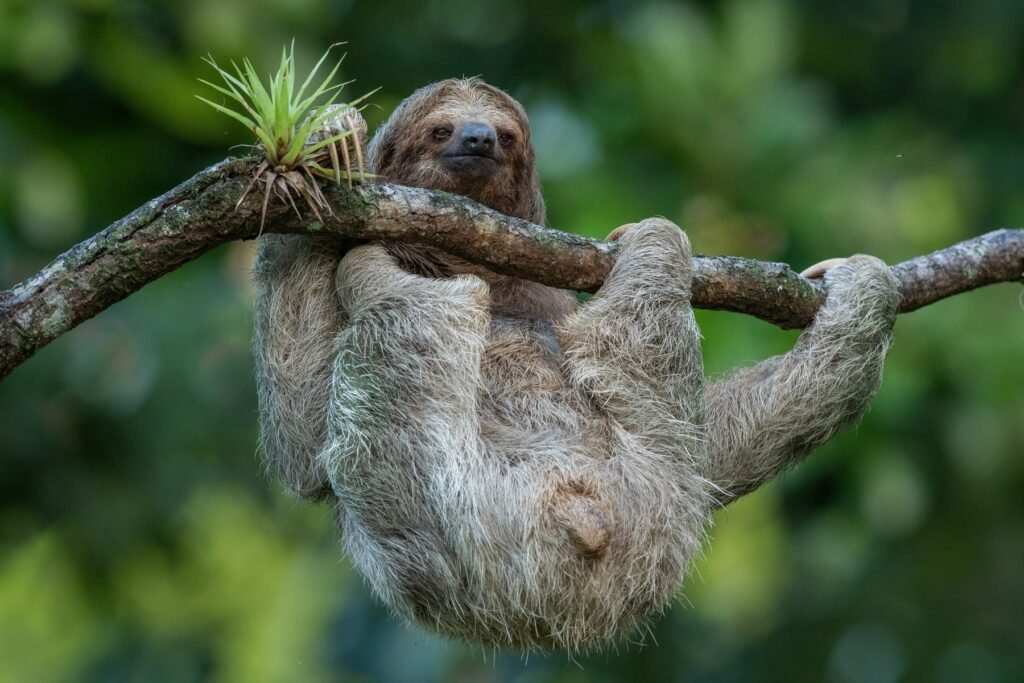
Sloth Facts: The Slow Life of the World’s Slowest Mammal
Sloth Facts at a Glance
Sloths are the world's slowest mammals, and that is not an insult. It is a survival strategy refined over millions of years. Hanging upside down in the rainforests of Central and South America, sloths move so little and so quietly that algae grows in their fur, turning them green and rendering them nearly invisible to predators. They sleep 15 to 20 hours a day, digest a single leaf for up to a month, and descend from their trees about once a week for a bathroom trip that remains one of zoology's great mysteries.
Here are the key sloth facts up front.
| Fact | Detail |
|---|---|
| Types | Six species in two groups: two-toed and three-toed sloths |
| Range | Tropical rainforests of Central and South America |
| Size | About 58 cm long, ~4 kg (three-toed); two-toed slightly larger |
| Diet | Herbivore: leaves, shoots, fruit (three-toed mostly leaves) |
| Sleep | 15-20 hours per day (captive studies); ~10 hours in the wild |
| Speed | About 6-8 feet (2 m) per minute climbing; ~40 yards per day |
| Digestion | Up to 30 days to fully process a meal |
| Lifespan | 20-30 years in the wild; up to 40+ in human care |
| Swimming | Strong, surprisingly fast swimmers |
| Status | Most species Least Concern; maned three-toed sloth Vulnerable |
Not One Animal but Two: Two-Toed vs Three-Toed Sloths
The first thing to know is that "sloth" describes two distinct groups of animals that look similar but diverged roughly 20 million years ago. As sloth researcher Jonathan Pauli of the University of Wisconsin puts it, a sloth is not a sloth. The groups are named, sensibly enough, for the number of digits on their forelimbs.
Three-toed sloths (genus Bradypus, four species) are the classic image: small, about 58 centimeters long and four kilograms, with a masked face that looks like it is permanently smiling. They are specialists, eating leaves from just a few tree species and spending most of their lives in a handful of individual trees. They are also the true slowpokes, with the lowest energetic needs of any mammal ever recorded.
Two-toed sloths (genus Choloepus, two species, including Hoffmann's two-toed sloth) are slightly larger and more robust, with a pig-like snout and no tail (three-toed sloths have a stubby tail). They are generalists, using a wider variety of habitats and eating leaves, fruits, and occasionally small prey. They are also more nocturnal and, by sloth standards, more active.
The two groups differ in diet, activity patterns, the trees they use, how far they move, and even their mating systems. Their resemblance is a case of convergent evolution: two separate lineages arriving at the same upside-down answer to life in the canopy. Both belong to the order Pilosa, making them relatives of anteaters, and to the superorder Xenarthra, which also includes armadillos.
Why Sloths Are So Slow: The Energy Budget That Rules Their Lives
Slowness in sloths is not laziness. It is economics. Leaves are a poor food: low in calories, hard to digest, and in some cases mildly toxic. An animal that eats leaves must either eat constantly (like a cow) or spend almost nothing (like a sloth). Sloths chose the second option, and they committed completely.
Their metabolic rate is astonishingly low. The three-toed sloth has the lowest energy requirements of any mammal ever measured. In calorie terms, a single potato would supply a three-toed sloth's entire daily needs, if sloths ate potatoes. They achieve this partly by barely moving, and partly by letting their body temperature fluctuate with the air temperature rather than burning fuel to hold it steady. They move in and out of shade to regulate their temperature behaviorally, and they maintain a low body temperature of roughly 86 to 93 degrees Fahrenheit.
Moving slowly also keeps sloths alive in a second way: it makes them invisible. Predators like jaguars, ocelots, and harpy eagles hunt by detecting movement. A sloth that barely moves, hanging motionless among leaves for hours, simply does not register as prey. Speed would not save a sloth anyway; stillness does.
Life Upside Down: Anatomy of a Tree Hanger
Everything about a sloth's body is built for hanging. Their long, curved claws, three to four inches on each front foot, act as hooks that lock over branches. Their grip is so tenacious, powered by tendons rather than constant muscle effort, that dead sloths have been found still hanging from branches. Their internal organs are arranged to function upside down, with the liver and stomach positioned so that gravity does not compress the lungs, and their fur grows in the opposite direction from most mammals, parting along the belly so rain runs off while they hang.
On the ground, this magnificent climbing machine becomes almost helpless. The hind legs are weak, the long claws are a hindrance, and sloths must dig their front claws into the earth and drag themselves forward on their bellies at about a foot per minute. If caught on land by a predator, they can only claw and bite in self-defense. This is why sloths almost never leave the trees, and why the one regular exception, the weekly descent to defecate, is so intriguing to scientists.
Their senses are tuned to their lifestyle. Sloths have poor eyesight and are colorblind, barely able to see in bright sunlight. They compensate with an excellent sense of smell and touch, and with hearing attuned to the sounds of the forest.
What Do Sloths Eat? (and the Month-Long Digestion)
Three-toed sloths are leaf-eating specialists, taking leaves, shoots, and buds from a small set of tree species, supplemented with some fruit. Two-toed sloths are more flexible, eating a wider variety of leaves and fruits and occasionally supplementing with insects or other small food items. All sloths get almost all their water from the juicy plants they eat.
Digestion matches the pace of everything else. A sloth's stomach is large and multi-chambered, working like a fermentation vat where microbes break down tough leaf fiber. A single meal can take up to 30 days to fully digest, and the stomach is essentially always full, slowly processing. This is why sloths only need to defecate about once a week: there is simply not much throughput.
The low-energy diet has a curious consequence for behavior. Because leaves provide so little energy, and because some leaves contain toxins, sloths must be choosy, and three-toed sloths in particular stick to familiar trees whose leaves their gut microbes can handle.
The Weekly Descent: Sloths' Strangest Habit
About once a week, a three-toed sloth does something dangerous and unexplained: it climbs down from the safety of the canopy to the forest floor to defecate at the base of its tree. On the ground it is slow, exposed, and vulnerable to every predator in the forest. It digs a small hollow with its tail, relieves itself, losing up to a third of its body weight in the process, and climbs back up. Two-toed sloths, interestingly, often just let go from the branches.
Why take the risk? Scientists have debated this for decades, and the leading explanations are all fascinating. One is camouflage maintenance: defecating at the base of the home tree may avoid fouling the feeding area or giving away the sloth's position. Another is nutrition: the trip may help maintain the sloth's fur ecosystem (more on that below). A third, proposed by researcher Jonathan Pauli's team, connects the descent to the sloth moths that live in the fur: the moths need the dung to reproduce, and the sloth needs the moths to fertilize the algae it eats. The dangerous weekly trip may be the price of keeping a tiny farm running.
Whatever the reason, the descent is a reminder that even the most settled animal behaviors can hide deep mysteries.
A Walking Ecosystem: Algae, Moths, and Fur
A sloth is not just an animal; it is a habitat. The cracks and grooves in sloth fur host an entire community: green algae, fungi, bacteria, and scores of tiny flightless moths found nowhere else. The algae tints the fur green, providing superb camouflage against the canopy. But Pauli's research revealed the relationship goes deeper than camouflage.
Here is the cycle his team uncovered. The sloth moths live in the sloth's fur and depend on the weekly defecation descent to reproduce: when the sloth descends, moths lay eggs in the fresh dung. The eggs hatch, caterpillars feed on the dung, and adult moths fly back up to find a sloth, the only sustained flight of their lives. When the moths die, their bodies decompose in the fur, and the nitrogen released fertilizes the algae. The algae grows, and the sloth eats it, gaining nutrients, including fats, that supplement its leaf diet. It is a closed loop: sloth feeds moth, moth fertilizes algae, algae feeds sloth.
A single sloth can host over 900 moths and beetles in its fur at any given time. Few animals on Earth carry their own fertilized garden around with them.
Masters of Disguise: Camouflage and Predators
The sloth's defense strategy has three layers, and all of them depend on staying unnoticed. First, stillness: by moving at a glacial pace, sloths avoid triggering the motion-detecting vision of predators. Second, camouflage: the algae-green fur blends with the canopy so well that a motionless sloth looks like a bundle of leaves or a termite nest. Third, timing: two-toed sloths are largely nocturnal, active when many predators are not.
When camouflage fails, sloths are not entirely helpless. Those three to four inch claws are formidable weapons, and a sloth can slash and bite with surprising speed in short bursts. Their main predators are jaguars, ocelots, and other wild cats, harpy eagles and other large raptors, and anacondas. Humans are a threat too, through deforestation, road collisions, power lines, and the illegal pet trade, which targets baby sloths.
Surprisingly Good Swimmers
Here is the fact that surprises almost everyone: sloths are excellent swimmers. Their long arms make efficient strokes, their bodies are naturally buoyant, and they can move through water far faster than they move through trees. Sloths sometimes fall from rainforest trees directly into rivers, and in seasonally flooded forests, swimming is essential. It also gives them a way to cover ground quickly when searching for mates or new territory, a shortcut that their land speed could never provide. Watching a sloth swim, all grace and ease, is a fine reminder that "slow" is a description of habit, not of capability.
Babies That Are Born Hanging
Sloths mate and give birth while hanging in the trees. After a gestation of about six months (three-toed) to nearly a year (two-toed), the female gives birth to a single baby, twins being rare. The newborn clings to its mother's belly fur immediately, and for the first nine months of life, a young three-toed sloth travels by hanging onto its mother, nursing and learning which leaves are safe to eat.
Young sloths inherit more than their mother's grip. They acquire the gut microbes needed to digest leaves, and they learn the home range tree by tree. Because sloths invest so much in a single offspring, and because that offspring stays dependent for so long, sloth populations grow slowly, which makes them vulnerable when adults are killed.
Giants of the Past: The Ground Sloths
Today's tree sloths are the last survivors of a much grander lineage. Thousands of years ago, giant ground sloths roamed the Americas, some as large as elephants. Megatherium, the most famous, stood about 10 feet tall when rearing up and weighed several tons. These giants browsed on trees across North and South America until they went extinct around 10,000 years ago, likely from a combination of climate change at the end of the last ice age and hunting by newly arrived humans.
The contrast is poignant: the sloth family once included some of the largest land mammals of its time, and now its only living members are small, slow canopy dwellers. Their survival may itself be a product of their strategy: when the giants vanished, the unobtrusive leaf-eaters of the treetops persisted.
Sloths and People: Conservation Outlook
Most sloth species are currently listed as Least Concern, but that status should not breed complacency. Deforestation in Central and South America fragments the canopy highways sloths depend on; a sloth cannot cross a cleared field or a highway safely. Power lines electrocute them, dogs attack them, and the pet trade and tourist photo trade tear babies from mothers.
There are encouraging signs. Pauli's team found that shade-grown cacao plantations in Costa Rica, with their diverse native tree canopy, provide genuinely suitable habitat, especially for two-toed sloths, pointing to farming models that can sustain both people and wildlife. Wildlife crossings, insulated power lines, and rescue centers that rehabilitate injured sloths all help. The maned three-toed sloth of Brazil's Atlantic forest, the most threatened of the six species, is listed as Vulnerable and needs targeted protection.
Frequently Asked Questions
How long do sloths sleep? In captivity, sloths sleep 15 to 20 hours a day. Wild sloths sleep less, around 10 hours daily, spending the rest of their time eating and moving slowly through the canopy.
Why are sloths so slow? Their leaf diet provides very little energy, so they evolved the lowest metabolic rate of any mammal to survive on it. Slowness also keeps them invisible to predators that hunt by detecting movement.
What is the difference between two-toed and three-toed sloths? They are distinct groups that diverged about 20 million years ago. Three-toed sloths (Bradypus) are smaller, eat mostly leaves from a few tree species, and have a stubby tail. Two-toed sloths (Choloepus) are larger, more generalist eaters, more nocturnal, and lack a tail.
What do sloths eat? Mostly leaves, plus shoots, buds, and fruit. Two-toed sloths have a broader diet that can include insects. All sloths also eat the algae that grows in their fur, which provides extra nutrients.
Are sloths dangerous? Sloths are not aggressive, but they have long, sharp claws and strong grips, and they will defend themselves if threatened. Wild sloths should never be handled; they are also easily stressed, which is why the tourist practice of holding sloths for photos is harmful.
Can sloths swim? Yes, and they are surprisingly good at it. They are buoyant and use their long arms to stroke efficiently, sometimes dropping from trees directly into rivers in flooded forests.
Why do sloths come down from trees to poop? About once a week, three-toed sloths descend to defecate at the base of their tree, losing up to a third of their body weight. Scientists believe the trip maintains camouflage, supports the sloth moth lifecycle, and fertilizes the algae in their fur.
How long does it take a sloth to digest food? Up to 30 days for a single meal. Their large, multi-chambered stomachs ferment tough leaves slowly, which is why they only need to defecate about once a week.
How long do sloths live? About 20 to 30 years in the wild. In human care they can live longer; one captive sloth lived to 43.
Are sloths endangered? Most species are Least Concern, but the maned three-toed sloth of Brazil is Vulnerable. All sloths face threats from deforestation, habitat fragmentation, power lines, and the illegal pet trade.
Did giant sloths really exist? Yes. Giant ground sloths like Megatherium, as large as elephants, roamed the Americas until about 10,000 years ago, when they went extinct, likely due to climate change and human hunting.
The Wisdom of Going Slow
The sloth's way of life looks like a joke until you examine the accounts. Every calorie is budgeted, every movement is weighed against the risk of being seen, and the body itself has become a garden that feeds its owner. In a world that rewards speed, sloths are a working demonstration that there is another way to survive: want little, move quietly, and let the forest overlook you. It worked for millions of years. Whether it keeps working depends on whether the forests remain.
Research note: Behavioral and ecological details follow the University of Wisconsin sloth research program (Jonathan Pauli and Zach Peery), National Geographic's sloth profile, and zoo-based references via Live Science; taxonomy follows current mammal references.