IUCN Red List Categories Explained: A Complete Guide
You have seen the labels. A tiger is "Endangered". A panda is "Vulnerable". A sparrow is "Least Concern". They appear in documentaries and news stories, usually as a small colored box next to an animal's name. But what do those labels actually mean, and who decides which species gets which one?
This guide explains the IUCN Red List categories in plain English: all nine of them, the five scientific criteria behind the labels, how a species moves from the field to the list, and real examples from every category, including species from Pakistan and South Asia.
What the IUCN Red List Actually Is
The IUCN Red List of Threatened Species is the world's most complete inventory of the extinction risk facing plants, animals, and fungi. Founded in 1964 by the International Union for Conservation of Nature (it grew out of the older "Red Data Book" idea), it is updated roughly twice a year. The October 2025 update covers 172,620 species, of which 48,646 are considered threatened with extinction.
The list does not just name threatened species. Every assessed species gets a category, from Extinct at one end to Least Concern at the other, assigned using a single global set of quantitative rules called the IUCN Red List Categories and Criteria (version 3.1). Because every assessment uses the same yardstick, a frog in Costa Rica and a fish in the Indus can be compared directly.
It helps to know what the Red List is not. It is not a law. A Red List category does not automatically ban hunting or trade; that job belongs to national legislation and treaties like CITES, though both lean heavily on Red List data. The list is a scientific diagnosis: a standardized, peer-reviewed statement of how likely a species is to disappear. It keeps growing into underrepresented groups: in March 2025, the number of fungi on the Red List passed 1,000 for the first time (1,300 species, at least 411 of them at risk).
The 9 IUCN Red List Categories at a Glance
The system uses nine categories. The three middle ones, Critically Endangered, Endangered, and Vulnerable, are collectively called the "threatened" categories. Here is the full set, from highest risk to lowest:
| Code | Category | What it means in plain English | Example |
|---|---|---|---|
| EX | Extinct | No reasonable doubt the last individual has died | Dodo |
| EW | Extinct in the Wild | Survives only in captivity, cultivation, or outside its native range | Spix's macaw |
| CR | Critically Endangered | Extremely high risk of extinction in the wild | Vaquita |
| EN | Endangered | Very high risk of extinction in the wild | Asian elephant |
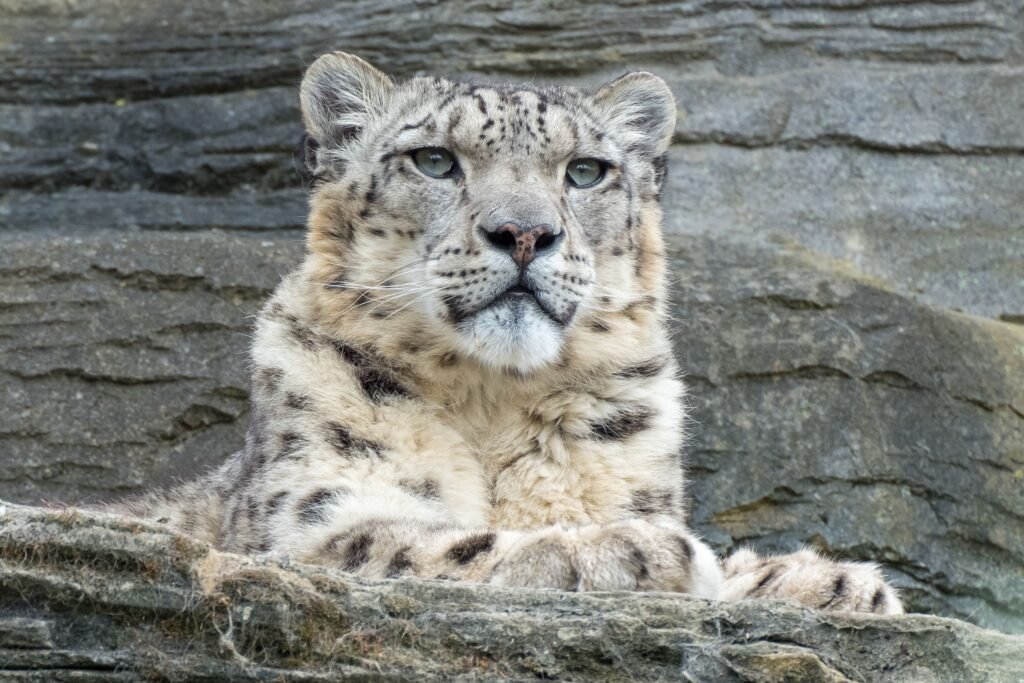
| VU | Vulnerable | High risk of extinction in the wild | Snow leopard |
| NT | Near Threatened | Close to qualifying as threatened, or likely to soon | Markhor |
| LC | Least Concern | Evaluated and not at risk right now | House sparrow |
| DD | Data Deficient | Not enough information to assess the risk | Many deep-sea species |
| NE | Not Evaluated | Not yet assessed against the criteria | Most known species on Earth |
The ordering matters. Think of it as a staircase: species move up toward greater danger (uplisting) or down toward safety (downlisting) as new evidence comes in.
What Each Category Really Means
The table gives you the shape of the system. The details are where it gets interesting.
Extinct (EX)
A species is Extinct when there is no reasonable doubt that the last individual has died. That bar is deliberately high, because declaring extinction has consequences: conservation funding stops, and hope dies with it. The dodo, the passenger pigeon, and the great auk sit in this category.
Extinct in the Wild (EW)
These species are gone from their natural habitat but alive somewhere else: in zoos, breeding centers, botanical gardens, or as naturalized populations outside their historic range. The Spix's macaw, the little blue parrot from Brazil, is the classic example. The category is also where some of conservation's greatest comebacks began: the California condor was effectively extinct in the wild in 1987, but captive breeding and reintroductions have brought it back to a wild (though still Critically Endangered) population.
Critically Endangered (CR)
The red alert. A species faces an extremely high risk of extinction in the wild, usually because its numbers have collapsed or its range has shrunk to almost nothing. The vaquita, a small porpoise found only in Mexico's Gulf of California, has fewer than 20 individuals left, most dying in illegal gillnets. The Sumatran rhino numbers fewer than 80, scattered across fragmented forests in Indonesia. When a species lands here, extinction is no longer a distant scenario; it is the default outcome unless something changes fast.
Endangered (EN)
One step down, but still dire: a very high risk of extinction in the wild. The mountain gorilla, with around a thousand individuals in the forests of central Africa, is the best-known example. The Asian elephant, found across South and Southeast Asia including India and Sri Lanka, is also Endangered, as is the hooded seal, uplisted in October 2025 as Arctic sea ice retreats.
Vulnerable (VU)
Species facing a high risk of extinction in the wild. This is the broadest of the three threatened categories and the one most species land in first. The snow leopard of the high Himalaya, Karakoram, and Hindu Kush is Vulnerable (it was moved down from Endangered as better surveys and conservation work improved its picture). The giant panda has been Vulnerable since 2016, after decades of forest protection in China lifted it out of Endangered, and the Arabian oryx, once extinct in the wild, was reintroduced to the Arabian Peninsula and now holds Vulnerable status.
Near Threatened (NT)
The warning zone. These species do not meet the threatened thresholds yet, but they are close, or likely to qualify soon. Pakistan's national animal, the markhor, sits here: it was listed as Endangered until 2015, when community-led conservation and anti-poaching work helped its numbers recover enough to move it down to Near Threatened. Near Threatened is arguably the most useful category of all: it flags trouble while there is still time to act.
Least Concern (LC)
The all-clear, at least for now. The species has been evaluated and does not qualify for any threatened or Near Threatened category. Most birds, from house sparrows to crows, sit here. Least Concern does not mean "doing fine forever"; it means the numbers and trends do not currently trigger alarm. The green turtle is the newest famous member: decades of beach protection, bycatch reduction, and trade curbs drove an estimated 28% global population increase since the 1970s, earning it a move from Endangered to Least Concern in October 2025.
Data Deficient (DD)
Not enough information exists to make even an indirect assessment of extinction risk. This is not a judgment about the species; it is an admission of ignorance. Deep-sea fishes, remote-island invertebrates, and newly described species pile up here. Data Deficient is a to-do list, not a clean bill of health.
Not Evaluated (NE)
The default state of life on Earth. The overwhelming majority of described species, and virtually all of the millions still undescribed, have never been run through the criteria.
The Five Assessment Criteria: A to E
Categories do not come from gut feeling. A species qualifies as threatened only if it meets at least one of five quantitative criteria, labeled A through E, at the thresholds for that category. If it meets any one criterion at Critically Endangered levels, it is listed as Critically Endangered, even if it misses the others. Here is what each criterion measures.
Criterion A: Population reduction. How fast is the population shrinking? A decline of at least 90% over the last 10 years or three generations (whichever is longer) points to Critically Endangered; 70% to Endangered; 50% to Vulnerable. This criterion catches species in freefall, whether they are still abundant or already rare.
Criterion B: Geographic range. How small is the species' range, and is it shrinking or fragmented? Two measures are used: extent of occurrence (the outer boundary of everywhere the species is found) and area of occupancy (the ground it actually lives on within that boundary). Thresholds: an extent of occurrence under 100 km² suggests Critically Endangered, under 5,000 km² Endangered, under 20,000 km² Vulnerable; for area of occupancy the lines are under 10, 500, and 2,000 km².
Criterion C: Small population size plus decline. Fewer than 250 mature individuals points to Critically Endangered, fewer than 2,500 to Endangered, fewer than 10,000 to Vulnerable, provided the population is also declining (or structured in a fragile way, such as nearly all individuals in one subpopulation).
Criterion D: Very small or restricted population. The emergency-room criterion. Under 50 mature individuals means Critically Endangered; under 250, Endangered; under 1,000, Vulnerable. For Vulnerable only, a species also qualifies if its area of occupancy is under 20 km² or it is known from five or fewer locations, making it one storm away from disaster.
Criterion E: Quantitative analysis. When enough data exists to build a population model, the math decides: an extinction probability of at least 50% within 10 years or three generations means Critically Endangered; at least 20% within 20 years or five generations means Endangered; at least 10% within 100 years means Vulnerable.
The key thresholds, side by side:
| Criterion | What it measures | CR threshold | EN threshold | VU threshold |
|---|---|---|---|---|
| A | Population decline (10 yrs or 3 generations) | 90% or more | 70% or more | 50% or more |
| B | Extent of occurrence | Under 100 km² | Under 5,000 km² | Under 20,000 km² |
| B | Area of occupancy | Under 10 km² | Under 500 km² | Under 2,000 km² |
| C | Mature individuals, with decline | Under 250 | Under 2,500 | Under 10,000 |
| D | Mature individuals, very small population | Under 50 | Under 250 | Under 1,000 |
| E | Modeled extinction probability | 50%+ in 10 yrs/3 gen | 20%+ in 20 yrs/5 gen | 10%+ in 100 yrs |
One subtlety worth knowing: the criteria are about symptoms of extinction risk, not rarity alone. A species can be naturally rare for millions of years without being threatened, and a once-abundant species can be in deep trouble. Criterion A exists precisely to catch the second case.
How a Species Gets Assessed: From Field Data to Red List
So who actually does the assessing? Not a single committee in Geneva, but a global network of specialists.
The work is coordinated through the IUCN Species Survival Commission (SSC), a network of thousands of scientists organized into Specialist Groups for particular taxa (cats, turtles, sharks, cycads, and many more). These groups, along with partners such as BirdLife International (which handles all birds), act as Red List Authorities: they decide who assesses what and make sure the criteria are applied consistently.
The pipeline looks like this:
- Data gathering. Assessors compile everything known about the species: population counts, range maps, habitat trends, threats, and conservation actions, drawn from published papers, museum records, field observations, satellite imagery, and local knowledge.
- Applying the criteria. The assessor runs the data through criteria A to E and proposes a category, documenting the evidence and the uncertainty behind every number.
- Peer review. Each assessment is checked by at least two qualified reviewers, usually assigned by the relevant Red List Authority, in a process much like peer review for a scientific paper.
- Consistency checks. The IUCN Red List Unit reviews the assessment for consistency across regions and taxa before it is finalized.
- Publication. The assessment goes live on iucnredlist.org, free for anyone to read, and is folded into the twice-yearly global updates.
Assessments are meant to be revisited: the IUCN aims to re-evaluate every species at least every ten years, and every five years where possible. That is why categories move. When the markhor was reassessed, better population data plus evidence of recovery moved it from Endangered to Near Threatened. When Arctic surveys showed ice-dependent seals in trouble, three seal species were uplisted in October 2025. The Red List Index, a summary of how extinction risk changes across whole groups of species over time, is one of the headline indicators the world uses to track progress on biodiversity goals.
Why the Categories Matter, and Where They Fall Short
The labels do real work. Governments use Red List data to set conservation priorities and design protected areas. International agreements, from CITES trade controls to biodiversity targets, lean on it, and scientists use it to track the planet's biodiversity pulse. The green turtle's downlisting did not happen by accident: decades of nesting-beach protection, turtle excluder devices in shrimp trawls, and curbs on the tortoiseshell trade all trace back to priorities the list helped set.
But the system has limits, and honest explainers should name them.
First, data gaps are enormous. Many species are Data Deficient or Not Evaluated simply because nobody has studied them, and the list is still biased toward vertebrates: mammals, birds, and amphibians are far better covered than insects, fungi, or deep-sea life.
Second, a global category can hide local reality. The markhor is Near Threatened globally, yet individual populations in parts of its range remain fragile and heavily dependent on community conservancies. National and regional Red Lists exist precisely to capture that finer picture.
Third, the list is a snapshot, not a forecast or a law. A Least Concern label is not a promise of safety, and a threatened label does not by itself make hunting illegal. Categories describe risk; humans still have to act on it.
Pakistan and South Asia on the Red List
The categories become concrete when you look at the animals outside your own window. South Asia, and Pakistan in particular, hosts species spanning almost the whole staircase.
The markhor, Pakistan's national animal, is the region's signature Red List story: listed as Endangered for years, it was moved to Near Threatened in 2015 after community-based conservancies, trophy-hunting revenue shared with villages, and stricter anti-poaching enforcement helped populations recover in the mountains of Khyber Pakhtunkhwa, Gilgit-Baltistan, and Balochistan.
The snow leopard, patrolling the high ranges of northern Pakistan, is listed as Vulnerable. The Indus river dolphin, one of the world's rarest freshwater cetaceans and found almost entirely in Pakistan's Indus River, is Endangered, threatened by barrages that fragment its habitat, pollution, and accidental entanglement in fishing gear. Across the border, the Bengal tiger and the Asian elephant are both Endangered, while the one-horned rhinoceros of India and Nepal, a famous recovery from the brink, is Vulnerable.
Reading the list through a South Asian lens shows what the categories are for: they turn distant global statistics into a to-do list for the rivers, forests, and mountains nearby.
IUCN Red List FAQs
How many IUCN Red List categories are there?
Nine: Extinct, Extinct in the Wild, Critically Endangered, Endangered, Vulnerable, Near Threatened, Least Concern, Data Deficient, and Not Evaluated. Only the first three threatened ones, Critically Endangered, Endangered, and Vulnerable, count as "threatened."
What is the difference between Endangered and Critically Endangered?
It is a difference of degree and urgency. Critically Endangered means an extremely high risk of extinction in the wild; Endangered means a very high risk. In numbers, the thresholds roughly halve or double at each step: for example, a population decline of 90% or more over 10 years or three generations points to Critically Endangered, while 70% points to Endangered and 50% to Vulnerable.
What are the five IUCN Red List assessment criteria?
Criterion A measures population reduction, B measures geographic range size, C measures small and declining populations, D measures very small or restricted populations, and E uses quantitative modeling of extinction probability. A species qualifies for a threatened category if it meets any one of the five at the relevant threshold.
How often is the IUCN Red List updated?
New and updated assessments are published roughly twice a year, in spring and autumn updates. The October 2025 update, for example, brought the totals to 172,620 species assessed and 48,646 threatened with extinction.
Is a Red List category legally binding?
No. The Red List is a scientific assessment, not a law. A threatened listing does not automatically restrict trade or hunting, though governments and treaties such as CITES rely heavily on Red List data when they write the rules that do.
Why is a species listed as Data Deficient instead of just guessing?
Because a wrong guess is worse than an honest gap. Data Deficient means the available information is inadequate for even an indirect assessment of extinction risk. It flags the species as needing research rather than assigning it a category the evidence cannot support.
Can a species move to a better category?
Yes, and it happens regularly. The markhor moved from Endangered to Near Threatened, the giant panda from Endangered to Vulnerable, the Arabian oryx from Extinct in the Wild to Vulnerable, and the green turtle from Endangered to Least Concern in October 2025. Downlisting is the list's way of saying conservation worked.
Reading the Labels Like a Conservationist
The IUCN Red List categories are, at heart, a translation device. They turn field counts, range maps, and population models into nine words anyone can understand, from Extinct to Least Concern. The five criteria keep the system honest: numbers, not vibes, decide where a species lands. And because assessments are repeated, the list also records movement, which is how we know the green turtle is recovering, the hooded seal is newly in trouble, and the markhor's mountain strongholds are holding.