How Dolphin Echolocation Works: Nature’s Sonar Explained
A dolphin hunting in dark or murky water faces a problem: it cannot see its prey. Yet dolphins chase down fast-moving fish in blackness with astonishing precision. The secret is biological sonar. This guide explains how dolphin echolocation works, step by step, from the click a dolphin produces in its nasal passages to the mental map its brain builds from returning echoes. It is one of the most sophisticated sensory systems in the animal kingdom, and it even lets a nearly blind dolphin in Pakistan's Indus River navigate one of the murkiest rivers on Earth.
What Is Echolocation? Nature's Sonar
Echolocation, sometimes called biosonar, is the ability to locate objects by producing sounds and interpreting the echoes that bounce back. A dolphin sends out sound waves; when those waves strike something, part of the signal reflects back; and the dolphin's brain reads the returning echo to judge what is out there.
Dolphins are not the only echolocators. Many bats navigate the night sky the same way, an example of convergent evolution: two unrelated groups arriving at the same solution independently. Among marine mammals, echolocation is the specialty of the toothed whales, the odontocetes, a group that includes dolphins, orcas, sperm whales, and porpoises. Baleen whales, which filter-feed on tiny prey, do not echolocate.
For a dolphin, echolocation is not a party trick. It is the primary sense for navigating, hunting, avoiding predators, and understanding the environment, especially where vision fails: in deep water, at night, or in silt-clouded rivers and estuaries.
Why Dolphins Depend on Sound, Not Sight
Light behaves badly underwater. It fades quickly with depth, scatters in murky water, and vanishes entirely at night. Sound, by contrast, behaves beautifully. In water, sound waves travel about 4.5 times faster than they do in air, which makes the ocean an ideal medium for an acoustic sense.
Dolphins are built around this fact. Unlike humans, they have no vocal cords and no external ear flaps. Their eyes work, but in the conditions where dolphins often hunt, in deep dark water or at night, their sense of sight is almost nil. They do not need it, because they can detect and chase fast prey through the emission of sounds alone.
It is worth noting what dolphins do with different sounds. Dolphins communicate with lower-frequency signals such as whistles and chirps, but they switch to very high-frequency clicks for echolocation. The two jobs use different frequency bands, like separate radio channels for talking and for scanning.
Step 1: Making the Click
Everything starts in the dolphin's nasal region, just below the blowhole. Dolphins have no vocal cords, so they generate sound through other internal structures. For echolocation, the key instruments are the phonic lips, paired structures in the nasal passages. When the dolphin pushes air between these lips, they open and close rapidly, and the surrounding tissues vibrate, producing sound waves.
These are the famous clicks: short, broadband burst-pulses that sound like sharp clicks to human ears. In bottlenose dolphins, echolocation clicks typically range from about 20 kilohertz up to around 150 kilohertz, far above the limit of human hearing, which tops out near 20 kilohertz. Even dogs and cats, with their celebrated hearing, hear only up to about 45 and 65 kilohertz respectively.
Dolphins do not simply fire clicks at random. They emit them in rapid sequences called click trains, and they precisely control each click's frequency, intensity, and repetition rate. Scanning a wide area calls for one pattern; closing in on a single fish calls for another. As researchers have found, dolphins can analyze extraordinary click rates, processing the returning information fast enough to track individual prey in real time.
Step 2: Focusing the Beam With the Melon
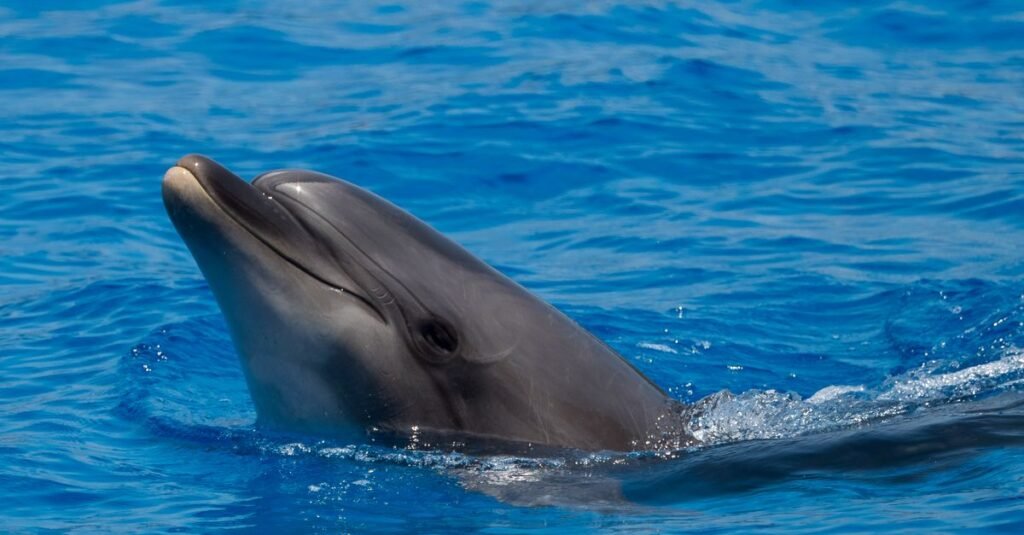
Raw clicks would scatter in all directions if the dolphin did nothing to aim them. The aiming device is the melon, the rounded, bulging forehead that gives dolphins their characteristic profile. The melon is a mass of specialized fatty tissue that acts as an acoustic lens.
Sound travels through the melon and emerges as a focused, directional beam projected forward into the water. Dolphins can even adjust the shape of the melon to change the beam, widening it to scan a broad area or narrowing it to interrogate a single target, much like adjusting a flashlight. This steering matters because a tight beam returns cleaner echoes and reveals finer detail.
The fats in the melon have acoustic properties close to those of seawater, which lets sound pass from the dolphin's head into the water with minimal reflection or loss. It is an elegant piece of engineering: a living lens made of fat. The principle scales up dramatically across the toothed whales: in sperm whales, the equivalent fatty sound-focusing structures can weigh many tons.
Step 3: Catching the Echo Through the Lower Jaw
When the click beam strikes an object, echoes scatter back toward the dolphin. Here comes the strangest part of the system: the dolphin does not primarily hear the returning echoes with its ears. It catches them with its lower jaw.
Behind a thin section of the lower jawbone, called the acoustic window, lies a channel of special fats similar in composition to the melon. These fats conduct sound vibrations efficiently from the jaw to the middle ear, and from there the signal travels along the auditory nerve to the brain. The fatty channel runs from the jaw all the way to the middle ear region, giving sound a dedicated private line into the dolphin's hearing system. Dolphins lack external ears entirely; the jaw pathway replaces them, and experiments suggest it also helps the dolphin judge the direction an echo comes from, since each side of the jaw receives slightly different timing.
The Woods Hole Oceanographic Institution describes the sequence plainly: the melon focuses the outgoing clicks into a directional beam, the echoes are received at the acoustic window in the lower jaw, and the information passes to the middle ear and ultimately to the brain for interpretation. Then, as their scientists cheerfully add, it is time to eat.
Step 4: Reading the Echo
The brain's job is where echolocation becomes genuinely extraordinary. A returning echo carries several kinds of information, and the dolphin's auditory system, one of the most developed among mammals, decodes them in fractions of a second:
- Distance. Sound travels at a known speed through water, so the time between sending a click and receiving its echo reveals exactly how far away the object is. Dolphins can resolve timing differences of less than 100 microseconds.
- Size and shape. The duration and waveform of the echo hint at the target's dimensions and outline.
- Direction and speed. Changes in the echo's frequency, the Doppler effect, show whether the target is moving toward or away from the dolphin and how fast.
- Composition and density. Some frequencies penetrate soft tissues, so the echo can reveal what something is made of. A dolphin can distinguish a fish from a rock, and researchers believe dolphins can even detect differences in internal structure, such as air pockets inside a fish's body.
- Fine detail. Laboratory studies show dolphins can discriminate between targets separated by just a few centimeters and can detect small objects, like a coin-sized item, from tens of meters away.
Put together, the dolphin builds a real-time acoustic image of its surroundings: not a photograph, but a rich spatial map of where things are, what they are, and how they are moving.
The Hunt in Sound: Click Trains and the Terminal Buzz
Echolocation during a hunt follows a recognizable sequence. As a dolphin closes in on prey, its clicking changes in a pattern researchers can read like a play-by-play:
| Stage | What the dolphin does | Purpose |
|---|---|---|
| 1. Initial detection | Emits broad click trains covering a wide area | Scanning for anything interesting in the vicinity |
| 2. Target acquisition | Focuses clicks into tighter trains with a rising repetition rate | Pinpointing one target and locking on |
| 3. Prey analysis | Varies click frequency and intensity | Judging the target's size, shape, speed, and identity |
| 4. Pursuit and capture | Fires rapid bursts of clicks known as the terminal buzz | Guiding the final strike with continuous updates |
The terminal buzz is the climax: a high-repetition burst of clicks that gives the dolphin echo feedback many times per second as it lunges. Similar buzz phases have been recorded in hunting bats, sperm whales, and porpoises, another sign that evolution keeps rediscovering the same good trick. Bottlenose dolphins often hunt cooperatively as well, herding fish into tight groups or trapping schools against sandbars and seawalls before taking turns charging through, with echolocation guiding the choreography.
Dolphin Echolocation vs. Human Sonar
Human engineers invented sonar by copying, knowingly or not, what toothed whales had been doing for millions of years. The parallels are striking:
| Feature | Dolphin echolocation | Human sonar |
|---|---|---|
| Sound source | Phonic lips in the nasal passages | Electronic transducers |
| Focusing | Fatty melon acts as an acoustic lens | Shaped transducer arrays |
| Receiver | Lower jaw fat channels to the middle ear | Hydrophone arrays |
| Frequency | Roughly 20 to 150 kHz in bottlenose dolphins | Varies widely by application |
| Processing | Brain interprets echoes in real time | Computers process return signals |
| Information gained | Distance, size, shape, speed, density | Distance, size, shape, speed |
Where humans still lag is in the processing. A dolphin's brain fuses echo timing, frequency shifts, and amplitude patterns into an instant, three-dimensional understanding of a moving target, all with hardware that runs on fish.
The Indus River Dolphin: A Life Built Entirely on Echoes
No animal demonstrates the power of dolphin echolocation better than the Indus river dolphin, known locally as the bhulan. It lives in the Indus River of Pakistan, where the water runs thick with silt and light barely penetrates. In such darkness, eyes are dead weight, and evolution has treated them that way: the Indus dolphin's eyes are tiny, lack a proper lens, and can sense little more than the level and direction of light. Scientists consider the species functionally blind.
So the bhulan sees with sound instead. It produces sound almost constantly while swimming, using echolocation to navigate, find food, and communicate in water where vision is useless. It often swims on its side, sweeping one flipper along the riverbed while its long beak probes for fish, prawns, and clams hiding in the mud, typically diving for 30 to 90 seconds between breaths. Every lunge is guided by echoes.
This makes the Indus dolphin one of the most echolocation-dependent mammals on Earth, and also one of the most vulnerable. NOAA Fisheries listed it as endangered in 1991. Dams and barrages have fragmented its habitat, shrinking its range dramatically, and it now survives mainly in a few separated stretches of the Indus. Entanglement in fishing gear, pollution, vessel strikes, and noise all threaten an animal that experiences the world almost entirely through sound. Protecting the bhulan means protecting the acoustic clarity of its river.
When the Ocean Gets Too Loud
Echolocation is exquisitely sensitive, which makes it fragile. The ocean is growing noisier: ship engines, seismic surveys, construction, military sonar, and coastal industry all pour sound into the water. For an animal that navigates by listening, this is like trying to read by flickering light.
Excessive noise can mask the faint echoes dolphins depend on, disorient them, and disrupt navigation and hunting. Very loud sounds can damage their hearing outright, and chronic noise forces dolphins to expend more energy vocalizing or to abandon otherwise good habitat. Researchers studying dolphin behavior consistently flag noise pollution as a serious and growing threat to toothed whales, one that is entirely human-made and entirely preventable in many cases through quieter ship designs, speed restrictions, and protected quiet zones.
What Echolocation Cannot Do
For all its sophistication, dolphin echolocation has limits, and honest science should name them. It is a short-to-medium-range sense: dolphins get their best results when targets lie roughly 5 to 200 meters away, not kilometers. Very close up, dolphins still use vision in clear water, and echolocation cannot resolve everything, such as fine color or texture that eyes capture easily.
It can also be fooled. Turbulent, bubble-filled water scatters clicks, and a noisy background can drown out faint echoes. And while dolphins extract remarkable detail from echoes, scientists are still working out exactly how much internal structure a dolphin can perceive; the evidence is strong but the precise limits remain an active area of research. Echolocation is a superpower with a range limit, not magic.
Frequently Asked Questions
How do dolphins make their clicking sounds?
Dolphins have no vocal cords. They make echolocation clicks with phonic lips, paired structures in the nasal passages below the blowhole. Pushing air between these lips makes the surrounding tissues vibrate, producing short bursts of high-frequency sound that the melon then focuses into a beam.
Can dolphins really "see" with sound?
In a functional sense, yes. By analyzing the timing, intensity, frequency, and direction of returning echoes, a dolphin's brain constructs a detailed spatial map of its surroundings, revealing an object's distance, size, shape, movement, and even density. It is not vision as humans know it, but it serves the same purpose.
What frequencies do dolphin echolocation clicks use?
Bottlenose dolphin clicks typically range from about 20 kilohertz to around 150 kilohertz, well above the roughly 20 kilohertz upper limit of human hearing. Dolphins use lower-frequency whistles and chirps for communication and reserve the high frequencies for echolocation.
Do all dolphins and whales use echolocation?
All toothed whales, the odontocetes, echolocate, including dolphins, orcas, sperm whales, and porpoises. Baleen whales, which feed by filtering tiny prey from the water, do not use echolocation.
Is the Indus river dolphin really blind?
It is functionally blind rather than completely sightless. Its tiny eyes can detect light levels and direction but cannot form images. Living in the silt-laden Indus River of Pakistan, where vision would be useless anyway, it navigates and hunts almost entirely by echolocation and is listed as endangered.
Conclusion
Understanding how dolphin echolocation works reveals an animal perfectly tuned to its medium: clicks forged in the nasal passages, aimed by a fatty lens in the forehead, caught through the jawbone, and decoded by a brain that turns echoes into a living map. From a bottlenose dolphin herding fish in clear coastal water to the blind bhulan sweeping the muddy Indus by sound alone, echolocation is the thread that lets these mammals thrive where eyes fail. It is a reminder that there are many ways to perceive a world, and that the oceans are worth keeping quiet enough for dolphins to keep listening. Toothed whales have refined this system over millions of years of evolution, and in many respects it still outperforms the technology humans built to do the same job.