Types of Renewable Energy: The Complete 2026 Guide
Every civilization has run on energy, but for two centuries we have run mostly on the compressed remains of ancient life: coal, oil, and gas. That era is ending, not because the fuels ran out, but because we found something better. Renewable energy, power drawn from sources that replenish themselves on human timescales, is now the cheapest way to generate new electricity in much of the world and the fastest-growing part of the global energy system. Each year, the world installs more solar and wind capacity than the year before, and investment in clean energy now exceeds investment in fossil fuels.
This guide walks through each major type of renewable energy, explains how it works, weighs the honest pros and cons, and looks at what the transition means, including for countries like Pakistan.
What makes energy renewable
The definition is simple: renewable energy comes from natural sources that are replenished as fast as we use them, or faster. Sunlight arrives daily. Wind blows with the weather. Rivers flow. Earth's interior heat persists. Plants regrow. Contrast this with fossil fuels, which took millions of years to form and are consumed in an instant on geological timescales.
A useful distinction is between variable and controllable renewables. Solar and wind are variable: their output rises and falls with weather. Hydropower from dammed reservoirs, geothermal, and biomass are controllable: they can generate on demand, which makes them invaluable partners in a clean grid. Modern grids blend both, increasingly with battery storage smoothing the variable share.
One clarification: nuclear power is low-carbon but not renewable, because it depends on mined uranium fuel that does not replenish. It belongs in the clean energy conversation, but not in this guide.
Solar energy
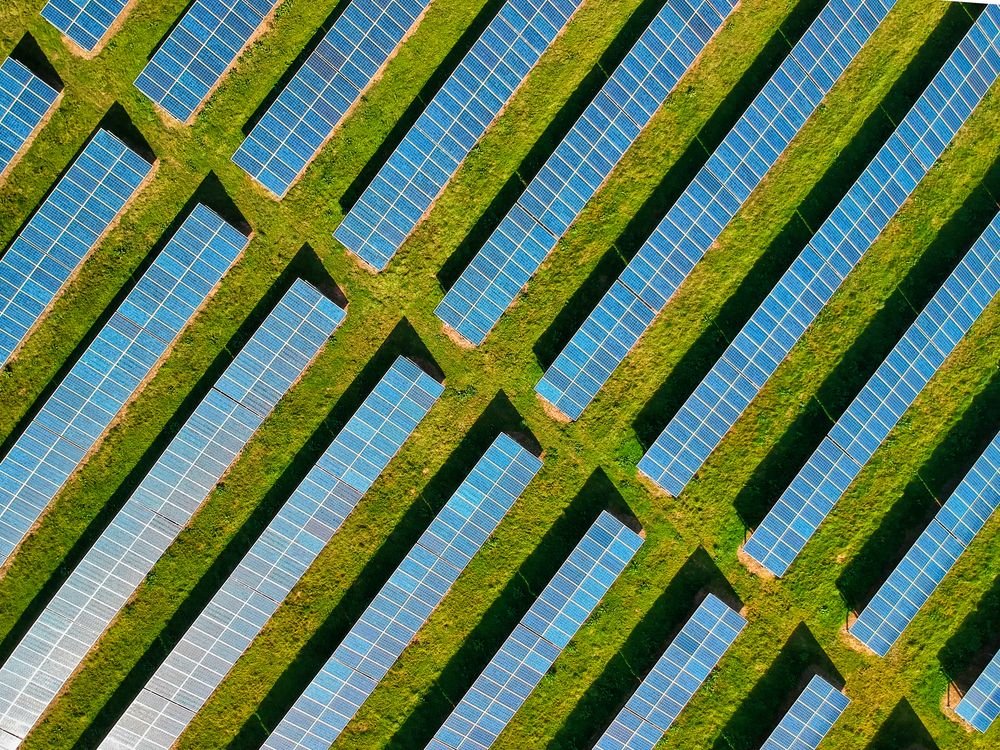
Solar is the most abundant energy source available to humanity. The sun delivers far more energy to Earth in an hour than civilization uses in a year. Capturing it takes two main forms.
Photovoltaic (PV) panels convert sunlight directly into electricity. When photons strike a semiconductor, usually silicon, they knock electrons loose, creating an electric current. Panel types differ in efficiency: monocrystalline silicon panels typically convert 15 to 20 percent of incoming sunlight, polycrystalline 12 to 16 percent, and thin-film cells 7 to 13 percent. Efficiencies keep creeping upward as manufacturing improves.
Solar thermal systems take a different route, concentrating sunlight with mirrors to heat a fluid, make steam, and drive a turbine, or simply heating water directly for buildings.
The strengths are compelling. Solar works at every scale, from a phone charger to gigawatt desert farms. It has no fuel cost, minimal maintenance, and silent operation. Rooftop solar lets households generate their own power, and costs have fallen roughly 90 percent since 2010.
The limits are real too. Output stops at night and dips under clouds, so storage or grid backup is needed. Large farms need land, though rooftops, parking lots, and degraded land reduce conflicts. Manufacturing panels uses energy and materials, and recycling infrastructure for old panels is still maturing, though the industry is scaling up take-back and material recovery programs as early installations age.
Pakistan's solar story is just beginning. With some of the world's best sunshine, particularly in Balochistan, Sindh, and southern Punjab, the resource dwarfs domestic demand. Falling panel prices have triggered a rooftop solar boom in cities like Lahore and Karachi, though grid integration and net-metering policies remain works in progress.
Wind energy
Wind turbines convert the kinetic energy of moving air into electricity. Blades catch the wind and spin a rotor, which drives a generator through a gearbox (or directly, in newer designs). A single modern offshore turbine can power thousands of homes.
Wind is now among the cheapest sources of new electricity globally, with low operating costs once turbines are built. Turbines occupy little ground area, so farmland can continue around them. Offshore wind taps stronger, steadier sea winds.
The drawbacks are familiar. Wind is variable, so output fluctuates. The best sites are often remote, requiring transmission lines. Turbines raise concerns about noise, visual impact, and bird and bat collisions, though careful siting and newer designs reduce harm, and fossil fuel infrastructure kills far more birds through pollution and climate change. Repowering, replacing old turbines with fewer, larger, more efficient ones, is now extending the life of early wind farms.
Wind met about 10 percent of electricity demand in more than a dozen countries as of the mid-2010s, and the share has grown since. Pakistan's Gharo-Jhimpir wind corridor in Sindh hosts a growing cluster of wind farms, showing how the technology suits the country's coastal wind regimes.
Hydropower
Hydropower is the oldest and still the largest renewable electricity source worldwide. Dams store water at height, then release it through turbines. Run-of-river designs skip the big reservoir, generating from natural flow.
Its great virtue is controllability. A dammed reservoir is a giant battery: operators can ramp generation up or down in minutes, making hydro the perfect partner for variable solar and wind. It is also long-lived, with dams operating for many decades, and cheap once built.
The costs are significant. Large dams flood valleys, displace communities, block fish migration, and alter river ecosystems and sediment flows that deltas depend on. Reservoirs in tropical regions can emit methane from submerged vegetation. Droughts, intensified by climate change, threaten output, as recent years have shown from the western United States to China.
Pakistan knows hydro intimately. Tarbela and Mangla are among the country's largest power sources, and projects like Diamer-Bhasha aim to add capacity and water storage. But the same climate change driving the energy transition also threatens Himalayan river flows through shifting glacier melt, a reminder that energy planning and climate adaptation are inseparable.
Geothermal energy
Beneath our feet, Earth is hot. Geothermal energy taps that heat, either directly for warming buildings or by drilling into steam reservoirs to spin turbines. Iceland, Kenya, Indonesia, and the Philippines lead in geothermal power; many more countries use geothermal heat pumps, which exploit stable underground temperatures for efficient heating and cooling.
Geothermal's superpower is reliability. It runs around the clock, in any weather, with a tiny land footprint and decades-long plant lifespans. For heating, geothermal heat pumps can cut energy use dramatically compared with furnaces.
The catch is geography and cost. High-grade geothermal resources cluster near tectonic boundaries, so not every country can build big plants. Drilling deep wells is expensive and technically demanding, and exploratory drilling sometimes comes up dry. Enhanced geothermal systems, which create artificial reservoirs by fracturing hot rock, could widen the map but remain early-stage, with pilot projects in the United States and Europe testing whether the approach can scale safely and affordably.
Biomass and bioenergy
Biomass burns organic material, wood, crop residues, animal waste, algae, to produce heat or electricity, or converts it into liquid biofuels. It is considered renewable because plants regrow, absorbing CO2 as they do.
Done well, biomass turns waste into value: agricultural residues that would rot, forestry offcuts, and even municipal waste become energy. It provides steady, controllable output and can use existing combustion infrastructure.
Done poorly, it is problematic. Clearing forests for fuel defeats the purpose. Burning biomass still emits CO2 and air pollutants at the stack; the climate benefit depends on genuine regrowth and full lifecycle accounting. Competition with food crops for land raises ethical questions, and hauling bulky fuel is costly.
The honest verdict: biomass works best as a waste-to-energy solution and a niche controllable source, not as a primary pillar of decarbonization. Where it is used, strict sustainability certification and full lifecycle emissions accounting separate the genuinely helpful projects from the greenwashed ones.
Ocean and tidal energy
The sea offers several energy forms. Tidal stream turbines harvest predictable tidal currents. Tidal barrages dam estuaries. Wave devices capture surface motion. Ocean thermal energy conversion exploits temperature differences between warm surface and cold deep water.
The appeal is predictability, especially tides, which run on lunar timetables rather than weather. The challenge is harsh marine engineering, high costs, and limited deployment. Tidal and wave energy remain the least utilized renewables, with only a handful of commercial-scale projects worldwide. For island and coastal nations with strong tides, the long-term potential is real, but the technology needs more development to compete.
Comparing the options
| Type | How it works | Key strengths | Key limitations |
|---|---|---|---|
| Solar PV | Panels convert sunlight to electricity | Cheap, scalable, silent, low maintenance | Variable, needs land or roofs, nighttime gap |
| Wind | Turbines capture air movement | Cheap, low operating cost, small footprint | Variable, siting and wildlife concerns |
| Hydropower | Falling water spins turbines | Controllable, long-lived, grid-stabilizing | Dams disrupt rivers, drought-vulnerable |
| Geothermal | Earth's heat makes steam or warms buildings | 24/7, tiny footprint, reliable | Geography-limited, costly drilling |
| Biomass | Burns or converts organic matter | Uses waste, controllable output | Emissions, land competition, lifecycle questions |
| Ocean/tidal | Tides, waves, thermal gradients | Predictable (tides) | Expensive, early-stage, harsh environment |
No single source does everything. The emerging consensus is a portfolio: cheap variable solar and wind providing the bulk of electricity, controllable hydro and geothermal firming supply, storage bridging gaps, and grids tying it together across regions and time zones.
How renewables are reshaping electricity markets
Cheap solar and wind are rewiring how power markets work. Because they have no fuel cost, they bid into electricity markets at near-zero marginal cost, pushing wholesale prices down whenever the sun shines and the wind blows. This "merit order effect" has already reshaped markets in Europe, parts of the United States, Australia, and increasingly in Asia.
The shift creates new challenges for market design. Traditional plants earned money by running steadily; in a renewables-heavy grid, value shifts to flexibility, the ability to ramp quickly, store energy, or shift demand. Capacity markets, time-of-use pricing, and payments for grid services are evolving to reward that flexibility.
For consumers, the long-run prize is cheaper, more stable electricity insulated from fuel price spikes. The transition period can be bumpy, as grids built for one-way flow from big plants adapt to millions of distributed solar roofs and batteries. But the direction is set: electrons from the sky and wind keep getting cheaper, while dug-up fuels do not.
The storage piece of the puzzle
Variable renewables raise an obvious question: what happens when the sun sets and the wind calms? Storage is the answer, and it is scaling fast.
Lithium-ion batteries, the same chemistry as in phones and EVs, now back grids for hours at a time, and costs have plunged. Pumped hydro storage, pumping water uphill when power is cheap and releasing it later, remains the largest form of grid storage by far. Emerging options include green hydrogen for long-duration storage and industrial uses, compressed air, and thermal storage.
Critics once argued grids could not run on high shares of variable renewables. Several countries and regions now regularly do, using forecasting, interconnection, demand flexibility, and storage. The engineering challenge is real but increasingly solved.
Jobs and the just transition
The energy transition is also an employment story. Renewable energy is labor-intensive to build: manufacturing panels and turbines, installing them, maintaining them, and upgrading grids creates millions of jobs worldwide. The International Renewable Energy Agency has tracked steady growth in renewable employment, with solar PV the largest employer.
But transitions have losers as well as winners. Coal miners, oil workers, and communities built around fossil plants face real disruption. The concept of a "just transition" insists these workers and regions get retraining, investment, and a genuine stake in the new economy rather than being abandoned. Germany's coal regions, Spain's mining towns, and parts of the United States show both the difficulty and the possibility of managed transitions.
For developing countries, the jobs argument cuts strongly in favor of renewables. Imported fuel sends money abroad; domestic sun, wind, and rivers keep investment and employment at home. Pakistan's solar boom has already created installation and maintenance livelihoods in cities and villages alike, a preview of what scaled deployment could deliver.
Renewables in Pakistan: the opportunity
Pakistan's energy mix still leans heavily on imported fossil fuels, which strain foreign exchange and expose the economy to price shocks. The renewable alternative is strikingly favorable.
Solar potential is world-class across much of the country. The Sindh wind corridor is proven. Hydropower from the Indus system already anchors the grid, with more projects planned. What lags is not resources but integration: transmission to carry power from sunny and windy regions to cities, storage and flexible demand to manage variability, and stable policies that give investors confidence.
The economics increasingly favor speed. Every year of delay locks in more imported fuel costs and more emissions. Countries that moved early on renewables now enjoy some of the world's cheapest electricity. Pakistan has the sun, the wind, and the rivers. The remaining ingredient is execution.
Frequently asked questions
What are the main types of renewable energy? The six main types are solar, wind, hydropower, geothermal, biomass, and ocean (tidal and wave) energy. Solar, wind, and hydro dominate global deployment today.
Which renewable energy is best? It depends on location and need. Solar and wind are cheapest for new electricity in most places. Hydropower and geothermal provide controllable baseload. The best systems combine several types with storage.
Is renewable energy really cheaper than fossil fuels? For new electricity generation, yes, in most of the world. Solar and wind have no fuel costs, and their equipment costs have fallen dramatically. Fossil plants face ongoing fuel expenses and price volatility.
What are the disadvantages of renewable energy? Intermittency for solar and wind, land use for large farms, ecosystem impacts from dams, geographic limits for geothermal, and lifecycle concerns for biomass. None are deal-breakers, but all require honest planning.
Can the world run entirely on renewable energy? Studies suggest it is technically feasible with a mix of sources, storage, expanded grids, and electrification, though the pace depends on investment and policy. Many researchers see renewables providing the large majority of a decarbonized energy system.
What is the fastest-growing renewable energy source? Solar power has been the fastest-growing source for years, with annual installations repeatedly breaking records. Wind follows, and both are growing far faster than fossil generation.
Do renewables work in cloudy or calm countries? Yes, with the right mix. Germany, not known for endless sunshine, gets a large share of its electricity from solar and wind. Grids balance variability with interconnection, storage, demand flexibility, and controllable sources like hydro.
The renewable transition is no longer a question of technology. The technologies work, the costs fell, and deployment is accelerating on every continent. What remains is the speed of the build-out, and that is a matter of choice. Every solar panel installed, every wind farm connected, and every coal plant retired early is a decision to make the energy system cleaner, cheaper, and more secure than the one it replaces.