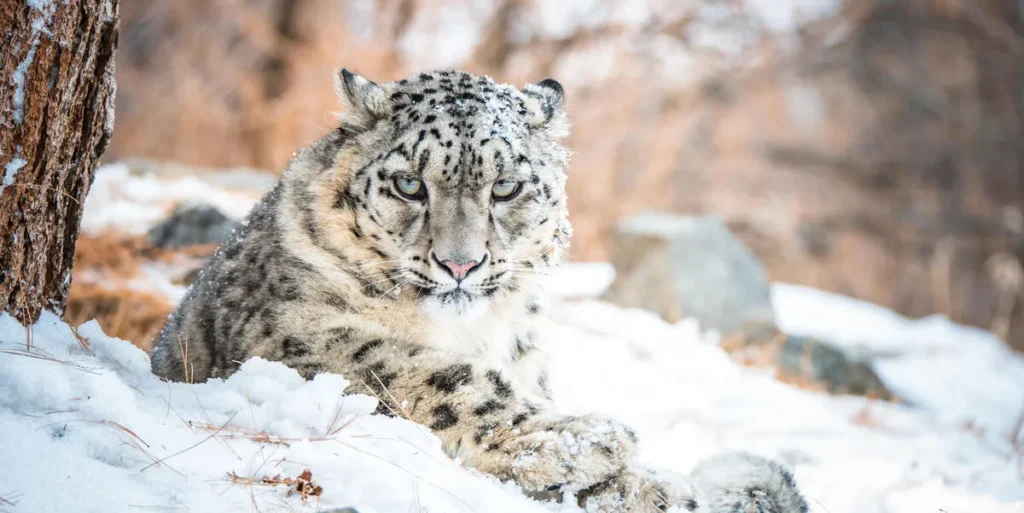
Snow Leopard in Pakistan: The Ghost of the Mountains
Few animals are as hard to see as the snow leopard. It moves through the cliffs and ridgelines of the world's highest mountains like smoke, gray on gray, silent and solitary. Researchers call it the ghost of the mountains, and in Pakistan that ghost haunts four great ranges: the Hindu Kush, the Karakoram, the Pamir and the western Himalayas. For decades, nobody knew how many snow leopards Pakistan actually had. Estimates bounced around between 200 and 400, based on little more than questionnaires and expert hunches. Then a decade-long scientific survey finally produced a real number, and it was sobering: about 167 snow leopards, making Pakistan's population one of the smallest and most vulnerable of any range country.
This article explains where snow leopards live in Pakistan, how scientists counted them, what makes them such extraordinary mountain animals, what threatens them, and who is working to keep them on the ridgelines.
Where snow leopards live in Pakistan
The snow leopard (Panthera uncia) is a cat of 12 countries across Central and South Asia, from Afghanistan and Russia to Mongolia and China. Globally, between 3,500 and 7,000 individuals are estimated to remain, and the species is listed as Vulnerable on the IUCN Red List, with the global population expected to keep declining.
In Pakistan, snow leopards occupy more than 80,000 square kilometres of mountain habitat, mainly in Gilgit-Baltistan and northern Khyber Pakhtunkhwa, with some presence in Azad Jammu and Kashmir. Their range spans four mountain systems, each with its own character. The table below breaks it down.
| Mountain range | Key areas | Notes |
|---|---|---|
| Karakoram | Central Karakoram National Park, Khunjerab area, Baltistan | Held the largest single population in the national survey |
| Hindu Kush | Chitral, including Chitral Gol National Park | Second-largest share; long history of camera-trap research |
| Pamir | High border country near Afghanistan and China | Remote, transboundary habitat |
| Western Himalayas | Parts of Gilgit-Baltistan and Azad Jammu and Kashmir | Smallest of the four shares in Pakistan |
The cats live in alpine and subalpine zones, typically between 3,000 and 4,500 metres (about 9,800 to 14,800 feet), where steep cliffs, ridges and rocky outcrops give them cover and vantage points. They need enormous home ranges because prey is scarce and thinly spread. National Geographic reports that a male's territory can reach 80 square miles (an area bigger than three Manhattans), while females use up to 48 square miles. In the sparsest habitat, a single cat's range can stretch to 1,000 square kilometres. One leopard fitted with a radio collar in 2004-2005 travelled from Pakistan into Afghanistan and back again, a reminder that these cats do not recognize borders.
How many are left: the 167 number explained
For a long time, Pakistan's snow leopard population was a guess. Published estimates ranged from about 100 to 420, extrapolated from questionnaires, field reports and expert opinion. Some government statements put the figure at 200; some compilations listed 250 to 420. None of it was based on a systematic national survey.
That changed with a landmark study led by the Snow Leopard Foundation (SLF) of Pakistan in partnership with the Snow Leopard Trust. The team ran two independent surveys in parallel:
Camera trapping (2010 to 2019). Researchers deployed more than 1,000 camera traps across some 40,000 square kilometres of habitat. The cameras photographed leopards at scent-marking spots and along ridgelines, and individual cats were identified by their unique spot patterns.
Genetics (2017 to 2023). Field teams walked high-altitude transects and collected more than 1,200 suspected snow leopard scats. DNA testing confirmed 235 of them as genuinely snow leopard (the rest belonged to lynx, wolves or foxes). Using a specially developed panel of single-nucleotide polymorphisms (SNPs), small variations at specific points in the genome, the lab identified 56 unique individual animals from the genetic material alone.
Running the genetic capture histories through a spatial capture-recapture model produced an estimate of 167.9 snow leopards, with a 95 percent confidence range of 129 to about 221. The camera-trap analysis produced essentially the same number independently. When two completely different methods agree this closely, ecologists call it methodological triangulation, and it turns a plausible guess into a real baseline. For the first time, Pakistan's conservation agencies have a number they can measure future change against.
The table below shows how the new science compares with older guesses.
| Source | Estimate | How it was derived |
|---|---|---|
| Earlier expert opinion | 200 to 420 | Questionnaires, field reports, extrapolations |
| Climate change ministry statement (older) | About 200 | DNA testing of scats, limited coverage |
| Some international compilations | 250 to 420 | Extrapolated from older regional surveys |
| SLF / Snow Leopard Trust national survey | About 167 (range 129-221) | Camera traps plus SNP genetics, 2010-2023 |
There is one more genetic warning worth knowing. A Stanford University whole-genome study of 37 snow leopards found that the species has the lowest genetic diversity of any big cat, lower even than the cheetah. The cause appears to be a persistently small population over evolutionary history rather than recent inbreeding. Low diversity makes the species less able to adapt to new diseases and a changing climate, which raises the stakes of protecting every remaining population, including Pakistan's.
Built for the high mountains
Everything about the snow leopard's body is a solution to cold, altitude and steep ground. It stands 4 to 5 feet long in the body, with a tail that can reach 36 inches, and weighs 60 to 120 pounds, with males larger than females. The coat is thick, smoky gray to creamy yellow, patterned with dark rosettes and spots that dissolve the cat's outline against broken rock.
The adaptations go deeper than fur. The feet are broad and fur-covered, acting as natural snowshoes that spread the cat's weight and grip steep, unstable surfaces. The small, rounded ears lose less heat than big ones. The nasal passages are short and wide, warming frigid air before it reaches the lungs. And the tail is extraordinary: thick with fat and fur, it serves as a rudder for balance on narrow ledges and doubles as a blanket the cat wraps around its face while sleeping, protecting its nose from the cold.
Snow leopards are tremendous athletes. National Geographic reports leaps of up to 50 feet, powered by long, muscular hind legs. They hunt mainly at dawn and twilight, resting through the midday cold. Despite being a big cat, the snow leopard cannot roar; the anatomy of its throat is different from a lion's or tiger's, so it communicates with mews, growls, yowls and a distinctive puffing sound called chuffing.
Behaviorally, it is the definition of elusive. Solitary outside the mating season (January to mid-March), shy and superbly camouflaged, it can live its whole life a few valleys from a village and never be seen by the people there. That elusiveness is part of its mystique, and part of why counting it took a decade of cameras and DNA.
What snow leopards eat in Pakistan
In Pakistan's mountains, the snow leopard's main wild prey is the Himalayan ibex, joined by markhor and, in some areas, blue sheep (bharal). These are tough, cliff-dwelling ungulates, and the cat is strong enough to kill animals up to three times its own weight, dragging the carcass to a sheltered spot to feed over several days. When wild prey is scarce, it takes smaller fare: marmots, hares and game birds. One well-documented Indian leopard was recorded eating five blue sheep, nine Tibetan woolly hares, 25 marmots, five domestic goats, one domestic sheep and 15 birds in a single year, which shows how varied the menu can be.
The problem is what happens when wild prey runs short and livestock stands in for it. Domestic sheep and goats are easier to catch than ibex, and a leopard that learns to raid a corral can kill many animals in one night. An older DNA-based study cited by Pakistani officials found that livestock made up about three-quarters of the diet of the leopards tested, while scat analysis near villages in India found domestic animals accounting for up to 89 percent. When a herder loses a dozen goats in a night, tolerance evaporates, and that is where conservation in Pakistan gets difficult.
Threats: conflict, climate, poaching and prey loss
The snow leopard's enemies in Pakistan are almost all human-caused, and they reinforce one another.
Retaliatory killing. This is the most direct threat. Herders who lose livestock to leopards sometimes kill the cat in return, with traps, poison or guns. Because the cats are so few, even a small number of retaliatory killings each year can push a local population downward.
Poaching for fur and bones. Snow leopard pelts and body parts are traded illegally, with parts used in traditional medicine. Poaching is listed in CITES Appendix I precisely because international demand has historically driven the trade, and enforcement in remote valleys is thin.
Climate change. Warming temperatures, retreating glaciers and shifting vegetation are shrinking and rearranging alpine habitat. As former Pakistan climate ministry spokesperson Muhammad Saleem Shaikh has explained, less snowfall and drought push leopards into lower areas, bringing them closer to villages and livestock, which raises the risk of conflict and retaliatory killing. Climate pressure is turning a habitat problem into a conflict problem.
Prey depletion. Overgrazing by livestock competes with wild ibex and markhor for the same pastures, and trophy hunting programs targeting those ungulates can reduce the prey base further if not carefully managed. Fewer wild prey means more livestock raiding, which means more retaliation.
Infrastructure, mining and tourism. Expanding roads, mining operations and unregulated tourism fragment habitat and disturb the cats, while large projects such as the China-Pakistan Economic Corridor corridor raise concerns about environmental pressure in sensitive valleys. Protected areas help, but one study found that 40 percent of snow leopard protected areas across the range are too small for such wide-roaming animals.
Who is saving the snow leopard in Pakistan
Pakistan's snow leopard conservation is a mix of science, community deals and policy, and it has been building for two decades.
The Snow Leopard Foundation (SLF), Pakistan's dedicated snow leopard organization, works with the international Snow Leopard Trust on research and community programs. One of its smartest ideas is the Snow Leopard Friendly Livestock Vaccination Program. Researchers found that herders lose three to five animals to disease for every one killed by a predator, so SLF makes livestock vaccines available in remote communities and trains local vaccinators. In return, communities sign conservation agreements pledging not to kill snow leopards or their wild prey and to limit herd sizes so livestock do not outcompete ibex and markhor. SLF runs the program in 12 communities in Chitral district and six valleys in Gilgit-Baltistan.
WWF-Pakistan complements this with livestock insurance schemes in the valleys around Khunjerab, Deosai, Qurumbar and Central Karakoram National Park, so a herder who loses animals to a leopard is compensated rather than driven to revenge. Predator-proof corrals, built with strong doors and roofs that leopards cannot breach, cut nighttime losses dramatically. Environmental anthropologist Shafqat Hussain, who has worked in Baltistan for over two decades, has championed exactly this kind of community-based approach, calling the region some of the best snow leopard habitat in the world.
At the policy level, Pakistan is a member of the Global Snow Leopard and Ecosystem Protection Programme (GSLEP), which unites all 12 range countries, and it runs the Pakistan Snow Leopard and Ecosystem Protection Programme (PSLEP) with support from the Global Environment Facility. The government has publicly recommitted to the species on International Snow Leopard Day, observed every October 23; the 2025 theme was "Safeguarding Snow Leopard Habitats for Future Generations." Legally, the cat is protected under instruments including the Gilgit-Baltistan Wildlife Preservation Act of 1975, and internationally under CITES Appendix I.
Where snow leopards are protected
Pakistan's national parks and reserves anchor snow leopard conservation, though the cats roam far beyond park boundaries too.
| Protected area | Region | Role for snow leopards |
|---|---|---|
| Khunjerab National Park | Gilgit-Baltistan (Hunza) | Core high-altitude habitat; site of tracking and documentary work |
| Central Karakoram National Park | Gilgit-Baltistan | Large protected landscape in prime Karakoram habitat |
| Chitral Gol National Park | Khyber Pakhtunkhwa (Chitral) | Key Hindu Kush habitat; camera-trap research site |
| Deosai National Park | Gilgit-Baltistan | Occasional snow leopard presence on the plateau margins |
| Qurumbar and surrounding valleys | Gilgit-Baltistan | Community conservation and insurance program areas |
The UNDP-supported PSLEP project aims to establish three model snow leopard landscapes covering 6 million hectares across Gilgit-Baltistan, Khyber Pakhtunkhwa and Azad Jammu and Kashmir, linking protected areas with community lands, wildlife corridors and rangelands, and connecting with transboundary habitat in Afghanistan, India and China.
Can you see a snow leopard in Pakistan?
Honestly, probably not, but that is part of the point. Wild snow leopard sightings are vanishingly rare anywhere in the world. In Pakistan, the best-known opportunity is Khunjerab National Park, where specialist operators run snow leopard tracking trips, typically from October to mid-May, when the cats descend to lower elevations and snow makes tracks visible. Even on week-long expeditions with expert local trackers, there is no guarantee; some groups spot a cat in the first days, others never do.
If you go, go responsibly. Choose operators that employ local trackers, contribute to community conservation and education programs, and keep a respectful distance from any animal. The viewing itself should never become another pressure on the cats. For most visitors, the realistic and still thrilling outcome is seeing the habitat, finding tracks and scrapes, and watching ibex, wolves, foxes, marmots and golden eagles in one of the wildest mountain landscapes on Earth.
Frequently asked questions
How many snow leopards are left in Pakistan? About 167, according to Pakistan's first scientific national survey, conducted by the Snow Leopard Foundation with the Snow Leopard Trust using camera traps (2010-2019) and DNA analysis (2017-2023). The 95 percent confidence range is 129 to 221. Older, non-scientific estimates ranged from 200 to 420.
Where do snow leopards live in Pakistan? Across more than 80,000 square kilometres of the Hindu Kush, Karakoram, Pamir and western Himalaya ranges, mostly in Gilgit-Baltistan and northern Khyber Pakhtunkhwa. The Karakoram-Pamir region holds the largest single share of the population.
Are snow leopards endangered? Globally they are listed as Vulnerable on the IUCN Red List, with 3,500 to 7,000 remaining across 12 countries and a decreasing trend. In Pakistan, with only about 167 animals, the national population is extremely fragile and effectively endangered at the country level.
Why do snow leopards attack livestock? Wild prey such as ibex and markhor has declined in many areas due to overgrazing and hunting, while livestock is abundant and easier to catch. Scat studies have found domestic animals making up a large share of some leopards' diets. Conservation programs respond with predator-proof corrals, livestock insurance and vaccination schemes that build herder tolerance.
What is being done to protect snow leopards in Pakistan? The Snow Leopard Foundation and Snow Leopard Trust run research and community programs, including a livestock vaccination scheme tied to no-kill pledges. WWF-Pakistan runs livestock insurance and has helped establish predator-proof corrals. Pakistan participates in the 12-country GSLEP initiative and the GEF-supported PSLEP program, and the government recommits to protection each International Snow Leopard Day on October 23.
The cat that cannot afford to lose
The snow leopard of Pakistan is a paradox: one of the most perfectly adapted animals on Earth, living in one of the harshest environments, and yet brought low by very ordinary human pressures, herders protecting their goats, poachers chasing a pelt, a climate warming faster in the mountains than almost anywhere else. The 167 number is sobering, but it is also a gift. For the first time, Pakistan knows exactly what it has, and exactly what it stands to lose. The cats are still out there on the ridgelines, wrapped in their tails against the cold, unseen. Whether they stay there depends on corrals with strong roofs, vaccines in remote valleys, fair compensation for a lost goat, and enough wild ibex on the cliffs that a leopard never needs to come down at all.