Indus River Dolphin: Pakistan’s Blind River Guardian
There is a dolphin in Pakistan that cannot see. It navigates the muddy waters of the Indus River the way bats navigate dark caves, by listening to echoes. Locals call it the bhulan, a name that roughly means "the bewildered one," and scientists know it as one of the rarest freshwater dolphins on Earth. The Indus river dolphin lives nowhere else except the lower Indus River system of Pakistan and one small stretch of the Beas River in India, which makes Pakistan the guardian of almost the entire global population of this species.
This article tells the full story of the Indus river dolphin: what it looks like, how it hunts without eyesight, how its world shrank to a fifth of what it once was, why its numbers are slowly rising again, and what the new protected river corridor means for its future.
What is the Indus river dolphin?
The Indus river dolphin is a freshwater cetacean belonging to the family Platanistidae. Its scientific name is written as Platanista gangetica minor, which reflects its close relationship to the Ganges river dolphin (Platanista gangetica) of India, Nepal and Bangladesh. The two are the only surviving members of a very old dolphin lineage. According to WWF, river dolphins are believed to have originated in the ancient Tethys Sea, and when that sea dried up roughly 50 million years ago, their ancestors adapted to life in rivers. The Indus dolphin has been evolving in the Indus basin ever since.
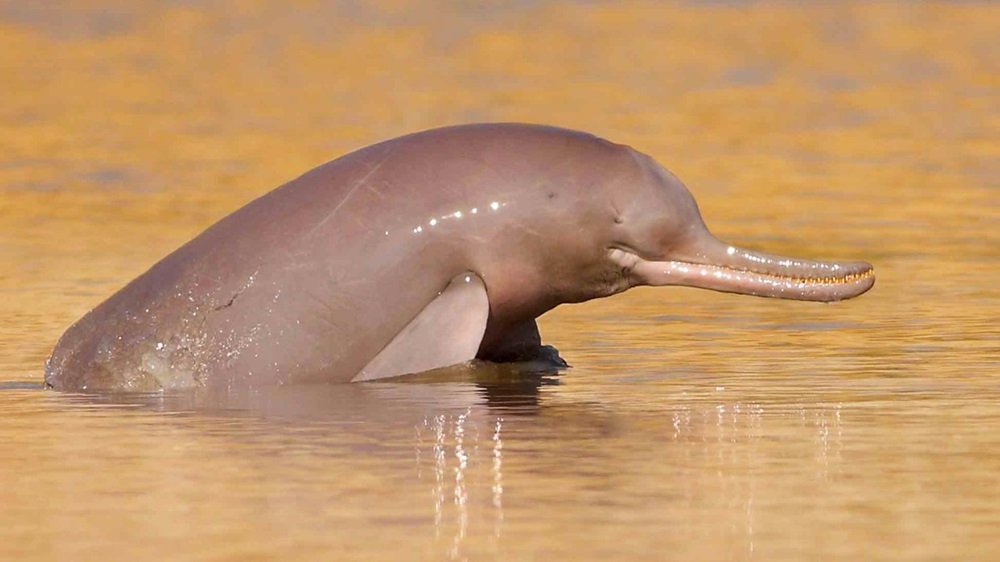
It is a modestly sized dolphin. NOAA Fisheries describes adults as 7 to 8.5 feet long and weighing 150 to 200 pounds, with females slightly larger than males. The body is rounded and stocky, with a small triangular dorsal fin set far back. The back is gray and the belly is pale white or pinkish. Its most striking feature is its long, narrow beak, lined with visible fang-like teeth that help it grip slippery fish, clams and shrimp along the river bottom. The head carries a rounded melon, the fatty forehead organ that focuses the sound pulses used in echolocation.
The eyes are tiny, poorly developed, and sit just above the corners of the mouth. Scientists consider the species functionally blind. NOAA notes that the eyes can likely only sense the level and direction of light. In the turbid, sediment-laden water of the Indus, vision would be nearly useless anyway, so the dolphin long ago traded sight for sound.
Locally, it is known as the bhulan. Depending on the telling, the name refers to the animal's habit of surfacing unexpectedly, as if confused or lost. Fishermen along the Indus have known this dolphin for generations, and in old stories it sometimes appears as a creature to be respected rather than feared.
A dolphin that hunts with sound
Vision may be gone, but the Indus river dolphin is far from helpless. It produces sound almost constantly to navigate, communicate and find food. Each click it emits bounces off objects in the water and returns as an echo, and the dolphin's brain builds a detailed map from those echoes. It can detect a fish in water so cloudy that a human hand would disappear a few inches below the surface.
When it surfaces to breathe, the dolphin makes a sound often compared to a sneeze. It usually appears alone or in pairs, although groups of up to 10 have been seen where food is plentiful. It rarely approaches boats. One of its most unusual habits is side-swimming: the dolphin often rolls onto one side as it moves, keeping its long beak pointed toward the riverbed while its echolocation scans ahead and downward. Researchers believe this posture helps it sweep the bottom for prey with maximum efficiency.
Feeding is a bottom-oriented affair. The dolphin probes the riverbed with its long beak and uses its fang-like teeth to seize clams, fish and shrimp. WWF lists prawns, catfish and carp among its prey. Its dives are short, typically lasting 30 to 90 seconds, although it can hold its breath for several minutes when needed.
The life history of the species is slow, which makes recovery from decline a long project. Indus river dolphins live for about 30 years and reach sexual maturity at around 9 years of age. Adults breed throughout the year, and females give birth to a single calf, which they nurse for about one year. A mother invests a great deal in each calf, which is why the population cannot bounce back quickly even when threats are reduced.
Where the bhulan lives today: a shrinking world
The historical range of the Indus river dolphin was enormous. NOAA records that it once occurred from the Indus River delta all the way to the shallow foothills of the Himalayas, and it also lived in the river's tributaries, including the Sutlej, Ravi and Beas. Today, its range represents only about 20 percent of that historic distribution, confined to the lower and middle areas of the Indus River in south-central Pakistan plus one small population in the Beas River in India.
The great shrinking happened because of barrages. Beginning in the 1930s, a network of dams and irrigation barrages was built across the Indus to feed Pakistan's vast canal system. Each gated barrage is an impassable wall for a dolphin. The river was sliced into segments, and the dolphin population was divided into six isolated subpopulations with almost no movement between them. Genetic exchange stopped, and each fragment became vulnerable to dying out on its own.
Today, nearly 99 percent of the surviving dolphins are concentrated in a roughly 690-kilometre stretch of river between the Chashma barrage in Punjab and the Sukkur barrage in Sindh, according to a 2025 abundance study. The dolphins favor deep river bends, confluences and areas with counter-currents, places where fish gather and where the slow, murky water suits their hunting style. In India, a tiny remnant population clings on in the Beas River, and the species is the state aquatic animal of Punjab.
The table below summarizes how the range has changed.
| Period | Estimated range | Key detail |
|---|---|---|
| 19th century | Around 3,400 km of the Indus system | Delta to Himalayan foothills, plus tributaries |
| Before barrages | Main stem and tributaries connected | Dolphins could migrate freely through the system |
| 1930s onward | Progressively fragmented | Each new barrage sealed off another river segment |
| Today | About 690 km holding 99% of dolphins | Between Chashma and Sukkur barrages, in six subpopulations |
The population story: decline, near extinction and recovery
The numbers tell a dramatic story. In the late 19th century, the Indus system is estimated to have held around 10,000 dolphins. Direct hunting for meat and oil, combined with the first wave of barrage construction, drove the population down through the 20th century. Legal protection in the 1970s finally ended deliberate hunting, and WWF's first census in 2001 found about 1,200 dolphins, a figure that suggested the species was sliding toward extinction.
What happened next is one of the few genuine recovery stories among river dolphins. A landmark 2025 study published in the journal Endangered Species Research estimated that the three largest subpopulations contained 1,987 dolphins in 2017, a 19.4 percent increase over the corresponding estimate of 1,665 in 2011. Researchers used mark-recapture modelling of sightings gathered by paired survey vessels to reach that figure. An earlier WWF survey had likewise reported a jump to 1,816 dolphins, about 50 percent more than the 1,200 counted in 2001, and credited community-based conservation for much of the gain.
The recovery is real, but it is fragile. The entire species, roughly 2,000 animals, now depends on a fraction of its former habitat. In India, the Beas River population is down to a handful of individuals. If Pakistan's dolphins were lost, there would be no comparable population anywhere else to secure the species' future, a point the study's lead author emphasized to Mongabay. Pakistan carries a unique global responsibility for the bhulan.
| Year or period | Population estimate | Source |
|---|---|---|
| Late 19th century | Around 10,000 | Historical estimates |
| 2001 | About 617 to 1,200 | WWF first census and related surveys |
| 2011 | 1,665 (three largest subpopulations) | Endangered Species Research study |
| 2017 | 1,987 (three largest subpopulations) | Endangered Species Research study, published 2025 |
| 2017 (WWF) | 1,816 in Pakistan | WWF comprehensive survey |
| India, Beas River | Around 5 to 11 (first organized census) | Punjab government and WWF-India census |
The threats it still faces
Recovery does not mean safety. The Indus river dolphin is still listed as Endangered on the IUCN Red List, and NOAA listed it as endangered under the US Endangered Species Act back in 1991. Conservationists warn that the gains of recent decades could unravel quickly if pressure on the river keeps rising.
Habitat fragmentation by barrages. The single greatest long-term threat remains the infrastructure itself. Dams, canals and barrages block movement between river segments and isolate subpopulations. Small, isolated groups are vulnerable to inbreeding and to local disasters such as a drought or a pollution spill in one segment.
Entanglement in fishing gear. This is the most immediate cause of death. Indus river dolphins are accidentally caught in gillnets and longlines, especially in side channels and adjacent pools where fishing activity is intense. Between 2008 and 2023, gillnet entanglement accounted for 52 percent of documented dolphin deaths in the Indus Basin, according to reporting on the 2025 research. For a population of fewer than 2,000, that level of bycatch is alarming.
Reduced water flow. Intensive irrigation diverts enormous volumes from the Indus, lowering water levels in the dry season. Climate change is expected to make the swings worse, increasing the severity of monsoon flooding and dry-season drought alike. Shallow, slow water is exactly what the dolphin needs, and it is also what irrigation takes.
Pollution. Wastewater discharges, agricultural runoff and industrial effluents flow into the river from many sources. Because dolphins live long lives and sit near the top of the food chain, they accumulate chemicals in their bodies. NOAA notes that these contaminants can damage the immune and reproductive systems of river dolphins, and they can also kill the fish the dolphins depend on.
Historical hunting and present-day poaching. Deliberate hunting for meat and oil was outlawed in the 1970s, which allowed the recovery to begin. However, WWF notes that dolphins are still hunted in some areas for their meat, oil and use in traditional medicines, and enforcement along a vast river is difficult.
Stranding in canals. Dolphins that enter irrigation canals during high flows can become stranded when water levels drop, and many die before they can be rescued.
Conservation: the new 400-kilometre corridor and the rescue teams
The most significant recent development for the species came in June 2026, when Pakistan's government created the Punjnad Indus River Dolphin Sanctuary in Punjab. The new sanctuary protects nearly 200 kilometres (about 123 miles) of river where an estimated 440 dolphins live. It connects directly with an existing protected area in Sindh province, creating a continuous 400-kilometre (249-mile) stretch of legally protected habitat, roughly the length of New York State, according to WWF-Pakistan. For a species divided into six fragments by barrages, even partial reconnection matters enormously.
WWF-Pakistan has worked on Indus dolphin conservation since the 1990s. Its program combines legal protection, habitat management and community engagement. Among its notable achievements: the first-ever satellite tagging of river dolphins in Asia, which revealed how dolphins move within river segments, and a long-running rescue program in which stranded dolphins are lifted from canals and returned to the main river. WWF also treats the dolphin as an indicator species, a living measure of the health of the whole river. If the top predator of the Indus is thriving, the river's fish, water quality and flow regime are probably in reasonable shape too.
Communities along the river are central to the effort. Fishers are being encouraged and equipped to use dolphin-safe practices, and awareness campaigns explain why entanglement must be reported rather than hidden. The 50 percent population jump recorded by WWF between 2001 and 2017 was attributed largely to this kind of community-based conservation.
International law adds another layer of protection. The species is listed in Appendix I of CITES, which bans international commercial trade, and in Appendix II of the Convention on Migratory Species. In Pakistan, it is legally protected, and the new sanctuary gives that protection a defined, manageable geography.
Quick facts at a glance
| Fact | Detail |
|---|---|
| Common names | Indus river dolphin, bhulan, blind dolphin |
| Scientific name | Platanista gangetica minor (sometimes written Platanista minor) |
| Family | Platanistidae |
| Size | 7 to 8.5 feet long; 150 to 200 pounds (females slightly larger) |
| Vision | Functionally blind; eyes detect only light level and direction |
| Navigation | Echolocation; swims on its side while hunting |
| Diet | Fish, prawns, shrimp, clams, catfish, carp |
| Lifespan | About 30 years; matures at 9; calves nursed for about a year |
| Range | Indus River, Pakistan (99% between Chashma and Sukkur barrages); tiny Beas River population in India |
| Population | Fewer than 2,000; about 1,987 in the three largest subpopulations in 2017 |
| IUCN status | Endangered |
| Main threats | Barrage fragmentation, gillnet entanglement, reduced flow, pollution |
Frequently asked questions
Why is the Indus river dolphin called blind? Its eyes are tiny and poorly developed, and scientists believe they can only sense the level and direction of light. In the murky Indus, vision would be useless anyway, so the dolphin navigates and hunts entirely by echolocation, building a sound picture of its surroundings from returning clicks.
How many Indus river dolphins are left? Fewer than 2,000 in the wild. A 2025 study in Endangered Species Research estimated 1,987 dolphins in the three largest subpopulations in 2017, up 19.4 percent from 2011. The population fell from an estimated 10,000 in the 19th century to a low point around 2001, so the trend is now upward but the species remains Endangered.
Where can the Indus river dolphin be found? Almost entirely in Pakistan's Indus River, with about 99 percent of the population concentrated in a 690-kilometre stretch between the Chashma and Sukkur barrages. A very small, isolated population survives in the Beas River in Indian Punjab, where the dolphin is the state aquatic animal.
What is the biggest threat to the Indus river dolphin? Historically, dams and irrigation barrages built from the 1930s onward fragmented its habitat into six isolated subpopulations. Today, the most immediate killer is accidental entanglement in fishing nets: gillnets accounted for 52 percent of documented dolphin deaths between 2008 and 2023. Pollution, reduced water flow and occasional poaching add to the pressure.
What is being done to save the Indus river dolphin? Pakistan created the Punjnad Indus River Dolphin Sanctuary in June 2026, linking with an existing Sindh reserve to form a 400-kilometre protected corridor. WWF-Pakistan has run a conservation program since the 1990s, including Asia's first satellite tagging of river dolphins, rescues of stranded animals from canals, and community programs that promote dolphin-safe fishing.
A river worth listening to
The Indus river dolphin has survived the drying of an ancient sea, the coming of barrages, and a century of being hunted and squeezed into ever smaller stretches of river. Its slow recovery since 2001 shows that conservation can work, even for a species as specialized and restricted as this one. But with fewer than 2,000 individuals left, divided into fragments by concrete walls, the bhulan's future still depends on decisions made far from the river: how much water stays in the Indus, how nets are set along its banks, and how seriously Pakistan and the world take their responsibility for a dolphin that belongs to this river alone. If we listen carefully enough, the sneeze-like surfacing of a bhulan is really the sound of a river telling us whether it is still alive.