Jellyfish Facts: 20 Surprising Truths About Sea Jellies
They pulse through the water like living lanterns, trail ribbons of venom, and include an animal that can reset its own aging. Jellyfish look simple, almost too simple to be real animals, yet they have survived every mass extinction for hundreds of millions of years. The most surprising jellyfish facts reveal creatures that are stranger than their reputation: brainless but coordinated, fragile yet nearly indestructible as a group, and far more important to the ocean than most people realize.
Not a Fish at All: What a Jellyfish Really Is
The name is a misnomer. Jellyfish are not fish. To avoid the confusion, scientists and aquariums increasingly call them sea jellies or simply jellies. True jellyfish are the medusa stage of certain gelatinous animals in the subphylum Medusozoa, part of the phylum Cnidaria, a group that also includes corals and sea anemones. Their relatives the comb jellies, or ctenophores, look like jellyfish but belong to a different phylum entirely and, unlike true jellyfish, cannot sting.
They are found in every ocean, from sunlit surface waters to the deep sea, and a few hardy species even live in fresh water. Most drift where currents take them, pulsing their bells for gentle propulsion but largely at the mercy of the water around them. It is a lifestyle that has worked for an astonishingly long time. Jellyfish have existed for at least 500 million years, and possibly 700 million years or more, making them the oldest multi-organ animal group on Earth. They were drifting through ancient seas some 400 million years before the first dinosaurs appeared.
Jellyfish Facts: Anatomy of an Animal Without Organs
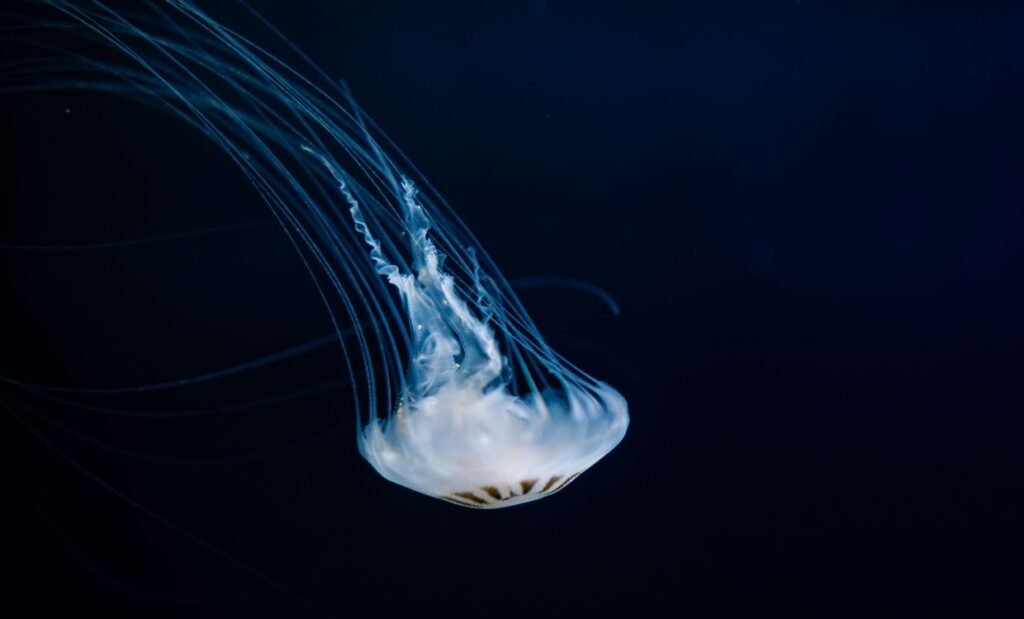
A jellyfish body is built around a simple, beautiful plan. The main part is the bell, an umbrella-shaped dome of gelatinous material called mesoglea, with tentacles trailing from its underside. The mouth sits in the center of the bell's underside, and the body shows radial symmetry, meaning its parts radiate from a central axis like the spokes of a wheel. That symmetry lets a jelly sense food or danger approaching from any direction.
What the body lacks is just as remarkable as what it has. Jellyfish have no brain, no heart, no bones, no blood, and no lungs or gills. They are about 95 percent water. Instead of a brain, they use a decentralized nerve net that detects light, vibration, and chemical cues and coordinates swimming. Instead of lungs, they absorb oxygen directly through their thin body walls. Digestion happens in a single gastrovascular cavity that doubles as a stomach and a simple circulation system.
| Feature | Detail |
|---|---|
| Scientific group | Phylum Cnidaria, subphylum Medusozoa |
| Body composition | About 95% water |
| Brain / heart / bones | None; uses a decentralized nerve net |
| Main body parts | Bell (mesoglea), tentacles, oral arms |
| Symmetry | Radial |
| Size range | Millimeters to over 2 meters across the bell |
| Lifespan (medusa stage) | Usually a few months; some live only days |
| Stinging cells | Nematocysts, inside cells called cnidocytes |
Size varies enormously. The smallest jellies are just millimeters wide, while the largest, the lion's mane, can trail tentacles more than 30 meters long. Most species grow fast, mature within a few months, and die soon after breeding, though the polyp stage of the life cycle can persist far longer.
The Sting: How Nematocysts Fire
The tentacles are the business end of a jellyfish. They are studded with specialized cells called cnidocytes, each containing a coiled, harpoon-like structure called a nematocyst. When a tentacle brushes against prey, or an unlucky swimmer, a microscopic trigger fires the nematocyst in a fraction of a second. The coiled thread shoots out, pierces the target, and injects venom. It is one of the fastest cellular mechanisms in nature.
The venom's job is to paralyze small prey such as plankton, crustaceans, and tiny fish, which the tentacles then ferry to the mouth. For humans, the effect ranges from a mild tingle to, in a few species, a medical emergency. Two things about the sting surprise people. First, most jellyfish cannot hurt us at all: their stinging cells are too small to pierce human skin. Only a small number of species can inflict serious harm. Second, a jellyfish can still sting after it is dead. Tentacles washed up on a beach, or even detached fragments in the water, can fire their nematocysts on contact, which is why beachgoers should never touch a stranded jelly.
A Life in Two Acts: The Medusa-Polyp Life Cycle
Few animals transform as dramatically as a jellyfish. Most species live a double life, alternating between a free-swimming sexual stage and a sedentary asexual stage. The familiar bell-shaped animal is only half the story.
| Stage | What happens |
|---|---|
| Medusa | The adult, free-swimming jellyfish; reproduces sexually, releasing eggs and sperm |
| Planula | A tiny swimming larva formed after fertilization |
| Polyp | The larva settles on a surface and grows into a stalk-like form resembling a miniature sea anemone |
| Strobilation | The polyp reproduces asexually, budding off a stack of juvenile jellies |
| Ephyra | The juvenile jellyfish released by the polyp; grows into an adult medusa |
The cycle begins when adult medusae release eggs and sperm into the water. The fertilized eggs develop into planula larvae, which drift until they find a surface, a rock, a shell, a ship hull, and settle. There they transform into polyps, which can live for months or years, cloning themselves and periodically releasing ephyrae, baby medusae that grow into the next generation of adults. In 1991, this cycle even went to space: 2,478 moon jelly polyps and babies rode the shuttle Columbia so scientists could study how weightlessness affected their development, a study with implications for understanding calcium loss in astronauts.
This two-act life explains a lot about jellyfish ecology. A single polyp colony on the seafloor can release huge numbers of medusae when conditions are right, which is one reason jellyfish populations can explode almost overnight.
Moving, Feeding and Sensing Without a Brain
Watching a jellyfish swim is watching minimalism in motion. The bell contracts and relaxes in a steady pulse, squeezing water out from underneath and pushing the animal upward. Then the bell reopens and the jelly drifts. This gets jellies up and down the water column, but horizontal travel is mostly outsourced: currents and winds carry them where they go. Some larger species are stronger swimmers than their reputation suggests, but none of them are chasing prey across the ocean.
Feeding is a tentacle operation. Nematocysts paralyze the catch, the tentacles contract to haul it in, and oral arms guide it to the mouth in the center of the bell. From there, radial canals distribute nutrients through the body. The menu is mostly small stuff: plankton, fish eggs, tiny crustaceans, and larval fish. Some jellies are cannibals and eat other jellyfish. A few, like the cross jellies studied by Monterey Bay researchers, appear to "smell" their prey, detecting chemicals in the water to find food they cannot see.
Sensing without a brain takes many forms. Beyond the nerve net, jellies carry simple sensory structures called rhopalia that detect light, gravity, and orientation. And in the deep sea, some species make their own light. Bioluminescent jellies produce blue or green glows that may startle predators, lure prey, or confuse attackers in the dark. For an animal with no brain, the toolkit is remarkably complete: detect, pulse, sting, eat, repeat.
The "Immortal" Jellyfish That Resets Its Own Life
Of all jellyfish facts, this one sounds like science fiction. Turritopsis dohrnii, a tiny jellyfish only millimeters across, can reverse its own aging. When the adult medusa is injured, starving, or simply old, it does not die. Instead it sinks to the seafloor, its body collapses into a blob-like cyst, and its adult cells transform into entirely different cell types, a rare process called transdifferentiation. Within a day or two the cyst settles and begins growing into a polyp colony, which then releases brand-new juvenile jellyfish, genetically identical to the original. The biological clock resets to zero, and the cycle can repeat with no known limit.
Scientists studying the species have found that the cyst stage switches on genes for DNA repair and telomere maintenance, the cellular machinery that protects genomes from damage. That hint of how the jelly avoids the slow accumulation of age-related damage is one reason aging researchers find it so fascinating. The word "immortal" needs a caveat, though. Turritopsis dohrnii can still be eaten by predators or killed by disease. It has conquered aging, not death.
Record Holders: The Biggest and the Deadliest Jellyfish
Jellyfish hold some genuine ocean records. The lion's mane jellyfish is the largest known jelly, with a bell that can exceed 2 meters across and tentacles stretching more than 30 meters, longer than a blue whale. Its sting is painful but rarely dangerous to healthy adults.
At the other end of the scale sits one of the most venomous animals on Earth. Box jellyfish, found mainly off northern Australia and across the Indo-Pacific, carry up to 15 tentacles that can reach 3 meters long, each loaded with millions of nematocysts. Their venom can cause a dangerous spike in blood pressure that may stop the heart. The U.S. National Science Foundation reports that 20 to 40 people die from box jellyfish stings each year in the Philippines alone, though worldwide fatalities are not reliably counted.
Box jellies are also unexpectedly sophisticated. They have 24 eyes arranged in clusters called rhopalia, including complex eyes with lenses, retinas, and corneas, the most advanced eyes in the jellyfish world. One small species, Tripedalia cystophora, keeps four of its eyes pointed permanently upward, watching for the silhouettes of tree branches overhead so it can navigate toward the mangrove swamps where it feeds. Whether a brainless animal truly "sees" in any familiar sense is still an open scientific question.
For perspective, the moon jelly, the translucent saucer common in coastal waters and aquariums worldwide, has a sting so mild that most people barely feel it. The danger of jellies spans the full spectrum from harmless to lethal, which is why identifying the species matters.
Blooms, Stings and What To Do If You Are Stung
Sometimes jellies gather in enormous numbers, and the vocabulary for these gatherings is precise. A bloom is a dense cloud caused by an actual spike in reproduction, often from polyp colonies releasing medusae at once. A swarm, or smack, is a group brought together by winds and currents. Either way, the results can be dramatic: clogged fishing nets, stung tourists, and even shutdowns at coastal power plants whose cooling intakes get overwhelmed.
If you are stung, expert advice from aquariums and ocean conservation groups is consistent, and it contradicts several popular myths.
| Do | Don't |
|---|---|
| Leave the water calmly | Don't rub the sting or touch tentacles with bare skin |
| Remove tentacles carefully, ideally with tweezers | Don't rinse with fresh water |
| Rinse with salt water or vinegar (vinegar helps stop nematocysts firing) | Don't urinate on the sting (a myth; urine contains fresh water) |
| Apply ice to ease pain | Don't ignore worsening symptoms |
| See a doctor if pain spreads, or after any box jellyfish sting | Don't assume a beached jellyfish is safe to touch |
Fresh water is the key mistake to avoid. It can trigger unfired nematocysts to discharge, making the sting worse. Vinegar, by contrast, can prevent further firing, and salt water rinses tentacles away safely. And no matter what you saw on television, urinating on a sting does not help. Most stings resolve with basic care, but box jellyfish stings and any sting causing breathing difficulty, chest pain, or spreading numbness need emergency treatment.
Why Jellyfish Matter to the Ocean (and to Us)
It is easy to dismiss jellyfish as drifting nuisances, but they are load-bearing members of marine ecosystems. As predators they keep populations of zooplankton and small fish in check, shaping the base of the food web. As prey they feed leatherback turtles, ocean sunfish, and other animals that specialize in eating them. They also help move carbon from surface waters to the deep ocean, a quiet contribution to the planet's carbon cycle.
Their relationship with people is older and richer than the sting stories suggest. In parts of Asia, blubber jellies are an accepted delicacy, harvested and prepared as food. Jellyfish have even left their mark on culture: one species, Phialella zappai, is named after musician Frank Zappa. And their strange biology keeps paying scientific dividends, from the 1991 space experiment to ongoing research into aging, regeneration, and venom chemistry that may one day inform medicine.
Jellyfish populations also tell us something about the changing ocean. Their blooms are natural events, but scientists are watching closely how warming waters, overfishing of their predators, and nutrient runoff shift the balance in their favor. A sea full of jellies is a sea sending a message, and learning to read it starts with understanding the animals themselves.
Frequently Asked Questions
Can a jellyfish live forever? One species comes close. Turritopsis dohrnii, the "immortal jellyfish," can transform its adult body back into a polyp and start its life cycle over through a process called transdifferentiation. It can repeat this indefinitely, though it can still be eaten or killed by disease. Most other jellyfish live only a few months as adults.
Do jellyfish have brains? No. Jellyfish have no brain, heart, bones, or blood. They coordinate movement and respond to light, touch, and chemicals with a decentralized nerve net spread through the body. Box jellyfish add surprisingly complex eyes to this simple setup, but there is still no central brain processing what they detect.
What should you do if stung by a jellyfish? Leave the water, carefully remove any tentacles without touching them with bare skin, and rinse the area with salt water or vinegar. Do not rinse with fresh water or urine, which can make stinging worse. Use ice for pain and see a doctor if symptoms spread or if a box jellyfish was involved.
Are all jellyfish dangerous to humans? No. Most jellyfish have stinging cells too small to pierce human skin and are harmless. Only a small number of species, notably box jellyfish and a few others, can inflict serious or life-threatening stings.
Are jellyfish actually fish? No. The name is misleading, which is why scientists often call them sea jellies. Jellyfish are invertebrates in the phylum Cnidaria, related to corals and sea anemones, not to fish.
How old are jellyfish as a group? Jellyfish have existed for at least 500 million years, and possibly 700 million years or more, making them the oldest multi-organ animal group known. They predate dinosaurs by roughly 400 million years.
Can a dead jellyfish still sting you? Yes. The stinging cells fire on contact through a mechanical trigger, so tentacles from a dead or beached jellyfish can still discharge venom. Never touch a jellyfish washed up on shore, even if it looks harmless.
What eats jellyfish? Leatherback sea turtles are famous jellyfish specialists, and ocean sunfish, some seabirds, and other fish eat them too. Jellies sit in the middle of the food web: predators of plankton and prey for larger animals.
Drifters Worth Knowing
Jellyfish are easy to underestimate. They have no brain and barely any body, yet they have outlasted nearly everything else in the sea. They sting with one of the fastest mechanisms in biology, live double lives as drifting medusae and anchored polyps, and one tiny species has found a loophole in aging itself. From the harmless moon jelly to the formidable box jellyfish, these are the jellyfish facts that matter: ancient survivors, ecological workhorses, and a reminder that the simplest-looking animals are often the most extraordinary.