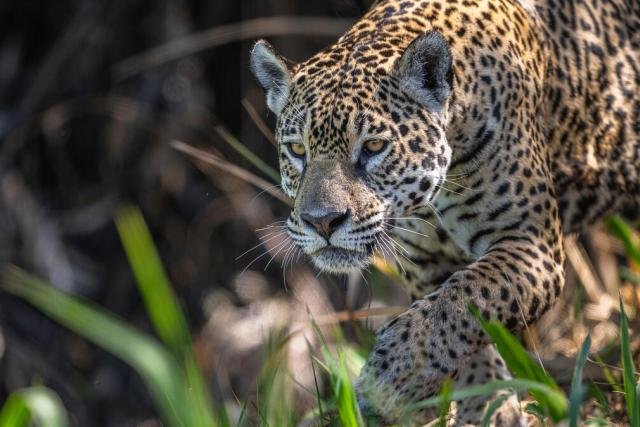
Jaguar vs Leopard: 9 Key Differences Between the Big Cats
Jaguar vs Leopard: The Quick Answer
Jaguars and leopards look like each other's twins, but they are different species living on different continents. The jaguar (Panthera onca) rules the Americas, from the southwestern United States to northern Argentina. The leopard (Panthera pardus) roams Africa and Asia, from sub-Saharan savannas to the forested hills of Pakistan.
The fastest way to tell them apart: look at the spots. Jaguar rosettes are larger and usually contain small black dots inside the ring. Leopard rosettes are smaller, more tightly packed, and empty in the middle. Beyond the coat, the jaguar is stockier and more powerfully built, with the strongest bite of any big cat relative to its size. The leopard is slimmer, longer-tailed, and a far better climber. Here are the differences in full.
1. Spot the Difference: Rosettes and Coat Patterns
Both cats wear rosettes, the rose-shaped rings of black markings that break up their outline in dappled forest light. But the details differ consistently:
Jaguar rosettes are large, typically 5 to 8 centimetres across, with thick and sometimes broken ring borders. Inside most rings sit one to four solid black spots, like islands in a lagoon. The overall impression is bold and chunky.
Leopard rosettes are smaller, about 2 to 5 centimetres across, with clean, unbroken rings that are consistently empty inside. They are packed more densely across the body, giving the coat a finer, more delicate look. In some dense-forest leopards of West and Central Africa, the rosettes crowd so tightly they nearly merge.
On the head, legs, and tail, both species switch to solid spots, and both have pale, spotted undersides. The rosette test is the single most reliable visual ID: spots inside the ring means jaguar, empty rings mean leopard.
2. Size and Build: The Powerhouse vs the Athlete
The jaguar is the third-largest cat in the world, after the tiger and the lion, and the largest cat in the Americas. Adult males typically weigh 56 to 96 kilograms, with exceptional Pantanal males reaching higher. The build is unmistakable: deep chest, massive shoulders, thick neck, short sturdy legs, and a broad, blocky head. Everything about the jaguar says power.
Leopards are lighter and more elongated. Males generally weigh 37 to 90 kilograms depending on region, with African males averaging around 60 kilograms and some Asian populations smaller. The body is leaner, the legs longer, and the tail notably longer, acting as a counterbalance during climbing and leaping. Where the jaguar is a wrestler, the leopard is a gymnast.
Sexual dimorphism is strong in both: males are markedly larger than females. But even a large male leopard lacks the sheer bulk of a big male jaguar.
3. The Bite: Why the Jaguar Crushes Skulls
This is the most dramatic functional difference between the two cats. Research by Adam Hartstone-Rose and colleagues at the University of South Carolina, comparing the bite forces of nine cat species, found the jaguar's bite measured about 880 newtons, against roughly 1,230 for the tiger and 560 for the leopard. Because the jaguar is much smaller than a tiger, pound for pound its bite is the strongest of any big cat. The secret lies in the skull architecture: slightly shorter jaws that increase leverage, and exceptionally robust jaw muscles anchored to wide cheek arches.
The jaguar uses that bite in a way no other big cat does. Lions, tigers, and leopards typically kill by clamping the throat and suffocating their prey. The jaguar often bites straight through the skull, driving its canines between the ears and into the brain for a near-instant kill. The same bite can pierce the armoured shells of river turtles and the hides of caimans, prey that other predators cannot touch. The name "jaguar" comes from an Indigenous word meaning "he who kills with one leap", and the killing method lives up to it.
The leopard's bite, while still formidable, follows the classic cat playbook: a suffocating throat hold, patiently maintained until the prey stops struggling.
4. Where They Live: Two Continents Apart
Jaguars are creatures of the Americas. Their range once stretched from the southwestern United States through Mexico and Central America deep into South America. Today the strongholds are the Amazon Basin and Brazil's Pantanal wetlands, with populations scattered from Mexico to Paraguay and northern Argentina. A small number still cross into southern Arizona. Jaguars favour tropical and subtropical moist forest, wetlands, and wooded river corridors, and they are almost always found near water.
Leopards have the widest distribution of any big cat. They range across most of sub-Saharan Africa and through Asia, from the Middle East and the Caucasus to India, Southeast Asia, China, and the Russian Far East. They occupy an extraordinary variety of habitats: savanna, rainforest, mountains, scrubland, and even the edges of cities. This adaptability is the leopard's superpower, and it is why leopards remain relatively widespread while more specialised cats decline.
The two species never meet in the wild. Any "jaguar vs leopard" confrontation exists only in hypothetical debates.
5. Hunting Styles: River Ambush vs Tree-Top Larder
Both are solitary, stalk-and-ambush hunters, but their strategies diverge with their bodies.
The jaguar is an ambush predator of land and water. It stalks through dense cover or waits along game trails and riverbanks, then explodes over short distances. Its prey list is one of the broadest of any big cat: capybaras, deer, peccaries, tapirs, caimans, turtles, iguanas, armadillos, fish, and monkeys. In the Pantanal, jaguars are famous for hunting caiman in the water, swimming out to drag the reptiles ashore. Kills are often dragged into dense cover but rarely into trees; the jaguar is too heavy for routine arboreal dining.
The leopard is the consummate opportunist. It hunts everything from dung beetles and rodents to antelope several times its own weight, and it is famous for what it does after the kill: hauling the carcass up into a tree. A leopard can drag prey heavier than itself vertically up a trunk, caching it in the branches beyond the reach of lions and hyenas. This tree-top larder lets the leopard feed in safety over several days, and it is a behaviour jaguars almost never show.
6. Climbing, Swimming, and Everyday Behaviour
Ask which cat climbs better and the answer is immediate: the leopard. Leopards are among the most arboreal of the big cats, resting in branches by day, descending headfirst, and hunting monkeys in the canopy. Their long tails and lighter frames are built for it.
Ask which cat swims better and the answer flips. Jaguars are the most aquatic of the big cats. They swim readily, hunt in rivers and flooded forest, and have been documented crossing wide water channels. Leopards can swim when they must, but they show nothing like the jaguar's affinity for water.
Both are largely solitary and territorial, marking ranges with scent and scrapes, and both are primarily nocturnal or crepuscular, though each will hunt by day when opportunity knocks.
7. The Black Panther Confusion
"Black panther" is not a species. It is a colour morph, melanism, an excess of dark pigment that can appear in either species. The rosettes are still there, ghosting beneath the black coat and visible in bright sunlight.
Melanism is more common in leopards, especially in the dense, dark forests of Southeast Asia, where a black coat improves camouflage. Black jaguars are rarer but do occur, mostly in the Amazon Basin. To further complicate matters, in the Americas the word "panther" is also used for the puma (mountain lion), a completely different, unspotted cat. So a "black panther" in a documentary could be a melanistic jaguar or a melanistic leopard, and you would need to see the build, the location, or the ghost rosettes to know which.
8. Jaguar vs Leopard Side by Side
| Feature | Jaguar (Panthera onca) | Leopard (Panthera pardus) |
|---|---|---|
| Range | Central and South America | Africa and Asia |
| Male weight | 56-96 kg | 37-90 kg |
| Build | Stocky, muscular, broad head | Slim, agile, longer tail |
| Rosettes | Large, with spots inside the ring | Smaller, empty rings |
| Bite force | Strongest of big cats pound for pound (~880 N measured) | Weaker (~560 N measured) |
| Killing method | Bites through the skull | Suffocating throat bite |
| Climbing | Capable but uncommon | Superb; caches kills in trees |
| Swimming | Strong, frequent swimmer | Reluctant swimmer |
| Melanism | Occurs, relatively rare | Occurs, more common |
| IUCN status | Near Threatened | Vulnerable |
9. Leopards in Pakistan: A Local Connection
For readers in Pakistan, this comparison has a local half. The jaguar never roamed South Asia, but the leopard is very much at home here. Common leopards (Panthera pardus) still prowl the forested hills of the Galiyat region, the Margalla Hills above Islamabad, and parts of Swat and Dir.
A 2019 study by Muhammad Asad, Muhammad Waseem, and colleagues, published in the journal Nature Conservation with WWF Pakistan's involvement, used camera trapping to confirm leopard presence across the Galiyat and Murree Forest Division, assessing the population's distribution and abundance in northern Pakistan. In the Margalla Hills National Park, the Islamabad Wildlife Management Board has identified at least five individual common leopards from camera-trap images since 2019, including a well-known resident female nicknamed Shezadi, regularly recorded between Trail 4 and Trail 6.
Pakistan's leopards face the classic pressures: habitat loss, poaching, retaliatory killing after livestock attacks, and shrinking wild prey. Locally they are considered critically endangered. Their story is a reminder that the "leopard" in this comparison is not an abstract African animal; for many South Asian readers, it is the spotted ghost of their own hills.
10. Conservation: Two Cats, Two Outlooks
The jaguar is listed as Near Threatened on the IUCN Red List, a status it has held since 2002, with populations declining. The main threats are deforestation for cattle ranching and soy farming, fragmentation of habitat by roads and settlements, and retaliatory killing by ranchers. Conservationists have mapped 51 Jaguar Conservation Units across Latin America, strongholds meant to keep breeding populations connected.
The leopard is listed as Vulnerable globally, with some regional populations faring worse. Its adaptability is both shield and curse: leopards survive near people, but that proximity brings conflict, poaching for skins and body parts, and prey depletion. In parts of their range, including Pakistan, local populations are in serious trouble even where the species as a whole persists.
Both cats are keystone predators whose presence shapes entire ecosystems, and both are legally protected across most of their range. Their futures depend less on biology than on whether humans leave them room to hunt.
Seeing Them in the Wild: Jaguar and Leopard Hotspots
For wildlife travellers, these two cats offer very different safaris. The jaguar's best stage is the northern Pantanal of Brazil, a vast seasonal wetland where the cats patrol riverbanks and are regularly seen from boats. Jaguars are also found through the Amazon Basin, though the dense forest makes sightings far harder. In Central America, protected areas in Costa Rica, Belize, and Mexico's Yucatán Peninsula offer slimmer but real chances.
Leopards, thanks to their vast range, offer more options. In Sri Lanka, Yala and Wilpattu National Parks are famous for daytime leopard sightings, with some of the highest densities recorded anywhere. Southern Africa's Sabi Sand region, bordering Kruger National Park, is another classic leopard destination. In India, reserves such as Kabini and Jhalana are known for them. And in Pakistan, the Margalla Hills National Park above Islamabad gives patient, quiet hikers a slim chance of glimpsing the resident common leopards, most often via the camera-trap images shared by the Islamabad Wildlife Management Board rather than in person.
Wherever you go, both species reward the same virtues: a good local guide, dawn and dusk timing, and patience.
Frequently Asked Questions
Which is bigger, a jaguar or a leopard? The jaguar. Male jaguars typically weigh 56 to 96 kilograms and are more heavily built, while male leopards range from 37 to 90 kilograms with a slimmer frame. The jaguar is the third-largest cat in the world; the leopard ranks below it.
Which has a stronger bite, jaguar or leopard? The jaguar, by a wide margin. Measured bite force studies put the jaguar at around 880 newtons versus about 560 for the leopard, and pound for pound the jaguar has the strongest bite of any big cat. That is why jaguars can pierce turtle shells and bite through skulls.
How can you tell a jaguar from a leopard in a photo? Check the rosettes. If the rings contain small black spots inside, it is a jaguar. If the rings are empty, it is a leopard. Also consider the build: a very stocky, broad-headed cat suggests jaguar, while a lanky, long-tailed one suggests leopard.
Is a black panther a jaguar or a leopard? It can be either. "Black panther" describes melanism, a dark colour variant, not a species. Black leopards are more common, especially in Asian forests, while black jaguars occur in the Amazon. Look at the location and the faint rosette pattern to tell them apart.
Who would win in a fight, a jaguar or a leopard? This is a favourite hypothetical, but it has no real-world answer: the two species live on different continents and never meet. On paper, the larger, stronger-biting jaguar would be favoured, but fights between wild big cats are rare, brief, and decided by circumstance as much as size.
Are there jaguars in Pakistan or India? No. Jaguars are found only in the Americas. The spotted big cat of Pakistan and India is the common leopard (Panthera pardus), with snow leopards in the high mountains of the north.
Can leopards live near cities? Yes, remarkably well. Leopards survive on the edges of several large cities, most famously in Mumbai, India, where a population lives in and around Sanjay Gandhi National Park and hunts stray dogs and pigs at night. This adaptability is unmatched among big cats, though it brings frequent human-wildlife conflict.
Do jaguars and leopards roar? Both do. Like all members of the Panthera genus, jaguars and leopards possess the specialised throat anatomy needed for true roaring. A leopard's territorial call is often described as a rasping, sawing cough repeated in a series, while the jaguar's is a deeper, throatier roar. Hearing either at night is unforgettable.
Can jaguars and leopards interbreed? They are separate species that never encounter each other in nature, so it does not happen in the wild. In captivity, big cats of the Panthera genus can occasionally produce hybrids, but such crosses are not part of either species' natural story.
Two Cats, One Lesson
The jaguar and the leopard show how evolution solves the same problem, being a medium-sized spotted ambush predator, in two different ways. The jaguar doubled down on power: a bone-crushing bite, a wrestler's body, and a taste for armoured prey. The leopard bet on versatility: climbing skill, a continent-spanning range, and the patience to wait out lions in a tree. Learn the rosettes, respect the differences, and you will never confuse them again.