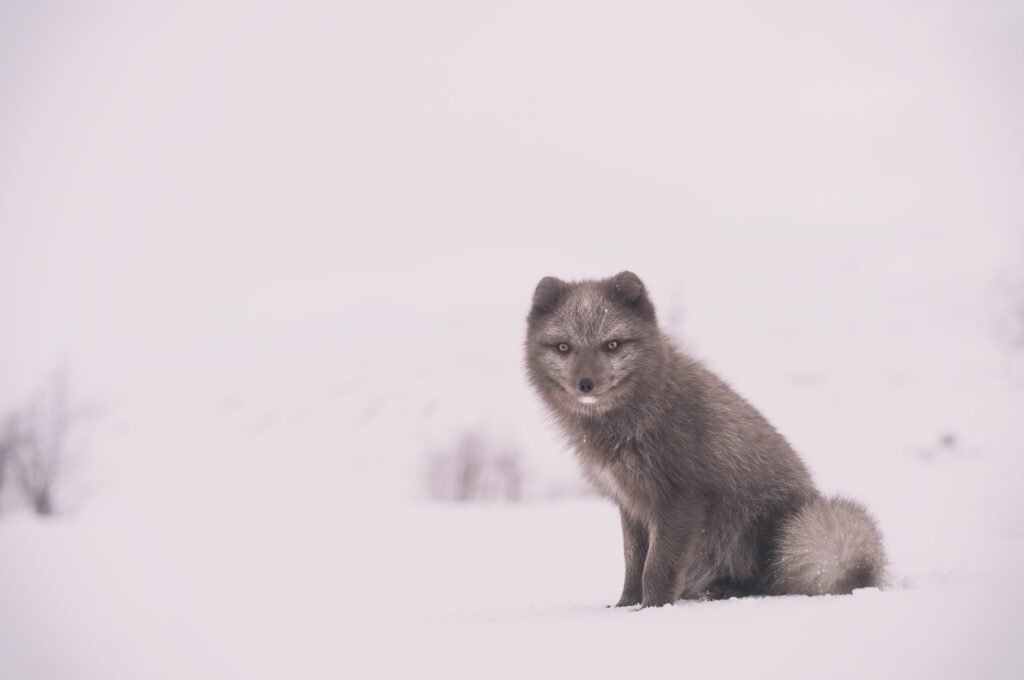
Arctic Fox Winter Adaptations: How They Survive -50°C
The Arctic Fox's Winter: A Quick Overview
The arctic fox (Vulpes lagopus) spends its life in one of the coldest inhabited places on Earth: the treeless tundra ringing the top of the planet, from Alaska and Canada to Greenland, Iceland, Scandinavia, and Siberia. Winter there means months of darkness, screaming winds, and temperatures that plunge to -50 C. Prey vanishes under metres of snow. And yet this cat-sized canid, weighing as little as 3 kilograms, not only endures the polar winter but stays active through it, hunting, travelling, and raising families.
It manages this with a layered defence: extraordinary insulation, a body plan that leaks almost no heat, feet that refuse to freeze, a metabolism that can idle like an engine, and behaviours refined over countless generations. Here is how each adaptation works.
The Warmest Fur of Any Arctic Mammal
The arctic fox's coat is its masterpiece. It is a dense, triple-layered pelt: a soft, woolly undercoat that traps still air against the skin, longer guard hairs that shed wind and snow, and an overall thickness that gives the fox the best-insulated fur of any mammal in the Arctic. Canadian Geographic notes that this coat lets the fox endure temperatures as low as -50 C, and some sources report that the animal does not even begin to shiver until the thermometer drops toward -70 C.
Insulation works by trapping air, and the fox's fur does this better than almost any natural material. In summer the fox sheds much of this undercoat, and the thermal conductance of its body more than doubles, a measured seasonal transformation from furnace to light jacket.
The coat is also camouflage. In winter, most arctic foxes turn brilliant white, vanishing against snow and ice. This serves double duty: prey cannot see the hunter coming, and larger predators such as wolves, wolverines, and golden eagles cannot easily spot the fox. When summer melts the snow, the coat moults to brown or grey, matching the rocks and tundra plants. The arctic fox is the only member of the dog family that changes coat colour with the seasons.
Built Compact: Small Ears, Short Muzzle, Round Body
Heat loss happens at surfaces, so cold-climate animals tend toward compact shapes with minimal exposed area. The arctic fox is a textbook example of this principle, known to biologists as Allen's rule.
Its ears are small and rounded, heavily lined with fur. Its muzzle is short, reducing the surface of the nose, another major avenue of heat loss. Its legs are short and its body is round and stocky, giving it one of the lowest surface-area-to-volume ratios of any canid. Less surface means less warmth radiated away into air that can be sixty degrees colder than the fox's core.
Even the eyes get protection: dense fur rings them, and a nictitating membrane, a translucent third eyelid, shields them from wind-driven ice crystals.
Feet That Refuse to Freeze
The arctic fox's feet are engineering marvels. The fox is the only canid that grows fur over its footpads, which is exactly what its scientific name celebrates: lagopus means "hare-footed". The furry soles insulate against frozen ground and grip ice like natural snowshoes.
Beneath the fur lies something cleverer. The legs contain a countercurrent heat exchange system: arteries carrying warm blood down to the feet run in close contact with veins carrying cold blood back up. Heat transfers from the outgoing arterial blood to the incoming venous blood, warming it before it reaches the body core. The result is that the feet can run far colder than the core without freezing, and very little body heat is wasted on warming the snow.
Research summarised by the Encyclopedia of Life describes how foxes fine-tune this system moment by moment. They can dilate vessels to send warm blood to a capillary network in the pad surface when standing on snow, or constrict vessels in the centre of the pad to conserve energy and minimise loss. The pads are held just above the tissue freezing point of about -1 C, warm enough to stay flexible and pain-free, cold enough to waste almost no heat. The core stays near 38 C while the feet idle near zero: two climates in one small animal.
The Tail: A Built-In Blanket
The arctic fox's tail, the "brush", makes up about a third of the animal's total length, reaching 30 centimetres in adults. It serves as a counterbalance when the fox pounces and turns, but in winter its main job is insulation.
When an arctic fox curls up to sleep in a blizzard, sometimes tunnelling directly into a snowdrift for shelter, it wraps that enormous tail around its body like a muff, covering its nose and feet. The tail's dense fur traps a pocket of warm air around the face, the most exposed part of the sleeping fox. Photographs of foxes sleeping in driving snow, completely encased except for a frost-rimmed tail tip, are among the most iconic images of Arctic wildlife.
Slowing the Engine: Winter Metabolism
Fur and feet handle heat loss, but the fox must also manage heat production and fuel. Winter on the tundra means famine, and the arctic fox responds by turning down its internal furnace.
Studies of captive and wild foxes show that the winter basal metabolic rate drops substantially below summer levels, with some sources reporting a reduction of around a quarter and others noting the fox can effectively halve its energy expenditure while remaining active. A lower idle speed means the fox burns through its autumn fat reserves more slowly, stretching each meal further.
Those fat reserves are critical. In autumn, arctic foxes build up thick layers of subcutaneous fat that serve as both insulation and a fuel tank. Combined with the lowered metabolism, this lets a fox survive stretches with little or no food that would starve a less efficient animal. When temperatures do plunge past the fox's comfort zone, its metabolism can ramp back up to generate extra heat, but the insulation is so good that this expensive option is rarely needed.
Eating Through the Dark Season
No adaptation matters without calories, and winter foraging on the tundra is a masterclass in opportunism.
Lemmings first. Small rodents, especially lemmings and voles, are the staple prey. The fox hunts them with extraordinary hearing, standing motionless with head cocked before launching into the famous pounce: a high, arcing leap that punches through the snow crust to pin prey in its tunnel below. Lemming populations boom and bust in famous multi-year cycles, and arctic fox breeding follows suit, with huge litters in lemming peak years.
Whatever else is available. The fox eats birds and their eggs, fish, insects, berries, and seaweed when it can get them. Coastal foxes patrol shorelines for whatever the sea delivers.
The polar bear's table scraps. In winter, when small prey is locked under snow, many arctic foxes shadow polar bears, sometimes trailing a single bear for weeks and feeding on the remains of seal kills. It is a risky strategy, a hungry bear is dangerous, but the payoff in calories can be enormous.
The lemming connection. The fox's fortunes rise and fall with lemming cycles, the famous multi-year booms and busts of tundra rodents. In peak lemming years, foxes breed prolifically, producing litters of up to 14 pups. When lemmings crash, many foxes skip breeding entirely, and pups that are born face long odds. This tight coupling means the arctic fox is not just adapted to cold but to unpredictability itself: its caching, fat storage, and metabolic flexibility are all hedges against a food supply that can vanish for years at a time.
The pantry system. Arctic foxes are dedicated cachers, burying surplus food in dozens of shallow holes across their territory during times of plenty. In lean months they relocate these stores with impressive spatial memory, a private network of frozen larders.
The 3,500-Kilometre Winter Trek
Arctic foxes are as mobile as they are hardy, and one young female proved it spectacularly. In 2018, scientists from the Norwegian Polar Institute fitted a GPS collar to a juvenile fox on Svalbard, Norway. She left the archipelago on 26 March and reached Ellesmere Island in Canada's Nunavut territory 76 days later, having walked 3,506 kilometres across sea ice and Greenland.
That is an average of 46.3 kilometres per day, more than a marathon daily for over ten weeks, with a single-day maximum of 155 kilometres. Published in the journal Polar Research, the journey ranks among the longest dispersal events ever recorded for the species and the fastest movement rate on record. The researchers were initially so surprised by the data that they double-checked whether the collar might have fallen off and been carried by a boat. It had not.
The trek shows what winter adaptations are really for: not just surviving in place, but staying mobile across an entire frozen ocean, switching from a marine diet in Svalbard to lemmings and small mammals in Canada along the way.
Dens Passed Down for Centuries
Arctic foxes are skilled architects. Breeding pairs dig elaborate burrow systems into hillsides, eskers, and cliffs, sometimes 1.8 to 3.6 metres deep with as many as 100 entrances, plus multiple chambers for sleeping and raising pups. Canadian Geographic reports that a nursing female's burrow can have dozens of openings, giving the family escape routes in every direction.
The remarkable part is their longevity. Because good den sites on the tundra are rare, prime locations are reused for generations. Some dens are believed to have been occupied, on and off, for centuries, maintained and expanded by successive fox families. A den is not just a shelter but an inheritance, a piece of infrastructure passed down like a family home.
Foxes usually form monogamous pairs, often mating for life, and both parents help raise the young. Litters are typically 5 to 8 pups but can reach up to 14, with the largest litters arriving in years when lemmings are abundant. Pups are born in spring, blind and helpless, and grow with astonishing speed on the brief Arctic summer's bounty.
Two Coats: The White and Blue Morphs
Not every arctic fox turns white. The species comes in two colour morphs:
| Feature | White morph | Blue morph |
|---|---|---|
| Winter coat | Brilliant white | Pale bluish-grey to dark charcoal |
| Summer coat | Brown or grey | Dark brown or grey |
| Where most common | Inland tundra, across the range | Coastal areas, Iceland, Aleutians |
| Camouflage logic | Vanishes against snow | Blends with dark rocks and open water |
| Frequency | The more common morph overall | Less common; dominates some island populations |
The blue morph's persistence is thought to suit coastal life, where dark shorelines and unfrozen water make white fur less useful. In Iceland, where foxes have lived for thousands of years, the blue morph is especially well represented. Both morphs share the same cold-weather physiology; the difference is purely in the wardrobe.
Arctic Fox Winter Adaptations at a Glance
| Adaptation | How it works |
|---|---|
| Triple-layered fur | Traps air; best-insulated fur of any Arctic mammal |
| Seasonal colour change | White in winter, brown-grey in summer; camouflage year-round |
| Compact body (Allen's rule) | Short ears, muzzle, and legs minimise heat-losing surface |
| Fur-covered footpads | Insulation plus traction; "hare-footed" (lagopus) |
| Countercurrent heat exchange | Recycles heat between leg arteries and veins; feet stay near 0 C while core stays at 38 C |
| Bushy tail | Wraps around face and feet as a sleeping blanket |
| Lowered winter metabolism | Burns less fuel; stretches fat reserves through famine |
| Fat storage | Autumn fat layer insulates and fuels the winter |
| Food caching | Dozens of buried stores relocated by memory |
| Acute hearing | Detects lemmings moving under snow; pounce hunting |
| Ancient dens | Multi-entrance burrows reused for generations |
The Red Fox Problem: Warming Threatens a Cold Specialist
Globally, the arctic fox is listed as Least Concern on the IUCN Red List, with a world population estimated in the several hundred thousands. But the picture is uneven. Isolated populations, such as those in Scandinavia, are critically endangered, and the species' greatest threat wears a familiar face: the red fox.
As the Arctic warms, red foxes are pushing north into tundra that was once too harsh for them. Larger and more aggressive, red foxes outcompete arctic foxes for dens and food, and even kill them. Warming also brings subtler damage: less reliable snow cover weakens the white morph's camouflage, and thawing can collapse the ancient dens. The arctic fox is a supreme cold specialist, which makes it exquisitely vulnerable to a warming world. Conservation programs in Scandinavia now include supplementary feeding and red fox control to keep the remaining arctic fox populations alive.
Frequently Asked Questions
How cold can arctic foxes survive? Arctic foxes can endure temperatures down to about -50 C without needing to raise their metabolic rate, thanks to their extraordinary insulation. They do not begin shivering until temperatures approach -70 C, a cold tolerance unmatched by almost any other mammal of their size.
Why do arctic foxes change colour in winter? Camouflage. The white winter coat hides them against snow from both prey and predators, while the brown-grey summer coat blends with the snow-free tundra. The change is triggered by daylight length and happens through moulting, not instant transformation.
What do arctic foxes eat in winter? Mostly lemmings and voles caught by listening through the snow, plus cached food buried during autumn, seabirds and carrion along coasts, and leftovers from polar bear kills. They are true opportunists and will eat fish, eggs, berries, and almost anything edible.
Do arctic foxes hibernate? No. Unlike bears, arctic foxes stay active all winter, hunting and travelling through the coldest months. Their strategy is insulation and efficiency, not sleep.
How long do arctic foxes live? Typically 3 to 6 years in the wild, where food shortages, predators, and harsh conditions take a toll. In captivity they can live a decade or more.
Are arctic foxes endangered? Globally they are listed as Least Concern, but some populations are in serious trouble. Scandinavian arctic foxes are critically endangered, threatened mainly by competition from northward-expanding red foxes as the climate warms.
Can arctic foxes be kept as pets? No. They are wild animals with specialised needs, powerful seasonal instincts, and, in most places, legal protections. They are also famously difficult: intelligent, destructive, and miserable outside their Arctic habitat.
Masters of the Cold
The arctic fox survives winter not with one trick but with a full system: the warmest fur in the Arctic, a body shaped to hoard heat, feet that run cold without freezing, a tail that doubles as a blanket, an engine that idles through famine, and the ingenuity to follow a polar bear or walk 3,500 kilometres to a better hunting ground. It is a reminder that the harshest season on Earth is not empty. It is fully occupied, by an animal that treats -50 C as business as usual.