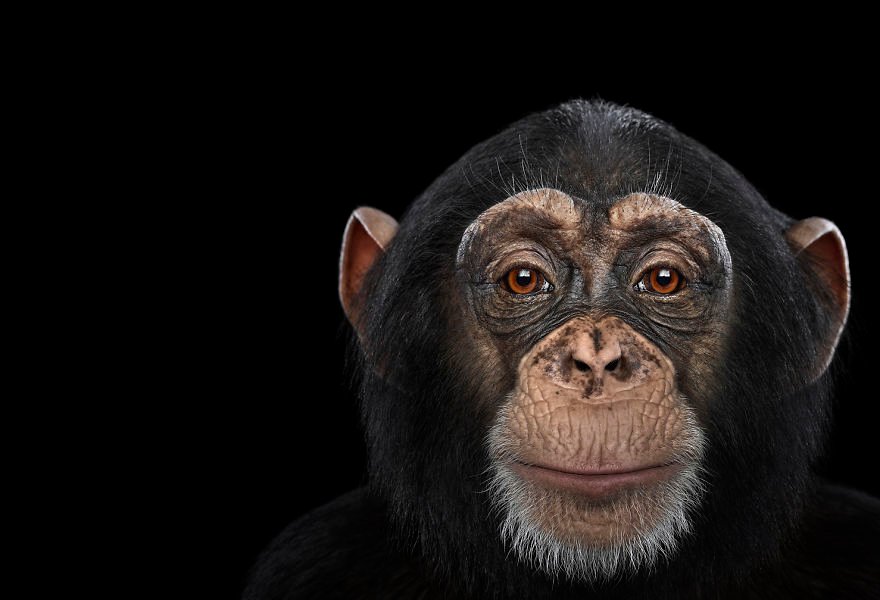
Chimpanzee Intelligence: How Smart Are Our Closest Relatives
How Smart Are Chimpanzees? The Short Answer
Chimpanzees are among the most intelligent animals on Earth, and our closest living relatives. They share roughly 98.8 percent of their DNA with humans, and the two lineages split only six to seven million years ago, a blink in evolutionary time. That closeness shows in the mind: chimpanzees make and use tools, pass down cultural traditions, recognise themselves in mirrors, solve multi-step problems, and even beat university students at certain memory games.
Their brains are about one-third the size of ours, yet what chimpanzees do with that brain tissue continues to surprise researchers. They are not "almost human" in any simple sense. They are a parallel experiment in intelligence, shaped by forest life, complex societies, and millions of years of separate evolution. Understanding chimpanzee intelligence tells us as much about ourselves as it does about them.
The Termite Twig That Changed Science
Our modern picture of chimpanzee intelligence began in 1960, when a 26-year-old English researcher named Jane Goodall arrived at Gombe Stream in Tanzania (now Gombe Stream National Park) to study wild chimpanzees. Within months she witnessed something no scientist had documented before.
She watched a male chimpanzee she had named David Greybeard strip the leaves from a twig, push it into a termite mound, and pull it out covered in insects to eat. He was not just using a tool. He was making one, modifying a natural object to suit a purpose. At the time, toolmaking was considered the defining line between humans and all other animals. Her mentor, Louis Leakey, reportedly responded that science would now have to rethink its definitions of both tools and humans.
Goodall went on to document far more than tool use: cooperative hunting, complex social manoeuvring, and emotional lives that included grief and affection. Her decades at Gombe turned the chimpanzee from a laboratory curiosity into one of the best-studied minds in nature.
Toolmakers of the Forest
Wild chimpanzees use a larger toolkit than any animal except humans. The classic examples come from decades of fieldwork across Africa:
Termite fishing and ant dipping. Chimpanzees select thin, flexible stems or strips of bark, sometimes stripping them to the right length and thickness, and probe them into termite mounds or ant nests. Different communities use different techniques, and young chimpanzees spend years watching their mothers before they master the skill.
Nut cracking. In West Africa, particularly in the Taï Forest of Ivory Coast and at Bossou in Guinea, chimpanzees place hard nuts on stone or root anvils and smash them with carefully chosen stone or wooden hammers. It is skilled work: the hammer must be heavy enough to crack the shell but controlled enough not to crush the kernel, and youngsters take years to learn it.
Leaf sponges. Folded and chewed leaves become sponges for soaking up drinking water from tree hollows, a neat solution for getting water out of places a mouth cannot reach.
Spears. In 2007, researchers Jill Pruetz and Paco Bertolani reported in the journal Current Biology that chimpanzees at Fongoli in Senegal hunt bushbabies with sharpened sticks. The chimps break off branches about 60 centimetres long, strip the leaves and bark, and sharpen one end with their teeth, following as many as five manufacturing steps. They then jab the spears into tree hollows where the small nocturnal primates sleep. Across 22 recorded hunting bouts, the researchers saw one successful kill. Notably, the spear-makers were mostly females and juveniles, not adult males.
This tool use is not a recent invention. In 2007, archaeologist Julio Mercader and colleagues reported in the Proceedings of the National Academy of Sciences that they had excavated a 4,300-year-old chimpanzee nut-cracking site in the Taï Forest, the Noulo site. The team recovered 479 stone pieces showing distinctive wear patterns, along with starch grains from nuts that chimpanzees still eat today. Because no farmers lived in the region 4,300 years ago, the chimps could not have copied the behaviour from people. Chimpanzee technology has deep roots, passed down through thousands of generations.
Chimpanzee Cultures: Traditions Across Generations
One of the most striking findings in animal cognition is that chimpanzees have cultures. In 1999, Andrew Whiten of the University of St Andrews, together with Jane Goodall and other long-term field researchers, published a landmark survey in the journal Nature. The team compared seven chimpanzee communities studied for between 8 and 38 years and catalogued 65 behaviour patterns.
Of those, 39 qualified as cultural: behaviours that were customary in some communities yet absent in others, with no ecological or genetic explanation for the difference. Some groups fish for termites with bark strips; others nearby do not. Some crack nuts with stone hammers; others ignore the same nuts. Some get attention by rapping knuckles on branches, while others tear leaves noisily between their teeth. Some communities even perform a distinctive rain dance, a charging display at the start of heavy rain.
The implication is that these are traditions, invented somewhere and spread by social learning rather than by genes or environment. Later experiments confirmed that chimpanzees can pick up entirely new behaviours seeded by researchers and pass them along group to group, like a game of Chinese whispers played with tools and gestures. No other non-human animal studied so far shows cultural variation this rich.
A Memory That Beat University Students
Perhaps the most humbling result in chimpanzee cognition research came from Kyoto University in Japan. In a study published in Current Biology in 2007, Sana Inoue and Tetsuro Matsuzawa tested young chimpanzees on a numerical memory task and pitted them against human university students.
Three pairs of chimpanzee mothers and infants had been trained to touch the Arabic numerals 1 to 9 in ascending order on a touchscreen. In the test, five numerals flashed on the screen and were then instantly masked by white squares. The subject had to remember where each number had been and touch the squares in the correct order.
When the numerals were visible for about 0.7 seconds, the young chimp Ayumu and the students both scored around 80 percent correct. But when the viewing time was cut to 0.43 seconds and then to just 0.21 seconds, too brief for a human eye to even scan the screen, the students' accuracy collapsed to about 40 percent. Ayumu stayed near 80 percent.
Matsuzawa suggested that young chimpanzees possess something close to photographic memory, an ability to retain extreme visual detail from a single glance that also appears in young human children but fades with age. The young chimps consistently outperformed their own mothers too. It was the first time any animal had beaten humans at a cognitive task in outright performance, not just shown a similar kind of ability. The researchers proposed a trade-off: as humans evolved language and complex social coordination, we may have lost some of the raw visual memory our shared ancestors possessed.
Learning to "Talk": Gestures, Calls, and Sign Language
Chimpanzees cannot speak. Their vocal anatomy simply will not produce human speech sounds, which is why early attempts to teach chimps to talk failed. But communication is one of their great strengths, and it runs through three channels.
Vocalisations. Wild chimpanzees use a rich repertoire of calls. The pant-hoot, a rising series of hoots that builds to a climax, carries over long distances and helps scattered group members stay in contact. There are distinct calls for food discoveries, for danger, and for social excitement, and calls vary subtly between individuals and communities.
Gestures. Much chimpanzee communication is physical: an outstretched begging hand, a grooming invitation, a swaggering display. Researchers have catalogued dozens of intentional gestures, and chimps adjust their signals depending on whether their audience is watching, a sign they understand attention itself.
Sign language. The most famous test of ape language began in 1966, when psychologists Allen and Beatrix Gardner of the University of Nevada, Reno, started teaching American Sign Language to a young female chimpanzee named Washoe. Raised much like a human child and surrounded by people signing, Washoe learned roughly 250 to 350 signs (the exact count depends on how strictly researchers score them). She combined signs into simple phrases and once, on seeing a swan, signed "water bird", a spontaneous combination that delighted researchers.
Washoe's adopted son Loulis later learned signs by watching his mother, becoming the first ape known to acquire signing from another ape rather than from humans. The ape-language projects remain debated: critics argue the chimps were cleverly associating signs with rewards rather than using true grammar. But even the sceptics agree the work proved something important, that a chimpanzee mind can learn, combine, and intentionally use hundreds of human symbols.
Social Strategists: Politics, Deception, and Empathy
In the wild, chimpanzee intelligence is above all social intelligence. Chimpanzees live in communities of up to 150 individuals with shifting alliances, and navigating that world demands constant calculation.
They form coalitions, reconcile after fights, and share meat to build political support. They practise tactical deception: Goodall documented individuals suppressing food calls to keep a discovery secret, or quietly leading rivals away from a hidden cache. Experiments at the Max Planck Institute showed that subordinate chimpanzees preferentially go for food that a dominant rival cannot see, evidence that they track what others do and do not know, a basic form of theory of mind.
Their emotional lives are equally complex. Primatologist Frans de Waal documented consolation, in which bystanders comfort a chimpanzee that has lost a fight, putting an arm around the victim. Chimpanzees grieve: mothers have been seen carrying dead infants for days, and groups fall silent around a dead companion. That same social brain has a dark side. At Gombe, Goodall documented a four-year period of coordinated lethal attacks by one community against a neighbouring splinter group, a grim reminder that organised violence is not uniquely human either.
Self-Awareness: Recognising Themselves
In 1970, psychologist Gordon Gallup devised the mirror test: mark an animal's forehead with odourless dye while it is anaesthetised, then see what it does when it sees its reflection. Chimpanzees passed. Instead of treating the mirror image as another chimp, they used the reflection to investigate the mark on their own bodies, touching and smelling the dye on themselves.
Passing the mirror test is taken as evidence of self-recognition, a sense of self as distinct from others. Very few animals pass it reliably: the great apes, dolphins, elephants, and magpies are the classic members of the club. For chimpanzees, self-awareness underpins much of their social cleverness, from deception to embarrassment to the ability to imagine another's perspective.
Solving Puzzles for Pure Enjoyment
Chimpanzees do not only think when there is food at stake. In a study published in the American Journal of Primatology in 2013, Zoological Society of London researcher Fay Clark gave six chimpanzees at Whipsnade Zoo a puzzle built from ordinary plumbing pipes. The task was to move red dice through the pipe network into an exit chamber by poking sticks through holes to change the dice's direction. The chimps received no training on the device.
The striking result was motivational: the chimpanzees kept working at the puzzle even when the dice were replaced with Brazil nuts and the exit chamber was removed so no reward fell out. They appeared to enjoy the challenge itself, much as humans do crosswords. Clark suggested the satisfaction of solving a hard problem is its own reward, a finding with real implications for how zoos keep intelligent animals mentally healthy.
Related research on metacognition, thinking about one's own thinking, has shown that chimpanzees seek out extra information when they are uncertain and skip the search when they already know the answer, adjusting their effort to their own state of knowledge.
Chimpanzee Intelligence Compared
| Ability | Chimpanzee | Human | Other standout animals |
|---|---|---|---|
| Tool manufacture | Yes: spears, hammers, probes, sponges | Yes: cumulative technology | New Caledonian crows, sea otters |
| Cultural traditions | Yes: 39+ documented regional traditions | Yes: cumulative culture | Orangutans, some whales and dolphins |
| Mirror self-recognition | Yes | Yes (from ~18 months) | Elephants, dolphins, magpies |
| Short-term visual memory | Can beat adult humans (Ayumu study) | Strong, but loses to young chimps on this task | Scrub jays show strong spatial memory |
| Symbolic communication | Hundreds of signs/gestures; no speech | Full language | African grey parrots, bonobos (lexigrams) |
| Theory of mind | Basic: tracks what others see and know | Fully developed | Limited evidence in some corvids, apes |
| Future planning | Yes: saves tools, plans routes | Yes: extensive | Scrub jays cache with future needs in mind |
The honest summary: chimpanzees match or exceed humans on a handful of specific cognitive tasks, run roughly even on social manoeuvring, and fall far behind on the open-ended, cumulative, language-driven intelligence that built civilisation. They are not failed humans. They are supremely successful chimpanzees.
Frequently Asked Questions
Are chimpanzees smarter than humans? No, not overall. Human intelligence is far more flexible, cumulative, and language-driven. But chimpanzees outperform humans on specific tasks, most famously the short-term numerical memory test in which the young chimp Ayumu beat university students. Intelligence is not a single ladder; it is a toolkit, and different species carry different tools.
Can chimpanzees talk? Not with spoken words. Their vocal tract cannot produce human speech sounds. They can, however, learn to communicate with hundreds of signs or symbols, as Washoe demonstrated with American Sign Language, and wild chimpanzees use a rich system of calls and gestures.
Do chimpanzees really have culture? Yes. The 1999 Whiten study documented 39 behaviour patterns that vary between communities for social rather than ecological reasons, from nut-cracking styles to attention-getting gestures. These traditions are learned socially and passed down generations, which meets the standard scientific definition of culture.
Are chimpanzees smarter than gorillas or orangutans? It depends on the test. Chimpanzees excel at social cognition and cooperative problem-solving. Orangutans are exceptional solitary problem-solvers. Gorillas are intelligent but have been studied less. Among the great apes, rankings shift with the task, which is why primatologists avoid a single league table.
Do chimpanzees feel grief? The evidence says yes. Researchers have documented mothers carrying dead infants for extended periods, groups becoming quiet and subdued around a deceased companion, and behaviours consistent with mourning. They also console distressed group members, showing empathy in action.
How long do chimpanzees live? Chimpanzees typically live 40 to 50 years in the wild, and can live beyond 60 in captivity with veterinary care. Their long lives support extended childhoods: infants stay close to their mothers for years, which is when most tool skills and social knowledge are learned by observation.
Are chimpanzees endangered? Yes. Chimpanzees are listed as Endangered on the IUCN Red List. Wild populations have declined sharply due to habitat destruction, poaching, and disease, with somewhere on the order of a few hundred thousand remaining across fragmented African forests. Protecting their habitat protects the cultures and knowledge described in this article, which vanish when a community does.
Why Chimpanzee Minds Matter
Every few years, chimpanzee research knocks another brick out of the wall humans built between "us" and "them". Toolmaking fell in 1960. Culture fell in 1999. The memory crown slipped in 2007. Each discovery reframes not only the chimpanzee but the human: our intelligence did not appear from nowhere. It is an elaboration of capacities with deep roots in the ape lineage we share.
That shared heritage carries a responsibility. Chimpanzees are endangered, and when a forest community disappears, its unique traditions, its tool styles, its dialects of gesture, disappear with it. Studying chimpanzee intelligence is ultimately a race against that loss, and every finding is an argument for keeping these remarkable minds, and the forests that shaped them, in the world.