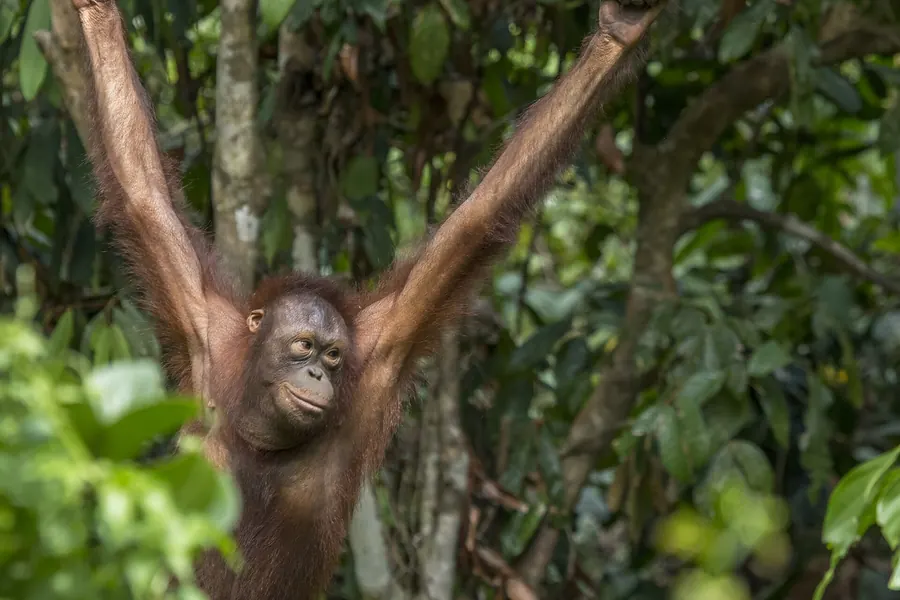
Bornean Orangutan Facts: The Tree-Living Giant of Borneo
Bornean Orangutan Facts at a Glance
The Bornean orangutan is the largest animal on Earth that spends almost its entire life in trees. Found only on the island of Borneo in Southeast Asia, this great ape (Pongo pygmaeus) is a slow, deliberate, red-haired climber that builds a new sleeping nest high in the canopy nearly every night. Around 104,700 Bornean orangutans remain in the wild, according to the World Wildlife Fund, and the species has been classified as Critically Endangered since the IUCN up-listed it in 2016 after its numbers fell by more than half over 60 years.
What makes these apes especially worth knowing is how much of the forest depends on them. Orangutans eat the fruit of more than 500 plant species, and the seeds that pass through their bodies or get spat onto the forest floor germinate more successfully than seeds that never met an orangutan. They are, in a very real sense, the gardeners of Borneo.
This article gathers the essential Bornean orangutan facts in one place: what they look like, where they live, what they eat, how they behave, why they are endangered, and what conservationists are doing to protect them.
| Fact | Detail |
|---|---|
| Scientific name | Pongo pygmaeus |
| Common name | Bornean orangutan; "orangutan" means "person of the forest" in Malay |
| Conservation status | Critically Endangered (IUCN Red List) |
| Estimated wild population | About 104,700 (WWF) |
| Range | Borneo: Indonesian Kalimantan, Malaysian Sabah and Sarawak |
| Habitat | Lowland rainforest, swamp forest, hill forest to about 1,500 m |
| Male size | 1.0 to 1.5 m tall, 50 to 100 kg |
| Female size | About 0.78 m tall, 40 to 50 kg |
| Lifespan | 35 to 45 years in the wild; up to 60 in human care |
| Diet | About 60 percent fruit, plus leaves, bark, flowers, insects, bird eggs |
What Is a Bornean Orangutan?
The Bornean orangutan is one of three living orangutan species. The others are the Sumatran orangutan (Pongo abelii) and the Tapanuli orangutan (Pongo tapanuliensis), both of which live on the island of Sumatra. Together they form the only genus of great apes native to Asia. All three are critically endangered.
The word "orangutan" comes from the Malay words orang (person) and utan (forest): the person of the forest. The name fits. Bornean orangutans share roughly 97 percent of their DNA with humans, and anyone who watches a mother patiently teaching her infant which fruits are safe will find the resemblance hard to miss.
Three subspecies of the Bornean orangutan are recognized, each living in a different part of the island:
- Northwest Bornean orangutan (P. p. pygmaeus): found in Sarawak and northern West Kalimantan. It is the most threatened of the three, with only around 1,500 individuals left in small, fragmented patches of forest that have been heavily affected by logging and hunting.
- Central Bornean orangutan (P. p. wurmbii): the most numerous subspecies, with at least 35,000 individuals in southern West Kalimantan and Central Kalimantan.
- Northeast Bornean orangutan (P. p. morio): the smallest in body size, living in Sabah and eastern Kalimantan as far as the Mahakam River.
These divisions matter for conservation because the subspecies face different threats and need different recovery plans.
Size, Appearance, and the Cheek-Padded Males
The Bornean orangutan is stocky and powerfully built, covered in a coarse, shaggy reddish coat that ranges from bright orange-red to dark maroon. Its face is darker than its Sumatran cousin's: Bornean orangutans have a broader face, a shorter beard, and slightly darker hair. Its arms are famously long, about one and a half times the length of its legs, with an arm span that can reach two meters or more in large adults. Those arms are the engine of its life, built for cautious climbing and suspension from branch to branch.
Orangutans are sexually dimorphic, meaning males and females differ well beyond their reproductive organs. Adult males stand 1.0 to 1.5 meters tall and weigh 50 to 100 kg, with some exceptionally large males approaching 100 kg. Adult females stand about 0.78 meters tall and weigh 40 to 50 kg. The males are also the ones that develop the species' most striking feature: broad, flat cheek pads called flanges, which frame the face like a fleshy ruff. Dominant adult males also grow a large throat sac, which they use to produce the long call, a booming vocalization that can carry for hundreds of meters through the forest and announces the caller's presence and rank to other males.
Young orangutans look quite different from the adults. Infants are smaller and paler, and they ride clinging to their mother's belly for the first years of life. Interestingly, male development can take two paths: some males become fully flanged, while others remain unflanged well into adulthood, a condition researchers link to social circumstances rather than age alone.
Habitat: Where Bornean Orangutans Live
Bornean orangutans live nowhere else on Earth but Borneo, the world's third largest island, which is divided among Indonesia (Kalimantan), Malaysia (Sabah and Sarawak), and Brunei. Within the island, they occupy lowland tropical rainforest, including dipterocarp forest, peat-swamp forest, and hill forest up to about 1,500 meters elevation.
They are most abundant in lowland and swamp forests, where fruit is plentiful. Peat-swamp forests in particular support some of the highest orangutan densities on the island. But their distribution is now patchy: the species has become rare in the southeast of the island and is absent from several stretches of forest in central Sarawak and western Sabah.
One uncomfortable fact shapes all conservation planning: most wild orangutans live outside protected areas. Their forests are timber concessions or land already earmarked for agriculture. WWF estimates that some 300 million trees have been cut in Borneo since 1994, and the Bornean orangutan's habitat has shrunk by at least 55 percent in the past 20 years. Where the forest fragments, orangutans are forced into smaller and smaller pockets, sometimes ending up in plantations where they cannot feed themselves.
What Do Bornean Orangutans Eat?
Fruit dominates the menu. Roughly 60 percent of the Bornean orangutan's diet is fruit, particularly wild figs and durians, and field researchers have recorded more than 500 plant species in the diet overall. The rest is an impressive variety of fallback foods: leaves, bark, flowers, seeds, sap, vines, honey, insects such as termites and ants, fungi, and occasionally bird eggs.
That dietary flexibility is a survival strategy. Borneo's forests are not constant supermarkets; fruit availability swings with seasons and with mast-fruiting events, when dozens of tree species fruit at once every few years. In lean months, orangutans fall back on bark and leaves, foods that require strong jaws and a slow metabolism. Orangutans have exceptionally slow metabolisms for their body size, which lets them survive on poor-quality food, and their bodies store fat efficiently during times of plenty, much like bears preparing for winter.
Water comes from tree holes, from bromeliads and pitcher plants, and even from the moisture in fruit itself. Orangutans have been observed using large leaves as makeshift cups or umbrellas, a small but telling example of their problem-solving ability.
Behavior, Intelligence, and a Surprisingly Solitary Social Life
Bornean orangutans are the most solitary of the great apes. Adult males live largely alone, and even adult females spend most of their time with only their dependent offspring. This is not antisocial behavior in any emotional sense; it is an ecological adaptation. Fruit is scattered through the forest, and a large ape needs a big territory to find enough of it, so adults mostly go their own way and meet to mate, to share a rich fruiting tree, or for young males to travel together.
Yet "solitary" understates what goes on inside these animals. Bornean orangutans are highly intelligent and display tool use and distinct cultural patterns that vary from region to region. Different populations have been documented using sticks to extract termites, to fish for seeds from spiny fruits, or to test water depth; using leaves as gloves for handling thorny food; and building rain hats or sun shelters from foliage. These are not instinctive behaviors shared by every orangutan. They are local traditions, learned by watching others, which is the working definition of culture.
Each night, an orangutan builds a new sleeping nest high in the trees, bending and weaving branches into a sturdy platform and sometimes adding a roof or a soft lining of leaves. Building a good nest takes skill and practice, and young orangutans spend years watching their mothers do it before they master the technique.
Vocal life is rich. The most famous call is the long call of the dominant male, a loud, rolling sequence of grunts and barks that can travel up to a kilometer through the forest. It serves as both a keep-away signal to rival males and an advertisement to receptive females. Mothers and infants use softer contact calls, and orangutans also produce alarm calls when they spot a predator such as a clouded leopard or a venomous snake.
On the ground, orangutans are slow and deliberate. They move quadrupedally, usually with their fists resting on the ground rather than their knuckles, and they cannot swim. Given the choice, they prefer not to touch the ground at all, and large males, who are heavy for the canopy, sometimes have no choice but to descend and walk.
Mothers and the Slowest Childhoods in the Animal World
Few mammals reproduce as slowly as the Bornean orangutan, and this fact sits at the center of its conservation crisis. Females typically give birth to a single infant, twins being rare, and the interval between births is six to eight years, among the longest of any mammal. A female does not usually begin reproducing until her mid-teens, though she reaches sexual maturity around eight.
The bond between mother and infant is one of the closest and longest in nature. An infant stays with its mother for six to nine years, riding on her body, sleeping in her nest, and nursing for several years. Daughters often stay with their mothers into their teens, watching and learning skills they will need when they eventually raise their own young, including which foods are safe, how to build nests, and how to read the forest's seasons. Because of this enormous investment, the loss of a single adult female removes not just one animal but the better part of a decade of future reproduction.
This slow life history means the population cannot bounce back quickly from losses. When humans kill orangutans, whether through hunting, retaliatory shootings, or capture for the pet trade, the population takes generations to recover.
The Gardeners of the Forest
Orangutans are among the most important seed dispersers in Borneo's forests. Because they eat fruit from hundreds of plant species and range widely through the canopy, they carry seeds in their guts and deposit them far from the parent tree, complete with a packet of fertilizer. Researchers have found that seeds handled by orangutans show greater germination success than seeds that never passed through an ape, and some of the larger seeds they swallow, nearly an inch long, can only be processed by animals as big as orangutans. They also spit seeds onto the forest floor as they eat, another effective dispersal route.
The implication is sobering: if orangutans disappear, the forest itself changes. The large-seeded trees that depend on them would struggle to regenerate, and Borneo's rainforest would slowly lose diversity and structure. Protecting orangutans is therefore not only about saving a charismatic animal; it is about keeping an entire ecosystem functioning.
Why Are Bornean Orangutans Endangered?
The IUCN up-listed the Bornean orangutan from Endangered to Critically Endangered in 2016, the category for species facing an extremely high risk of extinction in the wild. The threats are almost entirely human-caused,
Habitat loss. The foremost threat is the destruction of forest for logging and agriculture, especially oil palm plantations. An estimated 300 million trees have been cut in Borneo since 1994, and the species' habitat has shrunk by at least 55 percent in 20 years. Even where forest is not cleared outright, selective logging degrades it, removing the large fruiting trees orangutans depend on.
Forest fires. During the catastrophic 1997 to 1998 fires in Kalimantan, driven by drought and land clearing, up to 8,000 orangutans are estimated to have died. Fire remains a recurring threat in degraded peatlands, which burn readily once drained.
Hunting and retaliatory killing. Orangutans are sometimes shot as agricultural pests when they wander into oil palm plantations in search of food, particularly in hard times when the forest offers little. They are also hunted for meat, and there is a trade in orangutan parts in Kalimantan.
The illegal pet trade. Young orangutans are captured for the pet trade, a transaction that almost always begins with killing the mother. WWF reports that studies indicate 200 to 500 orangutans from Indonesian Borneo alone enter the pet trade each year. Because of the species' extremely slow reproduction, even this level of offtake is a serious threat.
Slow reproduction. As described above, the six to eight year interval between births means the population recovers from losses with agonizing slowness.
Together these pressures have cut the population by more than half in 60 years. Around 230,000 Bornean orangutans are thought to have existed a decade before the current estimate of roughly 104,700, and over 300,000 may have lived on the island in the 1970s.
Conservation: What Is Being Done
The news is not all bleak. A genuine conservation infrastructure exists for orangutans, and several lines of effort are making measurable progress.
Rescue and rehabilitation. Organizations rescue orangutans from traders, from people keeping them illegally as pets, and from forest fragments slated for clearance. Rescued animals are taken to rehabilitation centers, where they recover and learn forest skills, and are eventually released back into the wild, sometimes onto forested islands purchased or rented by the centers when no connected habitat remains.
Anti-poaching and law enforcement. WWF works with TRAFFIC, the wildlife trade monitoring network, to help governments enforce laws against orangutan capture and trade, strengthening the capacity of rangers, prosecutors, and customs officers to identify, investigate, and prosecute wildlife crimes.
Reducing human-orangutan conflict. Conservation groups work with plantation owners, local communities, and the Indigenous Dayak people to develop plantation management methods that reduce harm to orangutans, plan agricultural expansion away from key habitat, and build ecotourism that gives nearby residents an economic stake in keeping the forest standing.
Restoring habitat. WWF and partners help create and manage networks of protected areas and work with certified logging concessions to connect them through carefully managed ecological corridors. Research shows that Bornean orangutans can survive in logged forests when logging is selective, fruit trees are left standing, and hunting is controlled.
Community programs. In 2010, WWF launched a program in West Kalimantan that gives local communities cameras and training to document their surroundings, building local pride in the forest and passing conservation knowledge to younger generations.
Bornean vs Sumatran Orangutan: How to Tell Them Apart
For years scientists considered all orangutans one species; the Bornean and Sumatran forms were only formally separated in the late 20th century. Here is how the two compare.
| Feature | Bornean orangutan (P. pygmaeus) | Sumatran orangutan (P. abelii) |
|---|---|---|
| Island | Borneo | Sumatra |
| Face | Broader, with shorter beard | Longer, narrower face with longer pale beard |
| Coat | Shorter, darker reddish hair | Longer, paler hair |
| Males' cheek pads | Broad and prominent | Narrower |
| Body size | Slightly larger and heavier | Slightly smaller |
| Social life | More solitary | More social, especially around rich fruiting trees |
| Wild population | About 104,700 | Fewer than 14,000 |
| Status | Critically Endangered | Critically Endangered |
Frequently Asked Questions
How many Bornean orangutans are left in the wild? About 104,700, according to the World Wildlife Fund. That is less than half the number thought to exist a decade earlier, and the population continues to decline.
Why are Bornean orangutans endangered? The main drivers are deforestation for timber and oil palm plantations, forest fires, hunting, retaliatory killing in agricultural areas, and the illegal pet trade. Their extremely slow reproduction, with one infant every six to eight years, makes recovery from these losses very slow.
What do Bornean orangutans eat? Mostly fruit, about 60 percent of the diet, drawn from more than 500 plant species. They also eat leaves, bark, flowers, seeds, honey, insects, fungi, and occasionally bird eggs.
How long do Bornean orangutans live? In the wild they live 35 to 45 years. In human care, with regular food and no predators, they can live to 50 or even 60.
Are orangutans dangerous? Wild orangutans are generally peaceful and avoid people. Large adult males are extremely strong and should never be approached, but unprovoked attacks are virtually unheard of. In Borneo, people are far more dangerous to orangutans than the reverse.
Can orangutans swim? No. Orangutans avoid water and cannot swim. Rivers act as natural barriers that shape their distribution, which is one reason the three subspecies occupy distinct parts of the island.
How intelligent are Bornean orangutans? They are among the most intelligent nonhuman animals. They use tools, build elaborate sleeping nests each night, learn traditions from their mothers, and show distinct regional cultures, such as using sticks to extract termites or leaves as gloves for thorny food.
What is being done to save them? Rescue and rehabilitation centers, anti-poaching enforcement, work with plantation owners to reduce conflict, restoration of habitat corridors, and community programs that give local people a stake in conservation.
How can I help? Support reputable conservation organizations working in Borneo, choose products made with certified sustainable palm oil, and avoid supporting the illegal pet trade. Responsible ecotourism also gives local communities economic reasons to protect orangutan habitat.
A Forest That Needs Its Gardeners
The Bornean orangutan's story is, at its core, a story about time. These apes live slowly: they grow slowly, learn slowly, reproduce slowly, and think in seasons rather than days. Borneo's modern pressures, chainsaws, fires, and plantations, move far faster.
Research note: Population, decline, subspecies, and threat figures in this article come from the World Wildlife Fund's Bornean orangutan profile and the IUCN Red List assessment; taxonomy follows the American Society of Mammalogists Mammal Diversity Database.