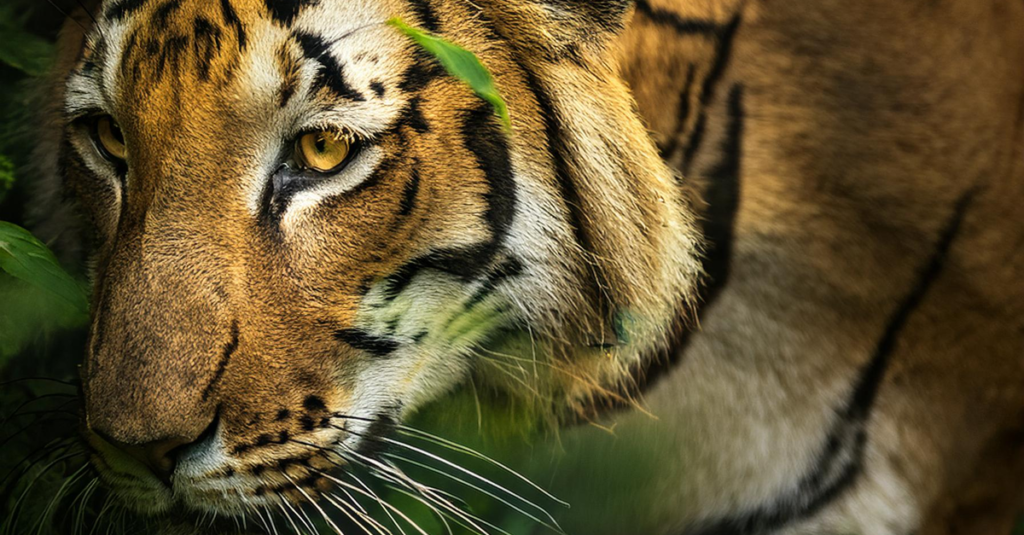
Bengal Tiger Habitat: Forests, Mangroves and Grasslands
The Bengal tiger is the most adaptable of all tigers. It stalks through steaming mangrove swamps, tall elephant grass, dry teak forests, and Himalayan foothills dusted with snow. No other tiger lives in so many kinds of country. This guide to Bengal tiger habitat explores every landscape the species calls home, from the tidal forests of the Sundarbans to the high valleys of Bhutan, and explains what these habitats have in common, what threatens them, and where the tiger's map has already shrunk.
Bengal Tiger Habitat at a Glance
| Fact | Detail |
|---|---|
| Scientific name | Panthera tigris tigris |
| Countries | India, Nepal, Bhutan, Bangladesh, southwestern China |
| Habitat types | Mangroves, alluvial grasslands, moist and dry deciduous forests, subtropical and temperate upland forests |
| Altitude range | Sea level to about 4,200 m (13,800 ft) |
| Estimated population | Roughly 3,700 to 4,300 wild tigers |
| IUCN Red List status | Endangered (tiger, Panthera tigris) |
| Historic range | Once reached the Indus River valley; extinct in Pakistan since 1906 |
| Key strongholds | Sundarbans, Terai Arc, Central Indian highlands, Western Ghats |
Where Bengal Tigers Live Today
The Bengal tiger is a population of the tiger subspecies Panthera tigris tigris, and it ranks among the largest of all wild cats. Its modern range covers India, southern Nepal, Bangladesh, Bhutan, and southwestern China. India holds the overwhelming majority: the 2022 national estimate put India's Bengal tigers at 3,167 to 3,682 individuals, roughly 70 percent of all wild tigers on Earth. Nepal holds an estimated 316 to 355, Bhutan 131, and Bangladesh around 125.
Within these countries, tigers are not spread evenly. They survive in a patchwork of protected landscapes separated by farmland, highways, and towns. The great strongholds are the Terai lowlands along the Himalayan foothills, the Central Indian highlands, the Western Ghats, the Brahmaputra floodplains of Assam, and the Sundarbans mangroves of the Bay of Bengal coast. Each of these landscapes looks and feels completely different, yet each supplies the three things every tiger needs: dense cover, water, and enough prey.
The famous white tiger is also a Bengal tiger, not a separate subspecies. It is a recessive color mutant reported from the wild in Assam, Bengal, Bihar, and especially the former state of Rewa. White tigers are not albinos; they are simply Bengal tigers carrying a rare genetic variant, and they are extremely rare in nature.
Bengal Tiger Habitat Types Compared
| Habitat type | Where | Key features | Famous reserves |
|---|---|---|---|
| Tidal mangrove forest | Sundarbans (India and Bangladesh) | Salt-tolerant trees, tidal creeks, no fresh water | Sundarbans National Park |
| Alluvial grassland | Terai-Duar plains, Brahmaputra valley | Tall grasses, riverine forest, rich prey biomass | Chitwan, Kaziranga, Dudhwa |
| Moist deciduous forest | Western Ghats, Northeast India | Dense canopy, heavy monsoon rain | Periyar, Manas, Nagarhole |
| Dry deciduous forest | Central India | Teak and sal, seasonal waterholes | Kanha, Bandhavgarh, Tadoba |
| Subtropical and temperate upland forest | Himalayan foothills, Bhutan | Steep terrain, cooler climate, high altitudes | Royal Manas, Jigme Dorji |
What unites these habitats is structure, not scenery. Tigers are ambush hunters. They need vegetation thick enough to hide a 200-kilogram cat within a few meters of its prey, water close enough to drink and cool off daily, and a prey base of deer, wild pigs, and other ungulates dense enough to support them.
The Sundarbans: Tigers of the Mangroves
The Sundarbans is the world's largest contiguous mangrove forest, roughly 10,000 square kilometers of tidal woodland spread across Bangladesh and India at the mouths of the Ganges, Brahmaputra, and Meghna rivers. The Bangladesh portion, 6,017 square kilometers, became a UNESCO World Heritage Site in 1997; the Indian Sundarbans National Park was listed in 1987. There are no roads inside the forest. Every movement is by boat.
Its tigers are unique. The Sundarbans population is the only mangrove-adapted tiger population in the world. These cats swim regularly across tidal channels 3 to 5 kilometers wide, moving between islands and even across the India-Bangladesh border as if the international boundary did not exist. Camera traps have confirmed that individuals photographed in India turn up in Bangladesh within weeks, making the two sides effectively a single population.
Life in the mangroves has shaped their bodies. The smallest recorded Bengal tigers come from the Bangladesh Sundarbans, where adult females weigh just 75 to 80 kilograms, barely half the weight of their Central Indian cousins. Scientists believe intense competition and smaller prey, mainly spotted deer (chital), wild boar, and rhesus macaque, keep them small.
The Sundarbans is also famous, grimly, for human-tiger conflict. Honey collectors, fishermen, and woodcutters entering the forest historically faced attack rates exceeding 100 per year, far higher than in other tiger habitats. Researchers debate the causes: scarce large prey in some sectors, tigers habituated to approaching rather than fleeing humans, and the physiological stress of drinking brackish water in a forest with no permanent fresh source. Villagers adapted with remarkable ingenuity, wearing clay face masks on the backs of their heads, since tigers prefer to attack from behind and are reportedly confused by the false face. Better enforcement of no-entry zones and community programs have brought attack rates down in recent decades.
The Bangladesh Sundarbans holds an estimated 100 to 150 tigers by the latest camera-trap census, while the Indian side counted about 86 in India's 2020 census. Both figures are fragile, because the habitat itself is under threat from the sea.
Terai Grasslands and Riverine Forests
At the foot of the Himalayas stretches the Terai, a belt of tall alluvial grasslands and riverine forest across southern Nepal and northern India. This is prime tiger country, and some of the highest tiger densities on Earth are found here. The extraordinary biomass of ungulate prey, chital, sambar, hog deer, nilgai, and wild buffalo, supports more tigers per square kilometer than almost anywhere else.
Nepal's Chitwan, Parsa, and Bardiya National Parks anchor the western Terai, while India's Dudhwa, Valmiki, and Corbett landscapes continue the belt east and west. In the early 1970s, researchers in Chitwan captured male tigers averaging 235 kilograms, among the heaviest reliably weighed wild tigers ever recorded, a testament to how rich this habitat is.
Kaziranga, in Assam's Brahmaputra floodplain, adds a wilder rhythm: annual monsoon floods drown much of the park, and tigers, rhinos, and elephants move to higher ground together. The grass here grows taller than a person, perfect stalking cover for a striped hunter.
Himalayan Foothills and High Altitudes
Bengal tigers climb higher than most people expect. In Bhutan, tigers have been recorded across 17 of the country's 18 districts, moving through subtropical broadleaf forest into cool temperate zones. In 2008, a camera trap in Bhutan photographed a Bengal tiger at 13,800 feet (about 4,200 meters), an altitude once thought far beyond the species' reach. In 2017, tigers were recorded in the Mishmi Hills of Arunachal Pradesh at 3,630 meters, in snow.
These highland forests are cooler, steeper, and less prey-rich than the lowlands, so tigers occur at lower densities. But the records matter: they show the species' remarkable flexibility and hint at corridors linking lowland populations across the Himalayan arc. As the climate warms, these upland refuges may become even more important.
Central India's Dry Forests
The classic image of the Bengal tiger, a great striped cat padding past ancient ruins or lounging at a waterhole, comes from Central India's dry deciduous forests. Reserves like Kanha, Bandhavgarh, Pench, Tadoba, and Panna protect tracts of teak and sal forest that turn parched and leafless in summer, concentrating animals around the remaining waterholes.
Here tigers hunt chital, sambar, nilgai, and wild boar, and occasionally take gaur, the massive wild cattle of Indian forests. In the dry months, a tiger's territory revolves around water. The forests are also where much of India's pioneering tiger research happened, and where tourism brings millions of visitors hoping for a glimpse of stripes through the trees.
What a Tiger Needs From Its Habitat
Strip away the scenery, and every Bengal tiger habitat must deliver the same essentials.
Dense cover. Tigers hunt by stealth, not speed. They creep to within a few meters of deer or pigs, then explode in a short rush. Only about one hunt in twenty succeeds, so the vegetation must let a large cat stay invisible until the last moment.
Water. Tigers drink daily and love to soak, especially in the heat. The Sundarbans tigers are famously strong swimmers, but even dry-forest tigers spend hot afternoons half-submerged in pools. Permanent water anchors a territory.
Prey. A tiger needs large ungulates: chital, sambar, nilgai, wild pigs, and in some areas gaur or barasingha. Where wild prey is depleted, tigers turn to livestock, which leads to conflict and retaliatory killing. The richest habitats, like the Terai, carry a prey biomass that can support dense tiger populations; the poorest, like the Sundarbans, produce smaller cats.
Space and connection. Tigers are solitary and territorial. Outside of mothers raising cubs, which stay with her for two to three years, Bengal tigers live alone, and on the rare occasions several converge at a rich food source, the gathering is called an ambush or streak. Males patrol large ranges that overlap those of several females, and young females usually settle near their mother's territory. When forests are fragmented by roads and farms, young tigers cannot disperse, populations become isolated, and inbreeding follows. Corridors of forest linking reserves are as important as the reserves themselves.
A Shrinking Map: The Tiger's Lost Range
The Bengal tiger's historic range was far larger than today's fragments. It once covered nearly all of India, eastern Pakistan, southern Nepal, Bangladesh, Bhutan, and southwestern China, and genetic evidence suggests tigers reached the Indian subcontinent 12,000 to 16,500 years ago, in the Late Pleistocene.
That range included the Indus River valley until the early 19th century. In what is now Pakistan, the tiger's last stronghold was the riverine jungle of the Indus basin. The final individuals were shot in 1906 in Bahawalpur. Pakistan, which today works to protect snow leopards, Indus dolphins, and markhor, lost its tigers to hunting and the clearing of riverine forest more than a century ago. It is a sobering reminder that habitat loss is not a distant threat; it has already erased entire populations within living memory's reach.
Across the remaining range, the great alluvial grasslands of the Gangetic and Brahmaputra plains, once a continuous sea of grass, riverine forest, and swamp stretching along the major rivers, have largely been converted to farmland or degraded. What survives exists as islands: the tiger conservation landscapes of Rajaji-Corbett, Dudhwa, Chitwan-Parsa-Valmiki, and a handful of others.
Threats to Tiger Habitat
Poaching. Tigers are killed for skins, bones, and body parts traded illegally, much of it destined for markets that value them in traditional medicine. A single tiger can fetch what amounts to a year's income for a poacher, which keeps the trade alive despite strict laws.
Habitat loss and fragmentation. Forests are cleared for agriculture, logged, mined, and cut by roads and railways. Each fragment holds fewer tigers, and isolated populations slowly wink out.
Human encroachment and conflict. As villages and farms press against reserve boundaries, tigers kill livestock and occasionally people. Retaliation follows. India's 2006 Forest Rights Act, which recognized the rights of forest-dwelling communities, improved human lives but increased pressure on tiger habitat, a genuine conservation dilemma.
Prey depletion. Where local hunting empties forests of deer and pigs, tigers go hungry and turn to cattle, deepening conflict.
Climate change. The Sundarbans faces sea-level rise of 3 to 8 millimeters per year, faster than the global average because the delta is also subsiding. Cyclones batter the coast, and saltwater pushes further into the forest. Low-lying islands have already been lost. UNESCO lists the Sundarbans as a site of significant climate concern, and the world's only mangrove tigers may lose their home to the sea.
Protecting Tiger Landscapes
The fightback began early. India launched Project Tiger in 1973, creating a network of tiger reserves that now anchors the species' survival. Nepal, Bhutan, and Bangladesh run their own protection programs, and the 12 tiger-range countries once pledged to double wild tiger numbers, the Tx2 goal. Numbers have responded: India's 2022 census recorded 3,167 to 3,682 tigers, up from about 1,411 in 2006, and Nepal's population has grown strongly as well.
Modern conservation works at the landscape scale. Anti-poaching patrols, camera-trap monitoring, and scientific censuses track the cats; village relocation programs, compensation for livestock losses, and corridor restoration address the human side. The lesson of the Bengal tiger's habitat story is that the species is flexible enough to live almost anywhere with cover, water, and prey. The question is whether people will leave it enough of that anywhere.
Frequently Asked Questions
Where do Bengal tigers live?
Bengal tigers live in India, Nepal, Bhutan, Bangladesh, and southwestern China. India holds about 70 percent of them. Their habitats include mangrove swamps, tall grasslands, moist and dry deciduous forests, and Himalayan foothill forests.
What is the main habitat of the Bengal tiger?
There is no single main habitat; the Bengal tiger is a habitat generalist. The most iconic are the Sundarbans mangroves, the Terai grasslands, and the dry deciduous forests of Central India, each holding major populations.
Do Bengal tigers live in the mangroves?
Yes. The Sundarbans, the world's largest mangrove forest across India and Bangladesh, holds the only mangrove-adapted tiger population in the world. These tigers swim tidal channels several kilometers wide and are smaller than tigers elsewhere.
Why are Bengal tigers endangered?
The tiger is listed as Endangered by the IUCN because of poaching for the illegal wildlife trade, habitat loss and fragmentation, depletion of prey, and conflict with humans. Climate-driven sea-level rise now threatens the Sundarbans population as well.
Did tigers ever live in Pakistan?
Yes. Bengal tigers historically ranged through the Indus River valley in what is now Pakistan. The last stronghold was around Khairpur and Bahawalpur, where the final individuals were shot in 1906. The species is extinct in Pakistan today.
Conclusion
From tidal mangroves to Himalayan snowline, Bengal tiger habitat is a tour of South Asia's wildest country. The tiger's adaptability is its greatest strength: give it cover, water, and prey, and it thrives from sea level to 4,200 meters. But adaptability cannot outrun bulldozers, snares, and rising seas. The shrinking of its map, including the complete loss of Pakistan's tigers a century ago, shows what happens when habitat is taken for granted. The expanding parts of the map, in India's reserves and Nepal's Terai, show what happens when it is defended. The Bengal tiger's future will be decided not in one forest but across all of them. Every reserve that holds its tigers, and every corridor that reconnects two forests, is a vote for a wilder subcontinent.