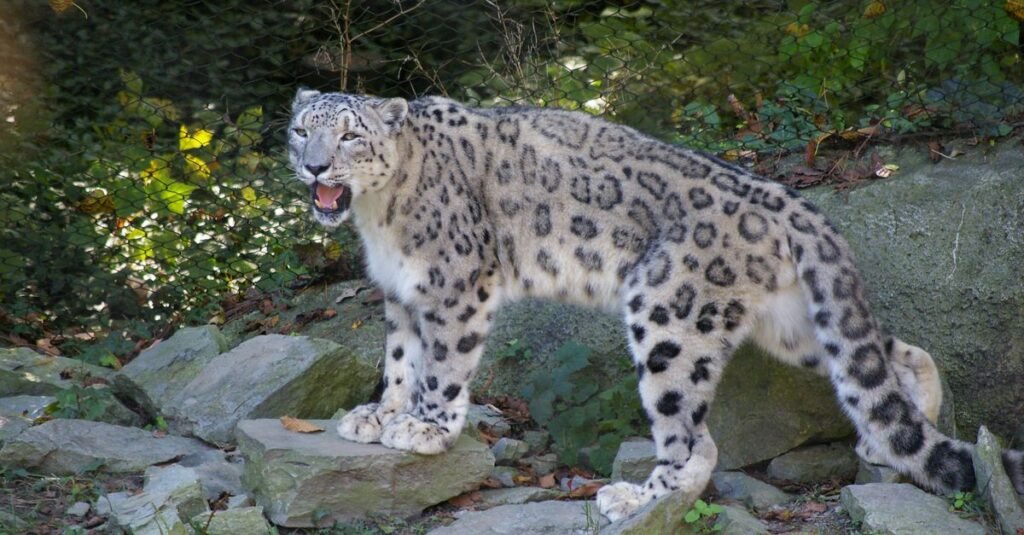
Snow Leopard Facts: The Ghost of the Mountains Explained
Few animals carry as much mystique as the snow leopard. It hunts on cliffs where the air is thin, vanishes into rock and scree with a coat made for camouflage, and is so rarely seen that entire expeditions return with nothing but footprints. These snow leopard facts gather what scientists actually know about Panthera uncia: how it is built, where it roams, what it eats, how many remain, and what stands between this cat and extinction.
Snow Leopard Facts at a Glance
| Fact | Detail |
|---|---|
| Scientific name | Panthera uncia |
| Common names | Snow leopard, ounce, ghost of the mountains |
| Family | Felidae (cats) |
| Size | About 2.1 m long including a 0.9 m tail; 0.6 m at the shoulder |
| Weight | 23 to 41 kg, males slightly larger than females |
| Coat | Smoky gray with dark rosettes; dense insulating undercoat |
| Habitat | Steep, rocky mountains at 3,000 to 5,000 m |
| Range | 12 countries across Central and South Asia |
| Diet | Blue sheep, ibex, argali, marmots, hares, game birds |
| Social life | Solitary; pairs meet only to breed |
| IUCN Red List status | Vulnerable (downlisted from Endangered in 2017) |
| Estimated population | 2,700 to 3,400 mature adults; up to 7,500 of all ages |
What Is a Snow Leopard?
The snow leopard is a medium-sized big cat native to the mountain ranges of Central and South Asia. Its scientific name is Panthera uncia, placing it in the same genus as lions, tigers, leopards, and jaguars. For a time, some authorities put it in a genus of its own, Uncia, because of its shorter skull and more rounded eye sockets. Genetic work has since confirmed its place among the Panthera cats.
Its closest living relative is the tiger. Britannica reports that the common ancestor of snow leopards and tigers split from the rest of the big cat lineage about 3.9 million years ago, and that snow leopards branched off from tigers around 3.2 million years ago. Fossil evidence suggests the species' deep roots in Asia, with snow leopard fossils from the Pabbi Hills of Pakistan dating to the Early Pleistocene.
Despite the family resemblance, the snow leopard took a very different evolutionary path from its lowland cousins. Everything about it, from its fur to its lungs, is tuned for life at altitudes where most predators cannot follow.
Built for the Cold: Remarkable Adaptations
A snow leopard's body reads like an inventory of cold-weather engineering.
Its coat is the first line of defense. The fur is pale smoky gray marked with dark rosettes, which breaks up the cat's outline against rock and patchy snow. Beneath the outer hairs sits a dense, woolly undercoat. Britannica notes the outer hairs reach about 5 cm long, while the fur on the underparts can be 10 cm deep, some of the thickest fur of any cat.
Its paws are wide and completely furred underneath, spreading the animal's weight the way a snowshoe does. National Geographic describes them as natural snowshoes that keep the cat from sinking into deep drifts while gripping icy rock. The ears are small and rounded to lose less heat, and the nasal cavity is unusually large, warming frigid air before it reaches the lungs.
Then there is the tail. Thick, bushy, and nearly as long as the body, it serves as a balancing rudder when the cat sprints across cliffs and as a warm scarf the leopard wraps around its face while sleeping in sub-zero cold.
Power completes the package. Snow leopards are tremendous leapers, able to cover as much as 50 feet (about 15 meters) in a single bound, roughly six times their body length, according to National Geographic and WWF. Their hind legs are notably longer and more muscular than their forelegs, built for launching up and down near-vertical terrain.
Where Snow Leopards Live: Habitat and Range
Snow leopards occupy one of the largest ranges of any wild cat, yet one of the emptiest. Their territory spans more than 2,000,000 square kilometers, an area roughly the size of Greenland, across 12 countries: China, Mongolia, Russia, Kazakhstan, Kyrgyzstan, Tajikistan, Uzbekistan, Afghanistan, Pakistan, India, Nepal, and Bhutan. China holds about half of the global range.
Within that vast map, the cats are picky. They favor steep, rugged, broken terrain with rocky outcrops and ravines: the Himalayas, Karakoram, Hindu Kush, Pamir, Tien Shan, Altai, and the highlands west of Lake Baikal. Typical elevations run from 3,000 to 5,000 meters (about 10,000 to 18,000 feet), though Britannica records occurrences from as low as 500 meters to as high as 5,800 meters. In summer they hunt above the treeline; in winter they may follow prey down into forests and meadows.
Because prey is thinly spread at these heights, each cat needs an enormous home range. National Geographic reports that males patrol up to 80 square miles, an area larger than three Manhattans, while females use up to 48 square miles. In Mongolia's South Gobi, males have ranged across 800 to 900 square kilometers, while in prey-rich parts of Nepal a home range can shrink to 40 square kilometers.
For readers in Pakistan, this cat is a neighbor. Snow leopards prowl the Karakoram, Hindu Kush, and western Himalayas of Gilgit-Baltistan and Khyber Pakhtunkhwa, including strongholds like Khunjerab National Park and the valleys of Baltistan. The Karakoram population hunts mainly ibex, the classic prey of these mountains.
What Snow Leopards Eat: Diet and Hunting
Snow leopards are opportunistic carnivores, and their menu changes with the mountain range. In the Himalayas, the staple is the blue sheep, or bharal. Across the Karakoram, Tien Shan, and Altai ranges, ibex and wild argali sheep dominate. Smaller prey fills the gaps: marmots, hares, pikas, and large birds such as snowcocks. Though these cats typically weigh under 45 kilograms, they can kill animals three times their own weight.
National Geographic recounts a striking year in the life of one Indian snow leopard observed in a national park: five blue sheep, nine Tibetan woolly hares, 25 marmots, five domestic goats, one domestic sheep, and 15 birds. That single diary entry shows both the cat's versatility and its growing dependence on livestock where wild prey has been depleted.
Snow leopards are crepuscular hunters, most active at dawn and dusk when low light favors their camouflage. Their signature move is the ambush from above. A cat will stalk along a ridgeline, then launch itself down a slope onto ibex or blue sheep below, chasing for up to 300 meters before making the kill. Afterward it drags the carcass to a sheltered spot to feed undisturbed.
Where wild sheep and goats have declined through poaching and competition with livestock, snow leopards increasingly turn to domestic animals. That shift puts them on a collision course with herders, one of the gravest threats the species faces.
A Solitary Life: Behavior, Breeding, and Cubs
Adult snow leopards live alone. Each cat patrols its own territory, and males and females come together only for the breeding season, which runs from about January to March. Males may mate with several females in a season.
After a gestation of 90 to 105 days, the female gives birth to a litter of two to four cubs in a sheltered den among rocks. The cubs are blind and helpless at first, opening their eyes within about a week. They stay with their mother for roughly a year, learning to navigate cliffs and hunt, before dispersing to find territories of their own. Females reach breeding age at about two years, males at around four.
In the wild, snow leopards probably live 10 to 12 years, though individuals in captivity have reached 21. Their elusive nature means basic facts like lifespan are still estimates drawn from collared animals and long-term camera-trap studies.
One of the best-known snow leopard facts concerns its voice. Unlike lions and tigers, the snow leopard cannot roar. A partially ossified hyoid bone, the structure that enables roaring in other big cats, limits it to purrs, meows, growls, hisses, and a soft puffing sound called a chuff. It is a quiet ghost in more ways than one.
How Many Snow Leopards Are Left?
Counting an animal that avoids humans across two million square kilometers of cliff and scree is extraordinarily difficult. The best current estimates, summarized by Britannica from IUCN data, put the population at 2,700 to 3,400 mature adults, with up to 7,500 animals of all ages. A conservation research group puts the total range at 4,500 to 7,500. Either way, the true number is small and the population trend is decreasing.
In 2017, the IUCN moved the snow leopard from Endangered to Vulnerable on the Red List. The change followed the discovery of an error in the population calculations behind the 2008 assessment, and it was controversial. Conservationists worried the downlisting would suggest the crisis was over. It is not. The species still has fewer than 10,000 mature individuals, and the IUCN lists its trend as decreasing.
National surveys are slowly sharpening the picture. A recent survey in India estimated 718 snow leopards, with 477 in Ladakh, 51 in Himachal Pradesh, and 21 in Sikkim. In China's Sanjiangyuan region, camera-trap research has identified around 1,000 individuals, roughly 11 to 21 percent of the global population, in one of the densest strongholds anywhere.
Threats Facing the Snow Leopard
Poaching and the Illegal Wildlife Trade
Snow leopard skins, bones, and organs fetch high prices on the black market, particularly for use in traditional medicine. Between 2008 and 2016, an estimated 220 to 450 snow leopards were killed and traded every year, roughly one cat per day. Poachers use rifles and untraceable steel snares, and cubs are sometimes stolen for private collections.
Loss of Wild Prey
The cat's natural prey, wild sheep and goats, has declined across much of its range through illegal hunting and competition with domestic livestock for grazing. Fewer wild prey animals means more attacks on livestock, which deepens the conflict with herders.
Human-Wildlife Conflict
Retaliatory killing by herders may account for more than half of all snow leopard deaths. For families living at the economic margin in high mountain valleys, the loss of even a few goats or sheep is devastating, and a snow leopard that learns to raid corrals rarely survives long.
Habitat Loss and Fragmentation
Roads, mines, fences, and expanding settlements carve up the cat's range. Border fences and railways increasingly block the movement of both snow leopards and their prey between countries. Many protected areas are too small for an animal that roams hundreds of square kilometers; one study found 40 percent of reserves in snow leopard range too small to hold even a single breeding pair.
Climate Change
Warming is pushing the treeline upward and shrinking the alpine zone the cats depend on. Researchers warn that up to one-third of snow leopard habitat could become unusable as temperatures rise. The Tibetan Plateau, home to more than half of the remaining cats, has already warmed by about 3 degrees Celsius in two decades. A warming climate also lets leopards, wolves, and tigers move higher, bringing new competitors into the snow leopard's refuge.
Protecting the Ghost of the Mountains
The conservation response has grown steadily. Protected areas now dot the range, including sanctuaries in Afghanistan, Mongolia, and Kyrgyzstan, whose mountains form a vital corridor between the northern and southern ends of the range. In 2013, all 12 range countries formed the Global Snow Leopard and Ecosystem Protection Program, pledging coordinated action.
On the ground, the most effective work often involves herders rather than fences. Conservation groups help build predator-proof corrals, compensate livestock losses, and train local people as rangers and wildlife monitors. In parts of Ladakh, Mongolia, and Pakistan, former hunters now earn income guiding snow leopard tracking tourism, giving the living cat more value than a dead one.
The snow leopard is also a flagship species, a charismatic ambassador for its entire ecosystem. Protecting the cat means protecting the watersheds, pastures, and prey communities of Asia's high mountains, which sustain millions of people downstream.
Research itself has become a conservation tool. Between 2008 and 2014, scientists fitted 16 snow leopards in Mongolia's Tost Mountains with GPS collars that logged each cat's position about four times a day for over a year. Published in the journal Biological Conservation, the study revealed home ranges up to 44 times larger than earlier estimates, reshaping how much land protection plans must actually cover. Camera traps now watch over cats from Ladakh to the Tien Shan, giving rangers eyes on cliffs no human patrol could reach daily.
Snow Leopards in Pakistan
Pakistan sits at the heart of snow leopard country. The cats roam the Karakoram, Hindu Kush, and Himalayan ranges of Gilgit-Baltistan and upper Khyber Pakhtunkhwa. Khunjerab National Park, Central Karakoram National Park, and the valleys of Baltistan and Chitral hold some of the most important habitat in South Asia, where snow leopards hunt Himalayan ibex and markhor across the same cliffs trekkers travel to see.
Pakistani conservationists have pioneered community-based protection here, including livestock insurance schemes that reimburse herders for kills and reduce retaliatory poisoning and shooting. For a country whose northern mountains are among the wildest places on Earth, the ghost of the mountains remains both a natural treasure and a test of how people and predators can share thin, high country.
Frequently Asked Questions
Can snow leopards roar?
No. A partially ossified hyoid bone prevents the snow leopard from roaring like a lion or tiger. Instead, it purrs, meows, growls, hisses, and makes a gentle puffing sound called a chuff.
How many snow leopards are left in the wild?
The best estimates place the population at 2,700 to 3,400 mature adults, with up to 7,500 animals of all ages. The IUCN classifies the species as Vulnerable, with a decreasing trend.
Where do snow leopards live?
They live in the high mountains of 12 Central and South Asian countries, from the Himalayas and Karakoram to the Altai and the highlands west of Lake Baikal, usually between 3,000 and 5,000 meters above sea level.
What do snow leopards eat?
Mainly wild mountain ungulates: blue sheep (bharal) in the Himalayas, and ibex and argali sheep across the Karakoram, Tien Shan, and Altai ranges. They also take marmots, hares, pikas, and game birds, and sometimes livestock.
Why are snow leopards threatened?
The main threats are poaching for skins and body parts, declining wild prey, retaliatory killing by herders after livestock attacks, habitat fragmentation from roads and development, and climate change shrinking their alpine habitat.
Conclusion
The snow leopard survives where almost nothing else can, on cliffs swept by wind and cold, hunting prey as agile as itself. These snow leopard facts reveal an animal superbly adapted to its world and increasingly squeezed by ours: by poachers, by shrinking prey, by warming mountains, and by conflict with the herders who share its range. Yet the same facts offer hope. Where communities are brought into conservation, where corrals are strengthened and the living cat gains value, the ghost of the mountains holds its ground. Its future, like its habitat, is fragile but still intact.