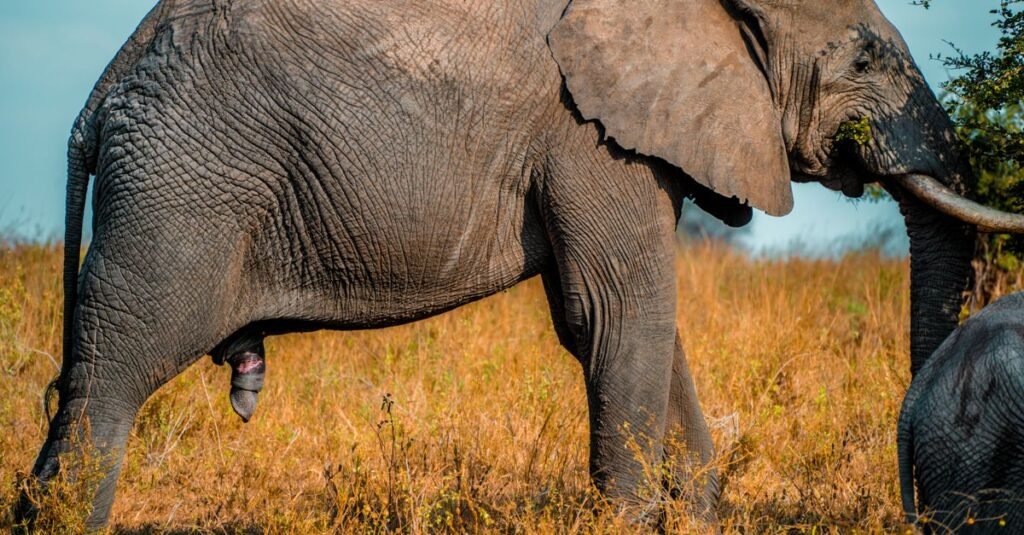
African Elephant Behavior: Inside the Matriarch’s Herd
Watch an elephant herd for an hour and you will see a society at work: calves disciplined with a trunk tap, aunts babysitting, old females leading the march to water, and bulls testing each other in slow-motion wrestling matches. African elephant behavior is among the most complex of any land animal, built on memory, touch, and sound. This guide explores how these giants organize their families, how they communicate across miles, how they raise their young, and what happens when their societies are shattered.
Quick Facts: African Elephant at a Glance
| Fact | Detail |
|---|---|
| Species | African savanna elephant (Loxodonta africana), African forest elephant (Loxodonta cyclotis) |
| Size | 8 to 13 feet at the shoulder; 2.5 to 7 tons |
| Lifespan | 60 to 70 years in the wild |
| Social structure | Matriarchal family units of related females and calves |
| Communication | Rumbles, trumpets, infrasound, touch, scent, seismic signals |
| Gestation | About 22 months, the longest of any mammal |
| Diet | Herbivore; up to 300 pounds of vegetation daily |
| IUCN Red List status | Savanna elephant: Endangered; forest elephant: Critically Endangered |
Actually Two Elephants: Savanna vs Forest
For most of modern history, the African elephant was treated as a single species. That changed in March 2021, when the IUCN assessed Africa's elephants as two distinct species for the first time, following mounting genetic evidence. The African savanna elephant (Loxodonta africana) was listed as Endangered, and the African forest elephant (Loxodonta cyclotis) as Critically Endangered, one step from extinction in the wild. Forest elephant numbers had fallen by at least 86 percent between 1984 and 2015, and savanna elephants by 60 percent between 1965 and 2015.
| Feature | Savanna elephant | Forest elephant |
|---|---|---|
| Scientific name | Loxodonta africana | Loxodonta cyclotis |
| IUCN status | Endangered | Critically Endangered |
| Size | Larger; world's biggest land animal | Smaller and darker gray |
| Tusks | Curve outward | Straighter, point downward |
| Habitat | Savannas, grasslands, woodlands, deserts | Dense tropical forests of Central and West Africa |
| Ears | Larger, Africa-shaped | Smaller, more rounded |
The two species rarely meet: forest elephants inhabit the Congo Basin and West African rainforests, while savanna elephants roam the open country of eastern and southern Africa. Most of the famous herd behaviors described below were studied in savanna elephants, though forest elephants share the same matriarchal blueprint.
The Matriarch Rules: Herd and Family Structure
African elephant society is built on mothers, daughters, sisters, and grandmothers. The basic unit is the family: several related adult females and their calves, typically 6 to 12 animals, sometimes up to 15. At its head stands the matriarch, the oldest and most experienced female. Her position is not won by fighting. It is earned through decades of survival and the trust of her family.
The matriarch decides when the herd moves, where it feeds, how it responds to danger, and where it drinks. Her memory is the herd's survival library. Safari guides in the Greater Kruger region have watched matriarchs lead families to waterholes unused for over a decade, remembered from previous droughts. Older elephants carry a mental map of scattered water, seasonal fruit, and safe routes across home ranges that can span thousands of square kilometers. Research summarized by conservationists notes that even a post-reproductive female can retain her role as matriarch, suggesting that wisdom, not just fertility, qualifies an elephant to lead.
Family units are not closed fortresses. Related families associate in larger clans, and in the wet season, when grass is abundant, many families may gather in aggregations that have historically numbered over a thousand animals. Bulls circle these gatherings, testing females for mating readiness. When a family grows beyond about 15 members, it tends to split, with one daughter or sister leading the new group. The bonds between the split groups persist for life.
One notable absence: there is no herd bull. Adult males drift between family units, inspect females, and move on. They play no leadership role in the family, though they may help defend it.
How Elephants Talk: Rumbles, Trumpets, and Seismic Signals
Elephants are among the most vocal land animals, and much of their conversation happens below the range of human hearing. Their signature sound is the rumble: a deep, low-frequency call that travels for kilometers through air and ground. A contact rumble, essentially "here I am, where are you," lets scattered family members stay in touch across several miles. Because low frequencies bend around vegetation and terrain, infrasound is an ideal long-distance channel in bush and forest.
The repertoire is wide. Trumpets, produced by blowing through the trunk, signal excitement or alarm. Roars and screams mark anger or exultation. Calves chirp and squeal; adults gurgle and rumble in dozens of distinct combinations that calves learn gradually. Alarm rumbles differ from greeting rumbles, and mating calls differ from both.
Sound is only part of the system. Elephants also listen with their feet. Vibrations from distant rumbles and footsteps travel through the ground, and elephants detect these seismic signals through sensitive cells in their feet and trunk tip, triangulating direction by comparing the signals. Touch carries meaning too: trunks entwine, rest in another's mouth, or stroke a calf in reassurance. Scent matters as well. Elephants greet by touching and smelling each other's temporal glands, the scent organs midway between eye and ear, likely reading mood and identity in a single sniff. Body language rounds it out: spread ears, a raised trunk, or a sharp headshake with an audible ear snap are unmistakable warnings to back away.
Greeting Ceremonies: Joy in the Herd
Few wildlife sights match an elephant reunion. When two related families meet after days or weeks apart, the greeting is explosive: running toward each other, trunks entwined, ears flapping, loud trumpeting and rumbling, spinning and backing up. Researchers call these greeting ceremonies. Guides who watch them regularly use a simpler word: joy.
Greeting is not reserved for reunions. Elephants meeting within the herd touch trunks to mouths, a gesture that seems to exchange reassurance and confirm identity. When a threat passes, calves press against their mothers and aunts, trunks seeking contact. Touch is the social glue of elephant life, constant and deliberate.
Raising a Calf: Allomothering and the Long Childhood
An elephant calf is born after about 22 months of gestation, the longest pregnancy of any mammal. Newborns weigh roughly 90 to 115 kilograms (200 to 250 pounds) and can stand within hours. They will suckle for up to five years, though they begin sampling vegetation within their first year, and they remain dependent on adults far longer than most mammals. Only the great apes rival the elephant's extended childhood.
Calves are not raised by mothers alone. The herd practices allomothering: sisters, aunts, and even unrelated females guard, guide, discipline, and comfort the young. If a mother dies, another female, often a sister or close relative, typically adopts the calf and nurses it as her own. This communal safety net is one reason intact families are so important to population health.
Female calves usually stay with their birth family for life, eventually becoming mothers and allomothers themselves. Males leave between the ages of 10 and 19, drifting off to join loose bachelor groups or wander alone. Play is constant among the young: chasing, mounting, mock fighting, and trunk tug-of-wars that teach the strength and coordination adult life demands.
Bulls, Bachelor Groups, and Musth
Life for a male elephant changes at adolescence. After leaving the family, young bulls join bachelor groups, loose associations of 2 to 20 males that form and dissolve over days or seasons. There, through play-fighting and sparring, they learn the hierarchy that will govern their adult lives. Dominance tracks size, age, and condition, and older bulls often command deference without a fight.
Then comes musth, one of the most dramatic physiological states in the animal kingdom. For one to three months each year, a mature bull enters a condition marked by surging testosterone, unpredictable behavior, and conspicuous secretions. Testosterone levels average about 60 times normal and can spike far higher in some individuals. A thick, tar-like secretion called temporin oozes from the temporal glands, staining the sides of the face, and the bull dribbles strong-smelling urine almost continuously. New Scientist once described a bull in musth as passing more than 300 liters of urine a day and smelling like a herd of goats.
The word musth comes from Persian, meaning intoxicated, and the behavior matches. Bulls in musth are aggressive, restless, and obsessed with finding mates. They advertise their state with a deep, pulsating musth rumble that carries for miles, drawing responses from receptive females and wary avoidance from rival bulls. A bull in musth usually outranks all others in contests for mating, which is likely the evolutionary point of the whole display. Females exercise choice too: a cow being courted can outrun a bull she does not favor, and being caught is widely read as her acceptance. Mating itself is brief, lasting less than a minute, and the family may greet the event with indifference or with a chorus of ear-flapping excitement.
Musth bulls are genuinely dangerous, to other elephants and to people, and wildlife managers treat them with extreme respect. In the wild, though, musth is simply the mechanism by which the strongest, healthiest males earn the right to breed.
Feeding Behavior: Sixteen Hours a Day
An elephant is a full-time eating machine. Adults feed for up to 16 hours a day, consuming as much as 300 pounds (about 135 kilograms) of vegetation, and they drink 120 to 160 liters of water daily. Grasses dominate in the wet season; in the dry months the diet shifts to bark, roots, twigs, and branches stripped from trees and shrubs.
The trunk is the principal feeding tool, an astonishing fusion of nose and upper lip packed with tens of thousands of muscles. It plucks a single leaf or uproots a sapling, smells out a favored herb hidden in grass, and curls water into the mouth. African elephants have two finger-like projections at the trunk tip for fine work. Tusks, which are elongated upper incisors that grow throughout life, dig, strip bark, and lever apart branches. Behind them, massive molars grind everything down; an elephant cycles through only six sets of molars per side in its lifetime, and when the last set wears out, the animal can starve.
Feeding shapes entire landscapes. Elephants push over trees, strip bark, and open woodland into grassland, earning the title of ecosystem engineers. Their dung, up to 150 kilograms a day, spreads seeds across miles. The paths they trample become firebreaks and highways for smaller animals; the holes they dig in dry riverbeds water other species. Where elephants are too many for the land, the same behavior can strip woodlands bare, which is why managing elephant numbers is one of conservation's hardest dilemmas.
Defense, Memory, and Grief
An adult elephant has no natural predators. Only calves are vulnerable, to lions, hyenas, and crocodiles, and the herd defends them with disciplined teamwork. When threatened, adult females form a wall facing the danger, ears spread wide, while calves are pushed to the center or rear. A charging elephant, ears out and head lowered, can run at nearly 35 kilometers per hour, and unlike the noisy headshake warning, a serious charge is strangely quiet.
The matriarch's memory is a defense in itself. Decades of experience with droughts, floods, and shifting food let her steer the family toward water and away from danger. During severe droughts, herds led by the oldest females survive best, because she alone remembers where the last emergency water lies.
Elephants also show a fascination with death that unsettles and moves observers. A wounded herd member is supported between the bodies of companions; a fallen one is touched and nudged with trunks and feet. Elephants encountering the bones of their own kind pause, touch the skulls and tusks with their trunks, and sometimes carry bones for a distance. The habit of tossing dirt and branches over a carcass is well documented. Scientists caution that the inner experience behind these behaviors is unproven; what looks like mourning may be investigation, and the precise understanding elephants have of death remains unknown. But the attention they pay to their dead is real, prolonged, and unlike that of almost any other animal.
When Society Breaks: Poaching and Social Collapse
Elephant behavior evolved for stable, long-lived families. Poaching attacks exactly that stability. Ivory hunters target the largest tusks, which means the oldest bulls and the oldest females, the matriarchs. When a matriarch is killed, her family loses its library of ecological knowledge and its social anchor in a single gunshot.
The consequences ripple for years. Orphaned calves may leave their groups and die alone. Young males raised without older bulls to discipline them can become dangerously aggressive, a pattern documented in populations where poaching removed the elder males. Research on orphaned female elephants has shown they form compensatory social bonds, but those bonds cannot fully replace decades of maternal knowledge.
This is why conservationists argue that counting elephants is not enough. A hundred elephants in intact family groups is a healthier, more resilient population than two hundred traumatized survivors of broken herds. Protecting elephants means protecting their society: keeping matriarchs alive, keeping families together, and keeping the corridors open that let young males disperse naturally.
The broader threats remain familiar. Between 2011 and 2013, more than 100,000 elephants were killed for ivory. Habitat is converted to farmland, migration routes are fenced, and droughts intensified by climate change kill calves and old animals first. The IUCN's 2021 decision to list savanna elephants as Endangered and forest elephants as Critically Endangered was a formal recognition of how far the decline has gone.
Frequently Asked Questions
Who leads an elephant herd?
The matriarch, the oldest and most experienced female, leads. She decides where the herd moves, feeds, and drinks, drawing on decades of memory. When she dies, her eldest daughter usually succeeds her.
How do elephants communicate over long distances?
They use infrasound: deep rumbles below human hearing that travel several kilometers through air and ground. Elephants also detect seismic vibrations through their feet, letting them sense distant calls and footsteps.
What is musth in elephants?
Musth is a periodic state in mature bulls when testosterone surges to roughly 60 times normal. The bull secretes a pungent fluid called temporin from glands on its face, dribbles urine, and becomes aggressive and restless. It typically lasts one to three months per year and helps the fittest males win mating rights.
Do elephants really mourn their dead?
Elephants pay intense attention to the bones and bodies of their kind, touching them with their trunks, standing vigil, and sometimes covering carcasses with branches and earth. Scientists agree the behavior is real but have not determined whether elephants understand death the way humans do.
How long are elephants pregnant?
About 22 months, the longest gestation of any land mammal. Females usually give birth to a single calf weighing around 100 kilograms, roughly once every three to four years.
Conclusion
African elephant behavior reveals a species that runs on relationships. The matriarch's memory, the rumble that crosses miles, the trunk that comforts a calf, the bachelor sparring that teaches restraint, the musth that crowns a champion, and the vigil kept over bones: each is a thread in a social fabric woven over decades. That fabric is also the species' vulnerability. Poaching does not just remove individuals; it tears the knowledge and bonds that hold herds together. To save elephants, we must save elephant society, the grandmothers, the aunts, the orphans, and the wandering bulls alike, because for the world's largest land animal, family is survival.