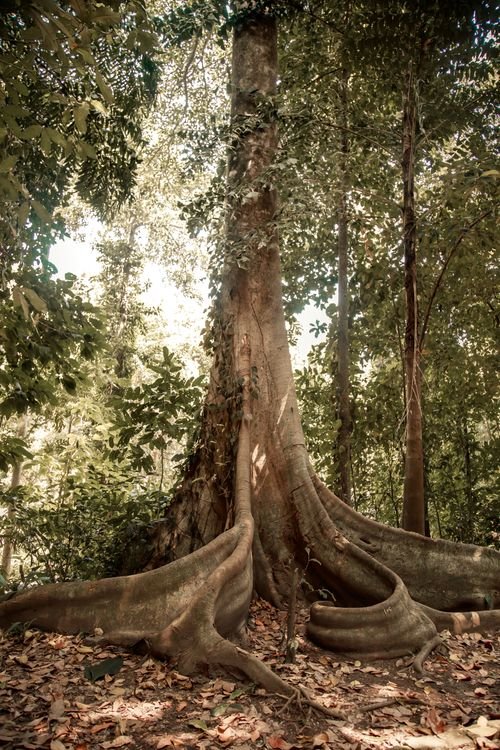
Strangler Fig Tree Facts: From Seed to Forest Giant
High in the canopy of a tropical forest, a bird eats a small fig and later leaves a dropping on the branch of another tree. Lodged in a bark crevice, one tiny seed germinates. It has no soil beneath it and no ground in sight, yet it begins to grow anyway, sending delicate roots creeping down the trunk of its host. Decades later, that seedling will be a towering tree with a hollow, latticed trunk, and the host tree that sheltered it will be gone.
This is the strangler fig, one of the most dramatic survival strategies in the plant kingdom. These strangler fig facts trace its full story: a life that starts in the sky, a slow-motion takeover measured in decades, one of the strangest pollination partnerships on Earth, and an ecological role so important that entire rainforest food webs lean on it.
What Is a Strangler Fig, Exactly?
The first surprise is that "strangler fig" is not a single species. It is a growth habit shared by several tropical fig species in the genus Ficus. The best studied is Ficus aurea, the Florida strangler fig, native to South Florida, southern Mexico through Panama, and the western Caribbean islands. It belongs to the Moraceae, the mulberry family.
A mature strangler fig is an imposing tree. According to the University of Florida's IFAS Extension, Ficus aurea reaches 50 to 60 feet tall with a spread of 50 to 70 feet, while the Florida Museum of Natural History notes specimens up to 70 feet tall with canopies 65 feet wide. Its broad, glossy, dark green leaves cast dense shade, and its smooth light-brown bark often shows the fused, rope-like pattern of its extraordinary youth. What makes it remarkable is not its size but how it gets there: it is the only common epiphyte that eventually overwhelms the very tree it grows on.
The Six Stages of a Strangler Fig's Life
The strangler fig's life reads like a slow heist film. Here is how it unfolds, stage by stage.
Stage 1: Delivery by bird
It starts with fruit. A bird or bat eats a ripe fig and deposits the seed, intact, onto a branch or into a bark crevice high in another tree's canopy. The seed is tiny, but it carries everything needed to begin.
Stage 2: Life as an epiphyte
The seed germinates without any soil, living as an epiphyte: a plant that grows on another plant. In these early years the young fig is harmless, even delicate, drawing moisture from rain and humidity and nutrients from trapped leaf litter. It is vine-like and unassuming, easy to overlook.
Stage 3: Roots descend
The seedling sends thin aerial roots downward along the host's trunk. These roots creep toward the forest floor, sometimes branching and fusing with each other as they go. This is the beginning of the structure that will one day be a trunk.
Stage 4: Ground contact
When the descending roots reach soil, everything changes. Anchored in the ground, the fig can now draw abundant water and nutrients, and its growth accelerates sharply. The aerial roots thicken into woody cables that grip the host trunk ever more tightly.
Stage 5: The embrace
Over years and decades, the fig's roots fuse and interlock into a lattice that completely encases the host's trunk. The fig's own canopy spreads wide above, shading out the host's leaves. Below ground, its roots outcompete the host's for water and nutrients. The host, starved of light and resources and physically constricted, weakens and eventually dies.
Stage 6: The hollow giant
The dead host rots away inside its living cage, and what remains is extraordinary: a self-supporting strangler fig whose hollow, lattice-like trunk is essentially a mold of the tree it replaced. Stand inside one of these natural cathedrals and you are standing in the exact shape of a tree that vanished decades ago.
Occasionally the story starts differently. The Florida Museum notes that strangler fig seeds dropped directly on the ground can also germinate and grow as ordinary free-standing trees, skipping the drama entirely.
Does It Really Strangle Its Host?
The name suggests violence, but botanists describe something more like ruthless competition. The fig does not inject poison or actively crush living wood in most cases. Instead, it wins by monopoly: its canopy steals the sunlight, its roots steal the water and nutrients, and the tightening lattice restricts the host trunk's growth. The host declines from deprivation rather than attack.
That said, the outcome is usually fatal for the host, which is why the "strangler" label stuck. It is worth remembering the fig is not a parasite in the early years. As a young epiphyte it takes nothing from the host's tissues, only using it as scaffolding. The relationship turns lethal only when the fig becomes large enough to compete, which makes the strangler fig less a murderer than an extremely ambitious tenant.
The Fig and the Wasp: A 60-Million-Year Partnership
Every one of the roughly 750 fig species on Earth is pollinated by its own dedicated species of tiny agaonid wasp, and the strangler fig is no exception. This is one of the most exquisite mutualisms in nature, refined over tens of millions of years of coevolution.
The trick begins with the fig's anatomy. What we call the fruit is actually a syconium: a hollow, fleshy structure lined on the inside with hundreds of tiny flowers. The flowers are invisible from outside; the only entrance is a minute pore called the ostiole. A female fig wasp, barely two millimeters long, squeezes through this pore, often losing her wings in the process. Inside, she pollinates the female flowers and lays her eggs in some of them.
Her offspring develop within the fig. Males hatch first, wingless, mate with the females, and chew an exit tunnel before dying without ever leaving. The new females collect pollen from the male flowers, escape through the tunnel, and fly off to find another fig in exactly the right stage of receptivity, carrying the next generation of both species with them.
Neither partner can reproduce without the other. If the wasps vanish, the figs set no seed; if the figs vanish, the wasps have nowhere to breed. It is a contract written in chemistry and anatomy, honored without interruption since the age of dinosaurs was ending.
Why Rainforests Cannot Live Without Figs
Figs are what ecologists call a keystone resource, and the reason is timing. Most tropical trees fruit in synchronized seasonal bursts, creating feasts followed by famines. Fig trees do the opposite: different individuals fruit at different times, so somewhere in the forest, figs are almost always ripe.
The Florida Museum highlights this for Ficus aurea, noting that because not all trees bear fruit simultaneously, the small, pencil-diameter fruits provide a reliable year-round food source for wildlife, including migrating songbirds that time their journeys through fig country. Across the tropics, the list of fig dependents runs into the hundreds of species: monkeys, toucans, hornbills, fruit bats, parrots, and countless insects. When other fruits fail, figs carry the forest through.
Remove figs from a rainforest and the system wobbles. That is why conservation biologists pay close attention to fig trees even when they are not officially endangered: protecting figs means protecting everything that eats during the lean months.
Strangler Fig vs. Banyan: What Is the Difference?
Visitors often confuse strangler figs with banyans, and understandably so. Both are giant Ficus trees with dramatic aerial roots. But their strategies differ.
| Strangler fig | Banyan (Ficus benghalensis) | |
|---|---|---|
| Starts life | As an epiphyte high on a host tree | Usually from a seed on the ground or a host |
| Aerial roots | Grow downward to wrap and replace a host | Drop from branches to form pillar trunks |
| The host | Typically dies and rots away | May survive; the tree expands outward instead |
| Final form | Hollow, latticed single trunk | Vast multi-trunked grove from one tree |
| Famous example | Fig trees threading Angkor's Ta Prohm temple | The Great Banyan of Howrah, India |
In short: a strangler fig climbs up by bringing another tree down, while a banyan spreads outward by building new trunks of its own. Both are Ficus, but they play entirely different long games.
The Fig Family: 750 Species, One Extraordinary Genus
The strangler fig belongs to Ficus, one of the largest and most ecologically important plant genera on Earth, with roughly 750 recognized species spread across the tropics and subtropics. Only a fraction are stranglers. The genus also includes the common edible fig (Ficus carica) cultivated around the Mediterranean for thousands of years, the banyan (Ficus benghalensis) of India, the sacred peepal or bodhi tree (Ficus religiosa) under which the Buddha is said to have attained enlightenment, and the fiddle-leaf fig (Ficus lyrata) now familiar as a houseplant.
What unites them all is the syconium, that inside-out flower cluster, and the wasp partnership. The genus likely originated tens of millions of years ago, and its diversification tracks the rise of tropical rainforests themselves. In a very real sense, Ficus helped build the forests it now dominates: by feeding frugivores year-round, fig trees sustain the very animals that disperse the seeds of countless other tree species. Foresters sometimes call figs "forest makers" for this reason. Protect a forest's figs and you protect its future canopy, because the birds and bats that eat figs also plant the next generation of the forest.
Famous Strangler Figs of the World
Few sights capture the strangler fig's character like the ruins of Ta Prohm in Cambodia, where massive fig trees (alongside silk-cotton trees) have spent a century weaving their roots through 12th-century temple stonework. Conservationists there face a genuine dilemma: the roots are slowly prying the ancient masonry apart, yet removing the trees would destroy both a living wonder and the very atmosphere that draws visitors. The compromise has been selective pruning and structural support, letting the stranglers stay while keeping the temple standing. Roots thicker than a person's torso grip carved towers, and the boundary between architecture and organism has effectively dissolved. It is the strangler fig's life cycle performed on a monument instead of a host tree.
In Florida, old strangler figs in Big Cypress National Preserve and the Everglades wrap themselves around bald cypresses, creating the layered, cathedral-like groves photographers travel to see. And in urban settings across the tropics, from Honolulu to Singapore, planted strangler figs demonstrate the species' other face: given open ground and no host to conquer, they simply become magnificent shade trees.
Can You Grow a Strangler Fig?
The University of Florida's horticulturists are blunt: the strangler fig is not recommended for small landscapes. It grows fast, reaches 60 feet with an almost equal spread, drops messy fruit, and develops aggressive surface roots that make lawn maintenance miserable beneath it. It needs full sun, warmth (hardy only in USDA zones 10B through 11), and room to be the giant it wants to be.
It does have its fans. The species is used in reclamation plantings, as a striking specimen tree for large properties, and even as bonsai, where its vigorous roots and small leaves adapt surprisingly well to miniaturization. Bonsai growers prize it for exactly the traits that make it a handful in the ground: fast growth, willing aerial roots, and bark that ages into character quickly. A strangler fig bonsai in a shallow pot becomes a miniature version of the hollow giants, complete with fused root trunk, which is part of its charm for collectors.
One caution from the extension literature: broken twigs exude a milky latex sap that can irritate skin in sensitive people, so handle prunings with care. The same sap that once served Indigenous makers as adhesive and medicine demands respect from modern gardeners too. Wear gloves, prune in the warm growing season when the tree recovers fastest, and give any in-ground specimen enormous room: this is a tree that thinks in decades and grows like it means it.
Indigenous peoples of Florida long ago found subtler uses for the tree. Miccosukee and Creek people fashioned arrows from its stems and bowstrings and lashings from its roots, while the latex sap served for chewing gum and medicinal preparations. Smithsonian researchers even identified native fig latex in a drawing on a shell artifact excavated in the 19th century, a reminder that humans and figs have been entangled for a very long time.
Frequently Asked Questions
How long does it take a strangler fig to kill its host?
There is no fixed timetable; it typically takes decades. The seedling may spend years as a harmless epiphyte before its roots reach the ground, and the encirclement of the host unfolds over many more years as the lattice thickens and the canopy closes overhead.
Is the strangler fig a parasite?
Not exactly. A true parasite taps directly into its host's tissues. The young strangler fig is an epiphyte that merely perches on the host, and even the mature tree kills mostly through competition for light, water, and nutrients rather than by feeding on the host itself.
What pollinates the strangler fig?
Tiny agaonid wasps, each fig species paired with its own wasp species. The female wasp enters the fig through a minute pore, pollinates the hidden flowers inside, and lays her eggs there. Neither the fig nor the wasp can reproduce without the other.
Are strangler figs bad for the forest?
Ecologically, no. While individual host trees die, the fig that replaces them becomes a keystone food source, fruiting year-round when other trees do not. Forests with healthy fig populations support more wildlife, not less.
What is the difference between a strangler fig and a banyan?
A strangler fig starts on a host tree and eventually replaces it, ending as a hollow-trunked single tree. A banyan drops aerial roots from its branches that become pillar trunks, expanding outward into a multi-trunked grove while the original trunk usually survives.
Can strangler figs grow without a host tree?
Yes. Seeds that land directly on soil can germinate and grow as ordinary free-standing trees. The dramatic strangling habit is an adaptation for reaching light in dense forest, not a requirement.
Conclusion
The strangler fig compresses several of nature's greatest themes into a single life: opportunism, patience, fierce competition, and deep cooperation. It begins as a speck in a bird dropping, spends its youth as a harmless guest, and ends as a hollow giant feeding half the forest. Along the way it sustains one of evolution's most faithful partnerships, the fig wasp, and anchors food webs through the seasons when nothing else fruits. It is easy to see the strangler as a villain, but rainforests tell a different story. In the economy of the canopy, this supposed killer is one of the most generous trees alive.