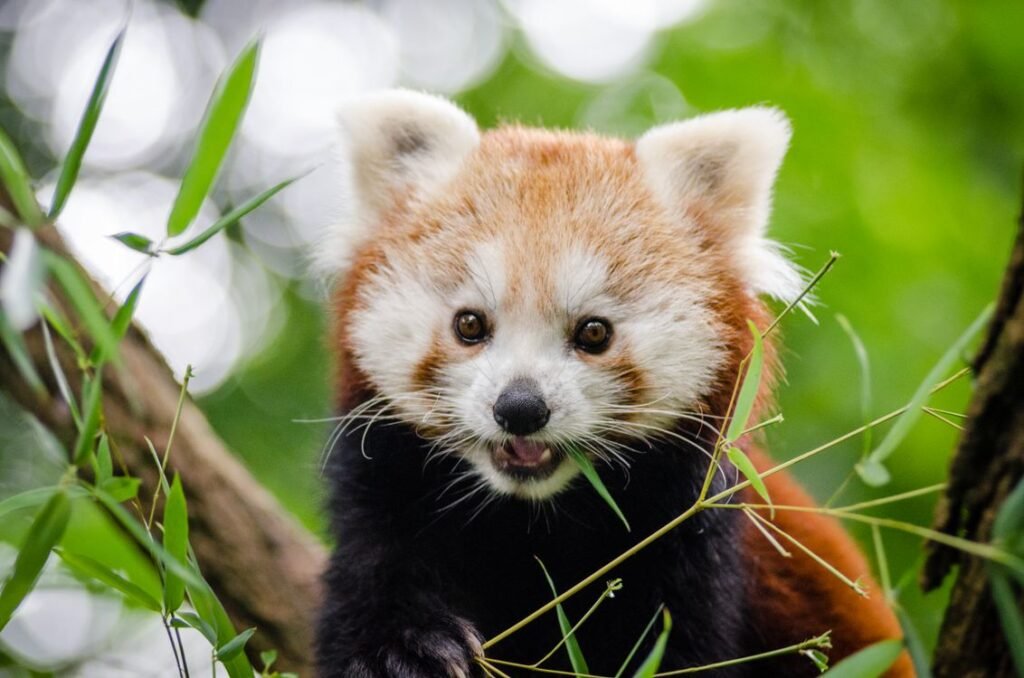
Red Panda Facts: The Original Panda’s Surprising Story
The red panda looks like a creature assembled from spare parts: the body of a small bear, the face of a fox, the tail of a raccoon, and a lifestyle borrowed from a koala. But there is nothing borrowed about its identity. The red panda was the first animal ever called a panda, it belongs to a family of its own, and it survives in one of the most demanding habitats on Earth by doing something biologically absurd. It eats bamboo for a living with the digestive system of a meat eater.
These red panda facts go beyond the cute photos. From tree-top acrobatics to quiet conversations made of squeals and huffs, from a disputed family tree to a fight for survival in the Himalayas, here is the full story of a species that deserves far more attention than its internet fame suggests.
Red Panda Facts at a Glance
| Fact | Detail |
|---|---|
| Scientific name | Ailurus fulgens |
| Family | Ailuridae (its own unique family) |
| Size | Body 22 to 25 inches, tail 15 to 19 inches |
| Weight | 8 to 17 pounds, roughly a large house cat |
| Lifespan | 8 to 10 years in the wild, up to 15 in zoos |
| Diet | About 95 percent bamboo, plus fruit, eggs, insects, and small birds |
| Range | Eastern Himalayas: Nepal, India, Bhutan, northern Myanmar, Tibet, and central China |
| Habitat | Temperate forests with bamboo understory, 5,000 to 15,700 feet elevation |
| Social life | Solitary except during breeding season |
| Conservation status | Endangered (IUCN), population around 10,000 and declining |
The Original Panda
Here is the red panda fact that surprises almost everyone. The red panda was the first animal to be called a panda. A French zoologist named Frédéric Cuvier described it in 1825, a full 48 years before scientists described the black-and-white bear we now call the giant panda. If anything, the giant panda was named after the red panda, not the other way around.
The name "panda" itself likely comes from the Nepali word "ponya," which means bamboo or plant-eating animal, according to the World Wildlife Fund. The red panda earned that name honestly: bamboo dominates its diet, and bamboo forests shape nearly every hour of its life.
Taxonomy, the science of classifying living things, has argued about this animal for more than a century. Early scientists placed it with raccoons because of the ringed tail. Others grouped it with bears because of its body shape and skull. DNA research eventually settled the debate in the red panda's favor. It belongs to its own unique family, Ailuridae, and its own genus, Ailurus. It is not a bear, not a raccoon, and not closely related to the giant panda. It is simply, and entirely, itself.
Where Red Pandas Live
Red pandas live in the rainy mountain forests of the Eastern Himalayas, in a band of habitat that stretches through Nepal, India, Bhutan, northern Myanmar, and into Tibet and the Sichuan and Yunnan provinces of China. Almost half of the species' habitat lies within the Eastern Himalayas. They live high up, generally between 5,000 and 15,700 feet above sea level, in cool temperate forests where bamboo grows thickly beneath the canopy.
This bamboo forest ecosystem gives them everything: food, shelter, and the branches they rest on. The forests are damp and mossy, draped in lichen, and the red panda's rust-colored coat blends into that world so well that researchers often walk right past the animals without noticing them. Each individual needs a surprising amount of space. The Smithsonian's National Zoo notes that a single red panda may require up to a square mile of forest for food and shelter.
Their range sits on some of the steepest, most fragmented terrain on the planet, which is part of why population estimates are so uncertain. Counting an elusive, tree-dwelling animal across five countries of Himalayan forest is genuinely difficult. The widely cited figure, from a 2015 estimate referenced by National Geographic, puts the wild population at about 10,000 animals, a drop of roughly 50 percent since 1997.
A Bamboo Eater With a Carnivore's Stomach
The red panda belongs to the order Carnivora, but that classification says more about its ancestry than its dinner. In practice, about 95 percent of what it eats is bamboo. It selects the most nutritious leaf tips and, in spring, tender new shoots, grinding through them with powerful molars.
The problem is efficiency. Bamboo is tough, fibrous, and hard to digest, and the red panda's gut is built for meat. It can digest only about 24 percent of the bamboo it eats. The rest passes straight through, barely used. To compensate, a red panda must eat a lot: 20 to 30 percent of its own body weight every day, roughly 1 to 2 kilograms of leaves and shoots. National Geographic reports that some individuals process up to four pounds of bamboo daily. Picture a housecat eating a bag of potatoes' worth of food every single day, and you start to grasp the commitment.
All that eating takes time. A red panda may spend about half of its waking hours foraging and munching. And because its diet is so low in calories, it has a backup plan. The Smithsonian notes that in times of famine, red pandas can lower their metabolism and sleep through most of the day, stretching their energy until food improves.
Despite the bamboo obsession, the red panda is not a strict vegetarian. It supplements its diet with fruit, acorns, roots, mushrooms, grasses, lichens, eggs, insects, rodents, and occasionally small birds or fish. This flexibility, plus its small size, is one reason the red panda is considered to have better survival odds than its giant bamboo-eating namesake when food gets scarce.
The False Thumb Trick
Like the giant panda, the red panda has an extended wrist bone that works almost like a thumb. This "false thumb" helps it grip bamboo stalks and strip leaves with surprising dexterity. It is one of the most elegant examples of convergent evolution in mammals: two unrelated animals, separated by tens of millions of years, independently inventing the same tool to solve the same problem.
Built for the Treetops
Red pandas are arboreal through and through. They spend most of their lives in trees, where they sleep curled on branches, sunbathe in the morning light, and escape predators. Their bodies carry a whole toolkit of climbing adaptations.
Their claws are sharp and semi-retractable, gripping slippery bark with ease. Their flexible ankles can rotate, giving them the rare ability to climb down a tree headfirst, a trick very few climbing mammals can manage. Their long, bushy tails, marked with alternating rings of rust and pale ochre, work as balancing poles on narrow branches. In winter, the same tail becomes a blanket: the animal wraps it around its body and face for warmth against the mountain chill.
The fur itself is engineering. Red pandas wear two layers, a soft undercoat beneath coarse guard hairs, that insulates them against snow and ice. The soles of their feet are thickly furred, giving them traction on frozen branches. And their coloring is camouflage. The rusty-red upper coat matches the moss and lichen of their tree homes, while the black belly and legs make the animal hard to spot from the ground below, where predators like snow leopards and jackals prowl. Every detail of this animal is a small solution to life at altitude.
Solitary Lives and Quiet Conversations
Red pandas are solitary creatures. Adults keep to themselves and defend their territories, coming together mainly during the breeding season. Only mothers with cubs share space otherwise. Yet they are far from silent.
They communicate with a vocabulary of quiet sounds: squeals, twitters, and a call scientists have named the "huff-quack," a mix between a duck's quack and a pig's snort. Threatened red pandas hiss or grunt, and they may stand on their hind legs, arching their tails over their backs to look larger. They also release a pungent liquid from scent glands at the base of the tail. Males use it to mark territory while searching for mates in winter and early spring, and it doubles as a defensive stink bomb when the animal feels cornered.
Breeding is a narrow window. Females are fertile for only a couple of days each year. After a gestation of roughly 114 to 145 days, a female typically gives birth to one to four cubs, usually in late spring or early summer. The cubs are born blind and helpless in a hollow tree or rock crevice, and the mother raises them alone; males take little or no interest in the young. In the wild, cubs face steep odds, and the slow reproductive rate makes every lost animal hard to replace.
One Species or Two?
For decades, scientists recognized two subspecies: the Himalayan red panda and the Chinese red panda. Growing genetic evidence now suggests they may actually be two distinct species. The Chinese red panda is a bit larger and wears more distinct rings on its fluffy tail.
If the split is formally accepted, it would have real consequences for conservation. Two smaller, more geographically isolated species are each more vulnerable than one larger population. It would also mean the world's captive breeding programs, which manage red pandas across zoos globally, would need to keep the two lineages separate to preserve their genetic integrity. The Smithsonian already notes the two forms within the genus, fulgens fulgens and fulgens refulgens, and researchers continue to gather the genetic data needed to settle the question.
This kind of hidden diversity is more common than most people realize. Many "single species" turn out to be two or more once DNA is examined, and each split redraws the map of what needs protecting.
Red Panda vs Giant Panda: Clearing Up the Confusion
Because they share a name and a favorite food, red pandas and giant pandas are constantly confused. Here is how they actually compare.
| Feature | Red Panda | Giant Panda |
|---|---|---|
| Scientific name | Ailurus fulgens | Ailuropoda melanoleuca |
| Family | Ailuridae (its own family) | Ursidae (true bears) |
| Size | House cat sized, 8 to 17 pounds | 200 to 300 pounds |
| Named "panda" | First, in 1825 | Second, in 1869 |
| Diet | About 95 percent bamboo, plus small extras | About 99 percent bamboo |
| Activity | Mostly nocturnal and crepuscular | Active day and night |
| Social life | Solitary | Solitary |
| Conservation status | Endangered | Vulnerable |
| Habitat | Eastern Himalayan forests | Central Chinese mountain forests |
The resemblance is a coincidence of appetite. Both animals converged on bamboo, and both evolved a false thumb to grip it, but their last common ancestor lived tens of millions of years ago.
Why Red Pandas Are Endangered
The International Union for Conservation of Nature lists the red panda as Endangered, with a decreasing population trend. The threats stack up from every direction.
Habitat loss is the largest. Logging and agricultural clearing remove the nesting trees and bamboo the animals depend on. Because each red panda needs so much forest, even small clearings fragment populations into isolated groups that struggle to find mates.
Poaching and trapping take a direct toll. Red pandas are caught in snares and traps set for other animals such as wild pigs and deer. They are also killed deliberately for their distinctive pelts in parts of China and Myanmar, and red panda fur caps have been found for sale in Bhutan. The illegal pet trade snatches animals from the wild as well.
Disease is a quieter killer. Domestic dogs that roam near forest edges can pass canine distemper and other illnesses to red pandas, which have no evolved defenses against them. And climate change is slowly shifting the cool, damp forest zones the species needs, squeezing its livable range uphill toward the mountaintops, where there is nowhere left to go.
Against all of this, the red panda has one natural defense that mostly works: it is very good at not being seen. Its main wild predators, snow leopards, martens, and jackals, hunt by sight, and a motionless red panda dissolved into moss and lichen is nearly invisible. But camouflage cannot hide an animal from a chainsaw or a snare.
How Conservationists Are Fighting Back
The good news is that the red panda has dedicated defenders, and some of the most effective work happens at the community level in Nepal, where an estimated 38 percent of the species' potential habitat lies.
The Red Panda Network works with local communities to monitor populations and protect forest corridors. Its "forest guardian" programs train local people, including former herders and hunters, to track red pandas, report threats, and restore habitat. When the people who share the forest become the species' protectors, conservation stops being an outside imposition and becomes local pride.
WWF takes a similar community-first approach across India, Nepal, and Bhutan. In Bhutan, it works with yak herders whose livestock graze in red panda habitat. One elegant solution is yak dung briquettes: compacted dung burned as fuel, which gives herders income and heat without cutting down red panda forest for firewood. Tourism packages built around red panda viewing give villages another reason to keep the forest standing. Nepal backs this up with law: anyone found guilty of killing, buying, or selling a red panda faces fines up to 1,000 dollars and up to ten years in jail.
Zoos play a role too. The Smithsonian's National Zoo and Conservation Biology Institute manages red pandas as part of coordinated breeding programs that maintain genetic diversity and fund field conservation. Captive animals also do quiet ambassador work: millions of visitors who come to see a red panda leave knowing the species exists, which is the first step toward caring whether it survives.
Red Panda FAQs
Are red pandas actually bears?
No. Red pandas belong to their own family, Ailuridae, and are not bears, raccoons, or close relatives of the giant panda. Early taxonomists grouped them with raccoons and then bears based on appearance, but DNA evidence showed they sit on their own branch of the mammal family tree.
How many red pandas are left in the wild?
The most widely cited estimate is about 10,000 animals, based on a 2015 assessment, and the population is declining. The true number is uncertain because red pandas are elusive and live in remote, rugged forest across five countries. The IUCN classifies the species as Endangered.
What do red pandas eat besides bamboo?
Bamboo makes up about 95 percent of the diet, but red pandas also eat fruit, acorns, roots, mushrooms, grasses, lichens, eggs, insects, rodents, and occasionally small birds or fish. This dietary flexibility helps them survive when bamboo is scarce.
Why do red pandas have a false thumb?
The red panda's extended wrist bone works like a thumb, helping it grip bamboo stalks and strip leaves. The giant panda evolved the same structure independently, a classic case of convergent evolution, where unrelated species develop similar solutions to similar problems.
Can red pandas be kept as pets?
No, and they should never be. Red pandas are endangered, protected by law in every range country, and taking one from the wild is illegal. They are also poor pets: they need huge territories of cool bamboo forest, a specialized diet, and solitude. The illegal pet trade is one of the threats pushing the species toward extinction.
A Species Worth More Than Its Memes
The red panda survived ice ages, outlived its own fossil relatives, and kept a carnivore's gut running on bamboo against all biological logic. It did this quietly, in forests most of the world will never visit. Its current crisis is not natural. It is the sum of chainsaws, snares, and a warming climate, all human-made, which means all of it can be answered by human choices.
Every red panda fact points to the same conclusion. This is not just a cute animal. It is the last member of an entire family, a living record of evolution's experiments, and a measure of whether the Himalayas' forests will still be forests in fifty years. Protecting it protects everything that shares its mountain home.
If these red panda facts made you care, the next step is simple: support the organizations doing the fieldwork, from the Red Panda Network to WWF's Himalayan programs, and tell someone else what you learned. Awareness is where every conservation story starts.