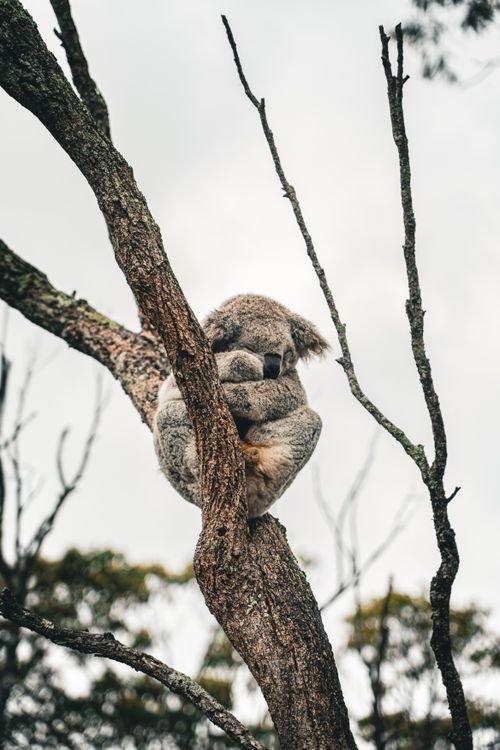
Koala Facts: 25 Things to Know About Australia’s Marsupial
Few animals are as instantly recognizable as the koala: round fluffy ears, a big black nose, and a permanent look of sleepy contentment. But behind the cuddly image is one of the most specialized mammals on Earth, an animal that survives on poisonous leaves, sleeps away most of its life, and raises babies the size of jellybeans in a backward-facing pouch.
Here are the essential koala facts, from what koalas really are to how they live, eat, and raise their young, and why this Australian icon is in trouble.
Koala Quick Facts
| Fact | Detail |
|---|---|
| Scientific name | Phascolarctos cinereus |
| Common names | Koala (not a bear) |
| Family | Phascolarctidae (only living member) |
| Type | Marsupial mammal |
| Diet | Eucalyptus leaves |
| Daily food | 500 g to 1 kg of leaves per night |
| Sleep | 18 to 22 hours per day |
| Size | 60 to 85 cm long; 4 to 15 kg |
| Lifespan | 10 to 18 years in the wild |
| Range | Eastern and southeastern Australia |
| IUCN status | Vulnerable (decreasing) |
| Closest relatives | Wombats |
Not a Bear: What Kind of Animal Is a Koala?
The first and most important koala fact: koalas are not bears. They are marsupials, mammals that carry and nurse their underdeveloped young in a pouch. The koala is the only living member of its family, Phascolarctidae, and its closest living relatives are wombats, the burrowing marsupials of Australia.
Like other marsupials, female koalas have a permanent pouch for raising young. The koala's pouch is unusual because it opens backward, toward the rear of the body rather than upward. This rear-facing design makes sense for an animal that spends its life clinging to tree trunks: a forward-facing pouch would spill the joey out every time the mother climbed. When a joey is in the pouch, the mother uses strong sphincter muscles to keep it closed.
Koalas have a stocky, tailless body covered in thick ash-grey fur with a white underbelly. Their large round head, fluffy ears, and distinctive black leathery nose make them unmistakable. Though their fur looks soft and plush, it is actually coarse, more like sheep's wool, and it insulates them against both heat and cold. Southern koalas, living in the cooler climates of Victoria and South Australia, grow thicker fur and larger bodies than their northern cousins, a textbook example of adaptation to local climate.
Where Koalas Live: Australia's Eucalyptus Country
Koalas are found only in Australia, along the east coast from northern Queensland down through New South Wales and Victoria into southeastern South Australia. They live in eucalypt forests and woodlands, and their entire existence revolves around eucalyptus trees, which provide both their food and their home.
Koalas are arboreal, meaning they live in trees. They sleep wedged into forks or nooks in the branches, climb with powerful claws, and travel between trees at night by climbing down, walking across the ground, and climbing up the next tree. A koala needs a lot of forest: roughly a hundred trees per animal, which is why habitat loss hits them so hard.
Size varies strikingly by region. Southern koalas in Victoria and South Australia are much larger, with females weighing 7 to 11 kilograms and males 9.5 to 14.5 kilograms. Northern koalas in Queensland and New South Wales are smaller, with females at 4 to 7 kilograms and males at 4 to 9 kilograms. The southern populations also tend to have thicker, darker fur, likely an adaptation to cooler conditions.
| Feature | Northern koalas (QLD, NSW) | Southern koalas (VIC, SA) |
|---|---|---|
| Male weight | 4 to 9 kg | 9.5 to 14.5 kg |
| Female weight | 4 to 7 kg | 7 to 11 kg |
| Fur | Thinner, lighter | Thicker, often darker |
| Climate | Warmer, subtropical | Cooler, temperate |
The Eucalyptus Diet: Surviving on Poison Leaves
Koalas eat eucalyptus leaves, and almost nothing else. An adult koala munches through 500 grams to 1 kilogram of leaves each night. They are famously picky eaters: of the hundreds of eucalyptus species in Australia, koalas feed on only a small number, and their preferred species vary from one region to another. In southeast Queensland, for example, favored food trees include forest red gum, tallowwood, and grey gum.
Eucalyptus leaves are a terrible food by most standards. They are low in nutrients, high in tough fiber, and laced with toxic compounds that would poison most mammals. Koalas survive on them through a combination of specialized digestion and extreme energy frugality.
The koala's digestive system is built for this challenge. They have an unusually long caecum, a pouch-like structure near the large intestine, where tough eucalyptus fiber is fermented and broken down. Their gut hosts specialized bacteria that help detoxify the leaves' poisons and extract what little nutrition is available. Even so, the process is slow and yields little energy, which explains almost everything else about koala life.
Young koalas are not born able to digest eucalyptus. They acquire the necessary gut bacteria from their mothers by feeding on a special soft substance called pap, a form of maternal droppings, during weaning. This introduces the live bacteria the joey's gut needs to process gum leaves for the rest of its life. It is an inelegant but effective system, and without it a young koala could not survive on its adult diet.
Koalas also get most of their water from eucalyptus leaves, which is why they rarely need to drink. During droughts, though, this system breaks down, and koalas are forced to come down from the trees to find water, spending precious energy and exposing themselves to predators and traffic.
Why Koalas Sleep Up to 20 Hours a Day
The koala's legendary laziness is not laziness at all. It is biochemistry. Eucalyptus leaves provide so little energy that koalas simply cannot afford to be active. They sleep 18 to 22 hours a day, tucked into tree forks, conserving every calorie.
They also run a slow metabolism, one of the slowest of any mammal their size, which stretches their meager energy budget further. When they are awake, they spend most of their time eating, which is the other half of the equation: constant refueling on a low-grade fuel.
Interestingly, koalas are not deeply asleep for all of those hours. They rest in a state of alert dozing, ears and nose still working, ready to react to threats. The image of the koala as a creature dead to the world is only half true. They are resting, not unconscious, and a wild koala always knows what is happening around its tree.
Built for the Trees: Paws, Nose, and Fur
Everything about the koala's body is designed for life in the branches.
Their paws are climbing tools. Each front paw has five digits, with two thumbs set opposite the other three, giving koalas a powerful two-thumbed grip on branches. Both hands and feet have rough pads and sharp claws for traction on bark. On their hind feet, two toes are fused together into a single grooming claw that koalas use to comb parasites and dirt from their fur.
Their nose is a chemical laboratory. Koalas have an excellent sense of smell, which they use to select the most nutritious and least toxic leaves. Since eucalyptus chemistry varies enormously between individual trees, even of the same species, a good nose is the difference between a decent meal and a mouthful of poison.
Their fur is climate control. Thick and insulating, it protects koalas from temperature extremes in both directions, which matters for an animal that cannot afford to waste energy on shivering or panting. Koalas even press themselves against cool tree trunks in hot weather to dump heat, a behavior researchers have documented during heatwaves.
Pouch Life: How a Joey Grows Up
Koala reproduction is a marvel of minimalism. After a gestation of only about 35 days, the female gives birth to a single joey that is blind, hairless, and about 2 centimeters long, roughly the size of a jellybean. Immediately after birth, this tiny creature hauls itself from the birth canal to the mother's pouch and latches onto a teat.
The joey stays in the pouch for about six months, growing and developing in safety. It does not poke its head out for roughly 22 weeks. After emerging, it graduates to riding on its mother's back or belly, still returning to the pouch to nurse until it grows too large to fit.
Weaning is a gradual process built around pap, the bacteria-rich substance that seeds the joey's gut with the microbes needed for a eucalyptus diet. The koala is fully weaned at about 12 months old and begins foraging in a home range overlapping its mother's. By two or three years of age, it disperses to find its own territory.
This slow, careful development reflects the koala's energy economics. Raising young on eucalyptus is expensive, so females typically produce one joey per breeding season, and the whole system is tuned to give that single offspring the best possible start.
Koala Communication: Bellows and Chest Glands
Koalas are solitary animals, but they are not silent. Adult males produce deep, resonant bellows that can carry long distances through the forest. These calls intimidate rivals and advertise to females during the breeding season. The bellow of a male koala is surprisingly deep for the animal's size, a product of specialized vocal anatomy.
Males also carry scent glands on their chests, which they rub against tree trunks to mark their territory and signal their presence to females. Between the bellowing and the scent marking, a male koala maintains an invisible territory across his home range without ever needing to confront a rival face to face.
Females are quieter but communicate with softer calls to their joeys. Growls, belches, and squeaks round out a vocal repertoire that is far richer than the sleepy image suggests.
Threats: Fire, Disease, and Vanishing Forests
Koalas face a gauntlet of threats, and their numbers are declining across much of their range.
Habitat loss is the fundamental problem. Land clearing for agriculture and development, logging, and urban expansion have carved eucalyptus forests into fragments. Because each koala needs around a hundred trees, shrinking forests mean fewer koalas, and fragmented forests isolate populations from one another.
Bushfires have been devastating. The 2019-2020 bushfire season, Australia's Black Summer, destroyed vast areas of koala habitat in New South Wales and Queensland. Koalas are particularly vulnerable in fires because their instinct is to climb higher into the canopy rather than flee, and eucalyptus forests burn intensely.
Disease, especially chlamydia, is widespread in some koala populations. The infection can cause blindness, infertility, and death, and it compounds the pressure from habitat loss by reducing breeding success.
Climate change is an emerging threat that National Geographic highlights as critical. Rising carbon dioxide in the atmosphere is reducing the nutritional quality of eucalyptus leaves, which is already extremely low, while longer droughts and more intense fires shrink and degrade habitat. The IUCN has named the koala one of the animals most vulnerable to climate change.
Cars and dogs kill many koalas each year, especially where suburbs meet bushland. Young males dispersing to find new territories are particularly at risk as they cross roads and backyards.
Koala Conservation: Where Things Stand
The koala's official status tells a story of decline. The IUCN Red List classifies the koala as Vulnerable, with a decreasing population trend. In 2022, koala populations in Queensland, New South Wales, and the Australian Capital Territory were listed as endangered under Australia's national environmental law, the EPBC Act. Populations in Victoria and South Australia are not listed as threatened, though they face their own pressures, including overabundance in some areas.
Conservation efforts are wide-ranging. Wildlife hospitals and rescue organizations care for injured and sick koalas, with the goal of releasing them back into the wild. Zoos and conservation groups are buying and protecting tracts of eucalyptus forest. State governments are creating new koala reserves, and campaigns urge landowners not to clear eucalyptus trees. Research into koala genetics, disease, and breeding biology is feeding into long-term recovery plans.
The challenge is scale. Koalas live across a huge area, much of it on private land, and protecting them means protecting entire forest landscapes, not just isolated patches.
Seeing Koalas in the Wild: Keep Your Distance
If you are lucky enough to spot a koala in an Australian forest, the kindest thing you can do is watch from at least 10 meters away. Wild koalas stress easily: approaching too closely, touching their tree, or trying to handle them can cause real harm. If you find one walking on the ground, which happens when koalas move between trees at night, do not approach. Give it space, and if it is on a road, help by slowing or stopping traffic until it climbs to safety. Sanctuaries and wildlife parks offer close encounters under expert supervision, which is the responsible way to meet a koala face to face.
Koala Myths vs Facts
| Myth | Fact |
|---|---|
| Koalas are bears | They are marsupials, related to wombats |
| Koalas are always asleep | They rest 18-22 hours but remain alert; they are often just dozing |
| Koalas never drink water | They get most moisture from leaves but will drink, especially in drought |
| Koalas are cuddly and tame | They are wild animals with sharp claws and teeth; they stress easily when handled |
| Baby koalas are called cubs | They are called joeys, like all young marsupials |
Koala FAQs
Are koalas bears? No. Koalas are marsupials, mammals that raise their young in a pouch. They are not related to bears at all; their closest living relatives are wombats.
What do koalas eat? Almost exclusively eucalyptus leaves. They eat 500 grams to 1 kilogram of leaves per night, choosing from a small number of preferred eucalyptus species that vary by region.
How long do koalas sleep? Koalas sleep or rest for 18 to 22 hours a day. Their low-energy eucalyptus diet gives them very little spare energy, so long rest periods are essential.
Where do koalas live? In the eucalyptus forests and woodlands of eastern and southeastern Australia: Queensland, New South Wales, Victoria, and southeastern South Australia.
Are koalas endangered? The IUCN lists koalas as Vulnerable with a decreasing population. In 2022, populations in Queensland, New South Wales, and the Australian Capital Territory were listed as endangered under Australian national law.
Why do koalas have chlamydia? Chlamydia is a bacterial infection widespread in some wild koala populations. It can cause blindness, infertility, and death, and it is a major concern for conservationists because it reduces breeding success in already declining populations.
The Quiet Marvel in the Gum Trees
The koala looks like nature's plush toy, but it is really one of evolution's most extreme specialists: a mammal that eats poison, sleeps through most of its life, and raises jellybean-sized babies in a backward pouch, all while clinging to the branches of a single type of tree. That specialization worked brilliantly for millions of years. Whether it can survive the next century depends on whether Australia's eucalyptus forests survive with it.