Clownfish Facts: 25 Things You Didn’t Know About Nemo’s Kin
Few fish are as instantly recognizable as the clownfish. A flash of orange, three white bars edged in black, and a permanent home inside a stinging sea anemone: the image is so familiar that most people feel they already know everything about these reef dwellers. But the real clownfish facts are stranger and more wonderful than the cartoon version. Clownfish change sex, talk in pops and clicks, perform careful dances with deadly anemones, and run their families with an iron-finned matriarchal discipline. Here is the full story of one of the ocean's most beloved small fish.
What exactly is a clownfish?
Clownfish, also called anemonefish, belong to the subfamily Amphiprioninae within the damselfish family Pomacentridae. Around 30 species are currently recognized, and while the classic orange-and-white look dominates the public imagination, the group is more varied than most people realize. Some species are deep maroon, others nearly black, and a few wear yellow tails or single head stripes instead of the famous triple bars.
The name "clownfish" comes from their bold patterning and their bouncy, almost comical swimming style as they dart among anemone tentacles. Scientists, however, take them very seriously: clownfish have become a model organism for studying symbiosis, sex determination, and how reef fish cope with a changing ocean. Their fame from the 2003 film Finding Nemo only added to the scientific interest, turning a small reef fish into one of the most studied animals on coral reefs.
Clownfish facts: size, stripes, and surprising colors
Most clownfish are small. The familiar ocellaris clownfish (Amphiprion ocellaris), the species that inspired Nemo, reaches only about 11 centimeters (4.3 inches) long, with females growing noticeably larger than males. Across the whole group, sizes range from about 10 centimeters (3.9 inches) in the smallest species to around 18 centimeters (7.1 inches) in the largest. They are pocket-sized fish living in a world of sharks and groupers, which is exactly why the anemone alliance matters so much.
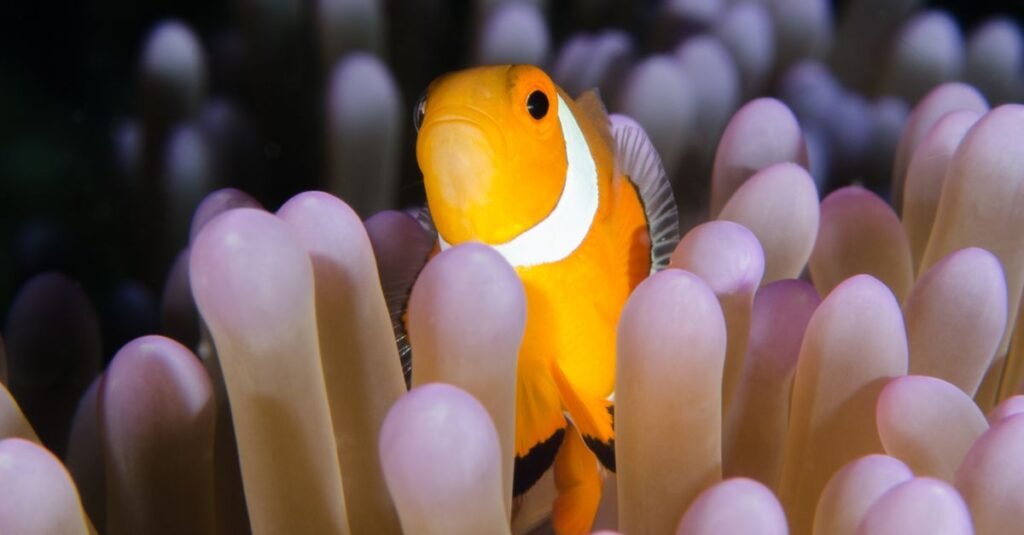
The signature look, an orange body with three white bars outlined in thin black, belongs to the ocellaris and its close cousin the true percula clownfish (Amphiprion percula). But color is flexible. Rare genetic variations produce individuals that are black, yellow, or darkly melanistic. Clark's anemonefish, nicknamed the yellowtail clownfish, pairs a dark body and white stripes with bright yellow fins and tail. The tomato clownfish is a deep orange-red and wears just a single white bar behind its eye. Juveniles of many species look different from adults, and colors can shift subtly with diet, location, and even mood.
One useful clownfish fact for aquarists and snorkelers: the similar-looking ocellaris and percula can be told apart by counting fin rays and spines, though in practice their ranges barely overlap, so location is often the easier clue.
Where do clownfish live?
Clownfish are strictly saltwater fish of the warm Indo-Pacific. Their range centers on the shallow waters of the Indian Ocean, the Red Sea, and the western Pacific, from the east coast of Africa and the Red Sea across Southeast Asia to northern Australia and southern Japan. The Great Barrier Reef, the coral triangle of Indonesia and the Philippines, and the reefs of the Red Sea are all clownfish strongholds.
Just as telling is where they do not live. There are no clownfish in the Atlantic Ocean, none in the Caribbean, and none in the Mediterranean. Their entire evolutionary story unfolded in Indo-Pacific reefs, and they never crossed into Atlantic waters.
Within that range, clownfish stick to shallow, sheltered habitats: coral reefs, lagoons, and rocky slopes, usually in the top 15 meters of water where sunlight feeds the symbiotic algae inside their anemone hosts. Each clownfish group centers on one anemone or a small cluster of them, and individuals rarely stray more than a few meters from home. A clownfish's whole world can be a single square patch of reef.
The anemone partnership: how clownfish survive the sting
The heart of every clownfish fact list is the relationship with sea anemones, and it deserves a close look because it is one of the ocean's great mutualisms. Sea anemones are close relatives of corals and jellyfish: sedentary predators armed with tentacles full of venom-filled stinging cells. A small fish that blunders into those tentacles is usually paralyzed and eaten. Clownfish nestle into them to sleep.
A clownfish is not born immune. When a young fish first approaches a potential host, it performs an elaborate acclimation dance, gently touching different parts of its body to the tentacles over and over. With each contact, the fish coats itself in a layer of mucus that gradually matches the anemone's own chemistry. Researchers believe this chemical camouflage convinces the anemone that the clownfish is part of itself rather than prey. The protection is real but conditional: a clownfish removed from its anemone for a time can lose the coating and be stung on return.
Both partners profit, which is why biologists call the bond mutualistic rather than merely convenient. The anemone gives the clownfish a fortress: few predators will brave the stinging tentacles to chase a small orange fish. In return, the clownfish repays its host several ways. It chases away anemone-eating fish such as butterflyfish, picks parasites off the tentacles, fans water over its host to improve circulation, and drops nitrogen-rich waste that feeds the anemone and the symbiotic algae living in its tissues. Some studies suggest clownfish waste even attracts beneficial microorganisms to the anemone. It is a full-service bodyguard, cleaner, and fertilizer contract, paid in shelter.
What do clownfish eat?
Despite their cute reputation, clownfish are omnivores with a practical diet. In the wild they feed mostly on tiny drifting animals, especially zooplankton and small crustaceans, plus algae, worms, and small invertebrates picked from the reef. They also scavenge undigested scraps from their host anemone's meals, turning leftovers into lunch.
Because food comes to them on the current and their territory is tiny, clownfish feed in short darting forays, always within sprinting distance of the tentacles. Their small size is an advantage here: it takes very little food to fuel a fish that weighs just tens of grams, and the anemone's neighborhood is rich in the plankton and detritus that larger predators ignore.
Born male: the clownfish sex change explained
Here is the clownfish fact that surprises almost everyone: every clownfish is born male, and each carries the ability to become female. Clownfish are protandrous hermaphrodites, meaning the male-to-female switch happens in one direction only, and once made, it cannot be reversed.
The switch is governed by social rank. A clownfish group living in one anemone is organized as a strict size-based hierarchy. At the top sits a single large breeding female, the undisputed boss of the anemone. Below her is the breeding male, her mate, and beneath him a queue of progressively smaller non-breeding males, each waiting its turn. Everyone knows their place, and the female enforces it aggressively; clownfish societies are matriarchies with teeth.
If the dominant female dies or disappears, the hierarchy shifts up one rung. The breeding male transforms into a female, a change involving hormones, gonads, and behavior that can complete in weeks, and the largest non-breeder matures into the new breeding male. The group never lacks a breeding pair for long. This elegant system guarantees that the two largest fish in any anemone are always a male-female pair ready to spawn, no matter what misfortune strikes.
Family life: eggs, devoted fathers, and drifting larvae
Clownfish form monogamous breeding pairs that can stay together for years. When spawning time comes, the male prepares a nest: a cleaned patch of rock or coral rubble right beside the anemone. He courts the female with fin displays, chasing, and gentle nipping until she is ready. Then she lays her eggs in neat rows on the prepared surface, anywhere from a hundred to a thousand of them, and he fertilizes them.
From that moment, childcare is largely the father's job, exactly as the film Finding Nemo suggested. The male fans the eggs with his fins to keep them oxygenated, mouths them gently to remove dead or infected ones, and guards the nest fiercely against egg predators. The female helps occasionally but leaves most of the work to him.
After about a week, depending on water temperature, the eggs hatch, usually after dark. The tiny larvae do not stay home. They rise into the plankton and drift with the currents in the open ocean, feeding and growing far from any anemone. Weeks later, the survivors settle back down to the reef as juveniles and begin the risky search for an unclaimed anemone, or a vacancy in an existing group. It is a high-mortality journey: of hundreds of eggs, only a handful will ever find an anemone of their own.
How clownfish talk, swim, and defend their patch
Clownfish are far from silent. They communicate with a vocabulary of pops and clicks produced by grinding their teeth and amplifying the sound through their swim bladders. Different sounds mark territory warnings, courtship, and aggression toward intruders. Divers with good ears (or hydrophones) can hear a clownfish colony chattering away.
Their swimming style is distinctive and, by fish standards, not very impressive. Clownfish are poor long-distance swimmers; they have no need to be, since their lives revolve around a single anemone. They get around with rapid, fluttering beats of their rounded pectoral fins, a rowing motion that gives them superb maneuverability in tight spaces but little speed in open water. That is another reason the anemone matters: a fish that cannot outswim predators must out-hide them.
What clownfish lack in speed they make up in attitude. They are famously territorial, and a breeding female will charge fish many times her size, including divers' masks and cameras, to defend her anemone. The boldness is not foolishness: inside the tentacles, she is nearly untouchable, and every intruder learns that the little orange fish bites.
Clownfish species compared
With around 30 species, the family has plenty of variety. Here are five of the best-known members and how to recognize them.
| Species | Scientific name | Distinguishing look |
|---|---|---|
| Ocellaris / false percula | Amphiprion ocellaris | Bright orange, three white bars with thin black edges; the "Nemo" fish |
| True percula | Amphiprion percula | Like ocellaris but with thicker black edging on the bars; different range |
| Tomato clownfish | Amphiprion frenatus | Deep orange-red body, single white bar behind the eye |
| Clark's / yellowtail clownfish | Amphiprion clarkii | Dark body, white stripes, yellow tail and fins |
| Maroon clownfish | Premnas biaculeatus | Largest species, deep maroon color, gold-striped bars, spiny cheeks |
The ocellaris is the most common in the aquarium trade and the species most people picture. The maroon clownfish, the heavyweight of the family, is also the most aggressive, and experienced aquarists house it with respect.
The aquarium trade and conservation
Clownfish are among the most popular marine aquarium fish in the world, and that popularity has a complicated history. In 2011, the ocellaris was the most imported clownfish species in the United States, accounting for nearly half of all imported clownfish. Many of those fish were taken from wild reefs, and on heavily collected reefs, local clownfish numbers fell. Studies have found that clownfish are more abundant inside marine protected areas where collecting is banned, a clear sign that the trade was denting wild populations.
There is good news on several fronts. Captive breeding of clownfish is now well established, and a large share of the aquarium trade, including the vivid "designer" color morphs, comes from aquaculture rather than wild capture. And the famous "Nemo effect" turns out to be weaker than headlines suggested: a 2017 study found no evidence that the film caused an immediate spike in sales of wild-caught ocellaris or orange clownfish.
The deeper threat is the same one facing all reef life. As of 2025, the IUCN Red List had assessed 25 of the 28 clownfish species, and most are currently listed as Least Concern, with McCulloch's anemonefish the exception at Vulnerable and the wide-band anemonefish listed as Data Deficient. But the assessment comes with warnings: ocean warming and acidification, coastal development, and aquarium collecting all pressure wild fish. The subtlest danger is bleaching of the anemones themselves. When heat stress bleaches an anemone, as it bleaches corals, the clownfish loses both its home and its shield, and researchers consider host bleaching the single greatest climate threat to these fish.
Finding Nemo: fact vs fiction
Pixar got a surprising amount right. Marlin's devoted egg-guarding really is typical clownfish fatherhood. The film's hero really is a false percula, Amphiprion ocellaris, just as National Geographic's fish experts noted when they pointed out that true perculas look nearly identical but live in different habitats.
The fiction is mostly a matter of scale and geography. Real clownfish would never cross an ocean basin; they spend their lives within meters of one anemone. The film's sharks-and-seagulls adventure compresses a lifetime of staying put into a road movie. And the movie's famous line about fish being friends not food has a real echo in clownfish society, where the hierarchy is strict but the group genuinely depends on every member doing its job.
One myth the film accidentally spread is worth correcting: clownfish are not freshwater fish, and they cannot survive in a home aquarium without proper marine care, stable water chemistry, and ideally a captive-bred specimen rather than a wild-caught one.
Clownfish facts: frequently asked questions
Are clownfish saltwater or freshwater fish? Clownfish are strictly saltwater fish. They live on tropical coral reefs in the Indo-Pacific and cannot survive in freshwater. Home aquarists keep them in marine tanks with carefully maintained salinity.
How do clownfish change from male to female? All clownfish hatch as males in a size-ordered queue. If the dominant breeding female dies, the largest male undergoes a hormonal transformation into a female, growing larger and taking her place, while the next male in line becomes the new breeder. The change is permanent.
Do clownfish get stung by their anemone? A properly acclimated clownfish does not. It builds up a mucus coating that matches the anemone's chemistry through repeated gentle contact, a process that takes time and is not present at birth. A clownfish separated from its host can lose this protection.
How long do clownfish live? In the wild, clownfish typically live 6 to 10 years. In well-kept aquariums they can live longer, with some individuals reaching 12 years or more. Their small size hides a relatively long life for a reef fish.
Why are they called clownfish? The name refers to their bold, "painted" coloration and their bouncy, playful-looking swimming style among the anemone tentacles. The scientific name for the group is the subfamily Amphiprioninae.
Why clownfish still surprise scientists
The clownfish looks like a solved puzzle: famous, well studied, and living in one of the most photographed habitats on Earth. Yet researchers are still uncovering new layers, from the exact chemistry of the mucus disguise to how reef noise, warming water, and acidification affect the larvae drifting between anemones. These small, stripe-wearing fish turned a deadly predator into a home, a queue of males into a guaranteed breeding pair, and fatherhood into an art form. Stripes aside, there is nothing simple about them, which is exactly why clownfish facts never get old.