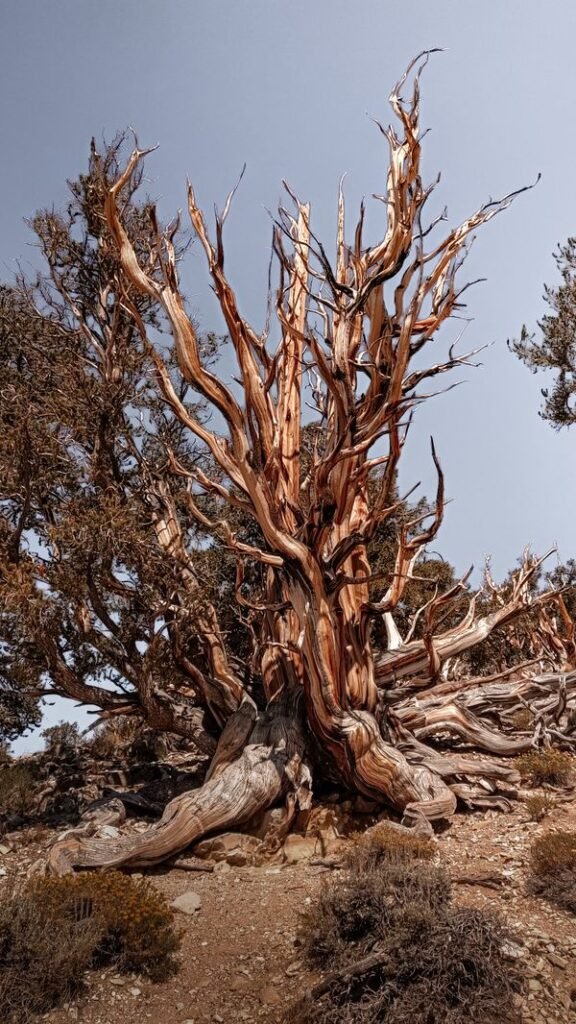
Bristlecone Pine: The Oldest Tree on Earth, Explained
High in the White Mountains of eastern California, where the air is thin and the wind rarely stops, grows a tree that was already ancient when the pyramids were young. It is not tall. It is not beautiful in any conventional sense. Its trunk is a twisted sculpture of bleached, wind-carved wood, and much of it looks dead. But somewhere along that gnarled trunk runs a thin ribbon of living bark, and every summer it adds another microscopic ring of growth, as it has done for nearly five thousand years.
This is a bristlecone pine, and one particular tree among them, nicknamed Methuselah, is the oldest confirmed living non-clonal tree on Earth. Understanding how it got so old, and what it can teach us, means journeying into dendrochronology, a tragic accident of science, and the strange strategy of surviving by barely growing at all.
Meet Methuselah: The Oldest Known Living Tree
Methuselah is a Great Basin bristlecone pine, Pinus longaeva, growing in the Ancient Bristlecone Pine Forest within California's Inyo National Forest. Its age is put at about 4,850 years, a figure that has been refined over the decades: core samples taken in 1957 put it over 4,789 years old according to the U.S. Department of Agriculture, while more recent references list its age as 4,857 to 4,858 years. However you count it, this single tree germinated around 2833 BCE, centuries before the Great Pyramid of Giza was built.
The tree was discovered and named in 1957 by Edmund Schulman, a scientist at the University of Arizona who pioneered dendrochronology, the science of dating trees by their rings. Schulman was the first to recognize bristlecone pines as a distinct group of conifers with unmatched longevity. He named the tree after the biblical patriarch Methuselah, who legend says lived 969 years, making the name a byword for longevity.
It is worth being precise about what "oldest" means here. Methuselah is the oldest known living tree that grew from a single seed and still stands as one individual. Some clonal organisms are far older: Pando, a colony of some 47,000 quaking aspen stems in Utah that all share one root system, is estimated to be between 9,000 and 16,000 years old. But Pando is a clone, constantly renewing itself. Methuselah is one tree, one trunk, one unbroken life stretching back nearly five millennia.
There are three species of bristlecone pine. Pinus longaeva, the Great Basin bristlecone, is the Methuselah species and by far the longest-lived. Its relatives, the Rocky Mountain bristlecone (Pinus aristata) and the foxtail pine (Pinus balfouriana), are impressive in their own right, with individuals measured at up to 3,000 years old, but they do not approach the extreme age of P. longaeva.
Why Methuselah's Exact Location Is a Secret
Here is one of the strangest facts about the world's most famous tree: the U.S. Forest Service will not tell you where it is. Methuselah grows somewhere in the "Methuselah Grove" of the Ancient Bristlecone Pine Forest, between 2,900 and 3,000 metres (9,500 to 9,800 feet) above sea level. The grove is real, it has a signed trail, and visitors walk through it every summer. But the individual tree is not marked, signed, or identified.
The reason is protection. Forest managers fear that a clearly labelled oldest tree would attract crowds, and with crowds come soil compaction around the roots, broken branches taken as souvenirs, carved bark, and the risk of deliberate vandalism. Anonymity, it turns out, is one of the most effective conservation tools ever applied to a single organism. As the Forest Service sees it, the best way to keep a 4,850-year-old tree alive is to make sure nobody knows which one it is.
That policy held for decades, though in 2021 the tree's location became widely circulated online after photographs of the specific tree appeared in a National Geographic article and a documentary. The Forest Service still does not officially disclose it, and the ethic among responsible visitors remains the same: admire the ancient grove, stay on the trails, and leave every tree exactly as you found it.
How Scientists Date a 5,000-Year-Old Tree
Nobody watched Methuselah sprout, so how do we know its age? The answer is dendrochronology, from the Greek dendron (tree) and chronos (time). Each year, a tree growing in a seasonal climate lays down one ring of wood: lighter, fast-grown wood in spring and summer, darker, denser wood toward winter. Count the rings, and you count the years.
For living ancient trees, scientists do not cut anything down. They use an increment borer, a specialized hollow drill that extracts a pencil-thin cylinder of wood, called a core, from the trunk. The hole is tiny and the tree quickly seals it. Back in the laboratory, researchers count and measure the rings under magnification. But a simple count is only the beginning. By overlapping ring patterns from many trees, living and dead, scientists build master chronologies. A distinctive sequence of wide and narrow rings, caused by a run of wet years or a famous drought, acts like a barcode that lets one tree's record be matched against another's.
Bristlecone pines are the gold standard for this work. Because dead bristlecone wood decays so slowly in the dry mountain air, researchers have been able to match the rings of long-dead trees with those of living ones, building continuous chronologies that reach back more than 9,000 years. These are among the longest annually resolved climate records on Earth. From them, scientists have reconstructed ancient droughts, rainfall patterns, temperature swings, volcanic eruptions, and even variations in solar activity. When climate scientists talk about what the weather was doing a thousand years before the Roman Empire, there is a good chance a bristlecone pine told them.
Edmund Schulman's 1957 coring of Methuselah was the breakthrough that started it all, proving that a living tree could be nearly 5,000 years old. The Laboratory of Tree-Ring Research at the University of Arizona, where Schulman worked, remains the world centre for this science.
The Tree a Scientist Cut Down: The Story of Prometheus
Every story about the oldest tree carries a shadow, and its name is Prometheus. In 1964, a young geography graduate student named Donald Currey was studying Ice Age glaciers on Wheeler Peak in Nevada. He wanted tree-ring data from the bristlecone pines growing there, and he had permission from the Forest Service to take core samples. But one particular tree defeated his equipment: as Currey later explained, the available increment borers were too small to core it, even from several angles.
With further permission, the tree was cut down, and a cross-section about 30 centimetres thick was taken for study. Only when Currey sat down to count the rings did the magnitude of what had happened become clear. The counts kept climbing: over 4,000, over 4,500, over 4,600, past the oldest age reported in the scientific literature at the time. The final estimate was around 4,900 years. Currey recounted and rechecked under higher magnification, but there was no mistake. He had felled what was then the oldest tree ever dated, a tree the local mountaineers had called Prometheus.
Nobody knew how old Prometheus was before it was cut; the tragedy was discovered, not intended. But the story changed science. Bristlecone pines came under much stricter federal protection, and the felling of Prometheus became a cautionary tale told to every student of dendrochronology: the oldest things in the forest deserve the gentlest methods.
Prometheus held the record for the oldest known tree until Methuselah's more careful dating surpassed it. There was also a brief challenger: in 2010, a bristlecone pine estimated at 5,062 years old was reported, but in 2017 the dendrochronologist Peter Brown, who maintains the authoritative "OldList" database of the world's oldest trees, removed it from his records because the tree and its core sample could not be verified. For now, Methuselah's crown is secure.
Why Bristlecone Pines Live So Long
The secret of the bristlecone pine is not rapid growth or ideal conditions. It is the opposite: the tree survives by growing where almost nothing else can, and by growing almost imperceptibly slowly.
The White Mountains sit in the rain shadow of the Sierra Nevada, not far from Death Valley, the driest and hottest place in the United States. Bristlecones grow at around 3,000 metres and above, on rocky, alkaline, nutrient-poor soils, battered by wind, extreme cold, and intense sunlight. The growing season is brutally short. Peter Brown, the dendrochronologist who curates the OldList, has explained the paradox simply: the oldest trees tend to grow in the most stressful, marginal environments, because hardship forces them to grow very, very slowly.
Slow growth produces extremely dense wood, and bristlecone wood is also loaded with resin. That combination resists insects, fungi, rot, and erosion to a remarkable degree. Dead bristlecone wood can stand for thousands of years without rotting, which is why the ring chronologies reach so far back.
Then there is the tree's most famous trick: sectored architecture. In a very old bristlecone, often only a narrow strip of bark is still alive, connecting a few living roots to a handful of green branches. The National Park Service explains it plainly: each root feeds only the section of the tree directly above it, so when a root dies, only that section dies. The rest of the tree carries on, growing around its own skeleton. A bristlecone can look 90 percent dead and still be adding new growth.
Even the needles play along. Bristlecone needles can remain alive and photosynthesizing for decades, far longer than the needles of most pines. In an environment where every growing season is short and unpredictable, keeping old needles working saves the enormous energy cost of replacing them.
The USDA has described bristlecones as "extremeophiles," organisms that thrive on adversity. Cold discourages the insects and fungi that would attack them. Thin soils discourage competitors. Drought discourages everything. The bristlecone's strategy is to outlast, not outgrow.
What the Oldest Tree Has Lived Through
Numbers like "4,850 years" are hard to feel. A timeline helps. Methuselah germinated around 2833 BCE. Consider what has happened since, while one tree kept adding rings on a California ridge:
| Approximate date | Event in human history | Methuselah's age |
|---|---|---|
| c. 2833 BCE | Methuselah germinates | 0 |
| c. 2560 BCE | Construction of the Great Pyramid of Giza begins | ~270 years |
| c. 2200 BCE | Stonehenge's great sarsen stones erected | ~630 years |
| c. 1200 BCE | Bronze Age collapse; era of the Trojan War legends | ~1,600 years |
| 44 BCE | Julius Caesar assassinated | ~2,790 years |
| 622 CE | The Hijrah; start of the Islamic calendar | ~3,450 years |
| c. 1000 CE | Viking voyages reach North America | ~3,830 years |
| 1440s CE | Gutenberg's printing press | ~4,270 years |
| 1800s CE | Industrial Revolution transforms the world | ~4,630 years |
| 1903 CE | First powered airplane flight | ~4,730 years |
| 1957 CE | Schulman cores Methuselah; Space Age begins | ~4,790 years |
| 1964 CE | Prometheus cut down in Nevada | ~4,800 years |
| Today | Satellites, smartphones, AI | ~4,858 years |
Every empire in recorded history has risen and fallen within this tree's lifetime. It was already older than the Roman Empire is today when Rome was founded. That continuity is what makes ancient trees more than biological curiosities: they are living witnesses, the longest-running experiments in survival the planet has ever run.
A New Threat: Climate Change and the Limber Pine Race
For millennia, the bristlecone's harsh home was its shield. Now the climate is shifting, and the shield is thinning. Researchers led by Brian Smithers, a PhD candidate at the University of California, Davis, found that a close relative, the limber pine, is moving upslope into bristlecone territory as temperatures warm. The limber pine, itself a tough tree that can live 2,000 years, is described as "leapfrogging" past the bristlecone, colonizing the warmer, more favourable spots and leaving less room for the slower bristlecone seedlings.
The scientists compared the two species to old men in a slow-motion race up a mountainside thousands of years long, with climate change firing the starting gun. Bristlecones cannot simply move higher forever; above them lies only rock and sky. Warming also threatens to change snowpack and soil moisture patterns at high elevations and may allow insects and diseases, previously held back by the cold, to reach trees that have never needed defences against them.
This is the quiet irony of the bristlecone's story. A tree that survived every catastrophe of the last five millennia, from droughts to ice ages, now faces a threat measured in decades: the pace of human-driven warming may simply be faster than a tree that measures its life in centuries can track.
Visiting the Ancient Bristlecone Pine Forest
You cannot visit Methuselah itself, at least not knowingly, but you can walk among its peers. The Ancient Bristlecone Pine Forest is open to the public, generally from mid-May through the end of November, weather permitting. Two groves anchor the experience:
- Schulman Grove, named for Edmund Schulman, sits near the visitor centre at about 3,000 metres. Its 4.5-mile Methuselah Grove trail loops through the side valley where the oldest tree lives, with numbered markers explained by a trail booklet. Rangers give interpretive talks in summer.
- Patriarch Grove, higher and more remote, holds the Patriarch Tree, the world's largest bristlecone pine, along a self-guided nature trail through some of the most otherworldly scenery in California.
Both groves lie about 30 miles (48 kilometres) from the town of Bishop, California, up a winding mountain road. The air is thin, the weather can turn fast, and the environment is fragile. The rules are simple and non-negotiable: stay on designated trails, never climb on the trees, do not touch or collect wood, cones, or rocks, and keep off the thin soils around the roots. These trees survived five thousand years of nature. The least visitors can do is not add themselves to the list of threats.
Frequently Asked Questions
What is the oldest tree in the world?
The oldest confirmed living non-clonal tree is Methuselah, a Great Basin bristlecone pine (Pinus longaeva) in California's White Mountains, estimated at about 4,850 years old. It was dated by dendrochronologist Edmund Schulman in 1957.
Where is the Methuselah tree?
It grows in the Methuselah Grove of the Ancient Bristlecone Pine Forest, in the White Mountains of Inyo County, eastern California, at roughly 2,900 to 3,000 metres elevation. The U.S. Forest Service keeps the exact tree unmarked and its precise location undisclosed to protect it from vandalism.
How do scientists know how old the oldest tree is?
Through dendrochronology: researchers extract a thin core with an increment borer, count the annual growth rings, and cross-match ring patterns with other trees to build verified chronologies. Bristlecone chronologies extend back more than 9,000 years.
What happened to the Prometheus tree?
In 1964, graduate student Donald Currey cut down a bristlecone pine on Wheeler Peak, Nevada, with Forest Service permission, after his coring tools proved too small. Ring counts later showed it was about 4,900 years old, the oldest tree ever dated at the time. The incident led to much stricter protections for bristlecones.
Are there living things older than the bristlecone pine?
Yes, but they are clonal organisms, not single trees. Pando, a quaking aspen colony in Utah sharing one root system, is estimated at 9,000 to 16,000 years old. Among individual non-clonal trees, the bristlecone pine remains the confirmed record holder.
Conclusion
The bristlecone pine rewrites our assumptions about what it takes to live long. Not speed, not size, not dominance, but patience: dense wood, resinous defences, needles that last for decades, and the willingness to let most of yourself die while a thin ribbon of life carries on. Methuselah has stood through the entire span of recorded civilization without moving an inch, recording every drought and deluge in its rings for scientists to read like pages.
Its greatest lesson may be humility. A tree that began growing before writing existed is now threatened by changes unfolding within a single human lifetime. Protecting the ancient bristlecone forests, through secrecy, through science, through the simple discipline of staying on the trail, is a small price for keeping the oldest witness on Earth alive to see what comes next.