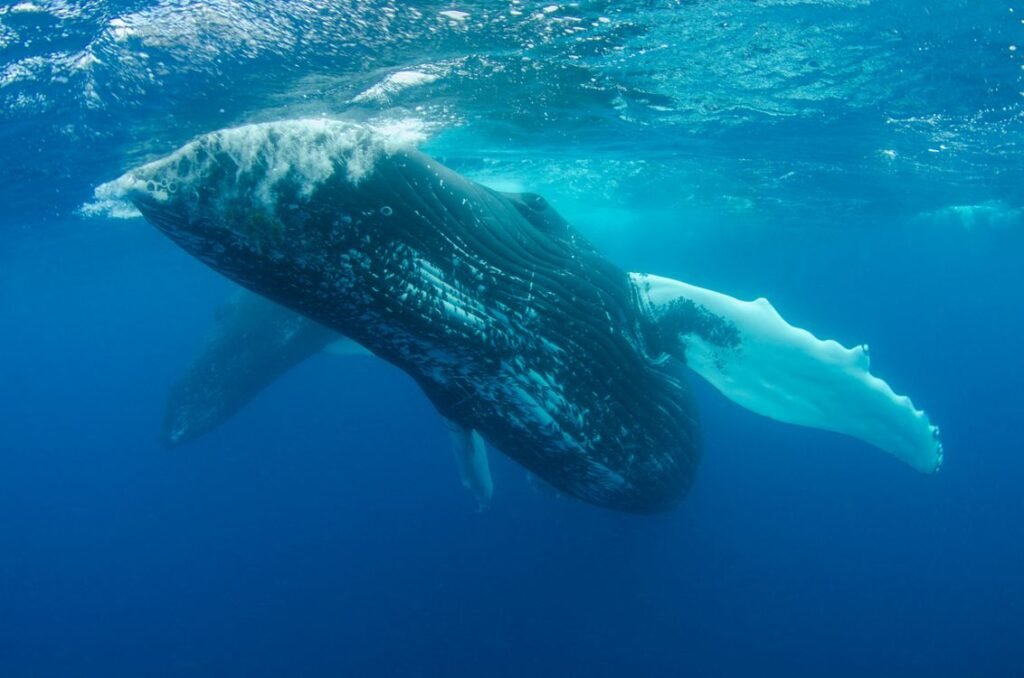
Blue Whale Facts: Size, Diet, Sounds and Lifespan Guide
The blue whale is the largest animal known to have ever existed. Larger than any dinosaur, longer than three buses, heavier than a herd of elephants, it swims in our oceans right now. And yet this mountain of an animal survives on some of the smallest creatures in the sea.
Here are the essential blue whale facts, verified against published research and assessments from NOAA Fisheries, the IUCN, and whale biologists: how big these giants truly get, what and how they eat, how they communicate across entire ocean basins, how they raise their calves, where they travel, and why they are still endangered despite decades of protection.
What Is a Blue Whale?
The blue whale, Balaenoptera musculus, is a baleen whale in the rorqual family, Balaenopteridae, which also includes fin whales, humpbacks, sei whales, and minkes. Rorquals are the lunge feeders of the whale world, built around enormous expandable throats that let them engulf staggering volumes of water and prey.
Despite the name, blue whales are not a vivid blue. Underwater they can look true blue, but at the surface their coloring is a mottled blue-grey, lighter underneath. Millions of microorganisms living in their skin can give the belly a yellowish tinge, which earned them the old whalers' nickname of "sulphur bottom." They have a broad, flat, U-shaped head that can make up a quarter of their body length, a long tapered body, and a small dorsal fin set far back.
Four subspecies are currently recognized by scientists: B. m. musculus in the North Atlantic and North Pacific, B. m. intermedia in the Southern Ocean, B. m. brevicauda, the pygmy blue whale of the Indian Ocean and South Pacific, and B. m. indica in the northern Indian Ocean. A population off Chile may represent a fifth. The pygmy blue whale, though smaller than its polar cousins, is still a giant by any other standard.
How Big Is a Blue Whale?
Blue whales reach a maximum confirmed length of 29.9 to 30.5 meters (98 to 100 feet) and can weigh up to 190 to 200 tonnes, according to published measurements summarized on Wikipedia. NOAA Fisheries gives a maximum of about 33.5 meters (110 feet) and 150 tonnes, while WWF puts the top weight at around 200 tons. Females grow larger than males. To grasp what that means, compare parts of the animal to things you know:
| Blue whale feature | Comparison |
|---|---|
| Total length (up to 30 m) | Longer than three buses end to end |
| Total weight (up to 200 tonnes) | About 33 elephants, or 2,500 people |
| Tongue | Weighs as much as an elephant |
| Heart | About the size of a small car, weighing roughly 450 kg (1,000 lb) |
| Blood vessels | Wide enough for a person to swim through |
| Newborn calf (7 to 8 m) | Longer than a giraffe is tall, weighing 3 to 4 tonnes |
| Blow (spout) | A column of mist up to 9 meters (30 ft) tall |
Even the calf is enormous. A newborn blue whale is already the size of a large elephant and, in its first months, will gain around 90 kilograms (200 pounds) every single day.
What Do Blue Whales Eat?
The biggest animal on Earth eats some of the smallest. Blue whales feed almost exclusively on krill, tiny shrimp-like crustaceans only a few centimeters long that drift in vast swarms through cold, productive waters. They may also take copepods and small fish, but krill is the foundation of the blue whale's existence.
The quantities are staggering. National Geographic and WWF report that an adult blue whale consumes about 4 tonnes of krill a day during the feeding season. Some of the largest individuals may take considerably more. National Geographic Kids puts the daily count at up to 40 million individual krill. WWF adds that a blue whale's stomach can hold about a tonne of krill at a time.
This diet explains one of the great puzzles of ocean life: why the largest animal that ever lived bothers with prey the size of a paperclip. The answer is energy economics. Krill gather in dense, predictable swarms, and a whale that can harvest tonnes of them in a single lunge gets an enormous caloric return for each dive. Nothing else in the ocean concentrates that much food in one place.
Lunge Feeding: How a Giant Eats the Tiniest Prey
Blue whales are filter feeders, and their feeding technique, called lunge feeding, is one of the most extreme acts of eating in nature. Here is how it works, step by step.
First, the whale accelerates into a dense swarm of krill with its mouth wide open. The throat and belly are pleated with 55 to 68 expandable grooves (other counts put the number higher), which balloon outward like a parachute, letting the mouth engulf an immense volume of water and krill. Washington's Department of Fish and Wildlife notes that a blue whale can take in water weighing up to 70 percent of its own body weight in a single lunge.
Then the mouth closes and the great tongue, itself the size of an elephant, forces the water back out through the baleen plates. Baleen is a fingernail-like material, and a blue whale carries 300 to 400 fringed plates hanging from its upper jaw. The bristly edges trap the krill inside while the water streams out. The whale then swallows the catch, thousands of krill at a gulp, and dives again.
Feeding dives usually last 10 to 20 minutes and take place shallower than 100 meters, where krill swarms are thickest. During the summer feeding season in polar waters, whales may feed almost continuously. Then, remarkably, they can go months eating little or nothing at all, living off blubber reserves while they migrate and breed.
The Loudest Voice in the Animal Kingdom
Blue whales are the loudest animals on the planet. Their low-frequency calls can reach up to 188 decibels, louder than a jet engine, and travel through water for hundreds of kilometers. The fundamental frequency of their vocalizations ranges from 8 to 25 hertz, at or below the lower limit of human hearing, so much of their "singing" is felt more than heard.
These are not random noises. Blue whale calls vary by region, season, behavior, and time of day, and different populations appear to have distinct dialects. According to Washington's Department of Fish and Wildlife, singing is performed only by males and occurs year-round, which suggests the songs play a role in breeding as well as in keeping in touch across the vast, dark ocean.
Sound is the perfect medium for a giant that lives mostly alone. In water, low-frequency sound travels enormous distances with little loss, so a whale can announce its presence, its location, and perhaps its intentions to others hundreds of kilometers away. In an increasingly noisy ocean, full of shipping traffic and seismic surveys, that long-distance channel is under growing pressure, and ocean noise is now listed by NOAA as a threat to the species.
Life Cycle: From Calf to Giant
Blue whales live 80 to 90 years in the wild, according to National Geographic and state wildlife assessments, and at least one famous individual is reported to have reached 110. They mature slowly: sexual maturity arrives at roughly 5 to 15 years depending on the population and sex.
Breeding follows a patient rhythm. Females give birth to a single calf every two to three years, the average calving interval estimated by NOAA. Gestation lasts 10 to 12 months. Calves are born in warm, low-latitude waters during the winter breeding season, measuring 6 to 8 meters long and weighing several tonnes, making them the biggest babies on the planet.
What follows is one of the fastest growth spurts in nature. A calf drinks up to 250 liters of its mother's rich milk every day and can gain around 90 kilograms daily. The calf stays close to its mother for seven to nine months before being weaned, learning the migration routes it will follow for the rest of its long life. Mother and calf form the strongest social bond in blue whale society; outside of these pairs, blue whales are usually solitary or travel in small groups of two to four, though feeding aggregations of up to 60 have been seen off California.
Blue whales can even hybridize with their close relatives: Washington wildlife officials note that breeding between blue whales and fin whales has produced hybrid offspring, a reminder of how recently these great rorquals diverged.
Four Subspecies of Blue Whale
Scientists currently recognize four subspecies, each tied to particular ocean regions. The table below summarizes them.
| Subspecies | Range | Notes |
|---|---|---|
| B. m. musculus | North Atlantic and North Pacific | The classic northern blue whale |
| B. m. intermedia | Southern Ocean | The largest form; Antarctic feeding grounds |
| B. m. brevicauda (pygmy blue whale) | Indian Ocean and South Pacific | Smaller, but still enormous |
| B. m. indica | Northern Indian Ocean | Resident population; taxonomy debated |
The northern Indian Ocean animals are of special interest to South Asian readers. Research indicates that a population of blue whales resides year-round in the northern Indian Ocean, ranging from the Arabian Peninsula in the west to Sri Lanka in the east and south to the Maldives, rather than migrating to polar waters like other populations. Whether these whales are pygmy blue whales, B. m. indica, or something else entirely is still debated by scientists, which makes them one of the great unsolved questions in whale biology.
Where Blue Whales Live and Migrate
Blue whales are found in every major ocean basin except the Arctic. In general, populations migrate between summer feeding grounds near the poles, where krill blooms are richest, and winter breeding grounds nearer the tropics. But the picture is more flexible than that: there is evidence of year-round residency in some areas and of partial migration that differs by age and sex.
For readers in Pakistan and South Asia, the most exciting blue whale story is close to home. Sri Lanka is now recognized as one of the finest places in the world to see blue whales. The whales seen off Mirissa, Trincomalee, and Kalpitiya are Indian Ocean pygmy blues, and during the peak months of December and January, dozens can be sighted in a single day. Scientists believe some of these whales forage in the Arabian Sea during the southwest monsoon before moving toward Maldivian waters.
And Pakistan itself has entered the blue whale story. In a remarkable event reported by Earth Touch News, WWF-trained tuna fishermen filmed a blue whale mother with her calf off Churna Island in the Arabian Sea, the first documented sighting of live blue whales in Pakistan's waters. The fishermen estimated the mother at around 17 meters, nearly the length of their boat. Dead blue whales had been reported in Pakistani waters before, but never living ones. WWF-Pakistan's team suggested the whales may have been drawn by the Arabian Sea's rich swarms of pelagic shrimp, and credited the sighting to their Fishing Crew Observer Programme, which trains skippers to identify and safely release marine life.
From Near Extinction to Slow Recovery
The blue whale's history is a cautionary tale. Abundant in nearly every ocean until the late 19th century, blue whales were hunted so intensively after the arrival of factory ships and the explosive harpoon in the 1920s that they were brought to the edge of extinction. The International Whaling Commission banned all blue whale hunting in 1966, and the species has been protected for decades since.
The IUCN listed the blue whale as Endangered in 2018, with the population trend now increasing. But recovery is slow and incomplete, and new threats have replaced the harpoon. NOAA Fisheries lists the leading dangers: vessel strikes, which kill whales outright, especially in busy shipping lanes; entanglement in fishing gear such as traps, pots, and nets; ocean noise; pollution; habitat degradation; and climate change, which threatens the krill populations the whales depend on.
In the United States, all blue whales are protected under the Marine Mammal Protection Act and the Endangered Species Act. Globally, conservation work focuses on reducing ship strikes through slower vessel speeds and rerouted lanes, disentanglement response, and quieter oceans. The species survived the whalers; whether it thrives in the age of container ships and warming seas depends on choices being made now.
Frequently Asked Questions
Is the blue whale the largest animal ever? Yes. At up to about 30 meters long and 200 tonnes, the blue whale is the largest animal known to have ever existed, larger than the biggest dinosaurs. Its heart alone is the size of a small car, and its tongue weighs as much as an elephant.
What do blue whales eat? Almost exclusively krill, tiny shrimp-like crustaceans a few centimeters long. An adult can eat about 4 tonnes of krill a day during the feeding season, filtering them from seawater with 300 to 400 baleen plates. They expand their pleated throats to engulf huge mouthfuls in a technique called lunge feeding.
How long do blue whales live? Blue whales typically live 80 to 90 years in the wild, and some individuals may live longer; one well-known whale reportedly reached 110. They mature slowly and females give birth to a single calf only every two to three years.
How loud is a blue whale? Blue whales produce the loudest sounds of any animal, up to 188 decibels, at frequencies of 8 to 25 hertz. Their calls can be heard underwater for hundreds of kilometers. Only males sing, and they do so year-round.
Are blue whales endangered? Yes. The IUCN lists the blue whale as Endangered. Commercial whaling, banned for blue whales in 1966, nearly wiped them out. Populations are now increasing, but vessel strikes, fishing gear entanglement, ocean noise, pollution, and climate change remain serious threats.
Can you see blue whales near Pakistan or Sri Lanka? Yes. Sri Lanka is one of the best whale-watching destinations in the world, with pygmy blue whales seen off Mirissa (December to April), Trincomalee (March to August), and Kalpitiya. In Pakistan, a blue whale mother and calf were filmed off Churna Island, the first documented live sighting in the country's waters, suggesting the Arabian Sea hosts these giants too.
Conclusion
The blue whale is a study in beautiful contradictions: the largest animal that ever lived, sustained by some of the smallest; a solitary wanderer whose voice crosses oceans; a slow-breeding giant recovering, step by step, from the brink of extinction. From the polar feeding grounds to the warm waters off Sri Lanka and Pakistan, its story is still being written, by scientists, by fishermen with cameras, and by the choices we make about the seas we share. Few animals reward curiosity as richly, and few deserve our protection as urgently.