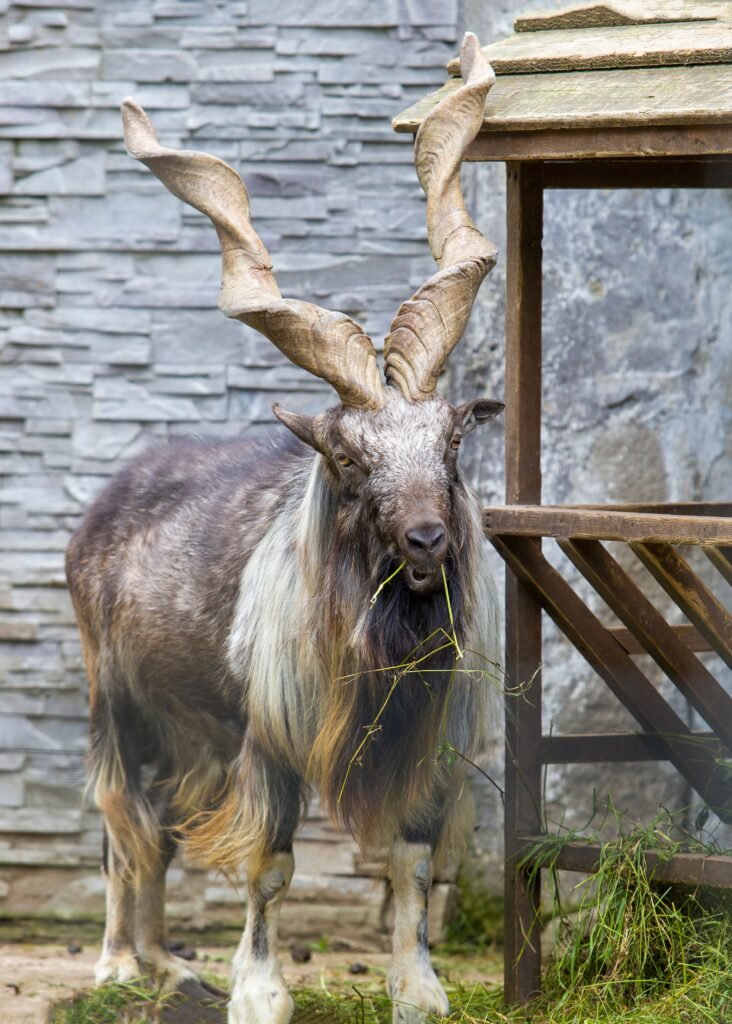
Markhor: Pakistan’s National Animal, the Screw-Horned Goat
High in the rocky mountains of northern Pakistan lives an animal that looks like it walked out of a legend. It has the body of a wild goat, the beard of a sage, and horns that spiral upward like corkscrews, sometimes reaching longer than a tall man is tall. Local people once believed it hunted snakes. Today it is Pakistan's national animal, a symbol of resilience printed on stamps, celebrated in folklore, and honored with its own international day.
The markhor's story is also one of the most remarkable conservation comebacks in South Asia. Hunted to the edge of extinction, it was pulled back by an unlikely alliance of mountain communities, wildlife departments, and carefully regulated hunting programs. This is the full story of the markhor: what it is, where it lives, how it behaves, why it nearly vanished, and how it is returning to the mountains.
Markhor at a Glance
| Fact | Detail |
|---|---|
| Scientific name | Capra falconeri (Wagner, 1839) |
| Common names | Markhor, screw-horned goat |
| National status | National animal of Pakistan |
| IUCN Red List | Near Threatened (since 2015; previously Endangered) |
| CITES | Appendix I |
| Size | 65 to 115 cm at the shoulder; 40 to 110 kg |
| Horns | Corkscrew-shaped; up to 160 cm in males, about 25 cm in females |
| Range | Karakoram and western Himalayas: Pakistan, Afghanistan, Tajikistan, Uzbekistan, Turkmenistan, and Indian-administered Kashmir |
| Habitat | Steep rocky slopes and scrub forest, 500 to 3,500 meters elevation |
| Diet | Grasses, leaves, and shrubs; a herbivore |
Meet the Markhor: Pakistan's National Animal
The markhor (Capra falconeri) is a large wild goat native to the mountain ranges where Central and South Asia meet: the Karakoram, the western Himalayas, and the Hindu Kush. It was chosen as Pakistan's national animal for its toughness and its deep connection to the country's northern mountains. Where the snow leopard is the ghost of these ranges, the markhor is their emblem: visible, vocal, and unmistakably of this place.
To understand the markhor, it helps to know what it is not. It is not an ibex, though it shares the mountains with ibex in some areas. It is not a domestic goat, though it can interbreed with them. It is the world's largest wild goat species, a member of the bovid family superbly adapted to cliffs, scree, and thin mountain air.
Within Pakistan, markhors are found in the northern regions: Chitral, Ghizar, and Hunza in Khyber Pakhtunkhwa and Gilgit-Baltistan. Chitral Gol National Park is one of its most important strongholds. Beyond Pakistan, populations survive in Afghanistan, Tajikistan, Uzbekistan, Turkmenistan, and the Kashmir region.
The Name and the Legend
Few animals carry a stranger name. "Markhor" comes from Persian: mar meaning snake, and khor meaning eater. The snake eater. According to ancient local belief, the markhor would actively seek out, kill, and consume snakes, and its flesh was thought to hold protective powers. The coiled shape of its horns, resembling a striking serpent, may have fed the legend.
The truth is less dramatic but no less interesting. The markhor is a strict herbivore. It eats grasses, leaves, and shrubs, and has never been observed hunting snakes. The legend likely grew from the horns' snakelike spirals combined with the animal's habit of chewing its cud with a distinctive, almost serpentine motion of the jaw. In English it is also called the screw-horned goat, a plainer name for the same extraordinary feature.
The name captures something real about how mountain communities related to this animal: with awe, with stories, and with a belief that it was no ordinary goat.
What a Markhor Looks Like
The first thing anyone notices is the horns. In adult males they rise in spectacular corkscrew spirals that can reach 160 centimeters, over five feet, making them among the most impressive horns of any wild goat or sheep in the world. Females carry the same spiral pattern in miniature, usually around 25 centimeters. The number of rings on the horns can be used to estimate an animal's age, much like counting the rings of a tree.
Markhors stand 65 to 115 centimeters at the shoulder and weigh between 40 and 110 kilograms, with males considerably larger than females. Their coloring shifts with the seasons: a reddish-gray or gray-brown coat in winter that thins to a warmer reddish tone in summer. Males are distinguished by a dark face and a magnificent mane of long white hair flowing from the neck and chest, sometimes reaching down to the knees, along with a full beard that thickens in cold weather. Females are a softer tan with a white underbelly and a distinctive black-and-white pattern on the legs.
Built for vertical life, the markhor has a stocky body, powerful legs, and sure-footed hooves that grip rock. Watching one traverse a near-vertical cliff face is to understand why mountain people consider it the master of its terrain.
Where Markhors Live
Markhors inhabit some of the most demanding terrain in Asia: steep, rocky slopes and open scrub forests between 500 and 3,500 meters above sea level. They favor areas with a mix of cliffs for escape and vegetated slopes for feeding, often in the dry temperate forests of juniper, oak, and pine that cling to the mountainsides.
In winter, markhors descend to lower elevations where snow is thinner and food is accessible. In summer, they climb higher to alpine pastures. This seasonal migration follows the green wave of new plant growth up and down the mountains.
The species' strongholds in Pakistan include Chitral Gol National Park, where a dedicated population has been studied and protected for decades, the Toshi-Shasha and Gahirat-Golen community conservancies in Chitral, and the mountains of Ghizar and Hunza. Across the border, the Kazinag landscape in Indian-administered Kashmir, including Kazinag National Park and the Limber and Lachipora wildlife sanctuaries, holds another important population, recently estimated at around 227 animals, a 71 percent increase from the 133 recorded in 2005.
Diet and Daily Life
The markhor is a herbivore with catholic tastes, grazing on grasses and browsing on the leaves, twigs, and shoots of shrubs and trees. One of its most charming behaviors is its habit of rearing up on its hind legs to reach the upper leaves of trees, standing like a person to strip branches other grazers cannot reach.
Markhors are most active in the early morning and late afternoon, resting through the heat of midday. Their social life follows a familiar mountain-goat pattern. Females gather in small herds of up to nine animals, often with their young, while adult males tend to live alone or in loose bachelor groups, joining the female herds during the autumn rutting season. During the rut, males compete for mates with dramatic displays and clashes of those great spiral horns.
Their senses are finely tuned for survival: excellent eyesight, acute hearing, and a sharp sense of smell that can detect predators and hunters from a considerable distance. Their main natural predators are snow leopards and wolves, with golden eagles occasionally taking young kids.
The Markhor Family: Subspecies
The markhor's horns vary strikingly across its range, and taxonomists recognize several subspecies distinguished largely by horn shape and the tightness of the spiral. The three most commonly described are the Astor markhor, with broad, relatively flat flaring horns; the Kabul (or Kashmir) markhor, with a tighter corkscrew twist, found in Chitral and Kashmir; and the Bukharan markhor, from the western part of the range in Tajikistan, Turkmenistan, and Uzbekistan.
These differences reflect long isolation in separate mountain valleys. All subspecies share the same essential biology and face similar threats, and conservation programs generally treat the species as a whole while protecting distinct local populations.
Why the Markhor Nearly Disappeared
For much of the twentieth century, the markhor's trajectory pointed toward extinction. The causes were multiple and reinforcing.
The most direct was hunting. Markhors were prized targets for trophy hunters drawn by the magnificent horns, and for local hunters who valued the meat; a large male can provide substantial food for a mountain household. During periods of political unrest, including heavy fighting in the region in the 1980s, organized protection collapsed and poaching surged.
Competition with domestic livestock compounded the problem. As human settlements expanded, goats and sheep were grazed ever higher into markhor habitat, stripping the same limited pastures. Studies in Chitral have documented severe dietary overlap between markhors and livestock, which can reduce the wild goats' survival and reproductive rates. Domestic goats also brought disease: contagious caprine pleuropneumonia, a respiratory illness of livestock, has spread to markhor populations, and cross-breeding with domestic goats threatens the genetic integrity of wild herds.
By 2012, the IUCN estimated that only about 2,500 markhors remained in the wild, and the species was listed as Endangered. The national animal of Pakistan was slipping away.
The Comeback: Communities Saving the Markhor
The markhor's recovery is one of conservation's most instructive stories, because it was achieved not by fencing people out, but by giving local communities a stake in the animal's survival.
Beginning in the late 1990s, Pakistan pioneered a community-based trophy hunting program in the markhor's Chitral range. The model is straightforward and, to many, surprising: a strictly limited number of hunting permits for old male markhors are auctioned each year, and 80 percent of the revenue goes directly to the local communities that share the mountains with the animals. The remaining 20 percent goes to the wildlife department. Villagers use the funds for anti-poaching patrols, schools, and development projects, which transforms the markhor from a competitor for grazing into the community's most valuable asset.
The results have been dramatic. In the Chitral region, where the program began, markhor numbers grew at nearly 12 percent per year. A comprehensive survey across northern Pakistan estimated the population at 7,579 animals. In Chitral Gol National Park alone, the population reached 2,926 individuals and expanded into the park's buffer zone. Overall, conservationists estimate more than 5,000 markhors now live in Pakistan, with a global population close to 6,000. In response, the IUCN downlisted the species from Endangered to Near Threatened in 2015, citing a population increase of roughly 20 percent.
The program's economics are striking. Trophy permits, auctioned internationally, have fetched extraordinary prices: a record $243,000 was paid for a single Kashmir markhor permit in the Toshi-Shasha Conservancy, for an animal with 55-inch horns. Earlier seasons saw permits sell for $185,000 and $68,000. The Khyber Pakhtunkhwa wildlife department sets a conservative annual quota, around four animals per year, calibrated to the population of trophy-size males, and each hunt is supervised by wildlife officials and community members.
The approach remains controversial. Critics argue that killing an endangered animal to save it is ethically fraught and that the model depends on wealthy foreign hunters. Supporters point to the numbers: where communities profit from live markhors, poaching has nearly vanished, habitat is guarded, and populations have multiplied severalfold. The United States Fish and Wildlife Service, convinced by the evidence, reclassified the markhor from endangered to threatened under American law, allowing the import of trophies from Pakistan's program and thereby sustaining the funding stream.
Markhor Conservation Milestones
| Year | Milestone |
|---|---|
| Late 1990s | Community-based trophy hunting program begins in Chitral; 80% of revenue to local communities |
| 2012 | IUCN estimates only about 2,500 markhors left in the wild |
| 2015 | IUCN downlists the markhor from Endangered to Near Threatened |
| 2019-2021 | Surveys estimate 7,579 markhors across northern Pakistan |
| 2 May 2024 | UN General Assembly proclaims the International Day of the Markhor |
| 24 May 2024 | First International Day of the Markhor observed |
| 2025 | Record $243,000 trophy permit in Toshi-Shasha; over 5,000 markhors estimated in Pakistan |
International Day of the Markhor
On 2 May 2024, the United Nations General Assembly proclaimed 24 May as the International Day of the Markhor, and the first observance followed on 24 May 2024. The resolution recognized Pakistan's conservation success and the markhor's role as a flagship for biodiversity in Central and South Asia.
Pakistan's leadership marked the occasion with national messages celebrating the population recovery. The Prime Minister's statement highlighted the significant increase in markhor numbers over the preceding decade, crediting conservation programs supported by local communities and guided by scientific research. Pakistan also pointed to its elevation to CITES Category I, recognizing strong legislation and enforcement, including the Pakistan Trade Control of Wild Fauna and Flora Act of 2012.
The international day gives the markhor something few wild goats enjoy: a place on the global calendar, and an annual reminder that community-led conservation can reverse even a steep decline.
Seeing a Markhor in the Wild
For travelers, the markhor is an attainable wildlife sighting rather than a near-mythical one. Chitral Gol National Park in Khyber Pakhtunkhwa offers the best chances, particularly in winter when the animals descend to lower slopes and are more visible. The Toshi-Shasha Conservancy and surrounding community-managed areas in Chitral also hold healthy populations.
Winter is the prime season: the goats come lower, the males are in their full winter manes, and the rutting season's drama may still be visible in late autumn. Local guides are essential, both for finding the animals and because the community conservancies manage access. Visitors should remember that these are the same communities whose stewardship brought the markhor back; hiring local guides and respecting park rules directly supports the conservation model.
Markhor: Frequently Asked Questions
Why is the markhor Pakistan's national animal?
The markhor was chosen as Pakistan's national animal for its resilience in the country's rugged northern mountains and its deep roots in the region's natural heritage. Its distinctive spiral horns and mountain mastery made it a fitting national symbol.
What does "markhor" mean?
It comes from the Persian words mar (snake) and khor (eater), meaning "snake eater," from an ancient belief that the markhor hunted snakes. It is a herbivore and does not eat snakes; the name likely refers to its coiled, snakelike horns.
How big are a markhor's horns?
Male markhors grow corkscrew-shaped horns up to 160 centimeters (over five feet) long, among the largest of any wild goat. Female horns are much smaller, around 25 centimeters, with the same spiral pattern.
Is the markhor still endangered?
No. The markhor was listed as Endangered but was downlisted to Near Threatened on the IUCN Red List in 2015 after its population increased by roughly 20 percent, thanks largely to community-based conservation in Pakistan. It remains protected under CITES Appendix I.
Where can I see a markhor in Pakistan?
Chitral Gol National Park in Khyber Pakhtunkhwa is the premier destination, along with the community conservancies of Chitral such as Toshi-Shasha. Winter offers the best viewing, when markhors descend to lower elevations.
What is the International Day of the Markhor?
The UN General Assembly proclaimed 24 May as the International Day of the Markhor on 2 May 2024, recognizing Pakistan's conservation achievements. It was first observed on 24 May 2024.
The Bottom Line
The markhor is Pakistan's national animal not only because it is magnificent, but because its story belongs to Pakistan's mountains and the people who live in them. From the ancient legend of the snake eater to the brink of extinction and back, the screw-horned goat has become a global example of what community-led conservation can achieve. Its spiraling horns now symbolize something beyond wild beauty: proof that when local people benefit from wildlife, wildlife thrives.