Community-Based Conservation: How Locals Save Wild Places
For most of the twentieth century, conservation followed a simple formula: draw a line around a wild place, put up a fence, and keep people out. In many places it failed, because the people living next to the fence still needed firewood, grazing land, and food, and they had no reason to protect animals that the law had just taken away from them.
Community-based conservation flips that formula, giving local people real authority over nearby forests, fisheries, and wildlife, plus a fair share of the income that protection generates.
This is how the approach works, where it has succeeded, and where it still falls short.
What community-based conservation actually means
At its core, community-based conservation is an approach to protecting biodiversity that gives local people an active role in managing the land, water, wildlife, or forests they live beside. Rather than outside agencies setting all the rules, communities help write them, enforce them, and benefit from them.
The logic is straightforward. People who depend on a habitat usually have the strongest incentive to keep it healthy, and they often know it best: seasonal movements of animals, which plants are harvested and when, how floods and droughts reshape the land. Plans built on that knowledge, combined with genuine local authority, tend to last longer than plans imposed from a capital city.
The IUCN recognizes four broad governance types for protected and conserved areas, and one of them, Type D, is governance by Indigenous peoples and local communities. Related to this are Indigenous and Community Conserved Areas (ICCAs), sometimes called "territories of life": ecosystems voluntarily conserved by communities through customary law. These are not side projects in global conservation. They are one of its recognized pillars.
It helps to be precise about what community-based conservation is not. It is not simply asking villagers to volunteer for a ranger's project. The defining feature is a transfer of real power: legal rights, local decision-making institutions, and benefits that flow back to the community. Participation without power is just consultation with a friendlier name.
Why conservationists started trusting communities
The older model, often called fortress conservation, took shape in the late 1800s. Yellowstone, created in 1872 as the world's first national park, set the template: spectacular nature preserved by removing the people who lived there. Colonial administrations across Africa and Asia copied it, carving out reserves while criminalizing the hunting, grazing, and gathering local communities had practiced for generations.
The results were mixed at best. Strictly protected parks did save some species and landscapes. But they also created lasting resentment. People who lost access to land had little reason to report poachers or respect boundaries, and governments rarely had enough rangers to police vast, remote areas on their own.
A different idea began to take hold. If conservation imposed real costs on local people, lost crops, lost grazing, dangerous animals, then it had to offer real benefits too. Early experiments in southern Africa gave rural communities legal rights over wildlife and a share of hunting and tourism revenue. Nepal began handing forests back to villages. The Convention on Biological Diversity, adopted in 1992, pushed countries to treat communities as partners rather than obstacles.
None of this happened because of sentimentality. It happened because exclusion was failing, and field biologists kept noticing the same thing: where local people had rights, income, and a say, wildlife and forests tended to do better.
How it works: rights, rules, and revenue
Community-based conservation goes by many names, community-based natural resource management (CBNRM) is the most common in policy circles, but successful programs tend to share three ingredients.
Rights. The community needs secure, legal authority over the resource. Namibia's 1996 Nature Conservation Amendment Act let communities form conservancies with rights to manage wildlife and keep the income. Nepal's Forest Act of 1993 let the government hand forests to community forest user groups. Without legal backing, local rules can be overruled the moment they become inconvenient.
Rules. Communities set and enforce the terms of use: which areas are off-limits, how much timber or fish can be taken, when grazing is allowed, who patrols. Enforcement usually comes from within, through community game guards or forest watchers whose authority carries local weight.
Revenue. Protection has to pay, or at least not impoverish. Income comes from ecotourism, regulated trophy hunting, sustainable timber and forest products, carbon payments, or jobs in monitoring and restoration. The money matters less than where it goes: into community accounts, funding schools, clinics, patrols, and compensation for the costs of living with wildlife.
When any one of these legs is missing, the model wobbles. Rights without revenue breed resentment. Revenue without rights breeds dependence. Rules without local legitimacy are simply ignored.
Namibia: the conservancies that brought back the desert elephants
Namibia is the flagship example of community-based conservation, and its story starts in desperation. In the early 1980s, the northwest region of Kaokoland was being hammered by drought, and poaching was emptying the landscape of wildlife. In 1983, conservationist Garth Owen-Smith and local leader Joseph Kagombe began appointing respected community members as game guards, since no government had the manpower to patrol such vast country.
After independence in 1990, Namibia became the first African country to write environmental protection into its constitution. A 1996 law then allowed rural communities to register communal conservancies, legal entities with rights to manage wildlife and keep the income it generated.
The numbers today are striking. According to WWF, Namibia now has 86 communal conservancies covering more than 20 percent of the country, with some 227,802 members, roughly 9 percent of the national population. Together they generate more than 10 million US dollars a year in cash income and in-kind benefits, money that flows back into anti-poaching patrols, wildlife management, schools, and clinics.
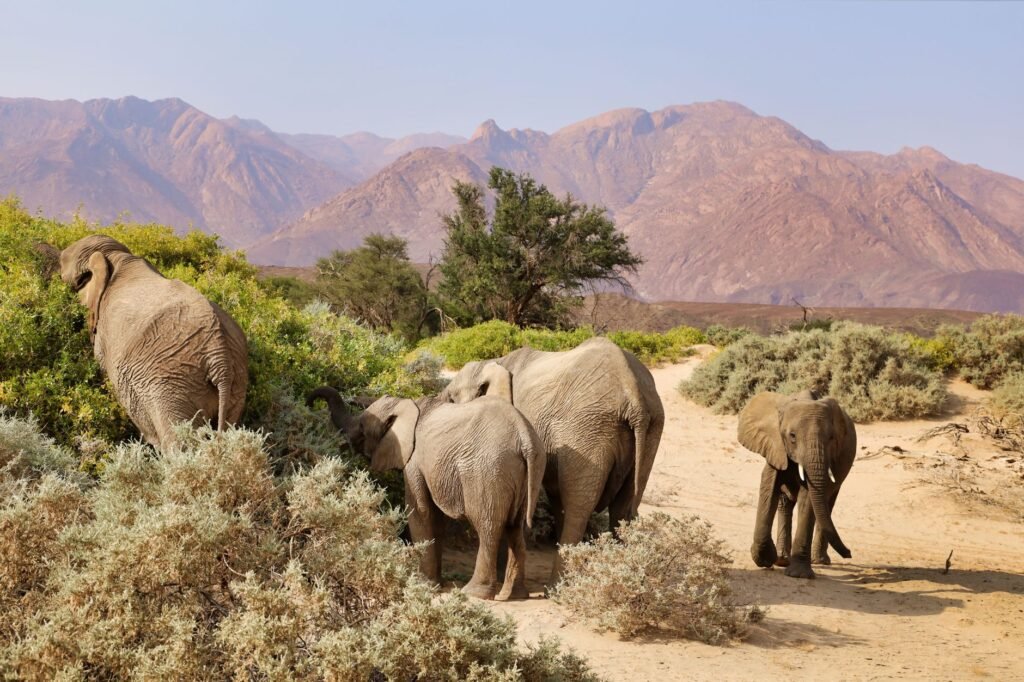
Wildlife has responded. Namibia's elephant population has more than tripled, growing from about 7,500 in 1995 to over 22,000 today. Desert-adapted lions, reduced to fewer than 25 animals in the mid-1990s, now number more than 150 across the northwest. The black rhino, once near extinction, has rebounded into one of the largest free-roaming populations anywhere. In Kunene region, oryx have grown from around 400 in 1982 to about 29,000, and springboks from roughly 600 to an estimated 175,000.
None of this was quick. It took decades of institution-building, training, and trial and error. But Namibia demonstrated something no one had proven at national scale: give communities legal rights and a share of the proceeds, and they will protect wildlife that was previously being poached to nothing.
Nepal: the forests that came back from the brink
Nepal's story begins with a forester and a frustrated village. In 1973, forester Tej Bahadur Singh Mahat arrived as district forest officer in Sindhupalchok to find villagers refusing to cooperate: a previous officer had let the forest they depended on for fuelwood be cut for timber and sold in Kathmandu. Mahat made a deal with the village chairperson, Nil Prasad Bhandari. If the community took responsibility for managing the forest, no outsiders would be allowed to use it. It worked, and the approach spread.
Nepal's Forest Act of 1993 turned that experiment into national policy, allowing the government to hand forests to community forest user groups. Today Nepal has more than 22,000 such groups, with members from over half of the country's households, managing roughly a third of the nation's forests. Between 1992 and 2016, national forest cover climbed from about 26 percent to around 45 percent, one of the most dramatic forest recoveries anywhere.
The wildlife gains have matched the trees. Community management extends into buffer zones around national parks, where a share of park revenues, between 30 and 50 percent, flows to local communities. In the Terai Arc landscape, home to tigers and rhinos, communities working with wildlife authorities have effectively eliminated poaching in key areas. Nepal's tiger population grew from about 125 in 2009 to 355 in 2024, and a camera-trap study around Chitwan National Park found community-managed buffer forest holding its own as tiger habitat, even as the human population around the park tripled.
Nepal's lesson is about scale. A single village forest was a nice story. Twenty-two thousand of them, backed by law, became a national transformation.
Pakistan: the markhor saved by trophy hunting
The most counterintuitive example comes from Pakistan's rugged west, and it remains the most debated. In the Torghar Hills of Balochistan, the straight-horned Suleiman markhor, a wild goat built for cliffs and scree, had been hammered by uncontrolled hunting. By the mid-1980s, fewer than 200 animals remained.
In 1985, local tribes, with support from conservationists, launched the Torghar Conservation Project under the Society for Torghar Environmental Protection (STEP). The deal was blunt: stop all uncontrolled hunting, hire local men as game guards to end poaching, manage the rangeland for both markhor and livestock, and fund the effort by selling a tiny number of tightly regulated trophy hunts each year.
Four decades on, the Torghar Hills hold more than 3,000 markhor, up from fewer than 200. A systematic survey in 2002 counted 1,684 animals in the conservation area alone, and more than 80 game guards from local tribes now patrol the hills. The mechanism is written into Pakistan's official position at CITES: local communities receive 80 percent of trophy hunting revenue for community-based conservation. CITES allocates Pakistan an annual quota of just 12 markhor, first granted in 1997 and later doubled, divided among the country's markhor areas. A similar program was started by WWF-Pakistan in the Bar Valley of Gilgit-Baltistan.
The ethics are genuinely contested, and the debate is worth having openly. Critics argue that killing an endangered animal to save it is morally fraught, that benefits can be captured by local elites, and that photo tourism could replace hunting revenue. Supporters point to the arithmetic: in remote mountains with almost no tourism infrastructure, a handful of high-value hunts funds dozens of guards, and the population trend speaks for itself. What is not in dispute is that the markhor's recovery was driven by giving local tribes a financial stake in the animal's survival. Before the program, a markhor was meat or a rival for grazing. After it, each animal became an asset worth guarding.
Community-based conservation examples around the world
Namibia, Nepal, and Pakistan are the headline cases, but the model has taken root on every continent:
- Kenya's Northern Rangelands Trust supports dozens of community conservancies. Elephant poaching for ivory in member conservancies fell from a peak of 103 cases in 2012 to zero in 2025. The Ishaqbini Community Conservancy runs Kenya's first community-led sanctuary for the hirola, the world's most endangered antelope, with roughly 500 left globally.
- Guyana's arapaima program has local fishers managing harvests of the giant arapaima through community-set quotas.
- Thailand's Pred Nai project restored mangrove forests through community rehabilitation, protecting fisheries and coastline.
- Belize's Port Honduras marine reserve is co-managed with local communities, protecting reefs and fishing grounds together.
- Peru's Casa Matsiguenka shows the ecotourism variant, with an Indigenous community running its own lodge.
- Mexico's Nuevo San Juan demonstrates community forestry at industrial scale, with a community-run timber enterprise funding forest management.
A review of dozens of such cases in the Proceedings of the National Academy of Sciences found the strongest programs share a trait: partnerships where communities, governments, and NGOs each play real roles, not top-down "participation" used as window dressing.
Three models, side by side
| Namibia: communal conservancies | Nepal: community forestry | Pakistan: Torghar markhor program | |
|---|---|---|---|
| Core mechanism | Legal conservancies manage wildlife and keep tourism and hunting income | Village user groups manage forests and share timber and forest-product income | Tribal guards end poaching, funded by a small quota of regulated trophy hunts |
| Legal basis | 1996 Nature Conservation Amendment Act | Forest Act of 1993 | Provincial wildlife rules plus CITES export quota |
| Scale | 86 conservancies, 20%+ of the country, ~228,000 members | 22,000+ user groups, ~1/3 of national forests | One mountain range, 80+ community guards |
| Wildlife result | Elephants 7,500 to 22,000+; lions under 25 to 150+ | Forest cover 26% to 45%; tigers 125 to 355 | Markhor under 200 to 3,000+ |
| People result | $10M+ yearly in community income and benefits | Household fuelwood, timber, income; 30-50% of park revenues shared in buffer zones | 80% of hunt revenue to communities; guard jobs |
| Main vulnerability | Drought and tourism downturns hit income | Elite capture; marginalized groups underrepresented | Ethical controversy; dependence on hunting demand |
Where community conservation struggles: challenges and criticisms
The success stories are real, but community-based conservation has failure modes worth naming.
Benefits do not always reach everyone. In Nepal, researchers and practitioners warn that Indigenous peoples, women, and Dalits often have little real influence over community forest decisions, even when they are formally members. Where elites capture the income, the conservation incentive quietly dies.
Living with wildlife has costs. In Nepal's Chitwan buffer zone, tigers kill seven or eight people a year, even as the tiger population recovers. Elephants raid crops in Namibia and Kenya; predators take livestock. Programs that do not compensate or reduce these losses, through insurance, fencing, or rapid response teams, ask the poorest households to subsidize conservation with their safety and harvests.
Income can be fragile. Tourism revenue, the lifeblood of many conservancies, collapsed during the COVID-19 pandemic; at Kenya's Il Ngwesi conservancy, revenues fell by more than half. Droughts, like the one that struck northern Kenya in 2021 and hammered the hirola sanctuary, test whether community institutions hold together when wildlife and livestock are dying.
Trophy hunting divides even supporters. The Torghar model works in population counts, but many conservationists and much of the public find it unacceptable in principle. Programs must also guard against quota creep and corruption, which is why independent monitoring and strict CITES quotas matter.
Scale is hard. A village forest is manageable; a national program needs laws, extension services, and decades of patient institution-building. Nepal and Namibia each took thirty-plus years. Funders and politicians often want results in three.
None of these criticisms invalidates the approach. They describe what has to be managed: equity, conflict, financial resilience, and time.
What makes it succeed or fail
Across the successes and the stumbles, the same conditions keep appearing. Secure tenure comes first: communities protect what they have legal rights to. Benefits must be tangible, fairly shared, and large enough to outweigh the costs of living with wildlife. Local institutions need real authority and transparent accounts. Outside partners work best as supporters rather than bosses, providing training, legal backing, and monitoring. And everything needs time: the programs that transformed Namibia and Nepal were given decades, not project cycles.
Frequently asked questions
What is community-based conservation in simple terms?
It is conservation run with local people, not around them. Communities get legal rights to manage nearby forests, wildlife, or fisheries, set the rules for their use, and keep a fair share of the income. The core idea: people protect nature best when protecting it also protects their livelihoods.
What are some examples of community-based conservation?
Namibia's 86 communal conservancies, which brought desert elephants and lions back; Nepal's 22,000-plus community forest user groups, which helped regrow forest cover from about 26 to 45 percent; Pakistan's Torghar program, where tribal game guards grew the Suleiman markhor from under 200 to over 3,000; and Kenya's Northern Rangelands Trust conservancies, which cut elephant poaching to zero in member areas.
What are the benefits of community-based conservation?
For wildlife: better protection across larger areas than governments can patrol alone, with documented recoveries of elephants, rhinos, tigers, and forests. For people: income from tourism and sustainable harvests, jobs as guards and guides, stronger local institutions, and a say in decisions affecting their land.
Does trophy hunting really help conservation?
In specific, well-regulated cases it has. Pakistan's markhor program channels 80 percent of hunting fees to local communities under a CITES quota of 12 animals a year, funding the guards that ended poaching. But the model is ethically contested, vulnerable to corruption without strict oversight, and only defensible where tourism cannot generate equivalent income.
How is community-based conservation different from a national park?
A national park is a place, usually run by the state with strict limits on human use. Community-based conservation is an approach to management that can apply inside buffer zones, on communal land, or in forests and fisheries outside parks altogether. The difference is who decides: park authorities, or local people with legal rights and a share of the benefits. The two often work together, as in Nepal, where community-managed buffer zones ring national parks.
Can community-based conservation work in the ocean?
Yes. The same principles apply to fisheries and reefs. Belize's Port Honduras marine reserve is co-managed with fishing communities, and on Kenya's coast, the Pate Marine Community Conservancy trains local scouts who patrol for illegal fishing and rescue entangled sea turtles.
Why does community-based conservation sometimes fail?
Usually for one of four reasons: communities never got real legal rights; benefits were captured by elites or never materialized; human-wildlife conflict costs were left uncompensated; or outside support vanished before local institutions were strong enough to stand alone.
The bottom line
Community-based conservation began as a concession to reality: fences and rangers alone could not save nature where people lived beside it. It became something more ambitious, a recognition that the people closest to wild places, given rights, revenue, and respect, are often its most effective guardians. The elephants of the Namib, the forests of the Nepali hills, and the markhor of the Torghar Hills are the evidence.
The model is not magic. It demands fair sharing, honest institutions, and patience measured in decades. But where those conditions are met, conservation stops being something done to communities and becomes something done by them.