Umbrella Species Examples: Nature’s Protective Umbrellas
Conservation budgets are finite, and the International Union for Conservation of Nature now lists nearly 50,000 species at risk of extinction. No organization can mount a rescue plan for each one, so conservationists look for leverage: single species whose protection automatically extends to many others. These are umbrella species, and this guide to umbrella species examples shows how protecting the right animal can shelter entire ecosystems, and what happens when the umbrella has holes.
What Is an Umbrella Species?
An umbrella species is a species chosen as the focus of conservation action because protecting it indirectly protects many other species that share its habitat. The protective side effect is called the umbrella effect. When a reserve is drawn around the home range of an umbrella species, every plant, insect, bird, and mammal living inside that boundary gets a measure of protection too, whether or not anyone planned it that way.
Conservation textbooks offer overlapping definitions, but the core idea is the same: pick a species whose needs are so broad that meeting them covers the needs of its neighbors. One widely used version calls an umbrella species "a wide-ranging species whose requirements include those of many other species."
The term dates to 1984, when biologist Bruce Wilcox defined an umbrella species as one whose minimum area requirements are at least as comprehensive as those of the rest of the community a protected area is meant to safeguard. Set aside enough land for the umbrella species, and you have set aside enough for everybody else. The concept caught on because it gave planners a practical shortcut: instead of mapping the needs of hundreds of obscure species, they could focus on one well-studied, wide-ranging animal.
How the Umbrella Effect Works
The umbrella effect rests on three facts about how certain species live. First, many umbrella species need large territories. A tiger, a grizzly bear, or a spotted owl cannot survive in a small patch of habitat; it needs room to roam, hunt, and breed. Second, their habitat requirements are demanding. Old-growth forest, intact grassland, or undisturbed coastline must be healthy for them to thrive. Third, their ranges overlap with the ranges of many other organisms. Draw a big, healthy protected area around such a species and you inevitably enclose whole communities of less famous plants and animals.
This is why the concept is as much a planning tool as a biological description. Researchers Jean-Michel Roberge and Per Angelstam, in a widely cited 2004 review in the journal Conservation Biology, noted that umbrella species help planners choose where to put reserves, decide how large those reserves need to be, and understand the composition, structure, and processes of the ecosystems inside them. The umbrella species becomes a kind of living measuring stick for the landscape.
Note the difference from a related idea, the trophic cascade, where a predator actively reshapes its ecosystem, like wolves in Yellowstone controlling elk so riverside vegetation recovers. The umbrella effect is simpler and more passive: other species benefit mainly because the land is protected. Many umbrellas, like tigers and wolves, produce both effects at once.
Umbrella Species Examples Around the World
Umbrella species turn up in almost every major habitat, from ocean to alpine meadow, and they are not always the charismatic giants people expect. Here are some of the best-documented examples:
| Umbrella species | Habitat | Species sheltered under the umbrella |
|---|---|---|
| Bengal and Amur tigers | Asian forests, from Indian jungles to the Russian Far East | Deer, wild boar, birds, and countless forest species within tiger reserves |
| Giant panda | Bamboo forests of China's mountains | Red panda, golden monkey, takin, crested ibis, multicolored pheasants |
| Jaguar | Forests of Central and South America | Endemic amphibians and reptiles (herpetofauna) sharing jaguar territory |
| Grizzly bear | North American wilderness, including British Columbia | Birds, mammals, and amphibians within large protected areas |
| Northern spotted owl | Old-growth forests of the US Pacific Northwest | Mollusks and salamanders in owl reserves of the Klamath-Siskiyou region |
| Bay checkerspot butterfly | Native grasslands of California | Grassland plants and insects sharing the butterfly's habitat |
| Gopher tortoise | Longleaf pine forests of the southeastern US | Threatened species of the longleaf pine ecosystem |
| Greater sage grouse | Sagebrush steppe of the American West | Around 350 "background" species of the sagebrush habitat |
| Right whale | Open ocean and coastal waters | Marine species sharing protected whale habitat |
Tigers: Asia's Great Forest Umbrella
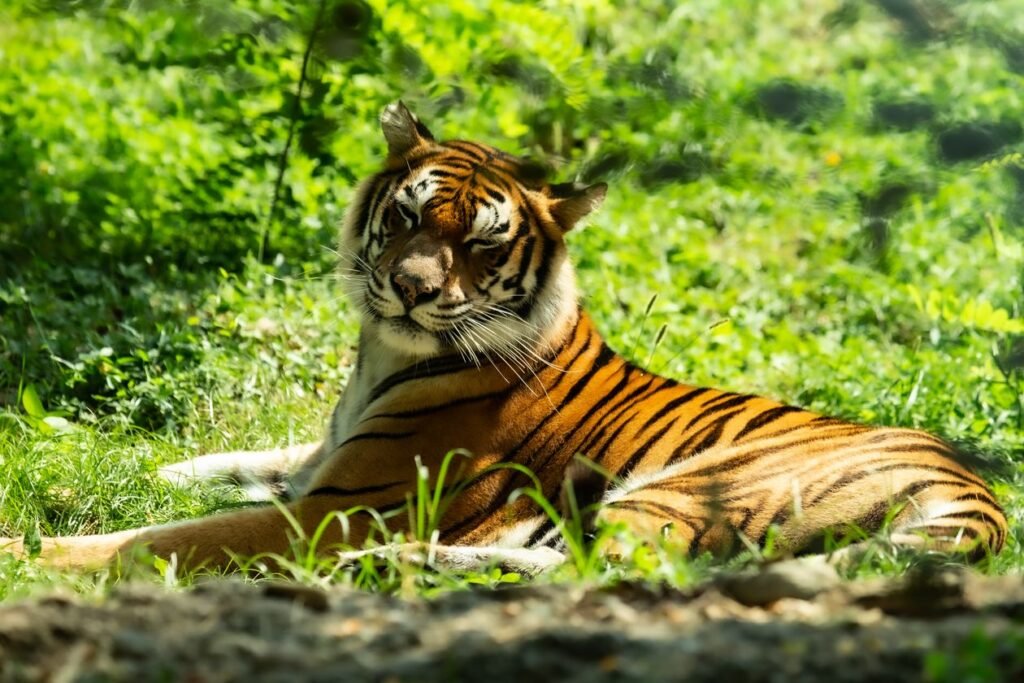
Few umbrella species examples are as powerful as the tiger. Tigers need vast, intact forests with healthy prey populations of deer and wild boar; protect a landscape large enough for breeding tigers and you automatically protect the watershed and every other creature in that forest. In the Russian Far East, Amur tigers are treated as both umbrella and keystone species for exactly this reason.
South Asia offers the most dramatic demonstration of the tiger umbrella at work. India's 2022 All India Tiger Estimation put the average at 3,682 tigers, up from 2,967 in 2018, an annual growth rate of about 6.1 percent. India now holds roughly 70 to 75 percent of the world's wild tigers, and more than three-quarters of them live inside protected areas. Project Tiger, the program behind this recovery, completed 50 years in 2023.
Those tiger reserves are umbrellas in the truest sense. Drawn around tiger habitat, they shelter elephants, rhinos, hornbills, and thousands of lesser-known species. When a tiger reserve stops logging, poaching, and encroachment, the whole forest breathes easier. For South Asia, the lesson is direct: protecting the tiger has always meant protecting the forest.
The Giant Panda's Bamboo Umbrella
The giant panda may be the most famous umbrella species on Earth, and also the most debated. Pandas live in temperate mountain forests in the Chinese provinces of Sichuan, Shaanxi, and Gansu, eating 26 to 84 pounds of bamboo a day. According to WWF, whose logo has been a panda since 1961, the biological diversity of panda habitat is unparalleled in the temperate world and rivals that of tropical ecosystems.
China's panda reserve network, now 67 reserves protecting nearly two-thirds of wild pandas, places an umbrella over one of the planet's richest temperate ecosystems, sheltering the red panda, golden monkey, takin, crested ibis, pheasants, salamanders, and endemic plants. Research from Duke University found that 96 percent of giant panda habitat overlaps with the ranges of other species found only in China. Protecting pandas, in other words, protects a remarkable slice of China's unique wildlife.
From roughly 1,200 animals in the 1980s, the wild population has grown to about 1,864, and in 2016 the IUCN Red List moved the species from Endangered to Vulnerable. Critics note, however, that the panda is an expensive umbrella: panda-focused spending does not always deliver the broadest biodiversity coverage per dollar. Charisma and efficiency do not always point in the same direction.
Jaguars, Grizzly Bears, and the Northern Spotted Owl
The Americas contribute some of the clearest umbrella species examples. In Central America, research by Figel and colleagues (2018) showed that conserving jaguars shelters threatened endemic amphibians and reptiles. Reserves designed for the wide-ranging big cat end up protecting frog and lizard species few people have heard of: one predator, dozens of quiet beneficiaries.
Grizzly bears play a similar role in North America; planners in British Columbia have long treated them as umbrellas, since a landscape big enough for bears is big enough for most regional wildlife. But the grizzly case also shows the concept's limits: a study of a plan to use grizzlies as umbrellas in Idaho found birds, mammals, and amphibians would benefit, while most reptiles would not.
The northern spotted owl is the classic American example. In the 1990s, protecting its old-growth habitat in the Pacific Northwest became a defining US conservation battle. Research by Dunk, Zielinski, and Welsh (2006) found that owl reserves in Northern California's Klamath-Siskiyou forests also protected mollusks and salamanders, serving as a reasonable coarse-filter umbrella for the groups studied.
Smaller umbrellas deserve mention too. The bay checkerspot butterfly, listed under the US Endangered Species Act since 1987, was studied as a potential umbrella for California's vanishing native grasslands. And in Florida's longleaf pine forests, researchers found that the gopher tortoise provided a broader umbrella for threatened species than the better-known red-cockaded woodpecker. The most obvious candidate is not always the best umbrella.
Snow Leopards: An Umbrella for High Asia
For readers in Pakistan and South Asia, the most relevant umbrella species may be the snow leopard. A 2025 paper in the journal Integrative Conservation describes the snow leopard as a vulnerable flagship and umbrella species for the alpine ecosystems and biodiversity of High Asia and the Tibetan Plateau. These cats patrol enormous high-altitude home ranges across Central and South Asia, including Pakistan's Karakoram and Hindu Kush ranges, where they have been photographed in places like Khunjerab National Park.
Protecting snow leopard habitat means protecting alpine meadows, watersheds, and prey populations across some of Earth's harshest landscapes. Conservation scientist Eric Wikramanayake has described the cat as an umbrella for high Himalayan biodiversity and an indicator of coming ecological change. With Himalayan temperatures projected to rise sharply in the coming decades, pushing alpine habitat upslope and fragmenting it, the umbrella function of large, connected snow leopard landscapes matters even more. When regional countries cooperate on snow leopard conservation, they are effectively cooperating on the future of the entire high-mountain ecosystem.
How Conservation Planners Use Umbrella Species
The umbrella species concept is not just a curiosity for textbooks. It is a working tool in conservation planning, used in several concrete ways.
First, umbrella species help planners decide where to put protected areas. If a region must support a viable population of tigers, pandas, or spotted owls, the reserve has to include the right mix of habitat types, water sources, and prey. Mapping one demanding species is far cheaper and faster than surveying every insect and plant in a candidate landscape.
Second, they help set reserve size. Wilcox's original 1984 formulation was explicitly about minimum area requirements: calculate how much land the umbrella species needs, and the reserve will be large enough for most of the community.
Third, umbrella species shape wildlife corridors. Planners choose focal species partly for their umbrella effect, then use geographic information systems to map their movement needs and design corridor networks between fragmented habitats. A corridor wide enough for a tiger or a grizzly is wide enough for almost everything smaller.
Umbrella Species vs Keystone Species vs Flagship Species
Few topics confuse students and nature lovers more than the difference between umbrella, keystone, and flagship species. The terms sound similar and the same animal can wear more than one label, but each describes a different role.
| Umbrella species | Keystone species | Flagship species | |
|---|---|---|---|
| What it means | Protecting it protects many other species sharing its habitat | Its impact on the ecosystem is disproportionately large relative to its abundance | A charismatic ambassador chosen to rally public support and funding |
| How it helps | Through shared space: its large habitat needs enclose whole communities | Through ecological function: predation, engineering, or competition that structures the community | Through attention: it attracts donations, media coverage, and political will |
| Classic example | Northern spotted owl sheltering old-growth forest communities | Sea otter controlling sea urchins to protect kelp forests | Giant panda as the global face of conservation and the WWF logo |
| Key limitation | Coverage can be patchy; some co-occurring species fall outside the umbrella | Removing it can collapse the system, so the stakes of failure are high | Popularity does not guarantee ecological coverage; funds may skew toward the cute |
The keystone concept, introduced by ecologist Robert T. Paine in 1969, is about ecological leverage: remove a keystone species and the community changes dramatically. The flagship concept is about human psychology: people donate to save pandas and tigers, and that money protects habitats. The umbrella concept sits between the two, linking a species' spatial needs to landscape-scale protection.
One species can be all three. The giant panda is a flagship, an umbrella, and arguably a keystone of its bamboo forests. But the labels do not automatically travel together: Florida's red-cockaded woodpecker is both a flagship and a keystone of longleaf pine, yet the less glamorous gopher tortoise proved the better umbrella. Charisma plus ecological influence does not always equal the broadest coverage.
When the Umbrella Fails: Limits of the Concept
For all its appeal, the umbrella species concept has drawn serious scientific criticism, and an honest account of umbrella species examples must include the failures. The core warning is simple: assuming that one species' protection covers everything else is a hypothesis to be tested, not a fact to be trusted.
The greater sage grouse of the American West is the cautionary tale. Promoted as an umbrella for some 350 background species, it had fallen from millions across 16 states and three Canadian provinces a century ago to fewer than 400,000. But when researcher Jason Carlisle and colleagues mapped the proposed umbrella in Wyoming, they found it would have protected only 82 percent of the state's sage grouse, and for 52 background species of conservation concern, coverage ranged from zero to 63 percent of their habitat.
Worse, management for the umbrella species can harm the species beneath it. When sagebrush was mowed to improve sage grouse habitat, the mowed patches completely lost nesting habitat for Brewer's sparrow and sage thrasher, and sage thrasher abundance was halved. Sagebrush can take decades to recover. What was meant to help the umbrella hurt its supposed beneficiaries.
Other studies tell similar stories. In coastal California, the California gnatcatcher proved a poor umbrella for three insect species sharing its habitat. In Idaho, the grizzly bear umbrella covered birds, mammals, and amphibians but left most reptiles out. And a University of Queensland analysis found that better-chosen umbrellas could benefit almost half of Australia's endangered terrestrial species, versus 6 percent under current selections, with the same funding.
The takeaway is not to abandon the concept but to use it honestly. As conservation biologist Tim Caro of UC Davis has argued, umbrellas have often worked as a shortcut because the reserves created for them were simply large. Treat the umbrella as a starting hypothesis, verify which background species it covers, and combine it with other approaches. An umbrella is a tool, not a guarantee.
Frequently Asked Questions
What is an umbrella species in simple terms?
An umbrella species is an animal or plant whose protection automatically helps protect many other species. Because it needs a large, healthy habitat, setting aside land for it shelters everything else living in that habitat, like an umbrella sheltering everyone standing under it.
What are some well-known umbrella species examples?
Tigers, giant pandas, jaguars, grizzly bears, and the northern spotted owl are classic examples. Others include the bay checkerspot butterfly, the gopher tortoise, the greater sage grouse, and, in the high mountains of Asia, the snow leopard.
What is the difference between an umbrella species and a keystone species?
An umbrella species protects others through shared space: its large habitat requirements mean reserves drawn for it cover whole communities. A keystone species protects the ecosystem through its ecological role: its impact is disproportionately large for its numbers, like sea otters controlling sea urchins to save kelp forests. Some species, like tigers, are both.
Are umbrella species always large animals?
Usually, but not always. Most are large, wide-ranging mammals or birds, because big home ranges make big umbrellas. But the bay checkerspot butterfly has been studied as an umbrella for California grasslands, and European researchers found that 168 beetle species living on decaying wood could umbrella relict stands of primeval forest. What matters is how much habitat the plan must protect, not the size of the animal.
Does protecting an umbrella species always protect everything else?
No. Studies of the greater sage grouse, the California gnatcatcher, and grizzly bears in Idaho all found gaps: some background species fell outside the umbrella's coverage, and habitat management for the umbrella sometimes harmed other species. Scientists recommend treating the umbrella as a hypothesis, checking which species it really covers, and combining it with other strategies.
Is there an umbrella species example relevant to Pakistan and South Asia?
Yes. The snow leopard is recognized as an umbrella species for the alpine ecosystems of High Asia, including Pakistan's Karakoram and Hindu Kush mountains. Conserving its vast high-altitude range protects watersheds, prey species like ibex, and the whole alpine community. The Bengal tiger plays the same role for South Asian forests, with India's tiger reserves sheltering elephants, rhinos, and thousands of other species.
Conclusion: Why Umbrella Species Still Matter
The umbrella species concept survives its criticisms because it answers a real problem: conservation will always have less money, less land, and less time than the biodiversity crisis demands. When chosen carefully and checked against the needs of the species underneath, umbrellas like the tiger, the panda, the jaguar, and the snow leopard focus limited resources where they shelter the most life. Open the umbrella with eyes open, verify its coverage, and the species holding the handle can genuinely protect the crowd beneath it.