Endangered Species Examples: 15 Animals on the Brink
The tiger stalking through an Indian forest, the blue whale surfacing in the open Pacific, the mountain gorilla cradling its infant in the mist of the Virungas: these are some of the most famous animals on Earth, and every one of them is officially at risk of disappearing. They appear on the IUCN Red List of Threatened Species, the global standard for measuring extinction risk, alongside tens of thousands of lesser-known creatures.
The scale is sobering. At the 2025 update announced at the IUCN World Conservation Congress, the Red List covered 172,620 assessed species, of which 48,646 were classified as threatened with extinction. That is more than one in four assessed species. This article explains what "endangered" actually means, profiles 15 endangered species examples across mammals, birds, ocean life, and plants, looks at the picture in Pakistan and South Asia, and examines why so many species are in trouble.
What Does "Endangered" Actually Mean?
In everyday speech, "endangered" means any species at risk of dying out. Scientists use it more precisely. Under the IUCN system, Endangered (EN) is a specific category: a species facing a very high risk of extinction in the wild in the near future, assessed against quantitative criteria such as population size, rate of decline, and geographic range.
It sits in a ladder of risk. Above it (worse) is Critically Endangered (CR): extremely high risk in the immediate future. Below it (less bad) is Vulnerable (VU): high risk in the medium term. Together, CR, EN, and VU make up the "threatened" species. Many articles, including this one, use "endangered species" loosely to cover the whole threatened group, but where a species' official category matters, accuracy matters more than shorthand, and the profiles below give each animal's real status.
The IUCN Red List Categories at a Glance
| Category | Meaning | Example |
|---|---|---|
| Extinct (EX) | No doubt the last individual has died | Dodo, passenger pigeon |
| Extinct in the Wild (EW) | Survives only in captivity or cultivation | Hawaiian crow, Père David's deer |
| Critically Endangered (CR) | Extremely high risk of extinction | Vaquita, Javan rhino |
| Endangered (EN) | Very high risk of extinction | Blue whale, Asian elephant |
| Vulnerable (VU) | High risk of extinction | Snow leopard, polar bear |
| Near Threatened (NT) | Likely to qualify as threatened soon | Markhor |
| Least Concern (LC) | Widespread and abundant | Green turtle (since 2025) |
| Data Deficient (DD) | Not enough information to assess | Many deep-sea species |
Endangered Mammals: Six Profiles
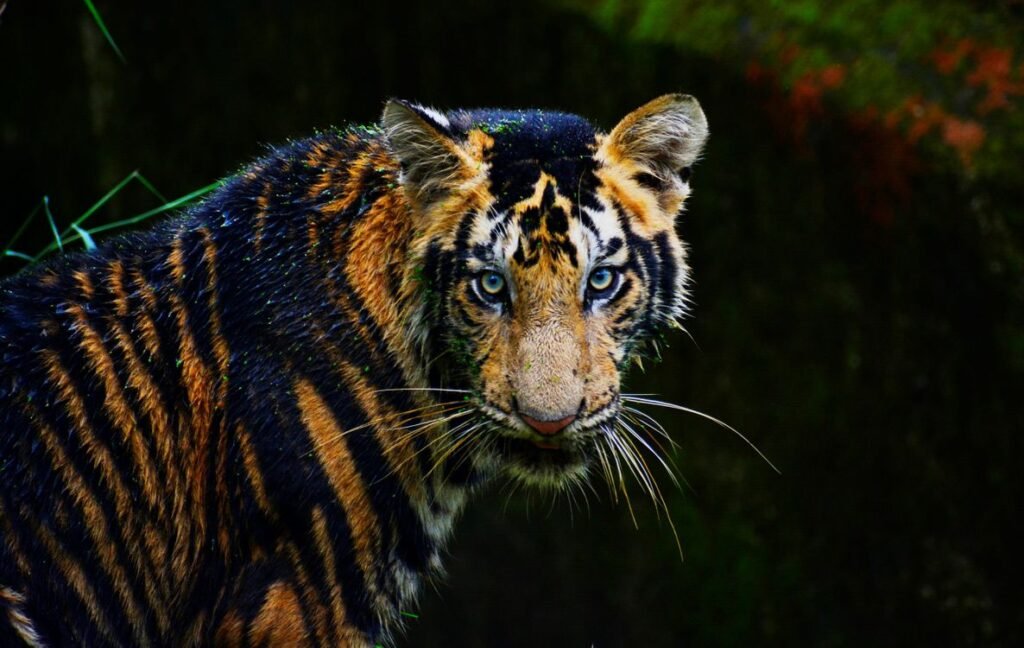
Tiger (Panthera tigris), Endangered. Perhaps the definitive endangered species example, the tiger has lost the vast majority of its historic range to habitat destruction and poaching for skins and body parts. The latest IUCN assessment puts the wild population at roughly 5,500, up from earlier estimates near 3,200, thanks largely to intensive protection in India, Nepal, and Russia. It is progress, but a species confined to scattered forest fragments remains one bad decade from crisis.
Asian elephant (Elephas maximus), Endangered. Fewer than 50,000 Asian elephants survive across 13 countries, and their habitat is being carved into ever-smaller patches by plantations, roads, and settlements. Fragmentation forces elephants into farmland, sparking human-elephant conflict that kills both people and elephants each year.
Blue whale (Balaenoptera musculus), Endangered. The largest animal ever to have lived was hunted to the edge of oblivion by industrial whaling, which killed hundreds of thousands in the 20th century. Perhaps 10,000 to 25,000 remain. Whaling has largely stopped, but ship strikes, ocean noise, entanglement in fishing gear, and shifting krill distributions now set the terms of recovery.
Mountain gorilla (Gorilla beringei beringei), Endangered. Confined to the volcanic Virunga mountains and Uganda's Bwindi forest, the mountain gorilla famously numbered in the low hundreds in the 1980s. Relentless protection, veterinary care, and tourism-funded ranger patrols have pushed the population past 1,000, earning a downlisting from Critically Endangered to Endangered in 2018. It remains one of conservation's greatest comebacks and one of its most fragile.
Orangutans, Critically Endangered. All three orangutan species, the Bornean, Sumatran, and Tapanuli, are Critically Endangered, driven by deforestation for palm oil and logging, plus poaching and the pet trade. The Tapanuli orangutan, recognized as a separate species only in 2017, numbers fewer than 800 in a single Sumatran forest block.
Snow leopard (Panthera uncia), Vulnerable. A note on accuracy: the ghost cat of the Himalaya is officially Vulnerable, not Endangered, since a 2017 reassessment. With an estimated 4,000 to 7,000 left across 12 countries, it belongs in any honest list of threatened species examples, but its real category is a useful reminder to check the Red List rather than trust loose labels.
Birds on the Brink
Birds are sending an alarming signal. The 2025 IUCN update reported that 61 percent of the world's bird species have declining populations, up from 44 percent in 2016, with habitat loss from agriculture and logging the most widespread driver.
The whooping crane (Grus americana), North America's tallest bird, is Endangered after crashing to barely 20 individuals in the 1940s. Captive breeding and reintroduction have rebuilt the wild flock to more than 500, but a single disease outbreak or hurricane on its Texas wintering grounds could still undo decades of work.
The Philippine eagle (Pithecophaga jefferyi), one of the world's largest forest raptors, is Critically Endangered with perhaps 400 pairs left, as logging shreds the old-growth Philippine forests it needs for nesting. Each pair requires a large territory, so forest fragmentation hits this species especially hard.
Ocean Life in Trouble
The vaquita (Phocoena sinus), a small porpoise found only in Mexico's upper Gulf of California, is the world's most endangered marine mammal, with around ten individuals remaining. It drowns in gillnets set illegally for the totoaba fish, whose swim bladders fetch enormous prices. Despite a zero-tolerance enforcement zone, the vaquita's decline has barely slowed, making it the starkest example of how wildlife trade can erase a species in real time.
The hawksbill sea turtle (Eretmochelys imbricata) is Critically Endangered, hunted for centuries for its beautiful shell, which becomes tortoiseshell jewelry. Trade bans have helped, but poaching and nest disturbance continue.
There is also good news from the sea. In the 2025 Red List update, the green turtle (Chelonia mydas) was downlisted from Endangered to Least Concern after an estimated 28 percent global population increase since the 1970s, driven by beach protection, community action, and turtle excluder devices in fisheries. It is living proof that sustained conservation moves the needle.
Reptiles, Amphibians, and Freshwater Life
The gharial (Gavialis gangeticus), South Asia's fish-eating crocodilian with its unmistakable long, narrow snout, is Critically Endangered. Once basking on sandbanks the length of the Ganges, Brahmaputra, and Indus systems, it now survives in scattered river stretches, with only a few hundred breeding adults left. Sand mining destroys its nesting banks, fishing nets drown it, and dams fragment its rivers. Captive rearing programs in India and Nepal release thousands of juveniles, but survival after release remains the hard part.
The axolotl (Ambystoma mexicanum) may be the most beloved endangered animal on this list. This permanently aquatic salamander, famous for regenerating lost limbs and for its perpetual "smile," lives only in the canal remnants of Lake Xochimilco near Mexico City. Urbanization, pollution, and introduced predatory fish have reduced the wild population to possibly fewer than a thousand individuals. Paradoxically, millions live in laboratories and aquariums worldwide, making the axolotl secure in captivity while vanishing at home.
The Chinese giant salamander (Andrias davidianus), the world's largest amphibian at up to 1.8 meters, is Critically Endangered after decades of overharvesting for luxury food and traditional medicine, compounded by habitat destruction. Farm breeding exists, but it has also spread disease and muddied the genetic picture. Recent research suggests "the" Chinese giant salamander may actually be several distinct species, some of which could already be extinct before being properly described, a grim reminder of how much biodiversity we are losing unseen.
Freshwater species as a group are among the most threatened on the planet, yet they receive a fraction of the attention mammals get. Rivers are dammed, drained, and polluted faster than almost any other habitat, and their inhabitants cannot simply move.
Endangered Plants Too
Endangered species examples are not all charismatic animals. The dawn redwood (Metasequoia glyptostroboides) was known only from fossils and presumed extinct for millions of years until living trees were discovered in a remote Chinese valley in the 1940s. Fewer than 6,000 wild trees remain, and it is listed as Endangered. Cycads, the ancient palm-like plants that fed dinosaurs, include some of the most threatened plant groups on Earth, with many species down to a few dozen wild individuals because of collecting and habitat loss.
Endangered Species in Pakistan and South Asia
South Asia holds a share of the planet's most threatened wildlife. Pakistan's own list is headlined by the Indus river dolphin (Platanista minor), Endangered, with roughly 2,000 left in a fragmented stretch of the Indus. The snow leopard roams the Karakoram and Himalaya of Gilgit-Baltistan. The markhor, Pakistan's national animal, was downlisted from Endangered to Near Threatened in 2015 after community-led conservation brought populations back, a regional success story. Offshore, Pakistan's coast hosts nesting green turtles, now Least Concern globally but still dependent on protected beaches at Hawkesbay and Sandspit, where Sindh Wildlife Department teams guard nests each season.
Pakistan's conservation story blends state protection with community stewardship. The country maintains a network of national parks, from Deosai's high plateau to Hingol's rugged coast, alongside wildlife sanctuaries and game reserves. In the mountains of Gilgit-Baltistan and Khyber Pakhtunkhwa, community-managed conservancies have pioneered a model where tightly regulated, high-fee trophy hunting of a few old markhor males funds anti-poaching patrols and village development, giving local people a direct economic stake in the herds' survival. It was this model that helped lift the markhor from Endangered to Near Threatened. Along the Indus, the dolphin rescue network run with WWF-Pakistan has pulled around 200 trapped dolphins from canals since the 1990s. The lesson from Pakistan mirrors the global one: species recover where people, science, and incentives align. The gharial, the fish-eating crocodilian of South Asian rivers, is Critically Endangered, and the Bengal tiger's stronghold in neighboring India makes the region central to the species' future.
Why Species Become Endangered
The drivers repeat across continents and taxa. The 2025 Red List assessments keep returning to the same handful of causes, and understanding them matters because each one points to a different kind of solution.
Habitat loss remains the dominant driver worldwide. The 2025 bird reassessment, nine years of work by thousands of experts, identified agricultural expansion and logging as the most prevalent threat to birds, and the pattern holds across groups: forests cleared, wetlands drained, grasslands plowed, rivers dammed. A species can survive poaching pressure or a bad decade of weather, but it cannot survive having nowhere to live.
What makes the current crisis especially dangerous is that threats compound each other. Climate change shrinks and shifts habitats while poaching removes the individuals most capable of adapting; pollution weakens immune systems while invasive predators pick off the survivors. The vaquita is not declining because of one problem but because illegal fishing, weak enforcement, and market demand for totoaba bladders reinforce each other. Conservation works best when it untangles these knots together rather than pulling a single thread.
| Threat | How it drives extinction | Example |
|---|---|---|
| Habitat loss and fragmentation | Shrinks populations below viable size | Orangutans and palm oil expansion |
| Poaching and wildlife trade | Removes individuals faster than breeding replaces them | Vaquita in totoaba gillnets |
| Climate change | Shifts or destroys the conditions species need | Hooded seal losing sea ice breeding platforms |
| Pollution | Poisons water, land, and food webs | Seabirds and plastic; river dolphins and effluent |
| Invasive species and disease | Outcompetes natives or spreads pathogens | Island birds vs. rats and cats |
Frequently Asked Questions
How many species are endangered right now?
At the 2025 IUCN Red List update, 48,646 of 172,620 assessed species were classified as threatened with extinction (Critically Endangered, Endangered, or Vulnerable). Because only a fraction of Earth's estimated species have been assessed, the true number is certainly higher.
What is the most endangered animal in the world?
There is no single answer, but the vaquita porpoise is often cited as the most endangered marine mammal, with around ten individuals left. Among land animals, species like the Javan rhino (around 70 left) and the Amur leopard are among the closest to the edge.
What is the difference between endangered and threatened?
"Threatened" is the umbrella term covering Vulnerable, Endangered, and Critically Endangered. "Endangered" is the middle category of the three, meaning a very high extinction risk. In casual use the words are often swapped, but the IUCN definitions are precise.
Can endangered species recover?
Yes. The green turtle's 2025 downlisting to Least Concern, the mountain gorilla's climb past 1,000 individuals, the markhor's recovery in Pakistan, and the whooping crane's return from 20 birds all show that protection, habitat work, and community involvement can reverse declines.
Why should we care about endangered species?
Beyond ethics, species underpin ecosystems that humans depend on: pollination, fisheries, clean water, and climate regulation. Each extinction also erases unique genetic information and weakens the resilience of the living systems we rely on.
Where can I check a species' status myself?
The IUCN Red List at iucnredlist.org is the authoritative source, with assessments, population trends, and threat details for each listed species. National red lists and wildlife department websites often carry the same assessments with local context.
Are insects and small animals endangered too?
Absolutely, and they may be in worse shape than the famous mammals. Freshwater mussels, island snails, and countless insects face severe threats, but most have never been assessed because the Red List has covered only a small fraction of Earth's species. The extinction crisis extends far beyond the animals that make posters.
Conclusion
The 15 endangered species examples in this article span whales and wasps' partners, cranes and cycads, yet their stories rhyme: habitat shrinking, trade pressuring, climate shifting, and small populations left holding on against lengthening odds. The 2025 Red List numbers, 48,646 threatened species and counting, are daunting. But the same update carried proof that the trajectory can bend. Green turtles nesting in greater numbers, mountain gorillas climbing past a thousand, markhors returning to Pakistan's cliffs: none of these happened by accident. They happened because people decided these species were worth the trouble. The list of the endangered is long, but it does not have to be a list of the doomed. Every recovery began with someone paying attention, and attention is the one resource conservation never runs out of. The next success story is already waiting for its champions.