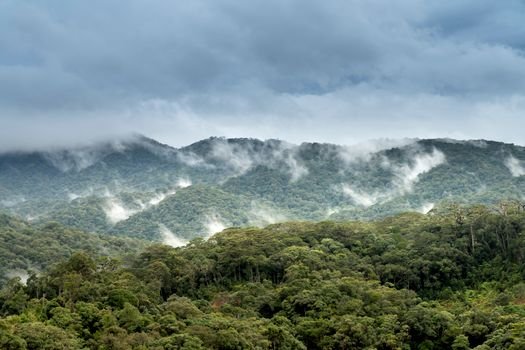
Cloud Forest Facts: Secrets of the Misty Mountains
High in the tropical mountains, where the air turns cool and damp, forests disappear into a veil of mist for much of the year. These are cloud forests, among the rarest and most biologically crowded habitats on Earth. They cover a fraction of the planet's land, yet they hold an outsized share of its species, shape the water supply of millions of people, and harbor creatures found nowhere else. Here is a complete guide to what cloud forests are, how they form, what lives in them, and why they are in trouble.
What Is a Cloud Forest?
A cloud forest, also called a fog forest, water forest, or tropical montane cloud forest, is a generally tropical or subtropical evergreen forest defined by one striking feature: persistent, frequent, or seasonal low-level cloud cover that sits right at the level of the tree canopy. Where an ordinary forest gets its water mostly as rain falling from above, a cloud forest is regularly bathed in mist that condenses directly onto leaves, branches, and moss.
The humidity is the point. Because the forest lives inside clouds, nearly every surface stays damp. Trunks and branches grow thick coats of mosses, liverworts, lichens, ferns, and orchids, giving many cloud forests their alternate name: mossy forests. In the most exposed, wind-blasted spots, trees grow stunted and gnarled into what botanists call elfin woodland, a miniature, twisted version of forest that looks like something from a fairy tale.
Cloud forests typically occur at altitudes between about 1,000 and 2,500 metres above sea level, though the full recorded range stretches from roughly 500 to 4,000 metres depending on latitude, distance from the sea, and local climate. An analysis of 477 tropical montane cloud forest sites around the world found that about 85 percent sit between 400 and 2,800 metres, with an average altitude of around 1,700 metres, average rainfall near 2,000 millimetres a year, and an average temperature of about 17.7 degrees Celsius. Cooler, wetter, and less sunny than the lowland rainforests below them, cloud forests are essentially rainforests reimagined for the mountains.
How a Cloud Forest Forms: The Science of Mountain Mist
Cloud forests owe their existence to a meeting of ocean, wind, and mountain slope. Warm, moist air travels inland from the sea. When it meets high mountain slopes, the terrain forces it upward in a process called orographic lift. As the air rises it cools, and once it cools past a threshold, the water vapor it carries condenses into the low, drifting clouds that cling to the slopes. This is why the cloud band settles at a fairly specific elevation: it is the height where rising air first becomes cool enough for condensation.
Once the clouds arrive, a second process keeps the forest soaked. The vegetation itself acts like a giant net. Millions of leaves, moss mats, and fern fronds intercept the drifting cloud, and water collects on them in countless tiny droplets. These droplets grow, merge, and eventually drip to the forest floor in a steady rain from the canopy known as fog drip. In the Q'eqchi' Maya language there is a saying, "the forest catches the clouds," which describes this water harvesting almost exactly as scientists do today.
Fog drip can add a large amount of water beyond ordinary rainfall. On mountain saddles, where clouds linger longest and the wind cannot easily strip the moisture away, this extra input makes conditions wet enough to sustain the mossy forests in their most luxuriant form. The result is an ecosystem that literally pulls water out of the sky, feeding streams and rivers that stay flowing even when the rains stop.
Where in the World Cloud Forests Grow
Cloud forests occur only where tropical or subtropical moisture meets mountains, so their global distribution is patchy. They are found in Central and South America, southern Mexico, parts of the Caribbean, Southeast Asia, eastern Africa, Madagascar, and New Guinea. A 2021 study led by Yale researchers found cloud forests in 60 countries, concentrated in tropical regions of Indonesia, South America, and Africa.
Some cloud forests are world famous, others are known mainly to researchers and local communities:
| Cloud forest | Location | Why it is notable |
|---|---|---|
| Monteverde | Costa Rica | The most visited cloud forest reserve in the world; founded 1972; over 500 orchid species |
| Bwindi Impenetrable Forest | Uganda | African montane cloud forest; protects about half of the world's mountain gorillas |
| Kinabalu | Malaysian Borneo | Rich in endemic tree ferns and pitcher plants |
| Maquipucuna and Mindo | Ecuador | Among the most biodiverse birding sites on Earth |
| Garajonay | Canary Islands, Spain | Ancient laurel cloud forest with mist-capture water dynamics studied for decades |
| Shola forests | Western Ghats, India | Southern India's cloud-forest equivalent: stunted evergreen forest patches in montane grasslands |
| Horton Plains | Sri Lanka | Misty montane cloud forest with high endemism |
The shola forests of India's Western Ghats deserve a note for South Asian readers. These high-altitude evergreen patches, growing between grasslands in the Nilgiri and Anamalai hills, function much like cloud forests: cool, damp, and full of species found nowhere else, including the Nilgiri tahr and endemic amphibians. Pakistan itself has no true tropical cloud forest, but its misty Himalayan temperate forests at places like Ayubia share something of the same atmosphere.
Cloud Forest vs Rainforest: What Is the Difference?
Cloud forests are often described as mountain rainforests, and the two ecosystems do share evergreen canopies and high rainfall. But they differ in several consistent ways:
| Feature | Cloud forest | Lowland rainforest |
|---|---|---|
| Altitude | Typically 1,000 to 2,500 m; up to 4,000 m | Mostly below 1,000 m |
| Temperature | Cool, averaging around 17.7°C across studied sites | Warm, typically 25 to 30°C |
| Water source | Rain plus heavy fog drip from cloud interception | Mostly direct rainfall |
| Trees | Short, gnarled, densely packed; canopy lower | Tall, layered; emergents up to 60 m |
| Light | Reduced sunlight under persistent cloud | Bright canopy gaps, dense shade below |
| Soils | Often acidic and nutrient poor | Variable, often poor but deeply weathered |
| Epiphytes | Exceptionally abundant: mosses, orchids, lichens blanket branches | Present but less dominant |
| Rivers | Shallow, fast flowing, rocky beds | Often large, slow flowing, with silt beds |
The cooler temperatures and lower light mean cloud forest trees grow slowly and stay short, yet the canopy is packed tighter than in lowland forest. Everything that can hold water does: moss mats can be many centimetres thick and act like sponges, and one study of Monteverde found that epiphytes make up nearly 29 percent of the reserve's flora, with 878 recorded species growing on trees rather than in the soil.
Animals and Plants of the Cloud Forest
Because cloud forests are cool, stable, and isolated on separate mountain ranges, they have become factories of endemism. Species evolve in one range of mountains and never leave it. The Yale-led 2021 study estimated that cloud forests, covering less than half of one percent of Earth's land mass, hold about 15 percent of the world's known species. Around 2,000 species of mammals, amphibians, birds, and tree ferns live exclusively in them.
Some of the most famous cloud forest residents include:
The resplendent quetzal. The icon of Central American cloud forests, this trogon flashes iridescent green plumage with a crimson breast, and males trail tail plumes that can approach a metre long. It feeds mainly on wild avocados and other laurel-family fruits, making it an important seed disperser. The International Union for Conservation of Nature lists it as Near Threatened, with an estimated 20,000 to 50,000 mature individuals remaining. It is the national bird of Guatemala and was sacred to the Maya and Aztec civilizations.
The mountain gorilla. The Bwindi Impenetrable Forest in southwestern Uganda is a cloud forest that shelters about half of the world's remaining mountain gorillas. The apes grow thicker fur than their lowland relatives to cope with the cool, damp air. After decades of decline driven by habitat destruction and civil conflict, their numbers have been slowly rising.
The golden toad. Monteverde was the only known home of this brilliant orange amphibian, which emerged from burrows to breed in temporary pools during the wet season. It was last seen in 1989 and is now considered extinct, an early warning of how climate shifts can erase a cloud forest specialist.
Orchids and bromeliads. Cloud forests are orchid heaven. Monteverde alone hosts more than 500 orchid species, many of them miniatures that bloom high in the canopy, which is why some call it the most orchid-diverse place on Earth. Bromeliads collect water in their leaf cups, creating tiny suspended ponds that shelter frogs, insects, and even crabs.
Pitcher plants and tree ferns. On Mount Kinabalu in Borneo, cloud forests shelter carnivorous pitcher plants such as Nepenthes hurrelliana, found only in the Sarawak highlands, alongside ancient tree ferns that have changed little in millions of years.
Spectacled bears, tapirs, and ocelots. In the Andes, cloud forests shelter the spectacled bear (the only bear of South America), mountain tapirs, and elusive cats that move through the mist at dawn and dusk.
Amphibians deserve special mention: many cloud forest frogs and salamanders never touch standing water, breeding instead in the permanent damp of moss and leaf litter. This makes them extraordinarily sensitive to any drying of the forest.
Why Cloud Forests Matter: Water, Climate, and Biodiversity
Cloud forests punch far above their area in the services they provide.
Water. By stripping moisture from clouds, cloud forests feed the headwaters of rivers that millions of people depend on. On the island of St Helena in the South Atlantic, about 60 percent of the island's fresh water is obtained through mist capture in its cloud forest, making the forest literally the island's waterworks. Across the tropics, cloud forest watersheds supply drinking water, irrigation, and hydropower; researchers have noted that in the 25 countries holding most of the world's cloud forests, a large share of hydropower dams depend on cloud forest water.
Biodiversity. Holding an estimated 15 percent of known species on less than 0.5 percent of the land makes cloud forests, in the words of Yale ecologist Walter Jetz, "the terrestrial version of coral reefs," with Earth's greatest concentration of species diversity on land packed into a small and shrinking area.
Climate. The dense, slow-growing vegetation stores carbon, while the constant dampness and shade moderate local climates. Cloud forests also act as living laboratories: because their species tolerate only a narrow band of temperature and moisture, scientists watch them closely for early signals of how ecosystems respond to warming.
Culture. Cloud forests are home to many Indigenous communities, including the Q'eqchi' Maya of Guatemala's highlands, whose relationship with the misty forests stretches back centuries. The forests also sustain ecotourism economies, from Monteverde's hanging bridges to guided night walks in search of quetzals.
Threats Facing Cloud Forests
Cloud forests are among the most threatened ecosystems on the planet, squeezed by two forces at once.
Deforestation. Logging, farming, and settlement eat away at the lower slopes of cloud forests. The Yale-led satellite study found that about 2.4 percent of the world's cloud forests were lost between 2001 and 2018 alone, with some regions losing as much as 8 percent, and the losses concentrated in the most accessible areas. Britannica reports that only about 1 percent of global woodlands were cloud forests in 2022, compared with 11 percent in the 1970s, a decline attributed to warming, deforestation, and other human pressures.
Climate change. This is the deeper threat. As temperatures rise, the cloud base lifts to higher elevations, and the band of mountains wrapped in mist shrinks. A NASA-supported study of Neotropical cloud forests found that declining cloud immersion would dominate across the Western Hemisphere, with cloud cover increasing for only about 1 percent of cloud forest areas. Species adapted to cool, constant dampness cannot simply move downhill into warmer forest, and on many peaks there is no higher ground left to climb. Researchers warn that cloud forests could be "squeezed out of existence" if warming continues.
Fragmentation. Even protected cloud forests suffer when surrounding forest is cleared. Smaller, isolated patches dry out at their edges, lose species, and become harder for animals like quetzals and large mammals to move through. The Yale study found that protected areas alone were failing to stop the erosion of the ecosystem, with encroachment continuing inside reserves.
Disease and drying. Amphibians in cloud forests have already suffered catastrophic declines from the chytrid fungus, and the disappearance of Monteverde's golden toad in 1989 remains a symbol of how quickly a specialist can vanish when conditions shift.
Can Cloud Forests Be Saved?
The outlook is serious but not hopeless, and conservationists are working on several fronts.
Protected areas remain the foundation. Monteverde, created in 1972 through the efforts of Quaker settlers, Costa Rican scientists, and the Tropical Science Center, grew from a small reserve into a landscape of connected protected zones and biological corridors, showing how community action can scale up. Similar community-led efforts, such as Guatemala's Community Cloud Forest Conservation, work with local people rather than around them.
Restoration is gaining ground. On St Helena, the Royal Society for the Protection of Birds and the St Helena National Trust are running a long-term project to restore the island's cloud forest and its mist-capture function together, after the island lost 584 of its 600 hectares of cloud forest cover.
Corridors matter enormously. Because cloud forest species often live on isolated peaks, linking forest fragments lets animals and plants shift their ranges as the climate changes. Conservationists increasingly target areas of low climate vulnerability for expanded protection, places where the models suggest clouds will linger longest.
Finally, there is the water argument. When cloud forests are framed as water infrastructure, as the forests that keep rivers flowing and dams generating, protecting them becomes an economic decision as well as an ecological one. Some researchers have proposed that hydropower revenue could help fund the protection of the cloud forests that feed the reservoirs. Whether or not that idea scales, it points to a simple truth: these misty forests are not just beautiful. They are load-bearing parts of the landscapes and lives around them.
Frequently Asked Questions
What is a cloud forest in simple terms?
A cloud forest is a mountain forest that spends much of its time inside low clouds. The persistent mist keeps everything damp, so trees grow thick coats of moss, ferns, orchids, and lichens. They are also called fog forests or mossy forests.
How does a cloud forest form?
Moist ocean air is pushed up mountain slopes, cools as it rises, and condenses into clouds at a certain altitude. The forest canopy then strips water directly from these clouds, a process called fog drip, which keeps the ecosystem wet even between rainstorms.
Where are cloud forests found?
In tropical and subtropical mountain regions: Central and South America, southern Mexico, the Caribbean, Southeast Asia, eastern Africa, Madagascar, and New Guinea. Famous examples include Monteverde in Costa Rica, Bwindi in Uganda, and Mount Kinabalu in Borneo.
What animals live in cloud forests?
Iconic residents include the resplendent quetzal, mountain gorilla, spectacled bear, mountain tapir, and hundreds of endemic frogs and birds. Cloud forests hold about 15 percent of the world's known species on less than 0.5 percent of Earth's land.
Are cloud forests endangered?
Yes. Roughly 2.4 percent of the world's cloud forests were lost between 2001 and 2018, and climate change is lifting cloud bases to higher elevations, shrinking the habitat. Britannica reports cloud forests fell from about 11 percent of global woodlands in the 1970s to about 1 percent in 2022.
What is the difference between a cloud forest and a rainforest?
Cloud forests grow at higher altitudes, are cooler, and get much of their water from fog drip rather than direct rain. Their trees are shorter and more gnarled, and they carry far heavier loads of mosses, orchids, and other epiphytes.