Mangrove Forest Importance: Nature’s Coastal Guardians
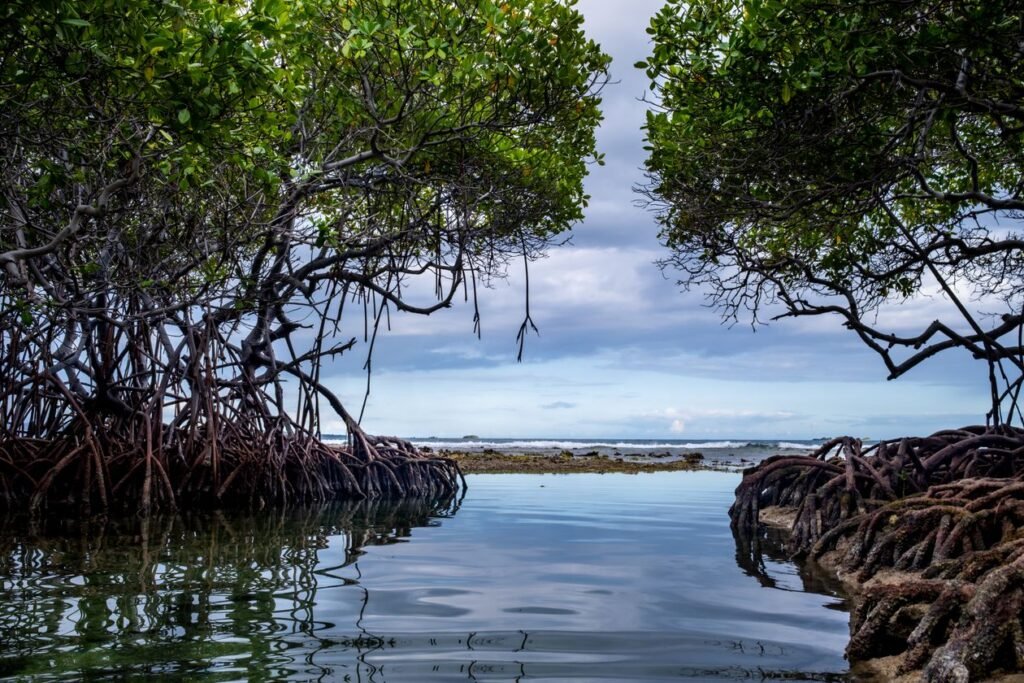
Stand at the edge of a mangrove forest at low tide and you will see something that looks like a forest learning to walk. Roots arch out of the mud like stilts, holding trunks above water that floods in twice a day. The air smells of salt and decay and life. Fish flicker between the roots. Crabs work the mud. A heron watches from a branch. It is a place caught between land and sea, and it is one of the most valuable ecosystems on the planet. Fishermen have known this for generations, reading the tides and the root lines the way farmers read soil. Scientists took longer to catch up, but the measurements now confirm what coastal communities always understood: where mangroves stand, coasts hold, fish return, and the land itself seems to breathe a little easier.
Mangrove forests cover only about 0.1 percent of Earth's surface, yet they punch far above their size. They shelter coastlines from storms, lock away carbon for centuries, raise the fish that feed millions, and harbor species found nowhere else. They have been called nature's coastal guardians, and the title is earned. Understanding mangrove forest importance means understanding five big roles these forests play, and what happens when we lose them.
What Are Mangrove Forests?
Mangroves are not a single species but a collection of around 73 known species of tropical and subtropical trees and shrubs, united by an extraordinary ability: they thrive where land meets sea, in salty, muddy, oxygen-poor ground that would kill almost any other tree. They grow in the intertidal zone along sheltered coastlines, tidal rivers, estuaries, and bays, where the tide floods and drains their roots each day.
Between them, mangrove forests account for about three quarters of the world's tropical coastline. The largest expanses grow in Southeast Asia, with Indonesia holding the greatest share, while the Sundarbans of Bangladesh and India form among the largest single blocks of mangrove forest on Earth. Mangroves also fringe coasts across Africa, Australia, and the Americas, wherever warm water and calm shores allow.
Each forest is a layered world. Above the waterline: trunks, canopy, and the leaves that feed an entire food web. At the waterline: the famous root systems, part anchor, part snorkel, part fortress. Below: mud rich with crabs, molluscs, worms, and microbes, the engine room of the ecosystem.
How Mangroves Survive Where Other Trees Cannot
Before appreciating what mangroves do for us, it helps to grasp what they survive. Seawater is roughly 35 parts salt per thousand, lethal to most plant tissue. Mangrove mud is waterlogged and nearly oxygen-free, so ordinary roots would suffocate. The tides batter, the sun bakes, and the ground shifts.
Mangroves answer with remarkable engineering. Many species send up pneumatophores, pencil-like breathing roots that poke out of the mud to draw in air when the tide is out. Others grow stilt-like prop roots that arch from the trunk into the mud, gripping the soft ground like a tripod. To handle salt, different species use different strategies: some filter most of it out at the roots, some store it in old bark and leaves that are then shed, and some excrete it through special glands on their leaves. Many mangrove species also germinate their seeds while the fruit is still attached to the parent tree, so the seedling drops into the mud already growing, ready to root before the tide carries it away.
These adaptations are not just curiosities. The roots that let mangroves survive are the same structures that slow waves, trap sediment, and shelter young fish. Survival and service are the same anatomy.
Importance 1: A Living Shield Against Storms and Tsunamis
Of all the reasons mangroves matter, coastal protection may be the most dramatic. The dense maze of roots, trunks, and canopy physically weakens moving water. According to the United Nations University, mangroves' roots, trunks, and canopy can reduce the force of oncoming waves by around 60 percent. The roots also trap and hold sediment, building the shoreline up over time and anchoring the soil against erosion.
The evidence is written in disaster records. After the 2004 Indian Ocean tsunami, ecologist Finn Danielsen and colleagues found that coastal areas with healthy mangrove cover suffered markedly less damage than exposed stretches. The trees reduced wave height and energy, shielding villages behind them. A separate study of 409 villages struck by a powerful cyclone in India in October 1999 found that villages fronted by wider mangrove belts recorded far fewer deaths than those with little or no mangrove cover.
This makes mangroves a prime example of green infrastructure. Seawalls and dykes are expensive to build and maintain; a healthy mangrove forest protects itself, grows back after damage, and protects people at the same time. Researchers have estimated that mangroves protect around 3.5 million people from storm surges, flooding, erosion, and sea-level rise. The catch is that the forest has to be there, wide enough and healthy enough, when the storm arrives.
Importance 2: Nurseries of the Sea
Beneath the tangle of roots lies one of the ocean's great nurseries. Young fish, shrimp, crabs, and shellfish shelter among the roots, hiding from predators in water too shallow and complex for big hunters to navigate. Many commercially important species spend their vulnerable early months in mangroves before moving out to reefs or open water as adults.
Scientists estimate that nearly 80 percent of the fish caught globally depend on mangroves at some stage of their lives. The fallen leaves feed detritus-based food webs: crabs shred the leaves, microbes break them down, and the resulting nutrients flow outward on the tide, enriching nearby waters. In this way, a mangrove forest feeds ecosystems far beyond its own edges, supporting fisheries that coastal communities depend on for food and income.
Remove the mangroves and the effect cascades. Fish catches fall. Shrimp fisheries that depend on mangrove nurseries collapse. The UN Environment Programme has valued mangrove-derived ecosystem services, including fisheries, timber, coastal protection, and nutrient cycling, at US$33,000 to US$57,000 per hectare per year, a figure that dwarfs the short-term profits of clearing the forest for development.
Importance 3: Blue Carbon Giants
Mangroves are among the most powerful natural climate tools we have. The carbon captured by coastal ecosystems like mangroves, seagrasses, and salt marshes is called blue carbon, and mangroves are its heavyweight champions.
Globally, mangrove forests store more than 6.23 gigatonnes of carbon, equivalent to about 22.86 gigatonnes of carbon dioxide. Per hectare, they can hold up to four times more carbon than other tropical rainforests, and some research suggests their sequestration rates run up to ten times those of many terrestrial forests. One global inventory found that mangroves pack away some 42 million tons of carbon every year.
The secret is in the mud. In most forests, dead leaves and wood decompose quickly, returning carbon to the air. In mangroves, dead roots, leaves, and branches fall into waterlogged, oxygen-poor sediment where decomposition slows to a crawl. Layer builds on layer, and the carbon stays buried for decades or even centuries. The forest keeps adding to the stockpile as long as it stands. Cut it down or drain it, and that long-buried carbon rushes back into the atmosphere; scientists estimate that mangrove loss and degradation cause greenhouse gas emissions doing billions of dollars of economic damage every year.
Importance 4: A Haven for Wildlife
Because mangroves sit between marine and terrestrial worlds, they host an unusual mix of both. The UN Environment Programme's report "Decades of Mangrove Forest Change" found that 1,533 species are associated with mangroves in some way, and 15 percent of them are threatened with extinction. Nearly half of the mangrove-associated mammals are threatened, along with 22 percent of the fishes, 16 percent of the plants, 13 percent of the amphibians, and 8 percent of the birds and reptiles. For 44 percent of these species, extinction risk is increasing.
The residents read like a field guide to the remarkable. Bengal tigers prowl the Sundarbans, the only mangrove forest on Earth with a resident tiger population. Fishing cats hunt in Asian mangrove waterways. The Ganges river dolphin navigates the turbid channels. In the Galapagos, the critically endangered mangrove finch, a small bird that uses tools to extract grubs, depends on shrinking mangrove patches. Proboscis monkeys, mudskippers (fish that walk on land and breathe air), fiddler crabs, and clouds of migratory birds all belong to this world. Even the trees themselves are at risk: the sundari tree, which gives the Sundarbans its name, is endangered.
Importance 5: Livelihoods for Coastal People
Hundreds of millions of people live in and around mangroves, and the forests are woven into daily life. Mangrove wood is dense and prized for construction and fuel because it resists both rot and insects. Coastal communities harvest it for charcoal and timber, collect plant extracts for medicine, use leaves as animal fodder, and gather mangrove honey. The forest waters supply fish, crabs, and shellfish for food and income.
Tourism and recreation add another layer of value: boardwalks through mangrove tunnels, birdwatching, kayaking, and wildlife viewing draw visitors worldwide. In places where communities manage the forest themselves, sustainable harvesting can support both incomes and conservation. UNESCO research has highlighted community forestry, where local people govern and manage mangrove resources, as a promising approach, though its benefits for both conservation and livelihoods are still being assessed across different settings.
What Is Destroying Mangrove Forests?
For all their value, mangroves are disappearing. Between 1990 and 2020, the world lost 1.04 million hectares of mangrove forest, about 6.6 percent of the total, according to FAO figures. Other estimates put the longer-term loss at around 35 percent since 1980, with nearly one-third wiped out in the last fifty years.
The drivers are familiar: coastal development, conversion to shrimp and fish farms, agriculture, and unsustainable harvesting. Aquaculture has been especially destructive in Southeast Asia, where ponds carved from mangroves often produce a few years of shrimp and then are abandoned, leaving dead ground behind. Pollution and altered freshwater flows degrade what remains.
Climate change adds a slower, harder threat: rising seas. USDA Forest Service research across the Asia-Pacific found that less than half of the sampled mangrove forests appear to be keeping up with sea-level rise. The forests that are adapting do it with their root architecture, trapping sediment from creeks and tides and growing their root mass so the forest floor effectively rises with the water. Forests without enough sediment supply are slowly drowning. Even beyond outright loss, remaining mangroves suffer degradation, pollution, and biodiversity decline that satellites cannot see.
Can Mangroves Be Saved?
The good news is that mangroves are among the most restorable ecosystems on Earth, if the conditions are right. The key insight from restoration science is that hydrology comes first: mangroves return on their own when tidal flows and freshwater inputs are restored, and planting seedlings into broken waterways usually fails. Successful projects start by fixing the water, then let nature, sometimes with a helping hand, do the planting.
Momentum is building. Pacific Rim countries are working to conserve and restore their mangroves, supported by scientists like the USDA's Richard MacKenzie, whose team has worked with Micronesia for over 15 years and expanded to Cambodia, Indonesia, Vietnam, the Philippines, Papua New Guinea, Madagascar, and India. Community forestry approaches give local people a stake in the forest's future. And the blue carbon stored in mangroves is increasingly recognized in climate finance, creating economic reasons to protect standing forests rather than clear them.
The stakes are plain. Protecting and restoring mangrove forests is both a climate mitigation and adaptation strategy: it keeps carbon buried, shields coasts, sustains fisheries, and preserves thousands of species. As UNEP puts it, the continued decline of mangroves would be an ecological and economic loss that coastal communities cannot afford.
Mangrove Forests at a Glance
| Importance | How it works | Key figure |
|---|---|---|
| Coastal protection | Roots, trunks, and canopy weaken waves; roots trap sediment and anchor shorelines | Wave force reduced by about 60% (UNU) |
| Fisheries | Root maze shelters juvenile fish, shrimp, crabs; leaf litter feeds food webs | Nearly 80% of global fish catch depends on mangroves |
| Blue carbon | Waterlogged soils bury carbon for decades to centuries | 6.23 gigatonnes stored globally; up to 4x per-hectare carbon of tropical rainforest |
| Biodiversity | Habitat spans marine and terrestrial worlds | 1,533 associated species; 15% threatened (UNEP) |
| Livelihoods | Timber, fuelwood, fisheries, honey, medicine, tourism | Services valued at US$33,000-57,000 per hectare per year (UNEP) |
| Climate adaptation | Sediment trapping can raise forest floor with sea level | Fewer than half of sampled forests keeping pace with sea-level rise (USDA) |
Mangrove Forest Importance: FAQ
Why are mangrove forests important?
Mangrove forests protect coastlines from storms and tsunamis, serve as nurseries for the fish millions of people eat, store vast amounts of carbon in their soils for centuries, support over 1,500 associated species, and sustain coastal livelihoods through timber, fisheries, and tourism. They deliver all of this on just 0.1 percent of Earth's surface.
How do mangroves protect against tsunamis and storms?
Their dense root systems, trunks, and canopy physically slow and weaken moving water, reducing wave force by around 60 percent. Their roots also trap sediment and stabilize shorelines against erosion. Studies after the 2004 Indian Ocean tsunami and the 1999 Indian cyclone found that areas with wider mangrove belts suffered less damage and fewer deaths.
What is blue carbon?
Blue carbon is the carbon captured and stored by coastal ecosystems, mainly mangroves, seagrasses, and salt marshes. Mangroves are exceptionally good at it because dead plant material gets buried in waterlogged, low-oxygen mud where it decomposes very slowly, locking carbon away for decades or centuries. Per hectare, mangroves can store up to four times more carbon than tropical rainforests.
What animals live in mangrove forests?
Mangroves host Bengal tigers (in the Sundarbans), fishing cats, Ganges river dolphins, proboscis monkeys, mudskippers, fiddler crabs, monitor lizards, sea turtles, and huge numbers of fish, shellfish, and migratory birds. The critically endangered mangrove finch of the Galapagos depends entirely on mangrove habitat.
Why are mangrove forests disappearing?
The main causes are coastal development, conversion to shrimp and fish farms, agriculture, unsustainable harvesting, pollution, and sea-level rise. About 1.04 million hectares were lost between 1990 and 2020. Restoration works best when natural tidal flows are restored first, allowing mangroves to recolonize on their own.
Next time you hear about a coastline surviving a storm that devastated the next bay over, or about a fishery that feeds a whole region, look for the tangled green fringe at the water's edge. Mangroves ask for nothing but salt water, mud, and tides, and in return they guard our shores, feed our seas, and quietly hold back the carbon that would otherwise warm our world. Few ecosystems give so much from so little ground. Protecting that fringe is not charity toward nature. It is one of the shrewdest investments coastal humanity can make, paying out in safety, food, and climate stability for as long as the tides keep coming in.