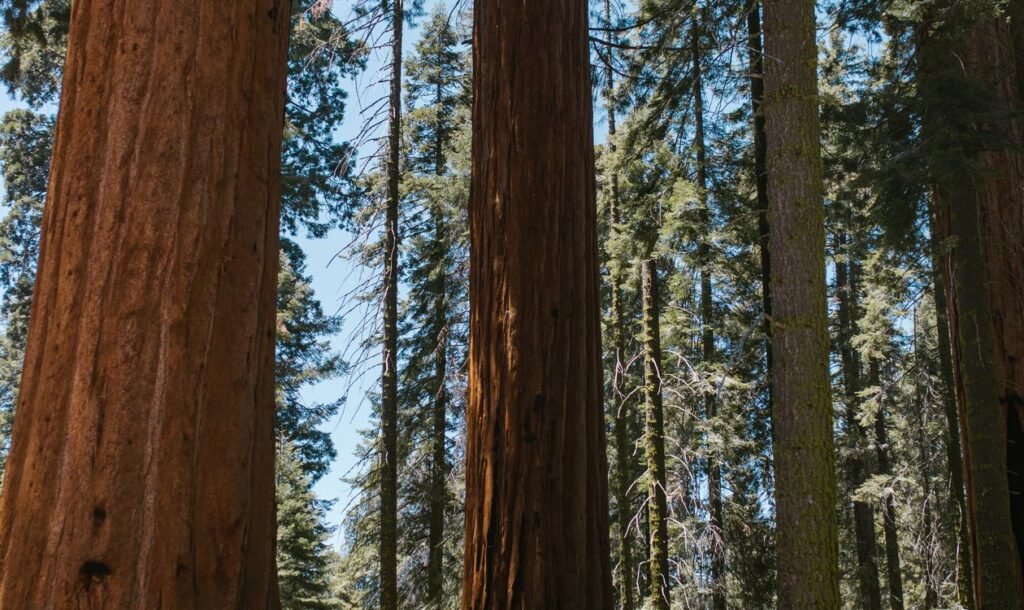
Giant Sequoia vs Redwood: Tallest vs Largest Trees Compared
California holds two world records in wood. Along the foggy northern coast grow the tallest living things on Earth, and high in the Sierra Nevada stand the largest. Visitors constantly mix them up, and no wonder: both are called redwoods, both wear cinnamon-colored bark, both can live for millennia, and both inspire the same open-mouthed awe. But the giant sequoia vs redwood story is a tale of two very different species with different bodies, different homes, and very different survival strategies. Here is how to tell them apart and why each one matters.
Giant sequoia vs redwood: the short answer
The giant sequoia (Sequoiadendron giganteum) is the world's largest tree by volume: no other living single-stem tree holds as much wood. The coast redwood (Sequoia sempervirens) is the world's tallest tree: no other living tree reaches as high. Put simply, the sequoia wins on bulk and the redwood wins on height.
They are close relatives in the cypress family, Cupressaceae, but they belong to different genera. The giant sequoia is the only living species in Sequoiadendron; the coast redwood is the only living species in Sequoia. Think of them as cousins, not twins, each shaped by a completely different California landscape.
Meet the redwood family: three species, not two
Most people know two redwoods, but there are three living species in the redwood subfamily. The third is the dawn redwood (Metasequoia glyptostroboides), a deciduous conifer from central China that drops its needles each autumn, unlike its evergreen American cousins. Thought extinct and known only from fossils, it was discovered alive in the 1940s, one of botany's great surprises.
This article focuses on the two Californian giants, since they are the pair everyone compares. But the dawn redwood is worth knowing: it proves the redwood lineage once spanned the Northern Hemisphere, and its discovery reminds us how much ancient history survives in living trees. Unlike its evergreen cousins, the dawn redwood turns golden and sheds its needles each autumn, and it grows fast enough to be planted widely in parks and gardens around the world, a living fossil anyone can meet.
Head-to-head: giant sequoia vs coast redwood
Here is the full comparison, the details that separate the two species.
| Feature | Giant sequoia (Sequoiadendron giganteum) | Coast redwood (Sequoia sempervirens) |
|---|---|---|
| World record | Largest tree by volume | Tallest living tree |
| Maximum height | About 300 ft (91 m) | About 325 ft (99 m); record 381 ft |
| Trunk | Massive, slightly tapering column | Slender, straight trunk |
| Bark thickness | Up to 3 ft, fibrous | About 12 inches |
| Foliage | Scale-like, juniper-like, blue-green | Flat needles in two feathery ranks |
| Cones | 2 to 3.5 inches (5-9 cm) | 0.8 to 1 inch (2-2.5 cm) |
| Native range | Western Sierra Nevada, California | Coastal northern California to southwest Oregon |
| Elevation | 2,700 to 8,858 ft | Near sea level to about 3,000 ft |
| Water source | Mountain snowmelt | Coastal fog and rain |
| Maximum lifespan | About 3,000 years | About 2,000 years |
| Wood use | Brittle, fibrous; not used for lumber | Valued, decay-resistant lumber |
| Hardiness | USDA Zone 6 | USDA Zones 7 to 10 |
The pattern is consistent: the sequoia is built for mass and endurance in a harsh mountain climate, while the redwood is built for height in a mild, dripping-wet coastal climate.
Record breakers: Hyperion and General Sherman
Every giant needs a champion, and these two species have the most famous individual trees on Earth.
Hyperion, a coast redwood in Redwood National Park, is the tallest known living tree in the world. Discovered on August 25, 2006, by naturalists Chris Atkins and Michael Taylor, it was measured at 379.1 feet by researcher Stephen Sillett, who climbed it with a tape. It has kept growing: recorded at 380.8 feet in 2019 and 381.3 feet (116.22 meters) in 2026. Named for a Titan of Greek mythology, Hyperion is estimated to be 600 to 800 years old. It does not stand alone at the top: the same park holds the second-, fourth-, and fifth-tallest known trees, coast redwoods named Helios, Icarus, and Daedalus, measured at 377, 371, and 363 feet in 2022. The world's tallest forest, it seems, keeps its champions close together. Its fame became a problem: so many visitors bushwhacked to its secret location that the surrounding habitat was trampled, and in July 2022 the National Park Service closed the entire area. Trespassers now face up to six months in jail and a $5,000 fine.
General Sherman, a giant sequoia in Sequoia National Park's Giant Forest, holds the volume crown. The National Park Service puts its stats at 274.9 feet tall, 102.6 feet around at the ground, 36.5 feet in maximum diameter, and about 52,500 cubic feet of wood, enough to build roughly 120 average houses. Its trunk alone weighs nearly 1,400 tons. At an estimated 2,200 years old, it was already ancient when Rome fell. Named for Civil War general William Tecumseh Sherman, it survived the September 2021 KNP Complex Fire only with human help: firefighters wrapped its base in protective foil as flames approached.
What a 2,200-year-old tree has lived through
General Sherman began life roughly around the time of China's Han Dynasty and just before the rise of the Roman Empire. It was already a towering adult when the printing press was invented, when the first ships crossed the Atlantic, and when California's gold rush brought the first waves of settlers to the Sierra. It has stood through droughts, lightning storms, earthquakes, and more than two millennia of Sierra winters.
It is not alone in its antiquity. Nearby in Kings Canyon National Park stands the General Grant tree, the second-largest giant sequoia, whose base circumference of 107.6 feet actually exceeds General Sherman's. Together these two trees anchor a forest of ancients: the Giant Forest contains hundreds of sequoias over a thousand years old, each one a living archive of climate, fire, and survival.
The redwoods keep their own deep time. A 2,000-year-old coast redwood sprouted when the Roman Empire was at its height. Hyperion, at 600 to 800 years old, is a youngster by redwood standards, yet it was already growing when Marco Polo traveled to China. Walking among these trees is the closest most of us will come to time travel.
Where they grow: fog belt vs snowy mountains
The ranges of the two species barely touch, and each is a prisoner of its water supply.
Giant sequoias grow in scattered groves along about 250 miles of the western Sierra Nevada. A 2013 survey counted 67 groves, most of them in Fresno and Tulare counties around Sequoia and Kings Canyon National Parks. They live at elevations between roughly 2,700 and 8,858 feet, where deep winter snowpacks melt slowly through the dry summer, feeding their roots. Sequoias are mountain trees, built for cold winters and dry summers.
Coast redwoods occupy a narrow strip along the Pacific, from southwestern Oregon through northern and central California, rarely more than a few dozen miles inland and from near sea level up to about 3,000 feet. Their water comes from the sky in two forms: winter rain and summer fog. Redwoods literally drink fog, combing moisture from the air with their needles, and the deep litter of the forest floor holds that water like a sponge. The tallest specimens cluster in Redwood National and State Parks, where the fog is thickest and the groves oldest.
How to tell them apart: bark, leaves, and cones
If you are standing in front of one, three clues settle the giant sequoia vs redwood question fast.
First, the bark. Both are reddish-brown and furrowed, but sequoia bark is extraordinarily thick, up to three feet, spongy, fibrous, and rich in tannins that resist fire and insects. Redwood bark is much thinner, around twelve inches, though still impressive by the standards of ordinary trees.
Second, the foliage. Sequoia leaves are small, scale-like, and sharp-pointed, hugging the twigs in the manner of junipers, with a dull blue-green cast. Redwood needles are flat, linear, up to an inch long, arranged in two neat opposite ranks that give sprays a feathery look, dark green above with pale bands beneath.
Third, the cones. Sequoia cones are big for a conifer, two to three and a half inches long and egg-shaped, while redwood cones are modest, under an inch. A cone on the ground is often the quickest identification of all.
Lifespan and growth: millennia in the making
Both species play the long game, but on different schedules. Giant sequoias can live about 3,000 years, with the oldest known individual estimated at roughly 3,200. Coast redwoods reach about 2,000 years, the oldest documented at 2,520. Either way, these are among the longest-lived organisms on the planet.
Their growth strategies differ. Young coast redwoods are sprinters, capable of adding six, eight, or more feet of height in a single good season, racing for the canopy light. Giant sequoias grow more deliberately, around two feet a year in their first century, but they never really stop: a mature sequoia keeps adding wood for millennia, which is why the oldest are also the most massive. A fun NPS statistic: in a single year, an average mature giant sequoia adds enough new wood to build a sixty-foot-tall oak tree three feet thick.
Reproduction reflects their temperaments too. Both make seeds, but coast redwoods also sprout vigorously from stumps and burls, so a logged or burned redwood can resurrect itself as a ring of new trunks around the old base, the famous "fairy rings." Sequoias depend on seeds and on fire-cleared ground to get them started.
Fire: destroyer and gardener
Fire has shaped both species, but especially the sequoia. Giant sequoias are superbly fire-adapted: bark up to three feet thick insulates the living tissue, tannins discourage insects and rot, and their great height keeps the crown above most flames. Low-intensity fires were historically frequent in sequoia groves, clearing competing firs and underbrush, exposing bare mineral soil, and opening cones so seeds could reach the light. In a real sense, the giant sequoia needs fire to reproduce.
That relationship is now strained. A century of fire suppression let fuels accumulate, and climate-driven drought has made fires hotter and more severe. The 2020 and 2021 fire seasons killed thousands of mature sequoias, trees that had survived hundreds of earlier fires, and forced the extraordinary step of wrapping General Sherman in fire shelter fabric. Coast redwoods, with thinner bark, are more vulnerable to intense fire, though their ability to resprout from the base gives them a second chance that sequoias lack.
Threats in a warming world
Climate change presses on both species through water. Sequoias depend on Sierra snowpack, and as winters warm, less snow falls and it melts earlier, leaving long dry summers with less water for trees that can drink hundreds of gallons a day. Stressed sequoias have shown new vulnerability to bark beetles, insects they historically shrugged off.
Redwoods depend on fog, and fog is declining. Warmer temperatures have reduced the number of foggy days along the California coast, drying the forest and stressing trees whose shallow roots, often only about twelve feet deep for a three-hundred-foot tree, depend on surface moisture. Both species also face the paradox of their fame: millions of visitors bring funding and love, but also soil compaction, trail damage, and, in Hyperion's case, outright habitat destruction.
Neither species is currently considered at imminent risk of extinction, and both are protected across large parks. But the margin of safety is narrowing, and forest managers now thin overcrowded groves, reintroduce controlled burns, and in extreme fire seasons, wrap the most famous trees like museum pieces.
Where to see them
For coast redwoods, head to Redwood National and State Parks in northern California. Hyperion itself is off-limits, but the parks' accessible groves, like Stout Grove and the Tall Trees Grove, hold plenty of giants nearly as tall. Muir Woods near San Francisco offers an easy first encounter, though it gets crowded.
For giant sequoias, Sequoia and Kings Canyon National Parks are the true heartland: the General Sherman Tree sits at the north end of the Giant Forest, a short walk from the trailhead, with the Congress Trail looping deeper into the grove. Yosemite's Mariposa Grove is another superb stop for sequoias.
Go in late spring for snowmelt-fed sequoia groves at their greenest, or in high summer when coastal fog gives redwood forests their cathedral gloom. Stay on trails, never carve bark, and remember that the duff beneath your feet is the shallow root zone these giants depend on. Give the ancients their space, and they will outlast us all.
Giant sequoia vs redwood: frequently asked questions
Are sequoias and redwoods the same tree? No. They are different species in different genera within the cypress family. The giant sequoia (Sequoiadendron giganteum) is the world's largest tree by volume; the coast redwood (Sequoia sempervirens) is the world's tallest tree. A third relative, the dawn redwood, grows in China.
Which is bigger, a sequoia or a redwood? It depends on the measure. Redwoods grow taller (up to about 381 feet for Hyperion), while giant sequoias grow more massive (General Sherman holds about 52,500 cubic feet of wood). The sequoia is bigger by volume; the redwood is bigger by height. Neither record is likely to fall any time soon.
Where do giant sequoias grow? Only in about 67 scattered groves on the western slopes of California's Sierra Nevada, at elevations of roughly 2,700 to 8,858 feet, mostly around Sequoia and Kings Canyon National Parks.
How tall do redwoods grow? Coast redwoods commonly exceed 200 feet, with the tallest known, Hyperion, measured at 381.3 feet in 2026. They grow along the foggy coast of northern California and southwestern Oregon, where the tallest specimens cluster in Redwood National and State Parks.
What is the tallest tree in the world? Hyperion, a coast redwood in Redwood National Park, California, at 381.3 feet (116.22 meters). Its exact location is closed to the public to protect it, and several other redwoods in the same park exceed 370 feet.
Two giants, one lesson
The giant sequoia vs redwood debate has no winner, and that is the point. One species turned mass into immortality in the mountains; the other turned height into dominance in the fog. Together they are proof of how much life can achieve when it is given time, water, and a little luck. The least we can do, after three thousand years of their patience, is give them a stable climate in return. Stand beneath either giant, tilt your head back until your neck aches, and you will understand why people have been doing exactly that, in hushed awe, for as long as these trees have had witnesses.