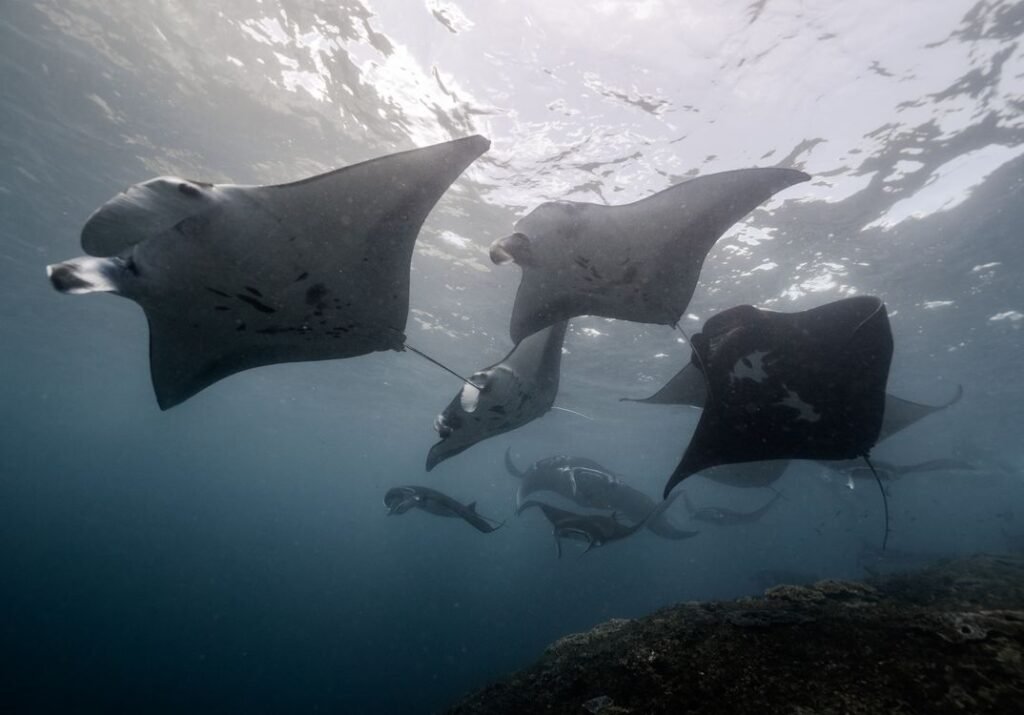
Manta Ray Facts: Meet the Gentle Giants of the Ocean
Gliding through blue water on wings wider than a small airplane, the manta ray looks like something between a bird and a dream. These are the largest rays on Earth, intelligent filter feeders with the biggest brains of any cold-blooded fish and spot patterns as individual as fingerprints. Yet for all their grace, manta rays are in serious trouble, hunted for body parts used in traditional medicine and listed as threatened across their range. These manta ray facts cover their biology, their surprising minds, and the fight to keep them gliding.
What is a manta ray?
Manta rays are giant rays in the genus Mobula, a group that also includes the smaller devil rays. Scientists once placed mantas in their own genus, Manta, but genetic research reorganized the family tree, and in 2023 the US National Oceanic and Atmospheric Administration formally revised the giant manta's scientific name to Mobula birostris to match the accepted taxonomy. They belong to the order Myliobatiformes, the stingrays and their relatives, though mantas themselves abandoned the sting long ago.
The word "manta" comes from Spanish, where it means blanket or cloak, a nod to the animal's broad, flat, diamond-shaped body. Early sailors who saw the two horn-shaped cephalic fins unfurling from the head called them "devil fish," a nickname that stuck even though the animal behind it is famously gentle. Everything about a manta is built for efficient cruising: triangular pectoral fins that flap like slow wings, a huge forward-facing mouth for scooping plankton, and a long whip-like tail that, unlike a stingray's, carries no venomous barb.
Manta ray species: giant oceanic vs reef manta
For most of modern history, science recognized only one manta ray species. That changed in 2008, when researchers confirmed that what everyone had been calling the manta ray was actually two distinct species with different habits and ranges. More recent work has identified a third, Atlantic species. Here is how they compare.
| Feature | Giant oceanic manta (Mobula birostris) | Reef manta (Mobula alfredi) | Atlantic manta (Mobula yarae) |
|---|---|---|---|
| Maximum wingspan | About 7 m (23 ft); reports up to 29 ft | About 5.5 m (18 ft); averages 11 ft | About 6 m (20 ft) |
| Range | All major oceans, tropical to temperate | Indo-Pacific coastlines | Atlantic Ocean |
| Lifestyle | Migratory, open ocean | Resident, coastal | Migratory |
| Diving | Deep offshore feeding dives | Shallower reef-associated | Open ocean |
The giant oceanic manta is the heavyweight: the largest ray species in the world, roaming entire ocean basins. The reef manta stays closer to home, haunting coastlines, coral reefs, and island chains across the Indo-Pacific, and it is the species most divers encounter. The Atlantic manta, the newest addition to the roster, reminds us that manta taxonomy is still being written.
How big do manta rays get?
Manta ray facts about size never fail to impress. A large giant oceanic manta can stretch 7 meters (23 feet) from wingtip to wingtip, and exceptional individuals have been reported at up to 29 feet, wider than a school bus is long. Reef mantas are smaller but still spectacular, averaging around 11 feet across, about the wingspan of a small aircraft.
Weight matches the wingspan. Large mantas can weigh up to two tonnes, roughly as much as a mid-size car, yet they move with a slow, flapping grace that seems to defy their bulk. Newborn pups, by contrast, start life at around 1.2 to 1.8 meters across, already miniature versions of their parents and ready to fend for themselves from day one.
Size brings a long life. Manta rays are slow-growing animals that can live for 50 years, maturing late and reproducing slowly. That unhurried life history is central to both their ecology and their vulnerability: a species that takes a decade to mature cannot quickly replace individuals lost to fishing.
Where do manta rays live?
Mantas inhabit tropical, subtropical, and warm temperate waters around the globe. Giant oceanic mantas are true ocean wanderers, migrating across open seas singly or in loose groups, turning up at offshore islands, seamounts, and upwelling zones wherever plankton blooms. Reef mantas are homebodies by comparison, sticking to coastal waters and showing strong fidelity to particular reefs, atolls, and cleaning stations, which they may visit repeatedly for years.
Famous manta hotspots read like a diver's wish list: the Maldives, Indonesia's Raja Ampat and Komodo, Hawaii's Kona coast, Ecuador's Isla de la Plata, and Mexico's Revillagigedo Islands. In Ecuador's waters, researchers believe more than 22,000 giant mantas gather, the largest known aggregation of the species, centered on Machalilla National Park and the Galapagos Marine Reserve. Elsewhere, regional populations are far smaller, often estimated at just a few hundred to a couple of thousand individuals.
What do manta rays eat?
Despite their size, manta rays eat some of the smallest food in the sea. They are filter feeders, swimming with their cavernous mouths held wide open and sieving zooplankton, krill, small crustaceans, and larval fish from the water. Rows of gill rakers, sometimes called gill plates, trap the tiny prey while water flows out through the gills.
Feeding mantas are creative. They perform slow barrel rolls and repeated somersaults to stay inside a dense patch of krill, and groups sometimes line up head-to-tail in "chain feeding," circling to create a spiraling vortex that concentrates plankton in the middle. The two cephalic fins on the head uncurl and act like guide vanes, funneling food-rich water into the mouth. Recent research has added a twist: much of a manta's nutrition may actually come from mesopelagic sources, the deep scattering layers of the twilight zone, suggesting these rays dive far deeper to feed than their surface cruising implies.
An average-sized manta may filter 20 to 30 kilograms of plankton from the sea in a single day, a colossal harvest of microscopic life that makes mantas important movers of nutrients through ocean food webs.
The manta ray's giant brain
Among the most remarkable manta ray facts is the size of their brain. Mantas have the largest brain-to-body ratio of any cold-blooded fish, and their behavior suggests they put it to good use. In controlled studies, manta rays have shown signs of self-awareness in mirror tests, a cognitive milestone shared with dolphins, great apes, and elephants. They appear to recognize themselves rather than mistaking the reflection for another ray.
Their memory is equally impressive. Research has shown that mantas build detailed mental maps of their environment using visual landmarks and smell, returning to the same cleaning stations and feeding grounds year after year. Alongside dolphins, primates, and elephants, they stand as one of the few animals with demonstrated long-term spatial memory of this sophistication.
Individual mantas can even be told apart by the unique pattern of dark spots on their pale undersides. Like a human fingerprint, no two belly patterns are alike, which lets researchers and citizen scientists identify individual rays from photographs and track their movements over decades.
Reproduction: slow lives, single pups
Manta reproduction runs at a stately pace. Females reach maturity at around eight to ten years old and give birth only once every couple of years, usually to a single pup and only occasionally to twins. Pregnancy lasts 12 to 13 months, one of the longest gestations of any fish, and ends with the live birth of a fully formed miniature ray that must immediately survive on its own.
Courtship itself is dramatic: males pursue a female in a slow underwater "train," sometimes for hours, before mating. Because a female may produce only a handful of pups in a 50-year life, manta populations grow extremely slowly. This is the biological reason conservationists worry so much about even modest fishing pressure. Remove a few adults from a local population and it can take decades to recover, if it recovers at all.
Cleaning stations and mysterious breaching
Like visitors to a spa, mantas make regular pilgrimages to cleaning stations: particular coral heads or reef patches where small cleaner fish pick parasites and dead skin from their bodies. A manta will hover almost motionless for several minutes while a team of tiny cleaners works over its gills, mouth, and wing surfaces. Many individuals return to the same stations repeatedly, another feat of their long-term memory.
Then there is breaching. Mantas sometimes launch their multi-tonne bodies clear out of the water and crash back down with a thunderous slap. Nobody knows exactly why. Proposed explanations include dislodging parasites, communicating with other mantas, stunning prey, or simply the exuberance of a powerful animal. Whatever the reason, a breaching manta is one of the ocean's great sights, and the mystery is part of the appeal.
Manta ray vs stingray: what is the difference?
People often confuse the two, so here is a direct comparison of these manta ray facts against their stingray cousins.
| Feature | Manta ray | Stingray |
|---|---|---|
| Tail weapon | No stinger; thin whip-like tail | Venomous barb on the tail |
| Mouth position | Forward-facing, at the front | Underside of the body |
| Size | Up to 29 ft wingspan | Mostly under 6 ft (some exceptions) |
| Feeding | Filter feeder on plankton | Bottom feeder on shellfish, worms |
| Habitat | Open water, reefs | Seafloor, sandy shallows |
| Danger to humans | Harmless | Can sting defensively if stepped on |
The key takeaway: mantas lost the stingray's defensive barb during their evolution toward open-water filter feeding. They are completely harmless to people.
Are manta rays dangerous?
No. Manta rays have no stinger, no venom, and no teeth designed for biting. Their peg-like teeth are tiny and play no role in feeding. Divers regularly swim alongside mantas, which are typically calm, curious, and unbothered by respectful company.
The real danger runs the other way. Because mantas feed and bask near the surface, they are vulnerable to boat strikes, and NOAA Fisheries advises boaters to slow down and keep at least 50 feet of distance. Anglers are asked never to cast at mantas, since foul-hooking causes serious injury. If you are lucky enough to meet one, the rule is simple: watch, do not touch, and let the ray set the terms of the encounter.
Threats and conservation
The conservation story is sobering. Both the giant and reef mantas are classified as Vulnerable on the IUCN Red List, and in 2018 the United States listed the giant manta ray as threatened under the Endangered Species Act. Their greatest enemy is fishing. Mantas are targeted directly and caught as bycatch, and they are increasingly hunted for their gill plates, which are dried and sold for use in traditional Chinese medicine, claimed without scientific evidence to treat everything from poor circulation to chickenpox. The international gill plate trade has been valued at around $30 million, and thousands of mantas are killed for it each year.
Because mantas reproduce so slowly, even light fishing can collapse a local population. But protection is growing. Since 2011, mantas have been shielded in international waters by the Convention on Migratory Species. Ecuador, Peru, Mexico, the Philippines, and New Zealand have enacted fishing bans, and in 2014 Indonesia, once home to the world's largest manta fishery, banned all fishing and trade of the animals. The economic argument helped: researchers estimate that manta tourism is so valuable that a single ray at a popular dive site can generate up to one million dollars for the local economy over its lifetime, while a dead manta's gills fetch only about $500. A living manta, it turns out, is worth far more than a dead one.
Seeing manta rays responsibly
If you want to meet a manta, choose operators with strict codes of conduct: no touching, no chasing, no flash photography at night dives, and limited group sizes. Night dives with mantas feeding on plankton drawn to dive lights, famous in Hawaii and the Maldives, are unforgettable when run responsibly. Snorkelers should stay at the surface and let curious rays approach on their own terms. And consider contributing your photos to manta identification databases: those unique belly spots make every tourist a potential citizen scientist.
Manta rays in culture and science
Long before science understood them, mantas haunted the human imagination. Sailors who watched a dark diamond shape rise beneath their boats, with two horns curling from its head, named it the devil fish, and the name traveled into maritime legend. In truth the "horns" are cephalic fins, feeding tools, but the eerie silhouette was enough to inspire stories of sea monsters in an age when almost nothing was known about life in the open ocean.
The scientific story is nearly as dramatic. The genus Manta was established in 1829, and for almost two centuries everyone assumed a single species circled the globe. The 2008 discovery that reef and oceanic mantas were distinct species rewrote textbooks and showed how much remained hidden in plain sight. The reorganization continued: genetic studies folded the old Manta genus into Mobula, and in November 2023 NOAA Fisheries formally updated the giant manta's name to Mobula birostris. Taxonomy, it turns out, is a living science.
Modern manta research is a high-tech affair. Scientists attach satellite tags to track migrations across ocean basins; one NOAA expedition in the Flower Garden Banks National Marine Sanctuary tagged a juvenile female just 6.5 feet wide, hoping six months of transmissions would reveal where young mantas travel. In the Maldives, researchers have built photo-identification catalogs of thousands of individual reef mantas, recognized by their belly spots, turning tourist snapshots into population data. Each new tracking point redraws our map of where these animals feed, breed, and need protection.
Manta ray facts: frequently asked questions
How big is a manta ray? Giant oceanic mantas reach about 23 feet across, with exceptional individuals reported up to 29 feet, and can weigh up to two tonnes. Reef mantas are smaller, averaging around 11 feet in wingspan.
What do manta rays eat? They are filter feeders that eat zooplankton, krill, and small crustaceans, sieving them from the water with gill rakers. They use somersaults and chain feeding to concentrate their tiny prey.
Are manta rays dangerous to humans? No. Unlike stingrays, mantas have no venomous barb and are completely harmless. They are calm, intelligent animals that often tolerate respectful divers and snorkelers.
What is the difference between a manta ray and a stingray? Mantas are giant open-water filter feeders with forward-facing mouths and no stinger. Stingrays are generally smaller bottom-feeders with mouths on their undersides and a venomous tail barb used for defense.
How long do manta rays live? Manta rays can live up to 50 years. They mature late, at eight to ten years old, and females produce only one pup every couple of years, which makes their populations very slow to recover from losses.
The ray that remembers
Manta rays glide through the ocean with brains built for memory, bellies patterned like fingerprints, and migrations that cross entire seas. They ask nothing of us except to be left alone, and they repay our restraint with some of the most magical wildlife encounters on Earth. In a sea full of urgent conservation stories, the manta's is unusually hopeful: protect the animal, and the animal pays for its own protection a million times over.