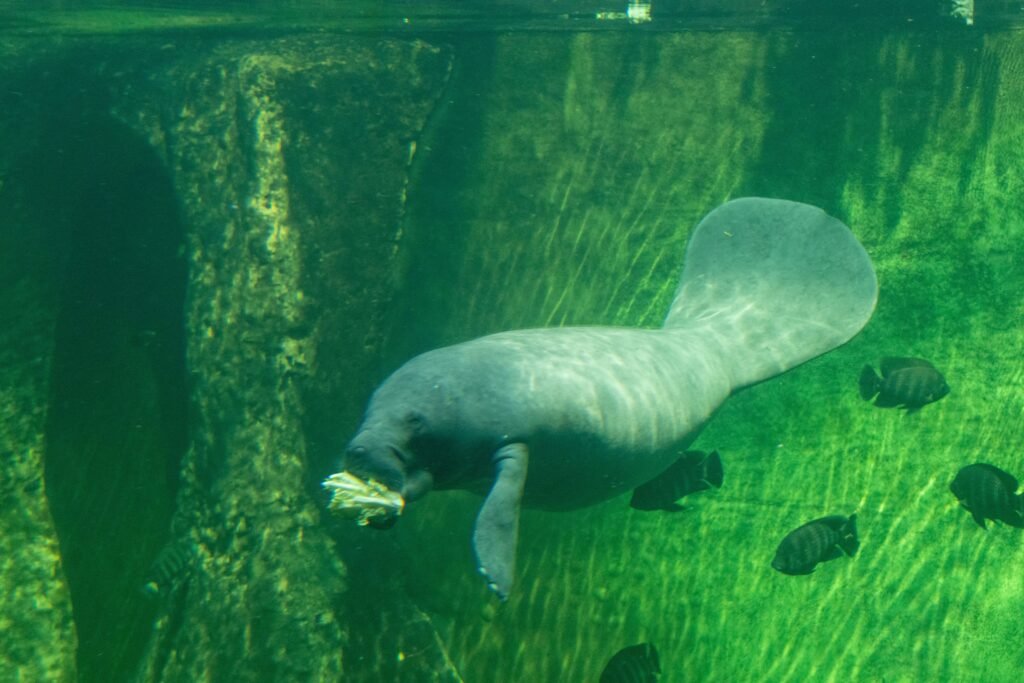
Dugong vs Manatee: 9 Differences Between the Sea Cows
They are the ocean's gentle grazers: slow, whiskered, plant-eating mammals that spend their days mowing underwater meadows. At a glance, a dugong and a manatee look like the same animal. They are not. Dugongs and manatees belong to different families, live on opposite sides of the planet, and differ in tails, snouts, teeth, and lifestyle. Once you know what to look for, you will never confuse them again.
Here is the complete guide to dugong vs manatee differences, from the one-second field identification trick to the evolutionary story that connects them both to elephants.
Dugong vs Manatee: The One-Second Answer
If you see the tail, you have your answer. A dugong's tail is fluked, split into two triangular lobes with a notch in the middle, like a dolphin or small whale. A manatee's tail is a single rounded paddle, broad and oval with no notch, more like a giant lily pad. No dugong has ever been seen with a paddle tail; no manatee has ever been seen with a fluke. The tail alone settles every identification, even from a distance or in murky water.
If you see the head instead, check the snout. A dugong's muzzle points sharply downward, a bristly disc built for vacuuming seagrass off the seafloor. A manatee's face is rounder, with a flexible, divided upper lip it uses like a hand to grab plants.
Everything else, the teeth, the flippers, the habitat, the range, flows from those two differences.
Full Comparison Table
| Feature | Dugong (Dugong dugon) | Manatee (Trichechus spp.) |
|---|---|---|
| Family | Dugongidae (one living species) | Trichechidae (three living species) |
| Tail | Fluked: two lobes with a central notch, like a dolphin | Rounded paddle: single oval, no notch |
| Snout | Downturned, trunk-like disc for bottom grazing | Rounded, with a cleft, prehensile upper lip |
| Teeth | Tusks (incisors) in males and older females, plus molars | No tusks; "marching molars" replaced continuously |
| Flipper nails | None | Present in West Indian and West African manatees; absent in Amazonian |
| Habitat | Strictly saltwater; never enters freshwater | Fresh, brackish, and salt water depending on species |
| Range | Indo-Pacific: East Africa to Australia | Atlantic basin: Americas, Caribbean, Amazon, West Africa |
| Size | Typically ~3 m, 250-400 kg | Up to ~4 m, 400-600+ kg (West Indian largest) |
| Diet | Almost exclusively seagrass | Seagrass plus freshwater plants and algae |
| Social life | Solitary or in herds of hundreds | Mostly solitary; strong mother-calf bonds |
| Lifespan | Up to 70 years | Up to 60-70 years |
| IUCN status | Vulnerable | Vulnerable (all three species) |
Tail Shape: The Definitive Difference
It is worth lingering on the tail, because it is the single most reliable field mark and it reflects how these animals move. The dugong's fluke is stiff and horizontally spread, built for efficient cruising over seagrass meadows. The manatee's paddle is fleshier and more flexible, rowed in a slow vertical sculling motion suited to rivers, springs, and shallow coastal lagoons.
Watch a dugong dive and the fluke pumps up and down like a whale's. Watch a manatee and the broad paddle sweeps in a gentler rhythm. Even when only the tail breaks the surface as the animal dives, the silhouette tells you which sea cow you are looking at.
Snouts, Teeth, and Flippers: Built for Different Menus
The dugong's face is a specialist's tool. Its large, bristled, downward-angled muzzle works like a shovel and vacuum combined: the animal roots along the seabed, uprooting entire seagrass plants, roots and all, and its powerful lips strip the leaves. Feeding dugongs leave winding trails in the sand, shallow grooves where they have ploughed through the meadow. Researchers use these feeding trails to survey dugong presence without ever seeing the animals.
The manatee's mouth is a generalist's toolkit. The divided, prehensile upper lip moves each side independently, grasping and tearing a wide variety of vegetation: seagrasses in the sea, water hyacinth and other plants in rivers, and algae wherever it grows. Manatees even use their flippers to help, scooping plants toward the mouth and, famously, appearing to "walk" along the bottom.
Teeth tell the same specialist-versus-generalist story. Male dugongs (and some older females) grow a pair of tusks, enlarged incisor teeth that erupt and persist for life. Behind them sit simple peg-like molars for grinding seagrass. Manatees have no incisors or canines at all as adults. Instead they run a conveyor belt of molars: new teeth erupt at the back of the jaw and march forward as the front ones wear down, an adaptation to a lifetime of grinding gritty, sandy vegetation. Elephants are the only other mammals with a similar system, which is fitting, as we will see.
The flippers offer one more clue. West Indian and West African manatees carry three or four small nails on each flipper, like vestigial fingernails. Dugongs have none, and neither does the Amazonian manatee.
Where They Live: Two Oceans, Two Lifestyles
Geography separates dugongs and manatees completely. Their ranges do not overlap anywhere on Earth.
Dugongs are creatures of the Indo-Pacific. Their range arcs from the Red Sea and the east coast of Africa, across the Indian Ocean and Southeast Asia, to northern Australia and the western Pacific islands. They are strictly marine, living in shallow coastal waters, bays, and mangrove channels, always near seagrass meadows. A dugong never enters freshwater. Australia holds the world's largest population, stretching from Shark Bay in the west to Moreton Bay in the east, which makes Australia the dugong's global stronghold.
Manatees belong to the Atlantic basin and come in three species:
- West Indian manatee (Trichechus manatus): the coasts of Florida, the Caribbean, the Gulf of Mexico, and Central and South America. It moves freely between salt, brackish, and fresh water.
- Amazonian manatee (Trichechus inunguis): the Amazon River basin only, the one manatee that lives entirely in freshwater.
- West African manatee (Trichechus senegalensis): rivers, estuaries, and coastal waters of West Africa, the least studied of the three.
This split reflects deep history. The two families diverged tens of millions of years ago, with dugong ancestors radiating through the Indo-Pacific while manatee ancestors colonized the Atlantic and its rivers.
Same Family Tree: The Sirenia Story
For all their differences, dugongs and manatees are each other's closest living relatives. Together with the extinct Steller's sea cow, they form the order Sirenia, the sea cows. The name comes from the sirens of Greek myth: sailors supposedly mistook these animals for mermaids, a story told about manatees in the Caribbean and dugongs in the Pacific alike.
Sirenians are the only fully aquatic herbivorous mammals on Earth, and their family tree holds a surprise. Their closest living relatives are elephants. Both groups descend from the same ancient lineage, which is why manatees replace their molars the way elephants do and why dugong tusks echo elephant tusks. The fossil record of sea cows stretches back some 50 million years to the Eocene, when four-legged ancestors waded in shallow tropical seas. They diversified through the ages, then dwindled.
The most dramatic chapter is the Steller's sea cow, a gigantic kelp-eating sirenian of the North Pacific that reached 8 metres or more. Discovered by Europeans in 1741, it was hunted to extinction within about 27 years, gone by 1768. It stands as a warning written into the order's history: large, slow-breeding, coastal herbivores are exceptionally vulnerable to human pressure.
Size and Daily Life
Manatees are the heavier-built of the two. A large West Indian manatee can reach 4 metres and weigh well over 500 kg, with exceptional individuals heavier still. Dugongs are slimmer and more streamlined, typically around 3 metres and 250 to 400 kg. In both groups, females tend to be slightly larger than males.
Daily life revolves around eating. Both animals are hindgut fermenters with enormous digestive systems, spending six to eight hours a day grazing. A dugong can eat tens of kilograms of seagrass daily; a large manatee may consume around a tenth of its body weight in vegetation each day.
Social lives differ. Manatees are mostly solitary, though they gather loosely at warm-water refuges in winter and mothers keep calves with them for up to two years. Dugongs can be solitary too, but they also form herds numbering in the hundreds, spectacular aggregations that sweep across seagrass banks in northern Australia.
Reproduction is slow in both, which matters for conservation. Dugongs live up to 70 years, mature at around a decade old, carry calves for 13 to 14 months, and nurse them for two to three years, so a female may give birth only once every three to seven years. Manatees mature earlier and breed somewhat faster, with roughly year-long pregnancies and calves dependent for up to two years, but they are still slow by mammal standards. When populations fall, recovery takes decades.
Dugongs in South Asia: Pakistan's Forgotten Sea Cow
For readers in Pakistan, this comparison has a local ghost. Dugongs were once part of the marine life of the country's own coast. Historical records and IUCN range data place dugongs along the Balochistan and Sindh coasts, including the Indus Delta region, where seagrass beds once supported them. Fishermen's accounts from the last century describe the animals in these waters.
Today the dugong is considered locally extinct, or at best vanishingly rare, along Pakistan's coast. The causes are the familiar litany: incidental capture in fishing nets, destruction of seagrass habitat, and hunting in earlier decades. Small numbers may still visit from neighboring waters, and every credible sighting deserves reporting to marine researchers. The story is a reminder that the dugong's range did not always end where it does now, and that protecting the seagrass meadows of the northern Arabian Sea is the first step toward any future recovery.
Conservation: Different Waters, Different Threats
All four living sirenians are listed as Vulnerable on the IUCN Red List, but the dangers they face differ by ocean.
Dugongs are declining across most of their range, with Australia as the exception that proves the rule. Their greatest enemy is the loss of seagrass meadows to coastal development, sediment runoff, and extreme weather. After Cyclone Yasi struck Queensland in 2011, floods smothered vast seagrass beds, and the estimated dugong population fell to its lowest since surveys began in 1986, with fewer than 600 animals counted and 187 found dead or dying. In Thailand, seagrass die-offs have devastated local dugongs: a 2022 survey found 273 animals, and researchers fear a third of the population has since been lost. Entanglement in gillnets and shark-control nets drowns dugongs every year, boat strikes kill them in busy coastal waters, and subsistence hunting continues in parts of Southeast Asia and the Pacific.
Manatees face a parallel set of pressures. In Florida, boat collisions are the leading known cause of death; nearly every adult Florida manatee bears propeller scars, which researchers use like fingerprints to identify individuals. Cold stress kills manatees in harsh winters, especially as natural warm-water springs are developed or power-plant outflows shut down. And seagrass loss has caused catastrophe: massive die-offs in the Indian River Lagoon since 2011 starved more than 1,500 manatees between 2020 and 2022 alone. The Amazonian manatee is hunted for meat in parts of its range, with calves sometimes taken for the illegal pet trade. The West African manatee is hunted and squeezed by habitat pressure along rapidly developing coastlines, and remains the least studied of all.
The conservation prescription is the same on both sides of the world: protect seagrass meadows, reduce boat speeds in key habitat, replace lethal fishing gear, and give these slow-breeding animals the decades they need to recover.
Spot the Difference: A 30-Second Checklist
Use this checklist the next time a photo or video has you guessing:
- Look at the tail. Notched fluke like a dolphin? Dugong. Rounded paddle with no notch? Manatee.
- Look at the snout. Sharply downturned, bristly disc? Dugong. Rounder face with a split, flexible upper lip? Manatee.
- Check the location. Indo-Pacific (East Africa, Red Sea, South Asia, Australia)? Dugong. Florida, the Caribbean, the Amazon, or West Africa? Manatee.
- Look at the water. Open coastal sea with seagrass beds? Could be either, but a river or freshwater spring means manatee, since dugongs never enter freshwater.
- Look for tusks. Visible short tusks on an adult male? Dugong. No tusks at all? Manatee.
Three checks out of five is plenty. In practice, the tail and the location together are decisive every time.
Frequently Asked Questions
What is the main difference between a dugong and a manatee? The tail. Dugongs have a fluked, whale-like tail with a notch; manatees have a rounded, paddle-shaped tail. Their snouts differ too: downturned in dugongs, rounded with a cleft lip in manatees.
Are dugongs and manatees related? Yes. They are the only living members of the order Sirenia, the sea cows, and each other's closest relatives. Their nearest living land relative is the elephant.
Where do dugongs live? In warm, shallow coastal waters of the Indo-Pacific, from East Africa and the Red Sea to Australia. They are strictly marine and never enter freshwater.
Where do manatees live? In the Atlantic basin: Florida and the Caribbean, the Amazon River, and West Africa, depending on the species. They tolerate fresh, brackish, and salt water.
Do dugongs have tusks? Adult males do, and some older females. They are enlarged incisor teeth. Manatees have no tusks; instead their molars are continuously replaced.
Are dugongs endangered? Dugongs are listed as Vulnerable by the IUCN, with declining populations across most of their range. All three manatee species are also listed as Vulnerable.
Can dugongs and manatees meet in the wild? No. Their ranges are on opposite sides of the planet and do not overlap. A sea cow in the Indo-Pacific is always a dugong; one in the Atlantic basin is always a manatee.
Which is bigger, a dugong or a manatee? Manatees, on average. A large West Indian manatee can reach 4 metres and over 500 kg, while dugongs are typically around 3 metres and 250 to 400 kg.
Do manatees and dugongs eat the same food? Mostly seagrass for both, but dugongs are stricter specialists, eating almost nothing else, while manatees also graze on freshwater plants and algae.
Dugongs and manatees took separate paths tens of millions of years ago and arrived at similar answers: graze peacefully, grow large, and live slow. Telling them apart takes only a glance at the tail, but understanding them takes in seagrass meadows, ancient elephants, and the modern pressures squeezing both. The sea cows have survived since the Eocene. Whether they thrive in the coming century is up to us. Learning their differences is the first step toward protecting both.
Image: an African manatee swimming underwater, photographed by Jakub Pabis via Pexels.