How Smart Is an Octopus? Inside the Ocean’s Cleverest Mind
Somewhere on a rocky seafloor, an octopus picks up two halves of a coconut shell and carries them across the sand like a traveler with a suitcase. It is not eating them. It is not playing. It is preparing a shelter it will assemble later, when danger comes. That is planning, and planning is one of the hallmarks of a mind.
Octopus intelligence has fascinated scientists for decades because it does not look like our kind of smart. The octopus is an invertebrate, closer kin to a sea slug than to a fish, yet it solves puzzles, uses tools, learns by watching others, and stages escapes that would make a locksmith proud. In this article, we explore how the octopus thinks, what its strange body reveals about the nature of intelligence itself, and why this short-lived animal may be the ocean's cleverest mind.
A Brain Unlike Any Other on Earth
The first thing to understand about octopus intelligence is that it starts with genuinely unusual hardware. An octopus carries around 500 million neurons, the largest nervous system of any invertebrate. For comparison, a dog has roughly the same number. The common octopus packs about as many brain cells as a cat or dog, yet only a small fraction sit inside its head.
Scientists at the Natural History Museum in London note that the octopus has the largest brain-to-body ratio of any invertebrate, and it holds its own against many vertebrates too. Research published in Nature's Lab Animal describes how the central brain contains just 40 to 45 million neurons, organized into about 40 lobes that wrap around the esophagus. The brain is literally shaped like a donut, and food passes straight through its center. That is why octopuses must chew their meals carefully: swallowing something too large can damage the very organ that makes them smart.
Behind the eyes sit two enormous optic lobes holding another 120 to 180 million neurons. Vision matters enormously to an octopus, and these lobes process visual information with a layered structure similar to the vertebrate retina. The remaining neurons, roughly two-thirds of the total, live in the arms.
The central brain also contains a structure called the vertical lobe. Researchers believe it handles short-term and long-term memory, problem solving, and the ability to tell shapes and patterns apart. In function, it resembles the hippocampus in the mammalian brain. What makes this so striking is that the octopus evolved this machinery completely independently. The ancestors of octopuses and vertebrates parted ways more than 550 million years ago, which means the octopus built a capable brain from scratch, along a separate evolutionary road.
The Thinking Arms: Intelligence Beyond the Head
The phrase "nine brains" is everywhere online, and it is worth pausing to get this right. An octopus has one central brain. What it also has is an extraordinary distributed nervous system: each of its eight arms contains nerve cords packed with neurons that can act without orders from the head.
According to research in Frontiers in Systems Neuroscience, most of the octopus's neurons are located in its arms, and those arms can keep responding to touch and solving local problems even when separated from the body. A severed octopus arm can still reach, grasp, and avoid noxious stimuli on its own. Each arm's nerve cord can adjust its grip, explore surfaces, and coordinate its hundreds of suckers while the central brain focuses on the bigger picture.
This is not eight separate minds. Think of it more like delegation. The central brain issues broad instructions, such as "search that crevice," and the arm works out the details: which sucker to flex, how hard to pull, when to release. Researchers call this distributed intelligence, and it lets the octopus manipulate objects with a flexibility no vertebrate limb can match.
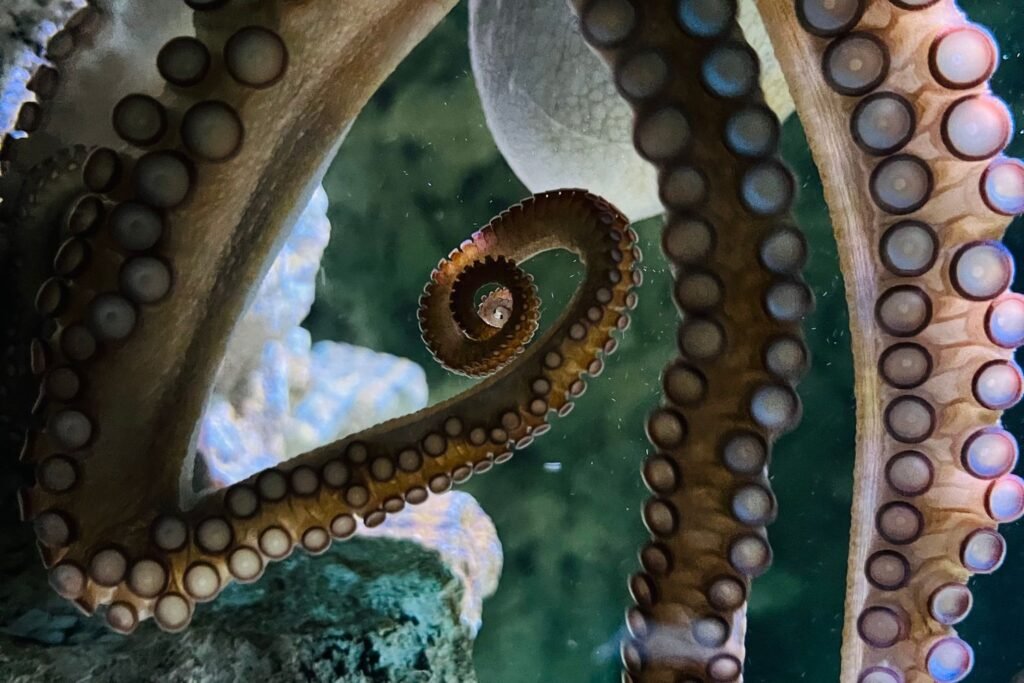
The arms are also sensory organs of an almost alien quality. Each sucker carries tens of thousands of mechanical and chemical receptors, making a single sucker far more sensitive than a human fingertip. Octopuses taste and smell through their skin, so every object they touch is also being chemically interrogated. When an octopus explores a new object, running its arms over every surface, it is quite literally tasting its way through the world.
Tool Use in the Wild: The Coconut-Carrying Octopus
Tool use was once treated as a members-only club for primates and a few clever birds. The veined octopus, Amphioctopus marginatus, forced science to reconsider. In 2009, researchers published a paper in Current Biology titled "Defensive tool use in a coconut-carrying octopus," and it became one of the most celebrated findings in cephalopod research.
Between 1999 and 2008, the team spent more than 500 diver hours observing veined octopuses on soft sandy seafloors off Sulawesi and Bali. They watched 20 individuals closely. On four separate occasions, octopuses were seen collecting stacked coconut shell halves and carrying them across the seafloor for distances of up to 20 meters.
The carrying technique is remarkable in itself. The researchers called it stilt walking. The octopus tucks the two shell halves beneath its body with the hollow sides facing up, stiffens its eight arms around and under the shells, and walks forward on its rigid arms. The whole package moves as one ungainly unit. The gait is measurably slower and more energy costly than normal movement, and the octopus travels with its soft body exposed to predators the entire way. There is no payoff while carrying. The benefit comes later.
When the animal stops, it flips the top shell over the bottom one, climbs inside, and pulls the closure shut around itself, leaving only a small gap for water flow. The assembled shells become a small hardened chamber that hides the octopus from view and shields it from attack. When it is ready to move again, it disassembles the shelter, restacks the halves, and stilt-walks onward.
What elevates this from clever hiding to genuine tool use is the element of futurity. The octopus collects the shells when it does not need them and carries them for future protection. That is planning ahead, a cognitive feat that places the octopus among a small group of animals known to prepare tools before the moment of use.
Veined octopuses are not the only resourceful builders. Other octopus species arrange rocks around their dens as barricades and carry shells and stones as portable shields. And in a 2022 study in Marine Pollution Bulletin, researchers examined 261 underwater images of bottom-dwelling octopuses interacting with marine litter. Glass bottles appeared in more than 40 percent of the interactions, with plastic, cans, and jars also pressed into service as shelters. Resourceful, yes, but also a reminder that pollution is forcing wild animals to improvise inside a human-altered ocean.
Escape Artists and Puzzle Solvers
Aquariums around the world have learned the hard way that an octopus regards a closed tank as a suggestion, not a rule. The most famous escape happened in April 2016, when an octopus named Inky slipped out of his tank at the National Aquarium of New Zealand overnight, squeezed through a small gap, and traveled through a drainpipe back into the ocean. Staff confirmed the escape succeeded because Inky found an unsecured gap at the top of his tank. Since octopuses have no rigid skeleton, they can compress their entire body through any opening larger than their beak, which is the only hard part of their body.
Aquarists have collected many similar stories. Octopuses have been found in neighboring tanks, raiding the occupants for a midnight meal before returning home. In one well-known case at the Seattle Aquarium, an octopus kept leaving its tank at night to eat fish from an adjacent exhibit, then slipping back before morning. Keepers only caught the culprit by setting up cameras. Some octopuses have even learned to squirt jets of water at aquarium lightbulbs, seemingly out of boredom or annoyance, shorting out the lights.
In the laboratory, octopus problem solving has been tested more formally. Octopuses learn to navigate mazes and remember the routes weeks later. They open screw-top jars, latched boxes, and childproof pill bottles to reach food inside. In one famous case described in National Geographic, an octopus nicknamed Billey was given a childproof jar that had to be pushed down and then turned. Billey figured it out in under an hour, and after that could open it in a few minutes. That is not trial and error repeated endlessly. That is learning, and then remembering.
Octopuses also explore containers systematically, testing different approaches until one works. Give them a puzzle box with a series of barriers between them and a crab, and many will work through the barriers in sequence. Their curiosity is constant. Presented with a novel object, an octopus will investigate it thoroughly with its arms, tasting and turning it over, which is exactly why researchers can coax them into such elaborate demonstrations. They do not need to be taught to be curious. They simply are.
Learning, Memory, and Play
One of the most surprising discoveries in cephalopod research is that octopuses can learn by watching. In a classic 1992 experiment published in Science, researchers showed that untrained octopuses learned to choose the correct object after observing trained octopuses complete a task. This is observational learning, a form of social cognition once thought rare outside mammals and birds. For an animal that lives alone and gets no parenting at all, the ability to pick up information from watching others is a powerful survival tool.
Memory in octopuses comes in both short- and long-term varieties, supported by the vertical lobe of the central brain. They remember solutions to puzzles, recognize individual human caretakers, and behave differently toward familiar keepers than toward strangers. Long-term studies show they can retain learned routes and strategies over extended periods, which is precisely what wild octopuses need when they return to productive hunting grounds.
Perhaps the most endearing evidence of octopus intelligence is that they appear to play. Researchers have documented octopuses chasing floating objects, jetting water at toys, and repeatedly manipulating shells and other items for no obvious reward. Play behavior, doing something purely for the pleasure of it, is associated with intelligent, flexible minds. Octopuses also show distinct personalities. Some are bold explorers, others are shy and cautious, and keepers who work with them daily can tell individuals apart by behavior alone.
Camouflage: Intelligence Worn on the Skin
An octopus changes color faster than you can blink, and that ability is itself a product of its extraordinary nervous system. The skin contains millions of specialized cells: chromatophores filled with pigment sacs, iridophores that reflect light, and leucophores that scatter it. Tiny muscles around each chromatophore pull the pigment sacs open or closed, and the entire system is under direct neural control. The result is camouflage that adjusts color, pattern, and even skin texture to match the surroundings in a fraction of a second.
This is not automatic, like a chameleon's mood ring. Octopuses use camouflage tactically. A hunting octopus can ripple bands of color down its body to mesmerize prey. A threatened one can flash bold, high-contrast patterns to startle a predator. The mimic octopus takes deception further, impersonating other animals such as lionfish, flatfish, and sea snakes to frighten away threats. Choosing the right disguise for the situation requires the octopus to read its environment and respond flexibly, which is a cognitive achievement in itself.
Camouflage also doubles as communication. Octopuses signal to each other through body patterns and postures, and the same neural machinery that hides them from predators lets them broadcast mood and intent to rivals and mates. An organ system that can lie, threaten, court, and vanish, all in seconds, deserves to be counted among the wonders of animal intelligence.
How Does Octopus Intelligence Compare to Other Animals?
Comparing minds across species is tricky, because intelligence is not a single ladder with humans at the top. Still, the comparisons help put octopus cognition in context.
| Animal | Approximate neurons | Notable cognitive strengths |
|---|---|---|
| Octopus | ~500 million | Tool use, mazes, escape artistry, observational learning, play |
| Dog | ~530 million | Social learning, emotion recognition, human communication |
| Crow | ~1.5 billion | Tool making, complex memory, future planning |
| Dolphin | ~5.8 billion | Language-like communication, self-awareness, social complexity |
| Chimpanzee | ~28 billion | Tool manufacture, culture, theory of mind |
The octopus holds fewer neurons than a crow or a dolphin, yet its cognitive achievements overlap with theirs in surprising ways. Tool use, play, individual recognition, and learning by observation were all once considered markers of advanced vertebrate minds. The octopus reaches them by a completely different route: a decentralized nervous system, arms that think locally, and a body that tastes the world as it touches it.
Some researchers compare octopus problem solving to that of dogs or human toddlers in specific tasks. That comparison should be handled with care, because the octopus mind is not a simpler version of ours. It is something stranger and arguably more interesting: proof that complex cognition can evolve more than once, on entirely different foundations.
The Tragic Paradox: A Brilliant Mind with a Short Life
Here is the part of the octopus story that researchers find almost heartbreaking. Most octopus species live only one to two years. They hatch as tiny planktonic larvae, grow at astonishing speed, learn everything they know entirely on their own, reproduce once, and then die. Females guard their eggs without eating until the hatchlings emerge, then waste away. Males deteriorate and die after mating.
An octopus gets no childhood and no teachers. Every skill, from hunting crabs to opening shells to navigating its home range, must be figured out within months. That makes their intelligence all the more remarkable. They do not have the luxury of years of practice that a crow or a chimpanzee enjoys. They are prodigies on a deadline.
This short lifespan also raises ethical questions that scientists and the public are only beginning to confront. In the United Kingdom, the Animal Welfare (Sentience) Act recognized cephalopods as sentient beings, and European regulations require ethical review for their use in research. Proposals to farm octopuses for food have drawn sharp criticism from animal welfare scientists, who argue that such intelligent, solitary, and curious animals cannot be farmed humanely. When we recognize a mind in an animal, the question of how we treat it becomes unavoidable.
Frequently Asked Questions
How many brains does an octopus have?
An octopus has one central brain, not nine. The confusion comes from its distributed nervous system: about two-thirds of its 500 million neurons are located in its eight arms, and each arm can sense, grasp, and react independently. It is better to think of one brain with eight semi-autonomous assistants.
How smart is an octopus compared to a human?
Direct comparisons are misleading because octopus and human intelligence evolved separately for over 550 million years. Octopuses excel at problem solving, tool use, learning, and memory in ways comparable to some birds and mammals, but their minds are built for a short, solitary underwater life, not for language or technology.
Do octopuses really use tools?
Yes. The best-documented case is the veined octopus, which carries coconut shell halves across the seafloor and assembles them into a shelter later. Researchers published this finding in Current Biology in 2009 after more than 500 hours of underwater observation, confirming that the octopus plans ahead by collecting tools for future use.
Can octopuses escape from aquariums?
They can and do. The most famous escape was Inky, an octopus at the National Aquarium of New Zealand, who slipped out of his tank through a gap in 2016 and reached the ocean via a drainpipe. Because octopuses have no bones, they can squeeze through any opening larger than their beak.
Do octopuses recognize people?
Yes. Octopuses can distinguish between individual humans, reacting differently to familiar caretakers and strangers. Aquarium keepers report that some octopuses show clear preferences, approaching certain people while avoiding others.
Why do octopuses die after reproducing?
Most octopuses are semelparous, meaning they reproduce once and then die. Females stop eating while guarding their eggs, and both sexes undergo rapid physical decline after breeding. This terminal decline is called senescence, and it is why most octopuses live only one to two years.
Why Octopus Intelligence Changes How We See Minds
The octopus reminds us that intelligence is not one thing, and it does not belong to one branch of the tree of life. A soft-bodied mollusk with no skeleton, three hearts, and blue blood built a mind capable of planning, learning, playing, and escaping, all within a life shorter than a dog's. It did so without parents, without a classroom, and without a single bone in its body.
When scientists study octopus intelligence, they are not just learning about an extraordinary animal. They are learning how many different ways there are to be smart on a living planet. And that may be the most intelligent thing about the octopus: it forces us to think differently about thinking itself.