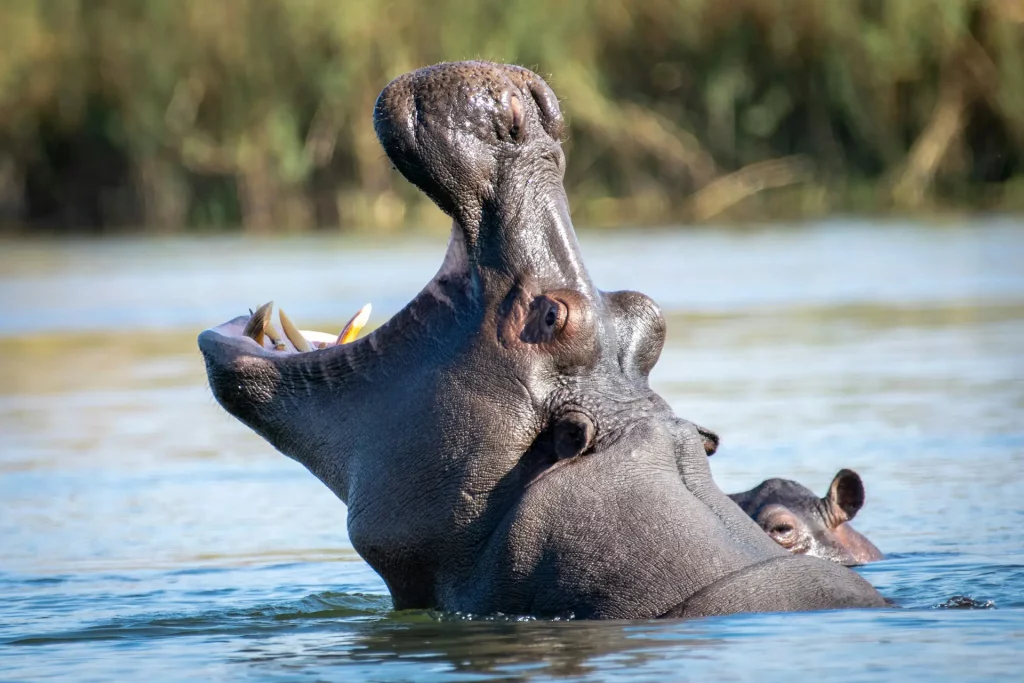
Hippopotamus Facts: 20 Surprising Truths About Hippos
Introduction: The River Horse Is Full of Surprises
The hippopotamus, whose name comes from the ancient Greek for "river horse", is one of Africa's most recognisable animals and one of its most misunderstood. It looks like an overgrown pig, spends its days bobbing in rivers, and eats nothing but grass. Yet beneath that placid surface lies an animal of superlatives: the third-largest land mammal on Earth, a cousin of whales, a manufacturer of natural sunscreen, and an ecosystem engineer whose dung reshapes entire rivers.
Here are 20 hippopotamus facts that reveal what this extraordinary animal is really about.
How Big Is a Hippopotamus?
1. Hippos are the third-largest land mammals alive. After elephants and rhinoceroses, the common hippopotamus (Hippopotamus amphibius) is the heaviest land animal on Earth, and the heaviest living member of the even-toed ungulates.
2. Males average around 1,500 kilograms. Adult males typically weigh about 1,500 kg (3,300 lbs), with females around 1,300 kg. Exceptional old males can exceed 3,000 kg, as much as a small car and a half.
3. Their skin is armour. Hippo skin is about 6 centimetres thick and can account for a quarter of the animal's body weight. It is nearly hairless and surprisingly sensitive: despite the sunscreen they produce, hippos must stay wet or their skin cracks.
The Whale Connection: Hippos' Surprising Family Tree
4. Hippos are more closely related to whales than to pigs. For centuries, naturalists grouped hippos with pigs based on their teeth and snouts. Then blood proteins, DNA, and fossils told a different story: the hippo's closest living relatives are cetaceans, the whales, dolphins, and porpoises.
5. They share an ancestor from about 55 to 60 million years ago. The common ancestor of hippos and whales branched off from other even-toed ungulates around 60 million years ago, and the hippo and whale lineages split soon after. Biologists group them together in the clade Whippomorpha, a name coined from "whippo", slang for the whale-hippo kinship.
6. The resemblance is more than skin deep. Hippos and whales both give birth and nurse underwater, both are nearly hairless, and both lack certain glands most mammals have. A 2021 study led by the American Museum of Natural History showed that their smooth aquatic skin evolved independently in each lineage, meaning the similarities are convergent solutions to life in water, not hand-me-downs from a shared aquatic ancestor.
Blood Sweat: The Hippo's Natural Sunscreen
7. Hippos secrete their own sunscreen. Hippo skin glands produce an oily fluid that starts colourless, turns red-orange within minutes, and eventually browns. Because of its colour, observers long believed hippos literally sweated blood. They do not: it is neither blood nor sweat.
8. It contains two remarkable pigments. Scientists have identified a red pigment, hipposudoric acid, and an orange one, norhipposudoric acid. Both are highly acidic compounds that absorb strongly in the ultraviolet range, shielding the hippo's sensitive skin from sunburn. The red pigment also inhibits the growth of disease-causing bacteria, giving the secretion antibiotic properties.
9. It is not a perfect shield. Even with this chemical sunscreen, a hippo that stays out of water too long will develop cracked, painful skin. The secretion supplements the hippo's aquatic lifestyle; it does not replace it.
Life Aquatic: 16 Hours a Day in the Water
10. Hippos spend up to 16 hours a day submerged. During the heat of the day, hippos wallow in rivers, lakes, and swamps, which keeps them cool and protects their skin. They emerge at dusk to graze through the night.
11. Their faces are built like periscopes. The eyes, ears, and nostrils sit high on top of the head, so a hippo can see, hear, and breathe while almost entirely underwater. They can close their ears and nostrils to seal out water.
12. Hippos cannot actually swim. Despite their aquatic life, hippos are too dense to float. They move by walking or bounding along the riverbed in slow-motion gallops, pushing off the bottom and gliding. It looks graceful precisely because the water hides the effort.
13. They can hold their breath for about five minutes. A sleeping hippo surfaces automatically to breathe without fully waking, bobbing up and down through the night like a living buoy.
14. Baby hippos are born underwater. Calves arrive in the water, must swim to the surface for their first breath within moments, and can nurse underwater, closing their ears and nostrils while they suckle. Mother hippos are famously protective, and a calf stays close for its first year.
The Night Shift: What Hippos Eat
15. Hippos are strict vegetarians. For all their fearsome weaponry, hippos eat grass, almost exclusively short grasses cropped close to the ground, plus the occasional fallen fruit. They do not eat meat, and they do not hunt.
16. They graze up to 40 kilograms a night. A hippo consumes roughly 1 to 1.5 percent of its body weight each night, a modest ration for its size, made possible by an inactive daytime lifestyle and an efficient three-chambered stomach that ferments tough grasses. They are pseudoruminants: the stomach is complex, but they do not chew cud like cattle.
17. Their grazing shapes the savanna. Nightly foraging parties fan out from the water, sometimes walking several kilometres, mowing "hippo lawns" of short grass along well-worn trails. These grazing lawns become important feeding grounds for other herbivores too.
Jaws of the River: Teeth Like Ivory Swords
18. A hippo's mouth opens up to 150 degrees. That gape, wider than any other large land animal's, is mostly for display and combat rather than eating. Yawning contests between rival males are ritualised tests of nerve.
19. Their canines can reach 50 centimetres. The lower canine tusks grow continuously into curved, self-sharpening ivory daggers. They are used for fighting other hippos, and they have made hippos targets for ivory poachers, a trade that threatens the species alongside habitat loss.
Gentle Giant? The Truth About Hippo Aggression
20. Hippos are among Africa's most dangerous animals. They are intensely territorial in water, where dominant males defend stretches of river, and females defend calves fiercely. A hippo can run at 30 km/h on land, faster than a human, and it will charge boats, people, and even crocodiles that blunder into its space. Most attacks happen when a hippo feels its territory, its young, or its escape route to water is threatened. The rule for safari-goers is simple: admire from a distance, never come between a hippo and the water.
How Hippos Talk: Honks Above and Below the Surface
Hippos are surprisingly chatty. Their signature call is the "wheeze honk", a loud bellow that starts as a wheeze and ends in a honk, audible over long distances and used to announce presence and identity. They grunt, bellow, and roar during confrontations, and they even vocalise underwater, where their calls travel efficiently between submerged animals. Mothers and calves keep in contact with softer exchanges, and the chorus of a hippo pod at dusk is one of the great sounds of the African night.
Territorial marking has its own theatre. When defecating, hippos spin their short tails like propellers, flinging dung across a wide area. This "muck-spreading" advertises a male's presence and marks the boundaries of his stretch of river.
Hippo Society: Pods, Bulls, and Bachelor Life
Hippos are social animals that gather in groups called pods, usually numbering 10 to 30 individuals, though much larger gatherings form around shrinking water in the dry season. A pod centres on a dominant bull who defends a stretch of river, plus several females, their calves, and subordinate younger males. Outside the territories, bachelor males live alone or in loose groups, biding their time.
Territorial disputes are settled largely by display: enormous yawns that show off the canines, loud bellowing, and mock charges. Real fights are brutal, with rivals slashing at each other's thick hides, and the scars on old bulls tell the story. Females run the nursery side of life. Calves are born in the water, stay glued to their mothers for the first year, and learn the pod's routines, where to wallow, when to graze, and how to read the moods of several tons of bad-tempered neighbours.
Ecosystem Engineers: What 4,000 Hippos Do to a River
Hippos do not just live in rivers; they run them. Research on Kenya's Mara River, home to more than 4,000 hippos, has revealed the scale of their influence. Ecologist Christopher Dutton and colleagues, publishing in Nature Communications, found that the Mara's hippos deposit about 8,500 kilograms of partially digested plant material into the river every single day.
That dung is a massive nutrient subsidy. A related analysis estimated the Mara's hippos contribute 1,277 tons of carbon, 180 tons of nitrogen, and 18 tons of phosphorus to the river each year, fertilising the aquatic food web from algae to fish. Hippo dung even drives the savanna's silicon cycle: up to three-quarters of the silicon moving along the Mara, a nutrient vital for microscopic diatoms, may come from hippo dung.
There is a darker side. In the dry season, dung accumulates in hippo pools, where decomposition drains the oxygen from the water. When heavy rains flush these pools, the pulse of deoxygenated water can suffocate fish downstream. Over three years of monitoring, researchers documented oxygen crashes during 49 of 55 flushing events, with 13 causing outright fish kills. The hippo is a keystone species in the fullest sense: rivers with hippos are fundamentally different rivers.
Meet the Pygmy Hippo
The common hippo has a lesser-known cousin: the pygmy hippopotamus (Choeropsis liberiensis), a separate species confined to the forests and swamps of West Africa, mainly Liberia. Standing barely half the height of its giant relative and weighing only a few hundred kilograms, the pygmy hippo is a solitary forest dweller that is more terrestrial and far shyer. It is classified as Endangered, threatened by deforestation and hunting, and far less studied than its famous cousin. When people say "hippo", they almost always mean the common hippopotamus, but the pygmy deserves its own chapter.
Conservation: A Vulnerable Giant
The common hippopotamus is listed as Vulnerable on the IUCN Red List. Its range, once stretching across much of Africa including the Nile Delta, has shrunk to sub-Saharan strongholds in East, Central, and parts of West and Southern Africa. The threats are familiar: wetland drainage and habitat loss, human-wildlife conflict as farms press against rivers, poaching for meat, and a persistent illegal trade in hippo ivory from those great canine teeth.
Yet hippos are also resilient where they are protected. Well-managed reserves in Zambia, Tanzania, Uganda, and Botswana hold thriving populations, and their role as ecosystem engineers gives conservationists an extra argument: protecting hippos means protecting the rivers themselves.
The Cocaine Hippos of Colombia
One of the strangest chapters in hippo history unfolded far from Africa. In the 1980s, drug lord Pablo Escobar illegally imported four hippos, one male and three females, for his private zoo at Hacienda Nápoles in Colombia. After Escobar was killed in 1993, the other exotic animals were relocated, but the hippos, too massive and aggressive to move easily, were left behind.
They did not just survive. They thrived. With year-round water, abundant food, and no predators or dry season to check them, the population grew at roughly 8 to 10 percent a year. By 2026, an estimated 150 to 200 hippos roamed the Magdalena River basin, the largest hippo population anywhere outside Africa, and Colombia's Environment Ministry warned the number could exceed 500 by 2030 without intervention.
The "cocaine hippos" are now officially an invasive species, stirring fierce debate. Fishermen report dangerous encounters and damaged livelihoods, ecologists worry about the impact on native river life, and in 2026 Colombia approved a plan to cull about 80 animals, alongside sterilisation and relocation efforts. It is a living experiment in what happens when a three-ton ecosystem engineer is dropped into a river system that never evolved with one.
Hippopotamus Quick Facts
| Fact | Detail |
|---|---|
| Scientific name | Hippopotamus amphibius ("river horse") |
| Size | Males ~1,500 kg (up to 3,000+ kg); females ~1,300 kg |
| Rank | Third-largest land mammal, after elephants and rhinos |
| Closest living relatives | Whales, dolphins, and porpoises |
| Diet | Herbivore; ~40 kg of grass per night |
| Time in water | Up to 16 hours per day |
| Breath hold | Around 5 minutes |
| Mouth gape | Up to 150 degrees; canines to 50 cm |
| Land speed | Up to 30 km/h in short bursts |
| Skin | ~6 cm thick; secretes UV-blocking "blood sweat" |
| Lifespan | 40-50 years in the wild |
| IUCN status | Vulnerable |
Frequently Asked Questions
Are hippopotamuses dangerous to humans? Yes. Hippos are considered among the most dangerous animals in Africa. They are highly territorial in water, fiercely protective of calves, and capable of charging at 30 km/h. Most incidents involve people blocking a hippo's path to water or surprising one at close range. They are not predators, every attack is defensive.
What do hippos eat? Grass, almost entirely. Hippos graze on short grasses at night, eating up to about 40 kg, and digest it with a complex three-chambered stomach. Despite their fearsome teeth, they do not eat meat.
Are hippos really related to whales? Yes. Molecular, fossil, and anatomical evidence shows that hippos' closest living relatives are cetaceans: whales, dolphins, and porpoises. The two lineages split around 55 million years ago.
What is hippo "blood sweat"? A reddish, oily skin secretion containing two pigments, hipposudoric acid and norhipposudoric acid. It absorbs ultraviolet light like sunscreen and inhibits bacterial growth. It is neither blood nor sweat.
Can hippos swim? Not really. They are too dense to float and instead walk or bound along riverbeds, surfacing to breathe. They can stay submerged for around five minutes at a time.
How long do hippos live? Typically 40 to 50 years in the wild, and longer in captivity, where some individuals have passed 60.
Do hippos ever eat meat? Almost never, but there are exceptions. Hippos are herbivores by design, yet researchers have occasionally documented them scavenging carcasses, including during droughts and anthrax outbreaks when dead animals are plentiful. These incidents are rare opportunism, not hunting, and grass remains the hippo's true diet.
Are hippos endangered? The common hippopotamus is listed as Vulnerable on the IUCN Red List, threatened by habitat loss, conflict with people, and poaching for meat and ivory. The pygmy hippopotamus is Endangered.
The River Horse, Reconsidered
The hippopotamus refuses to fit a simple label. It is a whale's cousin that eats grass, a gentle-looking giant that charges boats, an animal that cannot swim yet lives in water, and a vegetarian whose dung feeds entire rivers. Spend time with these twenty facts and the hippo stops being a background extra on safari and becomes what it truly is: one of evolution's most inventive answers to life at the water's edge.