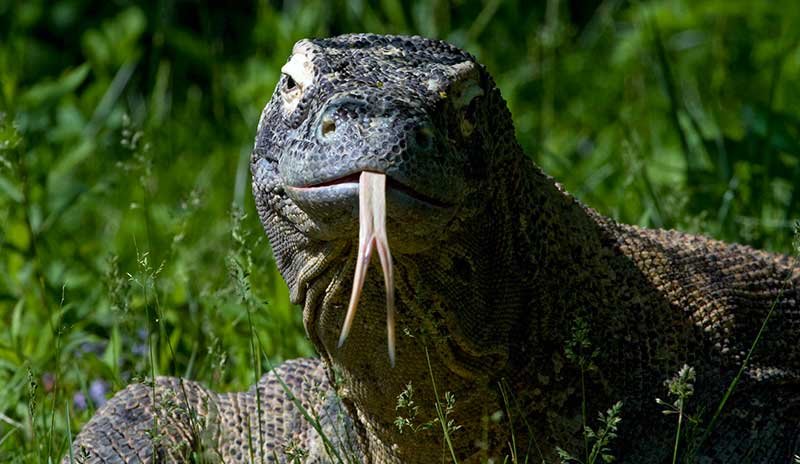
Komodo Dragon Venom: How the World’s Largest Lizard Kills
Are Komodo Dragons Venomous? The Short Answer
Yes. Komodo dragons (Varanus komodoensis) are venomous. They carry complex venom glands in their lower jaws that produce a cocktail of toxins which prevent blood clotting, drop blood pressure, and push victims toward shock. For decades, scientists believed the dragons killed with bacteria-laden saliva. That idea turned out to be wrong. The real weapon was hiding in the dragon's gums all along.
The Komodo dragon is the largest lizard on Earth, growing to around 3 metres and weighing more than 70 kilograms. It rules a handful of Indonesian islands as an apex predator, taking down deer, pigs, and even water buffalo. Understanding its venom explains how a reptile with a surprisingly weak bite became such an effective killer.
How Scientists Discovered the Venom
The breakthrough came in 2009, when a team led by venom researcher Bryan Fry of the University of Melbourne published a landmark study in the journal Proceedings of the National Academy of Sciences. Using MRI scans of a preserved Komodo dragon skull, the team found what no one had properly documented before: a series of large glands along the lower jaw that produce venom.
To study the toxins, the researchers extracted one of these glands from a dragon that had been euthanised at the Singapore Zoological Gardens because of a terminal illness. Analysis showed the gland secreted several toxic proteins. The paper concluded that Komodo dragons possess a sophisticated combined-arsenal killing apparatus: specialised teeth plus venom, working together.
The study made the Komodo dragon one of only a handful of known venomous lizards, alongside the Gila monster and the Mexican beaded lizard of North America. It also suggested that the dragon's extinct relative Megalania, a monitor lizard that reached 5.5 metres, may have been the largest venomous animal ever to live.
What Komodo Dragon Venom Does to Its Victims
Komodo dragon venom is primarily a blood-disrupting weapon. Its main documented effects include:
Anticoagulation. The venom's proteins interfere with blood clotting, so wounds keep bleeding. Fry's team found toxins related to kallikrein-like serine proteases that disrupt the coagulation cascade, meaning the victim's blood simply will not clot properly.
Hypotension. Other compounds in the venom cause blood vessels to relax and widen, which sends blood pressure plummeting. The combination of unchecked bleeding and falling blood pressure is what drives the victim toward shock.
Shock induction. The rapid blood loss and pressure drop leave the animal weak, drowsy, and eventually unconscious. Field ecologist Tim Jessop, who has studied dragons in the wild for years, observed that around 70 percent of bitten prey die within minutes, with most of the rest succumbing within hours.
Some reports on the 2009 study also note additional toxic effects, including muscle paralysis and lowered body temperature in envenomated prey. What is clear from the research is that the venom is not mainly a nerve poison. Unlike many snake venoms, it does not primarily paralyse. It bleeds the victim out and shuts the circulatory system down.
How the Venom Gets Into the Wound
Komodo dragons have no hollow fangs, so they cannot inject venom the way a viper does. Instead, the venom glands open through ducts near the front of the lower jaw and the toxins seep into the saliva. When the dragon bites, the venom washes passively into the deep wounds carved by its teeth.
And those teeth are formidable. A Komodo dragon has about 60 serrated, shark-like teeth, each up to 2.5 centimetres long, that are replaced throughout its life. The dragon bites down and pulls back with powerful neck muscles, a grip, rip and drip tactic that tears huge, gaping wounds. The venom then flows into those wounds and accelerates the blood loss.
This passive delivery system explains the dragon's famous hunting strategy: bite, release, and wait. A wounded deer may stagger away from the initial attack, but the venom keeps working. The dragon simply follows at a leisurely pace, using its extraordinary sense of smell to track the weakening animal until it collapses. Dragons have even been known to track a wounded animal for miles.
The Bacteria Myth: What Scientists Believed Before
Before 2009, the standard explanation for the dragon's lethal bite was the septic bite theory. In the 1970s and 1980s, biologist Walter Auffenberg studied Komodo dragons on their home island and noticed that large animals bitten by dragons often developed fatal infections. He proposed that the dragons used bacteria in their mouths as a kind of living weapon, flooding bite wounds with microbes that would slowly kill the victim.
The idea was repeated in textbooks, documentaries, and zoo displays for decades. But it had problems. Fry argued that it made little evolutionary sense, and subsequent research showed that the bacteria in a dragon's mouth are broadly similar to those found in the mouths of other carnivores. Water buffalo, the classic example of a dragon bite victim, are not even native to the islands; they were introduced by humans, and their infected wounds likely came from wallowing in filthy water rather than from dragon saliva.
The PNAS study formally rejected the toxic-bacteria explanation. Bacteria are still present in the bite, and any deep animal bite carries an infection risk, but they are not the dragon's killing mechanism. Venom is.
Why a Giant Lizard Needs Venom at All
There is an evolutionary puzzle here. Venom is usually a weapon for small animals that need to subdue larger prey or defend themselves, like scorpions or small snakes. Why would a 3-metre apex predator need it?
The answer lies in the dragon's skull. Computer modelling of the dragon's jaw by Fry's team showed that the lightweight skull is relatively poor at generating high bite forces but well adapted to resisting strong pulling loads. In plain terms, the dragon cannot crush, but it can slice and tear. A saltwater crocodile with a similarly sized skull produces about 6.5 times more bite force. Because the dragon cannot hold struggling prey the way a crocodile does, venom compensates: it lets the dragon wound an animal and let chemistry finish the job.
Fry's broader research also suggests that venom glands are an ancient inheritance. He found traces of venom glands in dozens of lizard and snake species and concluded that the ability to produce venom evolved just once, around 170 million years ago, in a common ancestor of lizards and snakes. Species that developed other ways of killing, like constricting snakes, lost the trait over time. The Komodo dragon kept it and paired it with a precision cutting skull, creating a dual-weapons system.
The 2009 Study in Detail: Scans, Glands, and Jaw Models
The paper that settled the debate was the work of an international team of more than two dozen researchers, led by Bryan Fry. It appeared in the Proceedings of the National Academy of Sciences on 2 June 2009 (volume 106, issue 22, pages 8969-8974), and it attacked the question from three directions at once: anatomy, biochemistry, and biomechanics.
The anatomy came first. Using magnetic resonance imaging on a preserved Komodo dragon head, the team mapped two large, previously underappreciated glands in the lower jaw, with ducts opening near the front of the mouth. The glands were far more elaborate than anything described in a monitor lizard before, and the study called them the most complex venom glands yet described in any reptile.
The biochemistry came from a rare opportunity. Two captive dragons, one at the Singapore Zoological Gardens, had to be euthanised because of terminal illness, and the team was able to extract venom gland tissue. Laboratory analysis revealed a mixture of toxic proteins whose known functions included inhibiting blood clotting, lowering blood pressure, causing muscle paralysis, and inducing hypothermia, a combination that drives envenomated prey into shock and unconsciousness.
The biomechanics closed the loop. The researchers built computer models of the dragon's skull and compared its performance with those of other predators. The models showed a lightweight skull that is relatively poor at generating high bite forces but excellent at resisting the high pulling loads produced when the animal yanks backward on a bite. In other words, the skull is built for slicing, not crushing, and the venom is the partner that turns a slicing wound into a killing one.
Together, these three lines of evidence rejected the long-standing bacteria explanation and established the dragon's bite as a combined-arsenal system: specialised serrated teeth plus venom with anticoagulant and shock-inducing activity.
Komodo Dragon Venom vs. Other Venoms
The Komodo dragon is not the only venomous lizard, and its venom works quite differently from a snake's. This comparison puts the differences side by side.
| Feature | Komodo dragon | Gila monster / beaded lizard | Viper (e.g., rattlesnake) |
|---|---|---|---|
| Gland location | Lower jaw | Lower jaw | Upper jaw, behind the eyes |
| Delivery method | Passive seep into wounds torn by serrated teeth | Chewing action forces venom through grooved teeth | Injection through hollow, hinged fangs |
| Main effects | Prevents clotting, drops blood pressure, induces shock | Lowers blood pressure, impairs clotting, attacks muscle tissue | Varies by species: destroys tissue, disrupts clotting, or attacks nerves |
| Hunting style | Bite, release, and track the weakening prey | Bites and chews, holding on | Strike and release, then follow the scent trail |
| Relative bite force | Weak for its size (a similar-sized crocodile skull bites 6.5x harder) | Modest | Not the main weapon; fangs do the work |
One striking finding from the reporting on Fry's work: some of the blood-pressure-lowering compounds in Komodo dragon venom were described as being as potent as those found in the venom of the inland Taipan of Australia, one of the most venomous snakes in the world. Potency, however, is only half the story. A Taipan injects its venom deep with precision fangs, while a dragon relies on gaping wounds and patience.
The Old Theory vs. the New Science
It helps to see exactly what changed in 2009, because the bacteria story was not a fringe idea. It was the mainstream explanation for nearly three decades.
| Aspect | Bacteria theory (pre-2009) | Venom science (2009 onward) |
|---|---|---|
| Proposed by | Walter Auffenberg, based on fieldwork from 1969 onward | Bryan Fry's team, University of Melbourne |
| Proposed mechanism | Bacteria in saliva flood the wound and cause fatal sepsis | Venom toxins stop clotting and crash blood pressure |
| Key evidence | Bitten water buffalo developed fatal infections | MRI revealed venom glands; lab tests identified toxic proteins |
| Supporting logic | Dragons seemed to let prey escape and die later | Computer jaw models showed weak bite force compensated by venom |
| Status today | Rejected as the killing mechanism by the PNAS study | Accepted; bacteria remain a secondary infection risk |
The bacteria theory was not entirely baseless. Komodo dragon mouths do harbour many bacterial strains, and a deep bite wound can absolutely become infected. The error was in assigning the bacteria the starring role. The 2009 study showed that the venom acts far too quickly, and far too specifically on the blood and circulatory system, for slow-moving infection to be the primary cause of death.
Beyond the Bite: What Dragon Biology Teaches Medicine
Venom research rarely ends with the animal. Compounds that manipulate blood pressure, clotting, and cell membranes are exactly the kinds of molecules drug developers look for, and lizard biology has already produced one famous medicine.
The diabetes drug exenatide, sold as Byetta, is a synthetic version of exendin-4, a hormone-like compound first identified in the venom of the Gila monster. The compound mimics a human gut hormone involved in insulin release, and it was approved by the US Food and Drug Administration in 2005 for type 2 diabetes. The discovery even helped pave the way for the wider class of GLP-1 drugs that followed. It is a reminder that a venomous lizard's chemistry can end up in a pharmacy.
The Komodo dragon has its own medical storyline, though it comes from blood rather than venom. Researchers at George Mason University, led by microbiologist Monique van Hoek, analysed the blood plasma of Komodo dragons and identified dozens of antimicrobial peptides, small protein fragments that fight bacteria. From one natural peptide, dubbed VK25, they engineered a short synthetic version called DRGN-1. In a study published in the journal npj Biofilms and Microbiomes in 2017, DRGN-1 killed multidrug-resistant bacterial strains, broke up tough bacterial biofilms, and significantly sped up wound healing in infected wounds in mice. It is early-stage research, not a medicine, but it shows how an animal that lives with a mouthful of bacteria became a source of ideas for fighting them.
Quick Facts: Komodo Dragon Venom at a Glance
| Feature | Detail |
|---|---|
| Venomous? | Yes, confirmed by MRI and biochemical study in 2009 |
| Gland location | Lower jaw, opening through ducts at the front |
| Delivery method | Passive seep into wounds (no hollow fangs) |
| Main effects | Prevents blood clotting, lowers blood pressure, induces shock |
| Primary strategy | Bite, release, and track the weakening prey |
| Old theory | Toxic bacteria in saliva (debunked by the 2009 study) |
| Other venomous lizards | Gila monster, Mexican beaded lizard |
| Scientific name | Varanus komodoensis |
Frequently Asked Questions
Is a Komodo dragon bite fatal to humans? It can be, though attacks on humans are rare. The combination of deep lacerations, venom-driven blood loss, and the risk of secondary infection makes any bite a medical emergency requiring immediate hospital care.
Is there an antivenom for Komodo dragon venom? No specific antivenom exists for Komodo dragon venom. Treatment is supportive: wound cleaning and surgical care, antibiotics to guard against infection, fluids to stabilise blood pressure, and blood products if the anticoagulant effect causes serious bleeding.
Is Komodo dragon venom like snake venom? Similar in some effects, different in delivery. Like some snake venoms, it disrupts clotting and blood pressure. But unlike a viper, the dragon cannot inject it; the venom seeps into wounds torn open by serrated teeth.
Are baby Komodo dragons venomous too? Young dragons hatch with the same anatomy, including venom glands and serrated teeth. They mostly hunt insects and small animals, and spend much of their youth in trees to avoid being eaten by adult dragons.
Why don't Komodo dragons poison themselves? Like many venomous animals, dragons appear to be resistant to their own toxins. Researchers have also found potent antimicrobial peptides in Komodo dragon blood, which may help them survive the bacteria-rich environment of their own mouths and wounds.
How quickly does Komodo dragon venom work? Faster than the old bacteria story ever allowed. Field researcher Tim Jessop observed that about 70 percent of bitten prey die within minutes and most of the rest within four hours. The venom's attack on clotting and blood pressure explains that speed.
Is Komodo dragon venom stronger than snake venom? In at least one respect it compares well: researchers found that some of its blood-pressure-lowering compounds are as potent as those in the venom of the inland Taipan, one of the world's most venomous snakes. But potency is not everything. A Taipan injects venom precisely through hollow fangs, while a dragon depends on large torn wounds and a waiting game.
What should you do if bitten by a Komodo dragon? Treat it as a medical emergency and get to a hospital immediately. Apply pressure to slow bleeding, keep the wound as clean as possible, and keep the victim still and calm. Do not wait to see whether symptoms develop, because the venom's effects on blood clotting and blood pressure need professional management.
Can Komodo dragons really smell blood from far away? Their sense of smell is extraordinary. Using their forked tongues to sample the air, dragons can detect carrion and wounded animals over long distances, which is how they relocate prey that escapes the first bite. Park guides in Komodo National Park advise visitors, including menstruating women, to be cautious, since the scent of blood can attract the dragons' interest.
A Predator Perfected
The story of Komodo dragon venom is a reminder that nature's most effective weapons are not always the obvious ones. For thirty years, science was confident the dragon killed with germs. It took a medical scanner and a willingness to question the textbooks to reveal the truth: a pair of unassuming glands, a mouthful of serrated blades, and a venom that turns a single bite into a slow, unstoppable collapse. On its remote Indonesian islands, the dragon remains exactly what it has always been, an apex predator whose every adaptation serves the hunt.