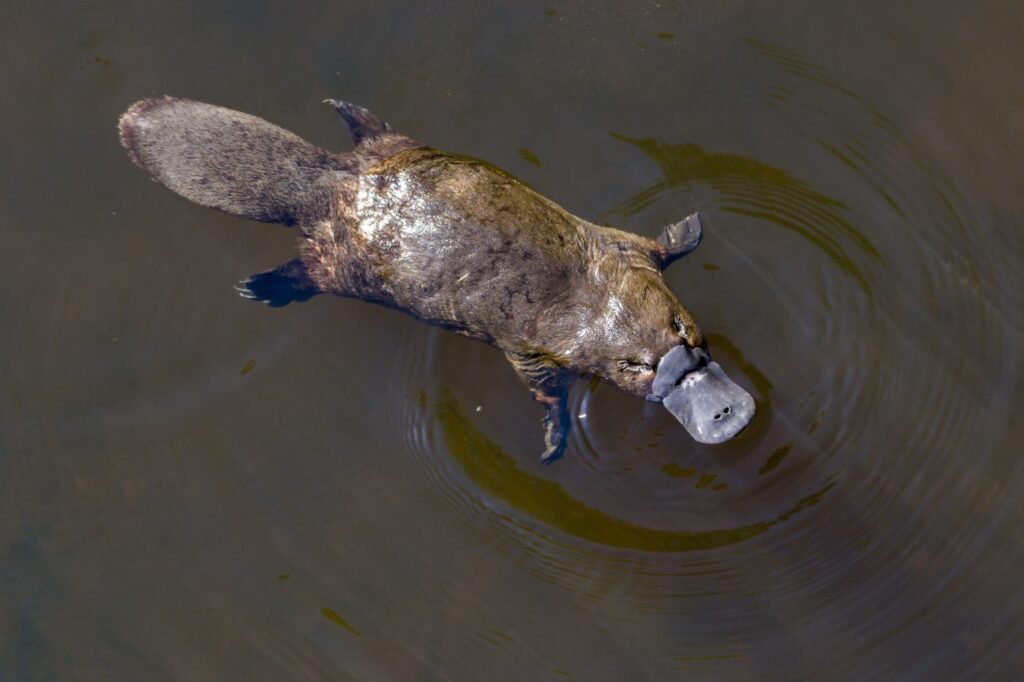
Platypus Facts: Eggs, Venom, and an Electric Sixth Sense
Platypus Facts at a Glance
The platypus (Ornithorhynchus anatinus) is the animal that made scientists question their own eyes. It has the bill of a duck, the tail of a beaver, the feet of an otter, and the reproductive habits of a reptile, yet it is unmistakably a mammal: warm-blooded, fur-covered, and nursing its young on milk. It lays eggs, hunts with an electric sense no other mammal shares, and the males carry venomous spurs on their ankles. When the first preserved specimen reached Europe in 1799, naturalists assumed it was a hoax stitched together from spare parts.
Here are the essential platypus facts before we unpack each wonder.
| Fact | Detail |
|---|---|
| Scientific name | Ornithorhynchus anatinus |
| Group | Monotreme: one of only five egg-laying mammals |
| Range | Eastern Australia, including Tasmania |
| Size | 40-63 cm long (males), 37-55 cm (females); 0.8-3 kg |
| Diet | Carnivore: insect larvae, worms, shrimp, yabbies, shellfish |
| Special sense | Electroreception: detects prey's electric fields with bill |
| Venom | Males have venomous spurs on hind ankles |
| Reproduction | Lays 1-3 leathery eggs in a burrow; no nipples, milk seeps through skin |
| Chromosomes | 52, including 10 sex chromosomes |
| Conservation status | Near Threatened (IUCN), population decreasing |
What Is a Platypus? A Mammal That Breaks the Rules
The platypus is the sole living member of its family, Ornithorhynchidae, and one of only five surviving monotremes, the ancient lineage of egg-laying mammals. The other four are echidnas, the spiny anteaters of Australia and New Guinea. Monotremes branched off from the rest of the mammal family tree before placental mammals and marsupials went their separate ways, which means the platypus preserves a window into what early mammals were like, more than 100 million years after the fact.
The name "monotreme" comes from Greek for "single opening," referring to the cloaca, the single rear opening for digestion, urination, and reproduction that monotremes share with birds and reptiles. The platypus's scientific name is equally descriptive: Ornithorhynchus means "bird snout," and anatinus means "duck-like."
Everything about the platypus looks like a compromise between categories, but modern biology reads it differently. The platypus is not a rough draft of a mammal. It is a highly specialized animal whose ancestors took a different evolutionary road and refined it for over a hundred million years.
The 1799 Hoax: When Scientists Thought It Was Fake
When European naturalists first encountered the platypus, disbelief was the rational response. In 1799, a preserved platypus skin reached the British Museum, sent from the new colony in New South Wales. The naturalist George Shaw examined it and concluded it was a fraud: some taxidermist's joke, a duck's bill sewn onto a beaver-like body. He even looked for stitches.
Shaw eventually published the first scientific description, but skepticism lingered for decades. When reports arrived that this furry, milk-producing animal laid eggs, many scientists refused to believe it until the 1880s, when conclusive observations finally settled the matter. The platypus had forced zoology to expand its definition of "mammal," and it remains the textbook example of why nature does not read textbooks.
A Mammal That Lays Eggs
Yes, platypuses lay eggs, and they are one of only two mammal groups on Earth that do. (The other is the echidnas.) Breeding happens in spring. The female digs an elaborate nursing burrow, much longer than her everyday burrow, up to 20 meters in some accounts, with chambers blocked by packed earth plugs for protection. There she lays one to three small, leathery eggs, softer and more flexible than a bird's.
She incubates them curled around the eggs, keeping them warm with her body and tail. After about 10 days, the eggs hatch, and out come babies the size of lima beans: blind, hairless, and utterly helpless. They remain in the burrow for about four months, growing rapidly on mother's milk before emerging to learn the water for themselves.
Why lay eggs at all, when every other mammal lineage abandoned the practice? The honest answer is that nobody fully knows, but the monotreme strategy works: by laying eggs, the female avoids carrying a pregnancy while maintaining the intense, energy-hungry lifestyle of an aquatic hunter, and she can invest heavily in milk afterward instead.
Milk Without Nipples: How Platypus Babies Feed
If egg-laying stretches the definition of mammal, platypus nursing stretches it further. Female platypuses have mammary glands but no nipples. Instead, milk is secreted through pores in the skin of the mother's belly and pools in grooves in her fur, where the babies lap it up. The mother typically nurses lying on her back, with the young suckling the milk from her abdominal fur.
Platypus milk is remarkably rich, and recent research has found it contains unique antibacterial proteins, one of which scientists have studied for potential antibiotic applications. This makes evolutionary sense: milk sitting on skin, exposed to river water and burrow soil, needs serious antimicrobial defenses to keep the babies safe. It is a small detail that reveals how thoroughly the platypus has adapted its mammal toolkit to its strange life.
Hunting With Electricity: The Bill's Sixth Sense
The platypus's bill looks like a duck's, but it is nothing like a beak. It is a soft, rubbery, extraordinarily sensitive organ packed with tens of thousands of receptors, and it gives the platypus a sense that no other mammal possesses: electroreception.
Here is how a hunt works. The platypus dives and closes everything: folds of skin seal its eyes and ears, and its nostrils shut with a watertight seal. Swimming blind, deaf, and smell-less, it sweeps its bill from side to side through the water. Every living thing generates faint electric fields through muscle contractions, and the electroreceptors in the bill detect those fields, while separate touch receptors sense water disturbances. Together, the two systems let the platypus pinpoint a shrimp or insect larva hidden in the mud with astonishing precision, in water too murky for eyes to be any use.
Only a few other animals share this sense, mostly fish like sharks and rays. Among mammals, only the monotremes have it. The platypus genome, sequenced in 2008 by an international team led by Washington University, revealed an expansion of odor-receptor genes as well, suggesting the bill may detect chemical cues underwater too, a sensory richness scientists are still mapping.
The Venomous Spur: One of the Few Venomous Mammals
Male platypuses carry a weapon that seems borrowed from another class of animals entirely: a sharp, hollow spur on each hind ankle, connected to a venom gland in the upper leg. During the breeding season, males use these spurs in fights with rivals, lashing out with their hind legs to inject venom.
The venom will not kill a human, but envenomation is famously agonizing. Pain can be immediate and excruciating, sometimes resistant to standard painkillers, and has been reported to linger for weeks or even months. It can kill smaller animals such as dogs. The venom's production ramps up during the breeding season, which strongly suggests its primary purpose is male-to-male combat rather than defense against predators.
The genome project added a remarkable twist: the genes behind platypus venom evolved from the same ancestral gene family as reptile venoms, duplicated independently. Nature invented venom twice using the same genetic raw material, once in snakes and lizards, once in this improbable mammal.
Built for Water: Fur, Feet, and Burrows
The platypus is superbly engineered for its semiaquatic life. Its body is streamlined and covered in dense, waterproof fur: a thick underfur that traps an insulating layer of air against the skin, plus longer guard hairs on top. The fur is so effective that the animal stays warm in cold mountain streams, and it must groom regularly to maintain the waterproofing. Its body temperature runs about 32 degrees Celsius, lower than the 37 typical of placental mammals, a trait researchers believe evolved as an energy-saving adaptation.
In the water, the platypus propels itself by paddling with its large, webbed front feet, steering with its hind feet and broad, flat tail. On land, the webbing retracts, folding back to expose strong claws, and the platypus walks on its knuckles to keep the webbing clear. It uses those claws to dig burrows in riverbanks, usually just above the waterline and often hidden under root tangles. There are two kinds: short, straight camping burrows for daily rest, with two entrances, and the long, elaborate nursing burrows females dig for breeding.
The tail doubles as a fat-storage organ, holding reserves the animal draws on when food is scarce, a useful buffer for a predator that burns enormous energy hunting. Platypuses sleep curled up with the tail wrapped around the bill, conserving heat, and they rest up to 14 hours a day in their burrows, reportedly spending more time in REM sleep than any other animal studied.
What Do Platypuses Eat?
Platypuses are carnivores and bottom feeders. They scoop up insect larvae, worms, freshwater shrimp, yabbies (Australian freshwater crayfish), and small shellfish from riverbeds, taking in mouthfuls of gravel and mud along with the prey. Everything is stored in cheek pouches, and at the surface the platypus mashes the catch into a paste for swallowing. Since platypuses have no teeth as adults, the swallowed gravel helps grind the food, a low-tech mill for a high-tech hunter.
They are prodigious eaters, needing to consume a large fraction of their body weight daily to fuel their active metabolism, which is why they spend so many hours foraging each night. They hunt mostly at night and in the early morning, resting in their burrows during the day.
Where Platypuses Live
Platypuses are found only in eastern Australia, from Queensland down through New South Wales and Victoria, plus Tasmania and King Island. They inhabit freshwater rivers, streams, and lakes, favoring clean water with stable banks for burrowing and plenty of invertebrate prey. Larger individuals tend to live in the south; Tasmanian platypuses are bigger than their Queensland relatives.
They are solitary and shy, with males and females coming together only to mate. Male territories often overlap, and the males avoid each other by foraging at different times, a time-share arrangement that reduces conflict outside the breeding season. Population densities are naturally low, which makes platypuses hard to study and slow to recover from declines.
Platypus vs Echidna: The Two Monotremes Compared
The platypus's only living relatives are the four echidna species, and comparing them shows how far the two monotreme lineages have diverged.
| Feature | Platypus | Echidnas |
|---|---|---|
| Species | 1 | 4 (short-beaked + 3 long-beaked) |
| Habitat | Freshwater rivers and lakes | Forests, deserts, alpine areas (land) |
| Diet | Aquatic invertebrates, shrimp, yabbies | Ants, termites, worms |
| Special sense | Electroreception in the bill | Electroreception in the snout (weaker) |
| Venom | Males: hind-ankle spurs | Males: smaller, non-venomous spur |
| Eggs | 1-3 leathery eggs in burrow | Single egg carried in a pouch |
| Swimming | Superb swimmer | Cannot swim well |
| Size | 0.8-3 kg | 2-16 kg depending on species |
Both lay eggs, both nurse without nipples, and both carry the ancient monotreme blueprint. But where the echidna became a land-dwelling ant specialist, the platypus committed to the water and became one of evolution's most inventive hunters.
Conservation: A Near-Threatened Icon
The platypus is listed as Near Threatened by the IUCN, with a decreasing population trend, and the pressures on it are thoroughly modern. Habitat destruction and fragmentation from land clearing, water extraction and drought reducing river flows, pollution and sedimentation, and drowning in fishing nets and yabby traps all take a toll. Climate change, bringing hotter droughts and more extreme floods to eastern Australia, threatens the stable river systems platypuses need.
In November 2020, a scientific assessment recommended upgrading the platypus to threatened status under Australia's federal EPBC Act, reflecting documented declines across its range. The species has been legally protected in all states where it occurs since 1912, when the fur trade that once targeted it was shut down, and captive breeding programs have had only limited success, which means wild habitat protection is the only real safety net.
There is also a quieter threat: because platypuses are solitary, shy, and largely nocturnal, declines can go unnoticed until they are severe. Long-term monitoring programs, including community platypus surveys in which volunteers watch rivers at dawn and dusk, are filling the data gaps. Protecting the platypus ultimately means protecting rivers themselves: clean water, natural flows, and intact banks.
Frequently Asked Questions
Do platypuses lay eggs? Yes. Platypuses are monotremes, mammals that lay eggs. The female lays one to three leathery eggs in a burrow nest; they hatch after about 10 days.
Are platypuses venomous? Males are. They have hollow spurs on their hind ankles connected to venom glands, used mainly in fights with other males during breeding season. The venom causes excruciating pain in humans that can last for weeks or months, though it is not lethal to people.
How do platypuses find food without seeing? They hunt with electroreception. With eyes, ears, and nostrils sealed shut underwater, they sweep their sensitive bills through the water to detect the faint electric fields generated by prey muscle movements, combined with touch receptors that sense water disturbance.
Do platypuses have nipples? No. Female platypuses secrete milk through pores in their belly skin, and the babies lap it from grooves in her fur. The milk contains unique antibacterial proteins that protect it from contamination.
Why did scientists think the platypus was fake? When the first specimen reached England in 1799, its combination of duck-like bill, beaver-like tail, webbed feet, and fur seemed like a taxidermist's hoax. Naturalist George Shaw looked for stitches before accepting it as real.
Are platypuses mammals if they lay eggs? Yes. They are warm-blooded, breathe air, have fur, and nurse their young with milk, all defining mammal traits. They belong to the monotremes, the egg-laying branch of the mammal family tree.
How many chromosomes does a platypus have? Fifty-two, including an extraordinary ten sex chromosomes. For comparison, humans have 46 chromosomes with two sex chromosomes. One of the platypus's X chromosomes resembles a bird's Z chromosome.
What do platypuses eat? Insect larvae, worms, freshwater shrimp, yabbies, and small shellfish, scooped from riverbeds and mashed with the help of swallowed gravel, since adults have no teeth.
Where do platypuses live? In freshwater rivers, streams, and lakes of eastern Australia and Tasmania. They rest in burrows dug into riverbanks during the day and forage mostly at night.
Can you have a platypus as a pet? No. Platypuses are protected species, extremely difficult to keep in captivity, and males are venomous. They are also solitary, shy wild animals with specialized needs no home can meet.
Are platypuses endangered? They are listed as Near Threatened with a decreasing population. A 2020 scientific assessment recommended upgrading them to threatened under Australia's federal law due to habitat destruction and declining numbers.
What is the difference between a platypus and an echidna? Both are egg-laying monotremes, but platypuses are semiaquatic with webbed feet, bills, and electroreception for hunting underwater prey, while echidnas are land-dwelling, spiny ant-eaters. Only male platypuses are venomous.
Evolution's Boldest Experiment
The platypus reads like a list of contradictions: a mammal that lays eggs, a duck-billed hunter that closes its eyes to see, a furry animal with reptile-born venom and ten sex chromosomes. But every contradiction resolves into an adaptation, refined over more than a hundred million years in Australia's rivers. The scientists of 1799 were wrong to suspect a hoax, but right about one thing: nothing about this animal was supposed to be possible. It simply is.
Research note: Genome and venom details follow the 2008 Nature platypus genome paper (Warren et al.) via Washington University; natural history follows National Geographic and Australian natural-history references; conservation status follows the IUCN Red List and the 2020 EPBC assessment recommendation.