Cheetah Speed Facts: How Fast Is the World’s Fastest Cat?
The cheetah is the fastest land animal on Earth, and that sentence barely does the work this cat's body performs. In the time it takes you to read this paragraph, a sprinting cheetah could cross a football field and turn twice. But the famous numbers you have heard, the "70 miles per hour" repeated in every documentary, deserve a closer look. Some are true. Some were never properly measured. And the most interesting cheetah speed facts are not about top speed at all.
This is the full story: the verified measurements, the body that makes them possible, what actually happens during a hunt, and why the fastest animal on land is losing the race against extinction.
Cheetah Speed Facts at a Glance
| Fact | Detail |
|---|---|
| Scientific name | Acinonyx jubatus |
| Commonly cited top speed | 60 to 70 mph (96 to 112 km/h) |
| Highest reliably measured speed | 104 km/h (65 mph) |
| Acceleration | 0 to 60 mph in about 3 seconds; 0 to 45 mph in 2.5 seconds |
| Stride length | 20 to 22 feet (6 to 6.7 m) per stride |
| Top speed endurance | About 30 seconds |
| Average hunt speed (GPS collars) | Around 54 km/h, well below top speed |
| After a chase | Needs about 30 minutes to recover before eating |
| Conservation status | Vulnerable (IUCN), fewer than 7,000 adults in the wild |
How Fast Can a Cheetah Run? Sorting Myth From Measurement
Ask how fast a cheetah runs and most sources answer "70 miles per hour." The Smithsonian's National Zoo cites 60 to 70 mph, or 96 to 112 km/h, and National Geographic agrees that wild cheetahs can reach nearly 70 mph. These figures are the standard, reputable answer, and they are not wrong. But they are the top of a range, not a single settled number, and the history behind them is messier than it looks.
For years, a figure of 114 km/h (71 mph) circulated widely in books and documentaries. According to a careful review summarized on Wikipedia, that number has been discredited because the measurement method behind it was faulty. It is a useful reminder that even famous animal facts deserve scrutiny. The highest reliably reported running speed is 104 km/h, about 65 mph. A speed of 100.1 km/h has also been reliably measured, and an 11-year-old cheetah at the Cincinnati Zoo was clocked at 98 km/h.
Then there is the gap between what a cheetah can do and what it usually does. Researchers who fitted wild cheetahs with GPS collars found that real hunts happen at much lower speeds than the record books suggest. The average running speed recorded during hunts was about 54 km/h (34 mph), and the highest was 93 km/h (58 mph). The cheetah uses its maximum speed only to close distance in a straight line, then follows its prey through three or four zigzag twists as the target tries to escape. Top speed is a tool, not a lifestyle.
Built for Speed: The Anatomy of a Sprinter
A cheetah is not a fast lion. It is a completely different machine, rebuilt from nose to tail for one purpose. Every major feature of its body contributes to the sprint.
The spine is the engine. A cheetah's backbone is extraordinarily flexible, coiling and extending like a spring with each stride. Combined with long, slender legs, this lets the cat fully stretch its body mid-sprint and cover 20 to 22 feet (6 to 6.7 meters) in a single stride, according to the San Diego Zoo. For much of that stride, all four feet leave the ground entirely. The animal is not running so much as repeatedly throwing itself forward through the air.
The feet are the tires. Cheetahs are the only big cats with semi-retractable claws, more like a dog's than a cat's. National Geographic compares them to the spikes on a sprinter's shoe: they dig in and provide traction during acceleration and hard turns. The foot pads are hard and ridged for grip, unlike the soft pads of other cats.
The tail is the rudder. Long and muscular with a flat shape, it swings to counterbalance the body during sharp turns. The San Diego Zoo notes that cheetahs can execute quick turns even in midair thanks to this tail, which lets them match the jinking escapes of antelope at full speed.
The lungs and airways are the intake system. Large nasal passages gulp in oxygen during the sprint, and an enlarged heart and lungs feed the muscles' enormous demand. Even the inner ear plays a role: National Geographic reports that the shape of the cheetah's inner ear helps it maintain balance and keep its head steady while the body pitches and rolls beneath it, so its eyes stay locked on the target.
| Adaptation | What it does |
|---|---|
| Flexible spine | Extends stride to 20+ feet, stores and releases energy like a spring |
| Long, slender legs | Maximizes stride length and reduces weight |
| Semi-retractable claws | Act like track spikes for traction during sprints and turns |
| Hard foot pads | Grip the ground instead of cushioning it |
| Long muscular tail | Works as a rudder for sharp turns, even midair |
| Large nasal passages | Flood the lungs with oxygen at full exertion |
| Specialized inner ear | Keeps the head steady and eyes fixed on prey |
Acceleration That Embarrasses Sports Cars
Top speed gets the headlines, but acceleration is the cheetah's true superpower. National Geographic reports that a cheetah can go from zero to 60 miles per hour in only three seconds. The Smithsonian puts it another way: zero to 45 mph in just 2.5 seconds. The fastest production cars in the world need about 3.5 seconds to reach 60 mph, according to Consumer Reports. The cheetah beats them off the line, on foot, powered by meat.
To put that in human terms, consider Usain Bolt, the fastest person ever recorded. His peak speed during his 2009 world record run was 27.34 mph (44 km/h), according to Guinness World Records. A cheetah at cruising hunt speed is already twice that. At full sprint, it is approaching three times faster than the greatest human sprinter in history. There is no outrunning this animal, and prey species know it: survival depends on turning, not on straight-line speed.
Even against other fast animals, the cheetah's launch is exceptional. For comparison, polo horses, themselves bred for quick bursts, go from zero to about 36 km/h in 3.6 seconds. The cheetah is doing nearly triple that speed in less time.
The 30-Second Rule
Here is the catch built into all that performance. A cheetah can hold top speed for only about 30 seconds. The sprint generates enormous heat and burns through oxygen and energy reserves at a terrifying rate. If the chase is not over quickly, it is over.
This is why cheetah hunts are usually finished in less than a minute. After a failed or successful chase, the cat is spent. It must rest for roughly half an hour before it can even eat, panting to dump heat and repay the oxygen debt. During that vulnerable window, the kill can be stolen. Lions, hyenas, and leopards routinely bully cheetahs off their meals, and the cheetah, exhausted and outmatched, usually walks away rather than fight. Speed won the race but cannot win the wrestling match.
This trade-off shapes everything about cheetah ecology. The cat must hunt in the cooler hours, must pick its moment with care, and must eat fast. It is the price of being the fastest: nothing else in nature sprints this hard.
Anatomy of a Hunt, Step by Step
A cheetah hunt is a daylight operation, which already sets it apart from most big cats. The sequence runs like this.
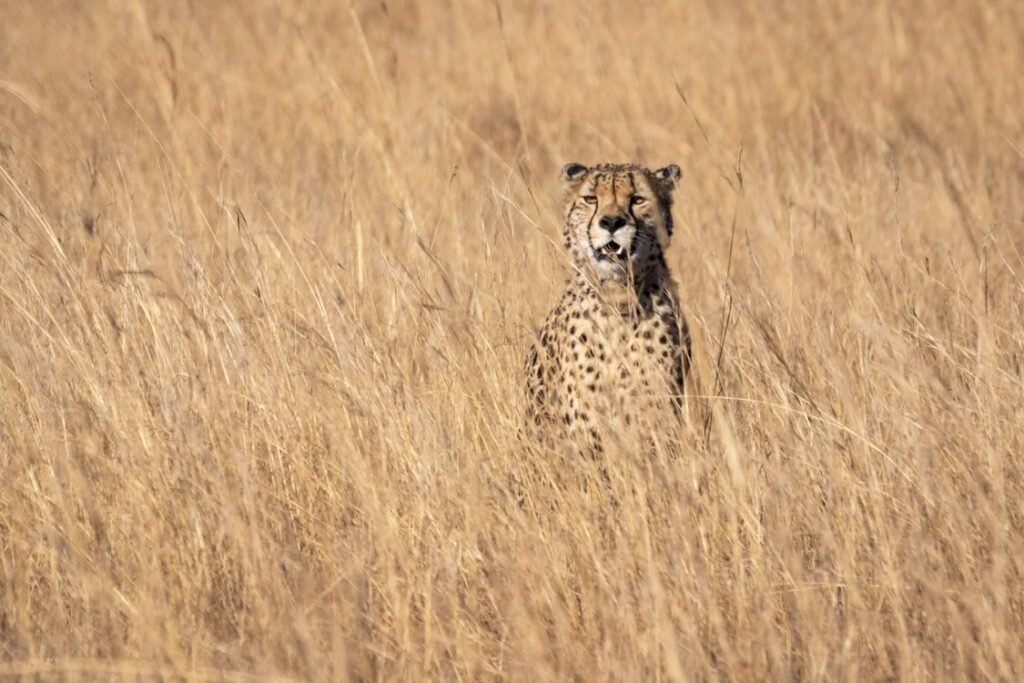
First comes the scan. Cheetahs have exceptional eyesight and use it to survey the grassland from a vantage point, a termite mound or a low rise, looking for antelope, warthogs, hares, or young wildebeest. Their spotted coats melt into the tall, dry grass, and they approach with slow, deliberate stealth, freezing whenever the prey looks up.
The cheetah creeps as close as it dares and waits. It begins the chase only when the target starts to flee, exploding from stillness to full speed in seconds.
Then comes the wrestling phase. Prey animals zigzag desperately, and the cheetah answers with the tail-rudder turns its body was built for. When it gets close enough, the cheetah does not pounce like a leopard. It trips or knocks the prey off balance, often with a sweeping forepaw, and brings it down at speed.
The kill is efficient rather than dramatic. A cheetah's teeth are shorter than those of other big cats, so instead of a crushing bite, it clamps its strong jaws around the prey's throat and suffocates it. Then, if the hunt succeeded, it eats as fast as it can, because every minute of delay is an invitation to every lion and hyena within smelling distance. Cheetahs rarely scavenge. They are hunters or they are hungry.
How Cheetah Speed Compares
The cheetah is the fastest land animal, but how big is the gap? Here is how the verified numbers stack up.
| Animal | Top speed | Notes |
|---|---|---|
| Cheetah | 104 km/h (65 mph) reliably measured | Up to 112 km/h widely cited; 30-second limit |
| Pronghorn | About 80 to 88 km/h | Fastest land animal in the Americas; built for endurance |
| Lion | About 80 km/h | Faster than it looks, but only in short bursts |
| Greyhound | About 72 km/h | Fastest dog breed; cheetahs outrun them easily |
| Wildebeest | About 80 km/h | Common cheetah prey; survives by turning and herding |
| Usain Bolt (human) | 44 km/h peak | Fastest human ever recorded, 2009 |
The pronghorn deserves a note. It is the second-fastest land mammal, and its speed is often explained as an evolutionary ghost: it evolved to outrun the now-extinct American cheetah, and kept its speed long after its predator vanished.
More Than Muscle: The Cheetah's Hidden Talents
Speed dominates the cheetah's reputation, but the animal is full of quieter surprises.
Each cheetah's spot pattern is unique, arranged like a fingerprint across its tawny coat, which helps researchers identify individuals. The coat itself shifts with habitat: desert cheetahs run smaller and paler, while a rare genetic mutation in southern Africa produces "king cheetahs" with merged spots and stripes.
The cheetah's voice is another surprise. Unlike lions, tigers, leopards, and jaguars, cheetahs cannot roar. Their vocal anatomy does not allow it. But they can purr, exactly like a house cat, and their vocabulary is wider than any other big cat's. The Smithsonian documents chirps like a bird's, a yelping call that carries up to a mile, hisses, stutters, and an "eeaow" that sounds remarkably like a domestic meow. Mothers chirp instructions to cubs; females chirp to attract mates.
Socially, cheetahs break the big-cat mold too. Females live alone with large home ranges, following migratory herds across territories that can span up to 370 square miles. Males, unusually, form small groups called coalitions, usually brothers from the same litter, who hold small territories together and defend them as a team. Lone males fare poorly; the coalition is the cheetah's answer to the lion's pride.
Cubs arrive after about three months of gestation, in litters of three to five, each weighing only 5 to 10 ounces, barely more than a newborn house kitten. They wear a silvery mantle of long hair along their necks and backs that fades as they grow. The mother raises them alone for about 18 months, teaching them to hunt through play. The odds are brutal: the African Wildlife Foundation estimates that only about 5 percent of cubs survive to adulthood, lost to lions, hyenas, eagles, and starvation.
Why the Fastest Animal on Land Is Losing the Race
Here is the hardest cheetah fact. The IUCN lists the cheetah as Vulnerable, with a decreasing population, and scientists have argued it should be uplisted to Endangered. National Geographic reports fewer than 7,000 adult cheetahs remaining in the wild. Around 1900, there were at least 100,000 cheetahs across Africa and western Asia. Today the species is extinct in at least 13 of its native countries and has lost as much as 90 percent of its historic range, surviving on roughly 10 percent of the land it once roamed.
The causes are almost entirely human. Cheetahs need enormous, connected territories: National Geographic cites estimates that viable populations require upwards of 3,800 square miles of linked habitat. Human settlement, farming, and roads have shattered the grasslands into fragments, and most protected areas are simply too small to hold cheetah populations. When cheetahs kill livestock, farmers kill cheetahs in retaliation. The illegal wildlife trade takes hundreds of cubs a year, many smuggled as exotic pets.
Underneath it all runs a genetic problem millions of years old. Cheetahs have extremely low genetic variation, the legacy of a population bottleneck near the end of the last ice age that nearly wiped them out. Low diversity means less ability to adapt to disease and environmental change. The species survived that ancient crisis. Whether it survives the current one depends on us.
Conservation is difficult precisely because cheetahs range so widely. It requires cooperation across countries, better land planning, livestock protection programs that reduce retaliatory killing, and strict enforcement against the pet trade. The Cheetah Conservation Fund works directly with farming communities in Namibia, home to the largest remaining population of about 2,500 cats, on solutions like livestock guarding dogs that protect herds without harming predators. Hunting cheetahs is illegal in most range countries, and international commercial trade has been banned under CITES since 1975.
The Asiatic Cheetah and India's Bold Homecoming
One cheetah story belongs to Asia, and it matters deeply to this magazine's readers. The Asiatic cheetah, a critically endangered subspecies, now survives only in Iran. In January 2022, Iranian officials reported that only about a dozen remained in the country. A century ago, Asiatic cheetahs ranged from the Arabian Peninsula to India. Today they are functionally one small population away from vanishing.
India, where the cheetah was declared extinct in 1952 after the last confirmed animals were killed in 1947, decided to bring the species back. On 17 September 2022, eight African cheetahs, five females and three males, were flown from Namibia and released into Kuno National Park in Madhya Pradesh. It was the world's first intercontinental translocation of a large wild carnivore. Twelve more cheetahs arrived from South Africa in February 2023.
The project, overseen by India's National Tiger Conservation Authority with scientists from the Wildlife Institute of India and the Cheetah Conservation Fund, has had both milestones and setbacks. Cubs have been born on Indian soil, the first in more than 70 years, and India's cheetah population has grown into the dozens. But several animals have died from illness and the stresses of adapting to a new land, and critics argue the habitat was not fully prepared.
Whatever the final outcome, Project Cheetah is one of the most ambitious rewilding experiments ever attempted. It is a reminder that extinction does not have to be the end of the story, and that speed alone never saved anyone. The cheetah's future will be decided by habitat, politics, and patience, not by how fast it can run.
Cheetah Speed FAQs
How fast can a cheetah run in mph?
Wild cheetahs are widely reported to reach 60 to 70 mph. The highest reliably measured speed is 104 km/h, about 65 mph. A long-circulated figure of 114 km/h (71 mph) has been discredited because of faulty measurement methods.
How fast can a cheetah go from 0 to 60?
About three seconds, according to National Geographic. The Smithsonian reports zero to 45 mph in just 2.5 seconds, which is quicker than most of the world's fastest production cars manage to 60 mph.
How long can a cheetah run at top speed?
Only about 30 seconds. The sprint generates so much heat and burns energy so fast that the cat must stop or risk collapse. Hunts are usually over in less than a minute, and the cheetah then needs about 30 minutes to recover before eating.
Can a cheetah outrun a car?
Off the line, a cheetah out-accelerates almost any car to 60 mph. But no land animal can sustain anything like highway speeds for long. The cheetah is a sprinter, not a marathoner; any chase longer than half a minute is already lost.
Are cheetahs endangered?
The IUCN classifies the cheetah as Vulnerable, one step below Endangered, with fewer than 7,000 adults left in the wild and populations still declining. Many scientists argue the species should be uplisted to Endangered given that it has lost about 90 percent of its historic range since 1900.
Speed Is Not Enough
The cheetah perfected the sprint and paid for it with everything else: fragile health after every chase, cubs that rarely survive, genes with almost no variation left, and a body so specialized it cannot fight for its own kills. It is a masterpiece of evolution and a warning about overspecialization at the same time.
These cheetah speed facts tell a bigger story than numbers on a stopwatch. The fastest animal on Earth cannot outrun habitat loss, cannot outpace the pet trade, and cannot sprint away from a changing climate. Its speed was shaped by millions of years of chasing antelope across open grassland. Whether those grasslands still exist in fifty years is a question only humans can answer, and the clock is already running.